Guide · 10 min read
How to hire a developer in India
A protective, step-by-step guide for a first-time buyer. It takes about ten minutes and can save you months.
The full explanation
Build or buy a diagnostics lab app?
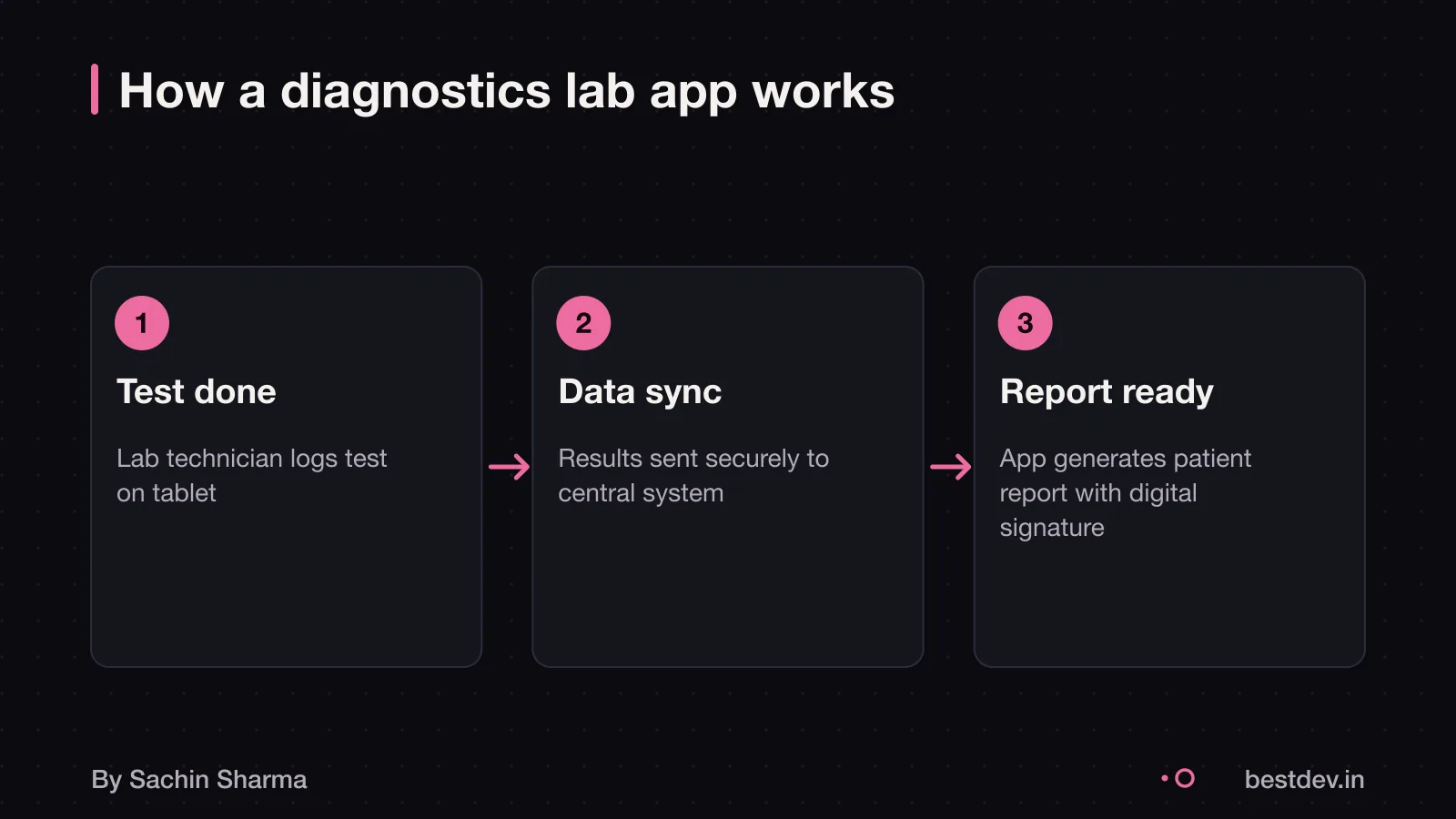
Build a custom app if your lab has unique workflows, high patient volume, or needs to follow strict data rules. Off-the-shelf software works if your needs match standard features and you want lower upfront cost. Custom software fits your rules, data, and daily work exactly. As a result, it changes as your lab grows. Off-the-shelf software costs less at first but may charge more later as you add users or features.
A diagnostics lab app may help simplify workflows and support remote monitoring. Some mobile labs use online LIMS software for instant reporting. This helps doctors get results faster. You may want these features if you serve hospitals or corporate clients who need quick turnarounds.
If you are in a small town or have low test volume, off-the-shelf tools may be enough. But if you plan to scale, custom software gives you control. The Indian diagnostic services market is projected to reach ₹1.1 trillion by 2027. As labs grow, so do demands on software. A custom app grows with you. Off-the-shelf tools may not adapt.
Compare both options by use, cost, and fit. Custom software is built for one business, not many. It follows your rules, not a template. Off-the-shelf is sold as a service, often with monthly fees. You save time at first but may pay more over time. For a deeper look at choices, see three options, not two. To see how digitisation helps day-to-day, read how software helps in daily operations.
How much does a diagnostics lab app cost?
As an estimate, assuming similar features and complexity, a diagnostics lab app in India may cost between ₹35 lakh. ₹2.6 crore, based on telemedicine app cost estimates of $40,000 to $300,000. As no published data exists for diagnostics lab apps specifically, this estimate is based on telemedicine app costs.
Costs rise with more features. A basic app with login, sample tracking, and PDF reports will cost less. A system with AI alerts, integration to lab machines, multi-location support, or offline use will cost more. Building for Android first also adds cost due to device variety and testing needs.
Team location affects price. Developers in metro cities like Bangalore or Mumbai charge more than those in smaller towns. Offshore teams may quote lower rates, but time zone and communication gaps can increase total cost.
You can build the cost of your app from weeks, people and rate[/cost/app-development-cost-in-india/].
How long does it take to build?
An MVP healthcare app takes 4 to 8 months to build on average. This includes core features like patient registration, sample tracking, and report generation, plus basic compliance with data rules. A fully featured healthcare app with complex integrations takes 9 to 15 months or more, including compliance audits. This longer timeline includes time for compliance audits.
One older source says telemedicine apps can take 3 to 12 months, but that range is broad and based on data from 2022. Your app’s timeline will depend on how many lab workflows you automate and how strict your data security needs are.
For a direct answer, and why it is only half the story, see a direct answer, and why it is only half the story.
Freelancer or agency: which to hire?
Hire a freelancer if your app needs just one person to handle a task, such as a mobile developer for patient reports. This works when you can manage other parts yourself, like design or testing. For example, a single Flutter developer can build a basic sample tracking app if you provide clear steps.
Choose an agency when your project needs a full team, including backend developers, UI designers, and QA testers. Agencies help when you lack time to coordinate or need fast delivery. For instance, a lab with multiple branches may need an agency to build and sync apps across locations.
Outsourcing to experienced teams in cost-effective areas like India can offer high-quality results at a fraction of the cost. But pick based on your needs, not price alone. If you are new to tech, an agency may guide you better. If you have a technical partner, a freelancer can save money.
For a full comparison, see freelancer or agency for a first app? pick by situation.
How to check a developer's medical app experience
A developer should show proof of integration with systems like LIS or EHRs. As healthcare apps often need to connect with existing systems for real-time data flow.
They may need to know healthcare integration standards like HL7 and FHIR. These standards help your app share data with electronic health records (EHRs), radiology systems (RIS), and other medical software.
Secure handling of patient data is critical. Check if they have used authentication standards like OAuth 2.0 to secure access in past projects. Do not rely on verbal claims. Ask to see a demo or a redacted screenshot of a past app.
For general tips on verifying a developer without being technical, see how to verify without being technical.
Legal rules for diagnostics lab apps in India
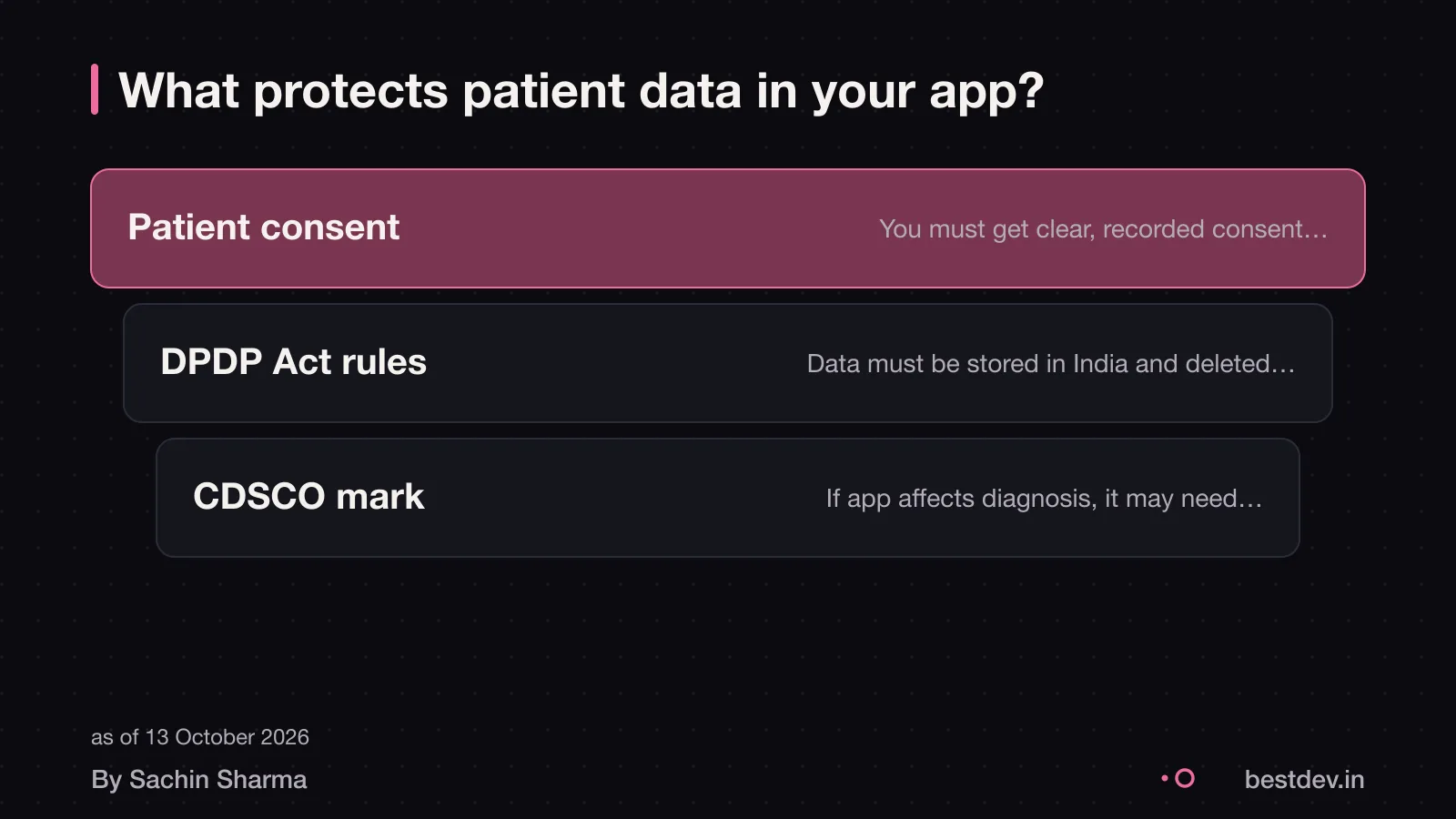
Yes, your diagnostics lab app must follow the Digital Personal Data Protection (DPDP) Act. If it collects patient data in digital form or digitises it later. This includes names, phone numbers, test results or medical history entered online or scanned from paper. The law also applies if your app stores or shares this data. Even if the server is outside India, the law still applies if the service is offered to people in India. You must build clear consent flows that let patients know what data you collect and why. For more, see the DPDP Act: consent flows an Indian app actually needs.
You may not need CDSCO registration for your software app if it does not analyse or interpret diagnostic results like a medical device. CDSCO regulates In Vitro Diagnostic Medical Devices (IVDs) as drugs under the Drugs and Cosmetics Act. If your app only manages lab operations, stores records, or delivers reports without making a diagnosis, it may not be treated as an IVD. Confirm with a healthcare lawyer. If your app includes AI that analyses or interprets diagnostic results, it may fall under CDSCO regulation as an IVD. Confirm with a healthcare lawyer.
This is not legal advice. Laws change and your lab’s use case may be unique. Consult a healthcare lawyer to confirm your app’s compliance with both DPDP and CDSCO rules. They can help you classify your app correctly and avoid fines or delays.
Who owns the code and can I switch developers?
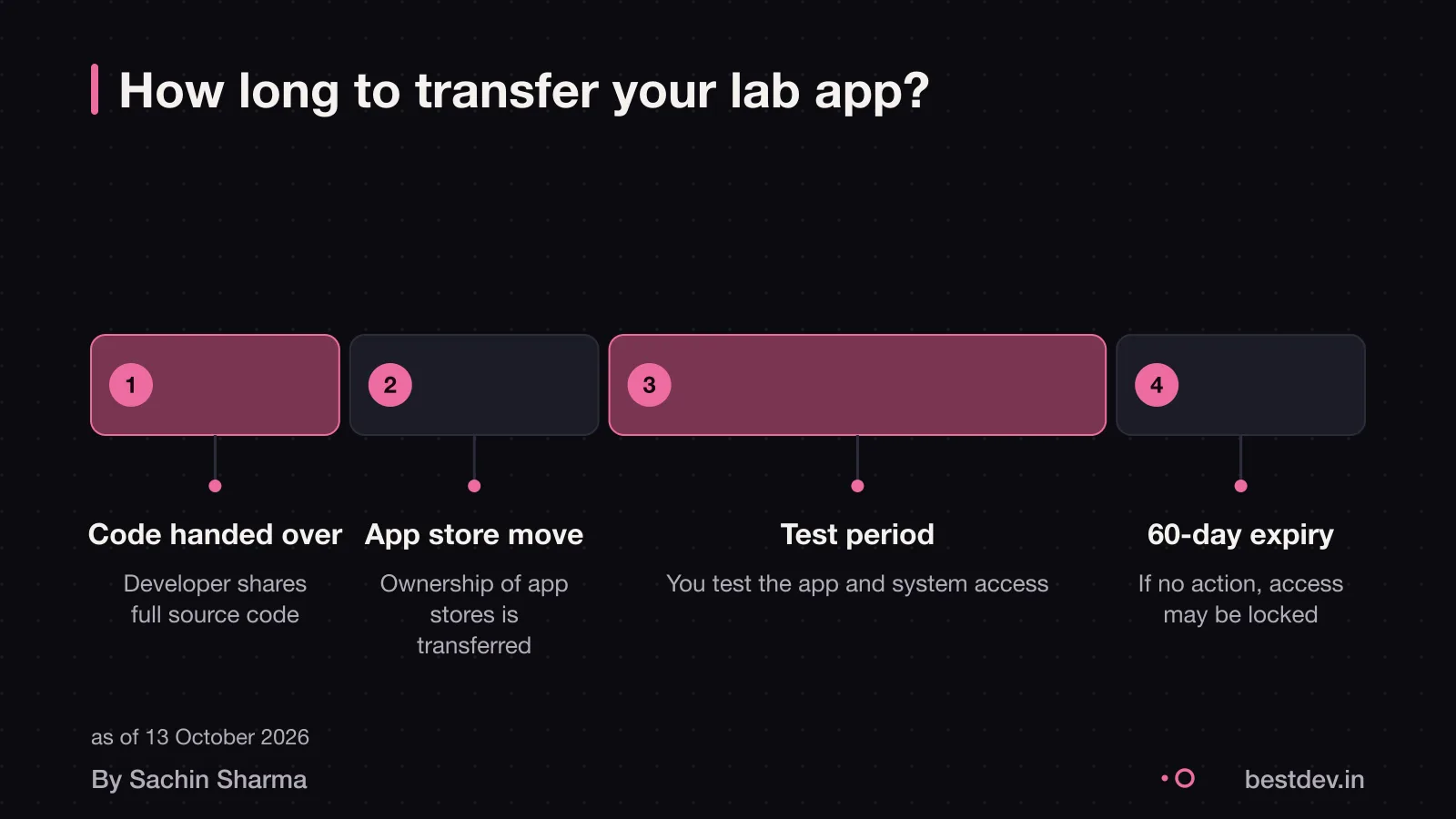
The developer should hand over the code within 6 months of receiving the $5,000 payment. As a standard, the code should be handed over within 6 months of project start. Without this, you cannot switch developers or make changes later. For Apple, only an Account Holder has the role permission to start the transfer. The new developer must accept it within 60 days, or the transfer expires.
If a developer uses subcontractors without your written consent, that may break your control.
For more, see: can I get the source code of my app?.
What if the developer fails to deliver?
If the developer delivers work, you have 45 days to accept or reject it in writing. You must send a written notice stating the reasons for rejection. The developer has 15 days to fix the issues, or another period the parties agree on. If they fail to correct the work within 15 days or another agreed period. You may terminate the agreement for that part and get a full refund for the rejected work.
Four risks often cause custom software projects to fail. Scope creep happens when no one agrees where the build ends, leading to endless new requests. Unclear ownership occurs when two parties assume the other is making decisions. Misaligned stakeholders means team members have different goals for the app. And maintenance is often forgotten, even though your system will need updates, hosting, monitoring, and security patches after launch.
Define clear acceptance criteria before work starts. Include them in the contract so you have proof of what was promised.
Even with a solid contract, some risks remain. Consider asking for source code access and a maintenance plan before launch.
Questions people ask
What should I check before hiring a developer for a diagnostics lab app?
Check that the developer has experience with medical integrations like HL7 or FHIR, secure authentication using OAuth 2.0. Connecting apps to systems like lab information systems (LIS), as these are common needs in healthcare apps. These help your app exchange data and connect with existing systems, but you should confirm how they are implemented in your case. Ask for proof of past healthcare projects.
What is a fair way to pay for a diagnostics lab app?
Pay in milestones tied to deliverables, not hourly or upfront. The developer must not add a surcharge if they use subcontractors. This protects you from hidden costs. Put all payments in writing, even if services start before the contract is signed.
What happens to my code and accounts if we stop midway?
The developer should deliver all source code within 6 months after the $5,000 payment is received. App store accounts can be transferred by the account holder, but the transfer expires if not accepted within 60 days. Ensure your contract names you as the account holder or sets a clear transfer process.
How do I verify a developer's claims about past projects?
Ask for specific proof, such as documentation of HL7/FHIR integration or OAuth 2.0 setup in past healthcare apps. You can also request a demo or contact details of past clients in the medical field. Cross-check their work with a technical advisor if possible.
What ongoing support will I need after launch?
Budget for cloud hosting, regular updates, compliance checks, and maintenance from day one. These include updating for new platforms, adapting to new requirements, and responding to changing marketing trends. Hidden costs like these can significantly impact your total investment.
Are there open-source tools to reduce cost for small labs?
The evidence does not list specific open-source tools for diagnostics lab apps. However, you can ask developers if they use open-source components to reduce costs. Some platforms may offer free or low-cost modules for basic lab functions, but check for compliance and support.
What if my lab is in a smaller city?
Location does not limit your options, as most developers work remotely. Focus on clear communication, defined timelines, and documented workflows. Ensure your internet setup supports regular syncs and cloud access, which are critical for app performance and support.
Assumptions behind the numbers
- Estimated cost range of $40,000 to $300,000 is based on telemedicine app data and may not reflect diagnostics-specific features.
- Assumed that diagnostics apps share cost drivers with telemedicine apps such as features, platforms, and integrations.
- Assumed that developers in India offer lower costs without compromising quality, based on outsourcing trends.
A protective, step-by-step guide for a first-time buyer. It takes about ten minutes and can save you months.
01 · Start here
Define your lab's digital needs
Before talking to developers, write down what your app must do. Will it manage reports, sync with machines, or support mobile units? Decide if patients will book tests or just receive results.
List three must-have features. Examples: uploading reports, syncing with LIMS, storing patient data. This helps developers give a realistic quote.
Do thisThree must-haves. No more.
02 · Decide
Choose custom or off-the-shelf
Custom software fits your workflow but costs more. Off-the-shelf starts cheaper but may charge per user or lack features you need.
If your lab has unique workflows, custom is better. If you want quick setup and standard features, off-the-shelf may work.
Do thisAsk if the software supports HL7 or FHIR.
03 · Find
Find and shortlist three developers
Look for developers with medical app experience. Check their portfolio and client references. Avoid those who promise everything without asking questions.
Shortlist three. One may know healthcare rules like the DPDP Act, another may show shipped apps, and a third may offer a Discovery Phase.
Do thisPrefer developers who ask about data rules early.
04 · Verify
Check past work and ownership terms
Ask to see a live app they built. Call one past client. Confirm that the lab owns the code and store accounts from day one.
Some developers hold source code hostage. Make sure the agreement says when and how you get it.
Do thisCall one past client. It takes ten minutes.
05 · Agree
Set milestones and data rules
A fair deal ties payment to testable milestones. Include who owns the code, how changes are priced, and what happens if the project stops.
State compliance needs in the contract. Apps handling health data must follow the DPDP Act and may need audit trails.
Do thisIf it isn't written down, it isn't included.
06 · Finish
Test, pay and take over
Test each milestone before paying. At the end, you should get the source code, app store access, and a guide to run it.
Plan for one month after launch. Real bugs appear when real data flows in. Know who fixes them and at what cost.
Do thisKeep one backup of everything, somewhere you control.
Quick answers
How much does a diagnostics app cost?
As an estimate, based on telemedicine app data, a diagnostics app may cost $40,000 to $300,000. Cost rises with features, platforms, and integrations.
How long does it take to build?
An MVP takes 4–8 months; full apps take 9–15 months. Complex apps may take longer, especially with compliance checks.
Do I need a technical co-founder?
Not to build a first version. You do need someone technical to ask hard questions of your vendor, which can be a paid hour with an independent advisor.
Can I switch developers mid-project?
Yes, if the contract allows it and you own the code. Some developers lock in work; others let you take over smoothly.
What if the developer fails?
You can reject work within 45 days and get a full refund if not fixed in 15 days.
Who owns the app after launch?
You should own the code and store accounts from the start. Make this clear in writing.
Should I hire in India?
Yes. Developers in India often cost less and understand local rules like the DPDP Act.
Keep going