Compare
Freelancer or agency, for a first app?
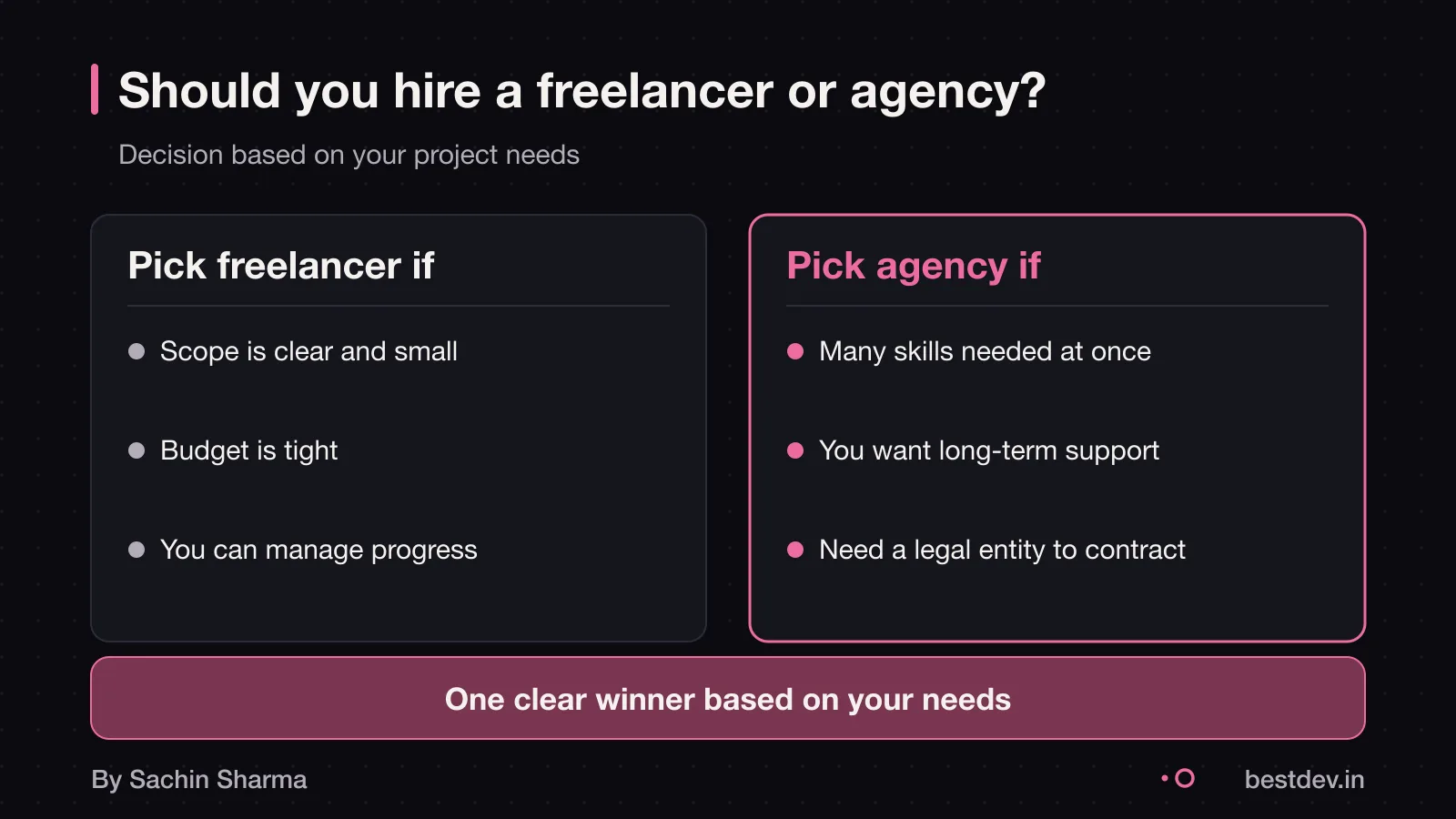
For a first app in India with a clear scope, hire a direct developer. They are faster and cheaper for short, well-scoped projects. Choose an agency when you need a team, long-term support, or a legal entity to contract with. This advice is for small businesses and first-time builders.
I am a solo developer, so I benefit from the first answer. That is why the table below also tells you when an agency is the better pick.
The full explanation
Who actually writes your app code?
With a freelancer, there is no project manager, separate tester or designer unless that same person also does those roles. They may do design if they also have that skill, since there is no separate designer or tester. A general developer may lack depth in specialist areas like graph schema design or query optimisation, which require specialist judgement.
An agency might assign different people to design, coding, testing, and project management, as some agencies provide teams with different skills for different tasks. An agency can provide teams of freelancers with different skills to work on different tasks at the same time.
For example, a freelancer might build a simple inventory app alone. An agency would use a designer for the screen layout, a backend developer for the database, and a tester to check errors.
If your app needs both general and specialist skills, a team may help. A general data engineer can build pipelines into Neo4j, but graph schema design and query optimisation require specialist judgement that takes time to develop. But if the scope is narrow and clear, one skilled developer can handle it all.
To find skilled individual developers in India, see Step three in depth: where to find candidates, and how many.
When a freelancer wins for your first app
A freelancer can work well for small, well-scoped tasks like a specific feature or a UI fix. Short projects with fixed goals suit freelancers because they do not need long-term support or team handovers. Freelancers are usually more affordable than agencies.
Quality can vary, so it is important to pick the right person. Freelancers often work directly on code with no middle layers. This means faster fixes and clearer communication. You can check their past work, code samples and client feedback before hiring. A direct-hire developer like me works directly with clients, with no agency layers.
If your idea is simple and well-defined, a freelancer can start in days, not weeks. You avoid long contracts and agency markups. But this only works if your scope does not change often and you can manage small risks like delays. For larger needs, an agency may be safer.

When an agency wins for your first app
An agency can help when your project is large and has many parts.
Agencies offer accountability structures and bench coverage that support continuity, as these are things individual freelancers cannot match. If one person leaves, others may step in, helping keep your project on track.
An agency can help when you need formal contracts and insurance, as some offer professional liability insurance. Agencies provide professional liability insurance and have a physical presence, which creates a secure foundation for your software investment. This setup may offer more structural security than a freelancer can provide.
An agency’s structure can offer better accountability than a solo developer, with project management and team coverage.
Ten checks that apply to everyone can help you judge any agency. Look for clear roles, documented processes, and proof of past deliveries.
Cost and overhead: what each charges
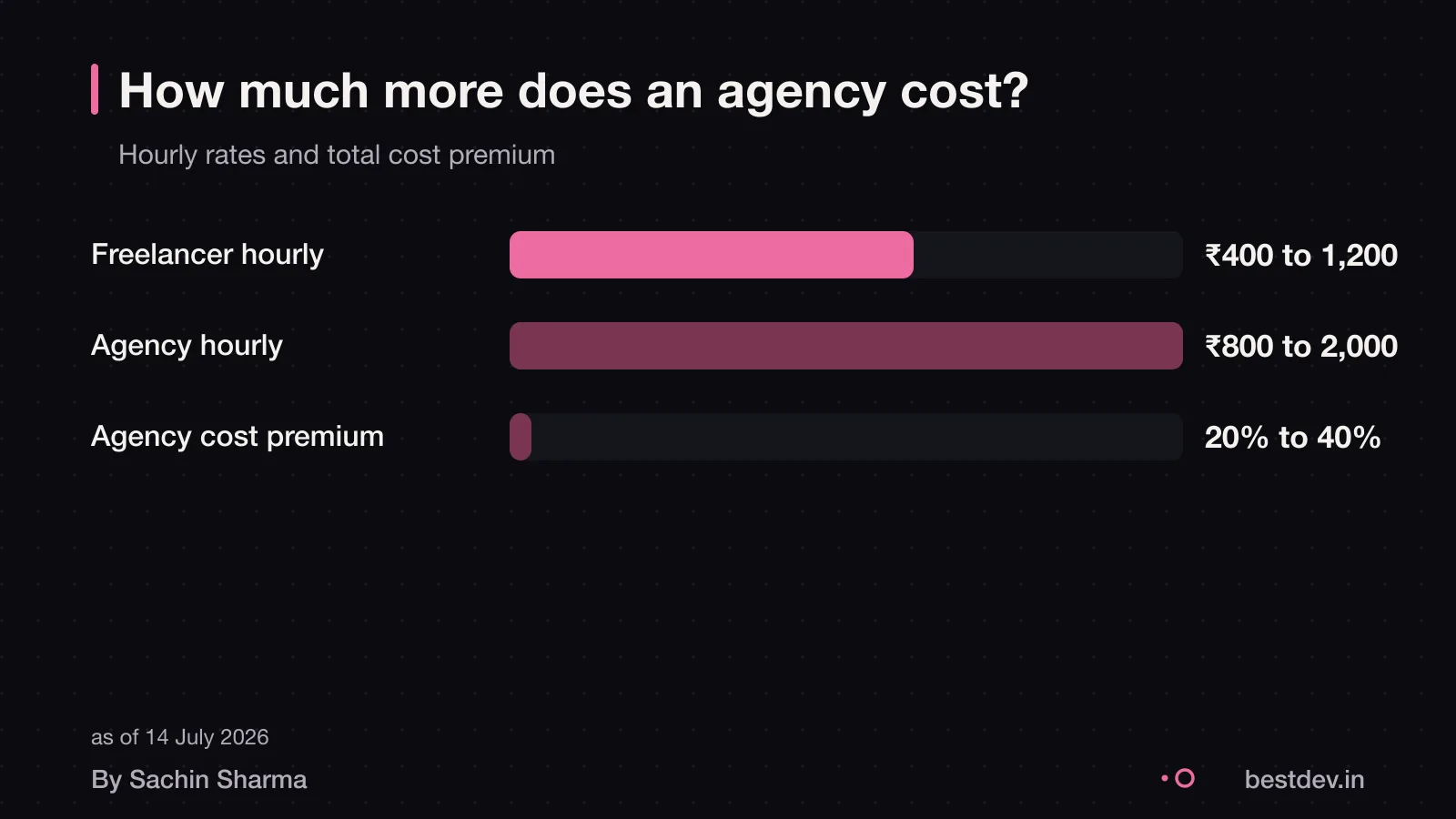
A freelancer in India may charge ₹400-₹1,200 an hour. A small agency charges ₹800 to ₹2,000 per hour. This means agencies cost 20 to 40 percent more upfront for the same minimum viable product (MVP). The higher rate covers team coordination, project management, and office overheads.
Agencies often offer fixed-price contracts for well-defined projects. This helps you control costs if your app scope is clear and unlikely to change. Freelancers may also offer fixed pricing, but it is less common and depends on their confidence in your plan. With hourly billing, you pay only for time spent. With fixed pricing, you know the total cost upfront but may pay extra for changes later.
The higher hourly rate of agencies does not always mean higher total cost. Agencies may finish faster due to parallel work, reducing total hours. But if your project is simple and you manage it closely, a freelancer’s lower rate can save you money. For a 6-month app with 1,000 hours of work, the freelancer’s cost could be ₹6 lakh to ₹12 lakh. The same app at an agency could cost ₹8 lakh to ₹20 lakh, depending on team size and pace.
You can estimate your total cost by multiplying hourly rates by expected hours. For a clearer picture of how many weeks each task takes, see Where the weeks come from.
Tax and compliance: GST, TDS and legal rules
A freelancer in India must register for GST only if their service turnover crosses ₹20 lakh in a financial year. Or they must register if the turnover is ₹10 lakh in special category states. But if their total service turnover from all clients crosses ₹20 lakh in a financial year, GST registration becomes mandatory. You should ask for their GST number before paying. If they have one, ensure the invoice includes it.
You must deduct tax at source (TDS) under Section 194Q when buying goods from a resident seller. If the aggregate value of goods purchased from the seller in the previous year exceeds ₹50 lakh. This happens if the total purchases from that person must exceed ₹50 lakh in the previous financial year. If both apply, you must deduct 0.1% from the amount exceeding ₹50 lakh as TDS. As an estimate, if you pay ₹60 lakh to a freelancer and your turnover is over ₹10 crore. You might deduct ₹1,000, which is 0.1% of ₹10 lakh, but this assumes the payment is for goods, not services.
Always consult a chartered accountant for your specific case. This is especially important if you are near the turnover thresholds.
For broader compliance, including data privacy, see Security safeguards and breaches.
Time to start: who can begin faster?
A freelancer may be able to start work quickly, depending on availability. An agency may take time to assign your project to a team, depending on capacity. You may save time with a freelancer if there are fewer internal processes to go through. With a freelancer, you talk directly to the developer. You agree on scope and begin. Some freelancers may start soon after being contacted, depending on availability. Remote work can reduce the impact of location when working with a freelancer.
You may still face delays if the freelancer is already busy. You may also face delays if you take time to decide. Agencies with open capacity can also start fast. To cut start time, have your app idea, features, and budget ready before you talk to anyone.
Local, remote or a mix explains how location affects hiring choices for Indian developers. The hiring model may have little effect on start time, as most work happens online. US companies can hire Indian developers as independent contractors. Using an Employer of Record (EOR) can get the first hire live within days. It skips the 3 to 6 month wait of setting up a local entity. No setup means faster start.
Parallel work: who delivers faster?
This parallel work shortens the calendar because tasks like UI design and backend coding can happen together, not one after another. A solo developer slows down when they lack a skill, such as QA testing, and must learn it or delay the work.
For example, if your app needs a clean interface, an agency assigns it to a designer. A secure API goes to a backend developer. Performance checks go to a QA specialist. But if your scope is small and needs only one skill, like a simple screen update, a freelancer can finish faster without handovers. As one guide notes, for projects needing a team for over six weeks, an agency is the lower-risk choice.
Reading the scrubber explains timelines for complex apps.
Hiring steps: how to start with each
You can explore freelancer platforms like Upwork, Freelancer, or Fiverr. Writing a clear brief that describes your app, its goals, and the skills you need can help you prepare before hiring.
To hire some agencies, the first step may be a discovery call. For example, one agency invites you to book a 30-minute call to find out if they are a good match for your project.
It should include your app’s purpose, key features, timeline, and budget range. Without a brief, you may face delays or mismatched expectations.
Both freelancers and agencies may expect you to know what you want to build. If you are unsure, spend time refining your idea before reaching out. A clear brief can help you start strong.
Worked example: cost for a 6-month app
As an estimate, assuming a mid-level developer works 40 hours a week for 6 months, the total cost with a freelancer is ₹3.84 lakh. This is based on the lower end of the freelancer hourly rate range of ₹400 to ₹1,200. As an estimate, at ₹400 per hour and 40 hours per week, weekly cost is ₹16,000. As an estimate, over 24 weeks, that totals ₹3.84 lakh (₹16,000 × 24).
As an estimate, the total cost with a small agency is based on a 30 percent premium over the freelancer cost: ₹3.84 lakh × 1.3 = ₹4.99 lakh, or about ₹5 lakh. This assumes an agency premium within the range of 20-40%.
A small agency hourly rate range is ₹800 to ₹2,000. As an estimate, a cost premium with an agency may account for project management, design. QA roles running in parallel, though not all roles may be billed hourly.
Assumptions driving these numbers: - Mid-level skill level and full-time effort (40 hrs/week) - Freelancer rate at ₹400/hr, agency effective rate 30% higher - No major scope changes or delays - Same quality and deliverables from both
You can adjust these numbers based on your app’s complexity. You can also adjust them based on your team needs. Build the cost of your app with your own inputs.
When this advice is wrong
Do not hire a freelancer if your app is something you cannot afford to lose.
Do not hire an agency if your app matches a proven template. It may not be worth paying custom-agency prices. As an estimate, agencies may charge more due to overhead. Off-the-shelf tools could do the job at a lower cost.
If your app matches a proven template, consider no-code tools or pre-built solutions instead of hiring.
Questions people ask
When does the other option win?
An agency may be a lower-risk option when your project needs a team for more than 6 weeks. For short projects, a freelancer may suit better than an agency or entity setup.
Can I switch later?
Yes, you can switch from an agency to a freelancer or vice versa. It is often the cheapest correct answer, according to one developer. One option is to have an agency build version one under a fixed-price contract with full source-code handover, then move maintenance to a freelancer.
What if I need both design and development?
A freelancer may handle both design and testing if they have the skills. But there is no separate tester or designer unless that same person also does that role. You can also hire two freelancers.
How do I protect my idea with a freelancer?
Your contract must include an explicit clause that assigns all intellectual property to you upon creation. Without this, ownership may revert to the freelancer unless the contract explicitly assigns IP to you. Use a written agreement, not just a verbal one.
Do I need a contract for a small project?
Yes, even small projects need a basic contract. It should include a clause allowing work stoppage if an invoice is overdue.
What if my developer gets sick?
Under the Indian Contract Act, 1872, the developer must follow the notice and handover terms in your agreement, nothing more and nothing less. If you have a bench candidate and handover clause, replacement takes 9 to 14 days. Without them, replacement takes over 30 days, based on contract placements where there is no handover clause or bench candidate.
Is a freelancer better for a simple app?
Yes, freelancers are usually more affordable than agencies, and suit smaller projects or startups. They work well for small feature builds, not full-product development.
Assumptions behind the numbers
- Mid-level developer skill level
- Project duration of 6 months
- Standard 40-hour work week
- Indian rupee context
Pick your situation
Which one is yours?
Freelancer wins. Nothing is lost between a salesperson and the person writing code. A clear scope is the case where one skilled person is fastest.
Side by side
The whole comparison
| Freelancer | Agency | |
|---|---|---|
| Who writes the code | The person you speak to | Often someone you never meet |
| Cost shape | ₹400–₹1,200/hour, little overhead | ₹800–₹2,000/hour, 20–40% premium |
| Time to start | Quick, if they have capacity | Slower to staff, steady once started |
| Main risk | One point of failure | Hand-offs and who is really on it |
| Breadth | Deep in a few things | Many specialisms available |
| Accountability | One name | A company and a contract |
Whichever you choose
Ask these four questions
- Who exactly will write my code?
- What happens to my code if we stop midway?
- What is not included?
- What does support cost after launch?
Keep going