Project · Community Outreach
Aashwasan: what it solved and how

Public health campaign using community outreach and local partnerships to reduce TB and COVID-19 in tribal India.
The full explanation
A public health campaign, not a tech product
Aashwasan is a public health campaign addressing TB and COVID-19 among tribal populations in India. It is a time-bound, intensive community outreach campaign addressing the spread and impact of COVID-19 and TB among tribal populations in India. The campaign uses community outreach, education, and local health workers to raise awareness and improve early detection.
It does not refer to a mobile or web app for gig or contract management. The name may be confused with a tech project, but it is a time-bound government-led initiative under the Tribal TB Initiative.
If you are looking for digital tools built by Sachin Sharma, see other projects by Sachin Sharma. These include real software products such as Loopin, a Flutter habit tracker, and Legease, a Flutter AI legal-document platform.
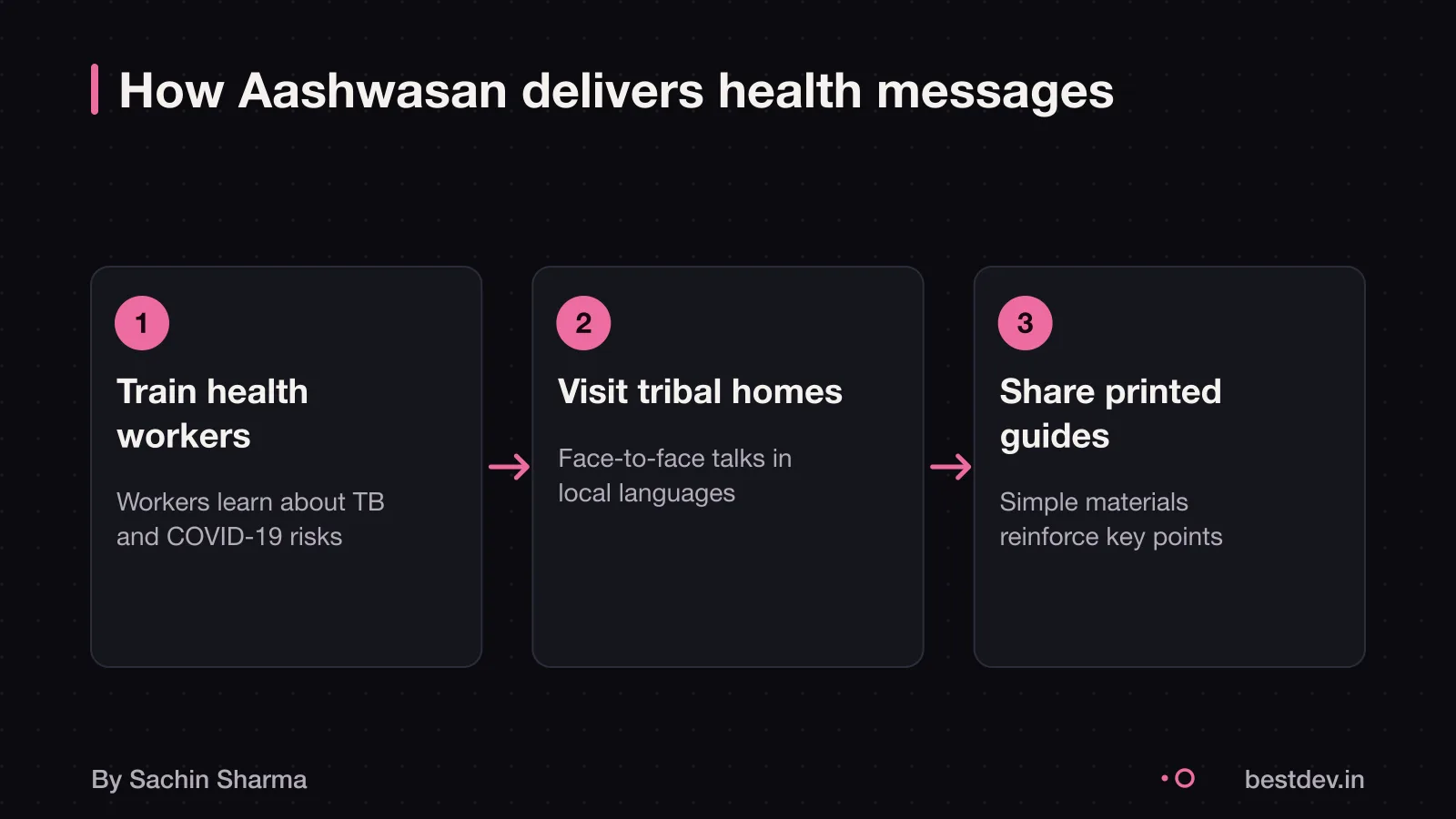
Implementation across 174 tribal districts
Aashwasan has been implemented in 174 tribal districts across 21 states and union territories in India, in phases. These districts are listed by the Ministry of Tribal Affairs. The rollout happens in phases, not all at once. State and district health departments take part in the on-ground work, as the campaign is planned and deployed with them.
You can learn more about regional software needs in tribal and rural India software needs in tribal and rural India.
What software buyers can learn about offline use
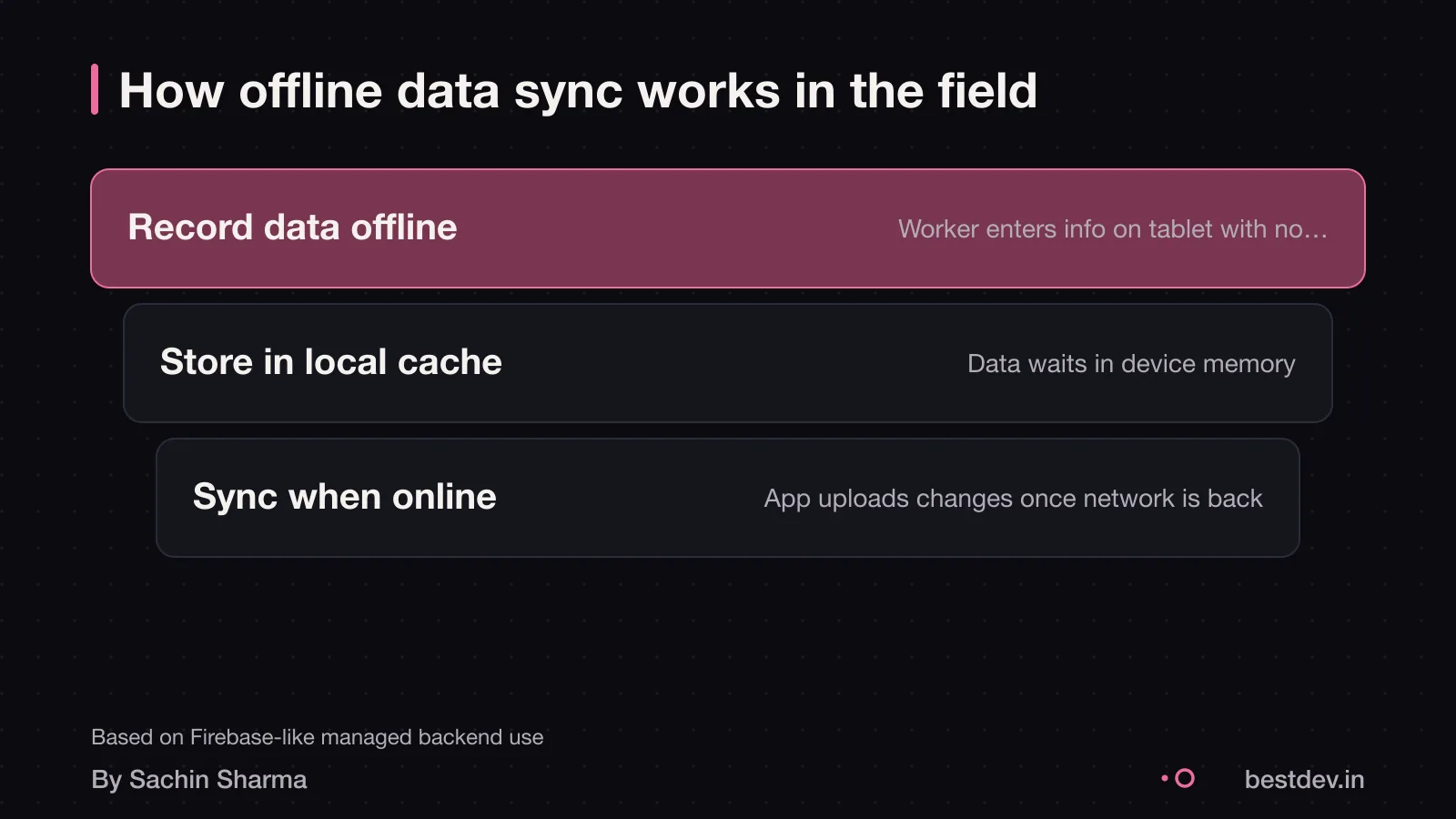
Connectivity varies, from totally offline to slow-but-solid in some areas. When a network request fails, the app handles the condition as gracefully as possible. For example, a health worker can record a patient visit offline, and the system uploads it later without data loss.
Most mobile apps assume constant connectivity, but real-world use in rural India demands otherwise. The Salesforce Mobile app, Field Service Mobile app. Lightning Web Components generally do not have a supported way to detect if a device is online. Instead, it assumes uncertainty and handles failed network requests gracefully.
You can apply this lesson if your team works in remote areas or relies on mobile data. Design your app to work without a live connection from day one. Use local storage to save progress and sync in the background. This approach is similar to how Loopin works offline first using Hive and Google Drive sync.
Using managed tools to focus on mission
This means you can move faster. You can spend your effort where it matters: the workflow that defines your app.
Firebase offers free Crashlytics for error tracking. It also offers free FCM push notifications. You get these tools without extra cost. It supports native Indian phone number OTP authentication. The Spark plan is a free tier with features described as generous. Google Cloud supports INR billing, which may help Indian teams with local payments.
You can learn more about when to use managed services in our guide to tech stacks for quick-commerce apps [/compare/best-tech-stack-for-a-quick-commerce-app/].
When Aashwasan is not the right model
- If you are building a gig or contract management app, Aashwasan may not be the right model to follow. Sachin lists Aashwasan as a Flutter + Firebase gig and contract management app.
- For software buyers, the real lesson may not be in Aashwasan’s features. Aashwasan is a public health campaign, not a software product. However, Sachin lists Aashwasan as a Flutter + Firebase gig and contract management app.
What this means for your software project
Aashwasan uses Firebase as a managed backend. For your project, consider whether a managed backend can save time on infrastructure and let you work faster on what matters.
Related reading: how Loopin works offline first, when to use managed services, message Sachin on WhatsApp.
What is escrow, and how can it protect your contract app?
Escrow means using a neutral third party to hold money or property until both sides meet agreed terms. This protects both buyer and seller by reducing fraud risk. For example, in a gig app, the client’s payment can sit in escrow until the worker fulfils their obligation. Only then may the money be released. This ensures fairness and security. You can apply escrow to digital services, software delivery, or physical goods. It works well for small businesses dealing with unreliable vendors or new clients.
The escrow process involves both parties agreeing on rules, the buyer sending money, and the seller fulfilling their obligation. The buyer sends money to the escrow service. The seller completes their task, like finishing a design or delivering a product. Once the buyer confirms satisfaction, funds are released. If there is a dispute, pre-set terms help resolve it quickly. This avoids long delays or losses. Escrow also helps with cash flow planning by giving a clear timeline for when money moves.
You can show escrow records to banks, investors, or tax officials to prove clean transactions. Clear transactions can make your business more appealing to lenders and investors. Having a financial middleman in place adds a protective layer by holding funds until both parties confirm satisfaction.
Are there costs or risks in using escrow?
Yes, escrow services charge fees, either a fixed amount or a percentage of the transaction value. These costs add up, especially on low-value or high-volume work. Before choosing a provider, ask for their fee structure in writing. Compare this with the risk of fraud or non-payment. For small, repeat jobs between trusted parties, escrow may not be worth the cost.
Not all platforms support escrow natively. If you build an app like Aashwasan, you must integrate a third-party service or build your own rules engine. Either way, define clearly who can trigger state changes, like moving a contract from “in progress” to “complete.” Without this, disputes may arise over who decides when work is done.
Never assume escrow removes all risk. It only works if the terms are specific and provable. For example, “deliver a logo” is too vague. But “deliver a 300 DPI PNG logo with source files via upload” is clear and verifiable. Vague terms lead to disagreements even with escrow in place.
How do you decide whether to use escrow in your app?
Use escrow when trust between parties is low, or the transaction value is high. It may be useful for first-time buyers, remote workers, or cross-border deals. Avoid it for small, recurring tasks between known users, like daily micro-tasks, because fees and delays outweigh benefits.
Ask yourself: What happens if one side does not deliver? Can you prove it? If the answer is unclear, escrow may help. But if your app relies on subjective approval, like creative work, build clear review periods and feedback loops first. Escrow should back fair rules, not replace them.
Check if your payment provider supports escrow-like features. Some Indian fintech platforms offer milestone-based payouts or locked wallets. These can mimic escrow without a third party. Always test the flow with real users before launch. Watch for delays in release, confusion over terms, or unexpected costs.
Remember, the goal is not just security, but clarity. A contract app works best when every state change is visible, justified, and agreed upon. Escrow supports that, but only if the rules are solid to begin with.
Questions people ask
What is the goal of the Aashwasan campaign?
The Aashwasan campaign is one of the early and major activities of the Tribal TB Initiative.
Which states and UTs are included in Aashwasan?
Aashwasan is implemented in 174 tribal districts across 21 states and union territories in India. These districts are listed by the Ministry of Tribal Affairs.
How is Aashwasan different from a digital health app?
Aashwasan is one of the early and major activities of the Tribal TB Initiative.
Can I volunteer for Aashwasan?
There is no public volunteer programme for Aashwasan. If you want to help, contact your state or district health department for official opportunities. Do not rely on informal channels.
Is Aashwasan funded by the government?
Yes, Aashwasan is implemented in partnership with state and district health departments, as the campaign is planned and deployed with them.
What role does technology play in Aashwasan?
Poor internet is common in tribal areas. Offline functionality can help in such conditions.
How long has Aashwasan been running?
The exact start date of Aashwasan is not known.
Does Aashwasan collect health data?
It is not stated whether Aashwasan collects health data. If digital tools are used, they must follow the Digital Personal Data Protection (DPDP) Act. Check this for your case with a data protection officer or lawyer.
The thinking
One decision worth defending
- 01
Problem
Public health outreach in tribal areas with poor connectivity and low digital literacy, needing trusted local engagement to fight TB and COVID-19.
- 02
Decision
Focus on community outreach and local partnerships instead of building a gig or contract management app.
- 03
Why it holds
Health outcomes depend on trust and local presence. Software alone cannot replace face-to-face engagement in remote tribal settings. Managed tools and human networks scale better than custom platforms.
What it includes
Built
- Community health worker coordination across 174 districts
- Local language content delivery with offline fallback
- Integration with state health department systems
Not every social impact goal needs custom software. Focus on the core mission—health education and access—and use existing managed tools where they fit.
Keep going