Compare
Freelancer or agency, for a first app?
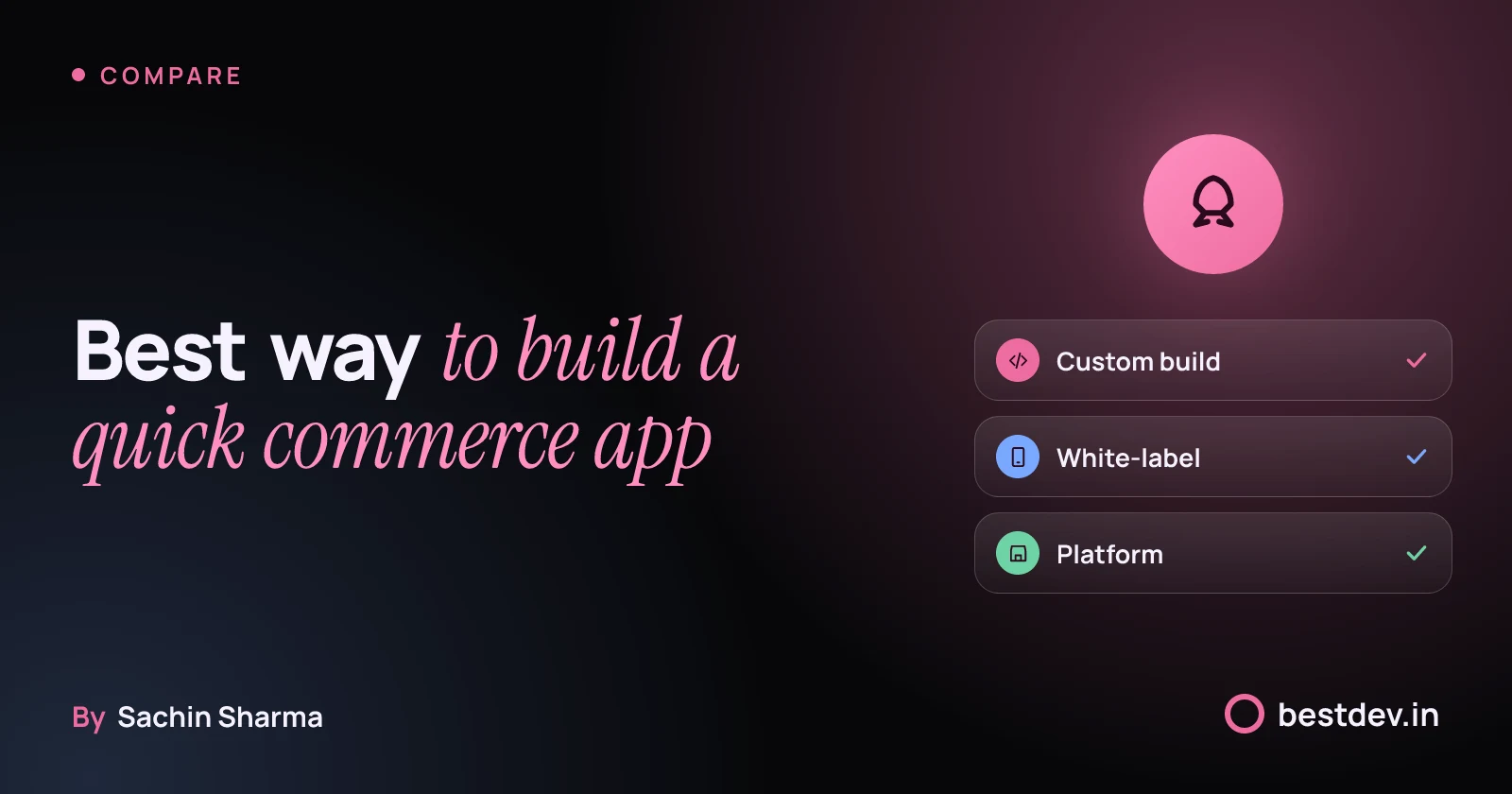
Build custom if you want full control and long-term scale, but only if your contract guarantees IP ownership. Choose white-label to launch faster with lower cost and moderate customisation. Use a ready-made platform only to test demand cheaply, but check exit terms. Your best choice depends on brand goals, budget, and how much you need to own.
I build custom apps, so I benefit from the first answer. That is why the table also shows when white-label or platform options suit better.
The full explanation
What is a quick commerce app?
A quick commerce app delivers groceries and daily essentials in 10 to 30 minutes using hyperlocal dark stores. Unlike regular delivery apps that ship from distant warehouses, quick commerce relies on micro-warehouses within 2 to 3 km of customers. These dark stores stock 2,000 to 3,000 high-demand SKUs to enable fast pick-and-pack. The market is expected to reach ₹1 lakh crore by 2030. Non-grocery items like pet supplies and beauty products are growing 1.6 times faster than groceries on these platforms. Speed alone does not keep customers; they stay when needs are met consistently, not just delivered fast. This model works best in dense urban areas where delivery distance is short.
Three ways to build a quick commerce app
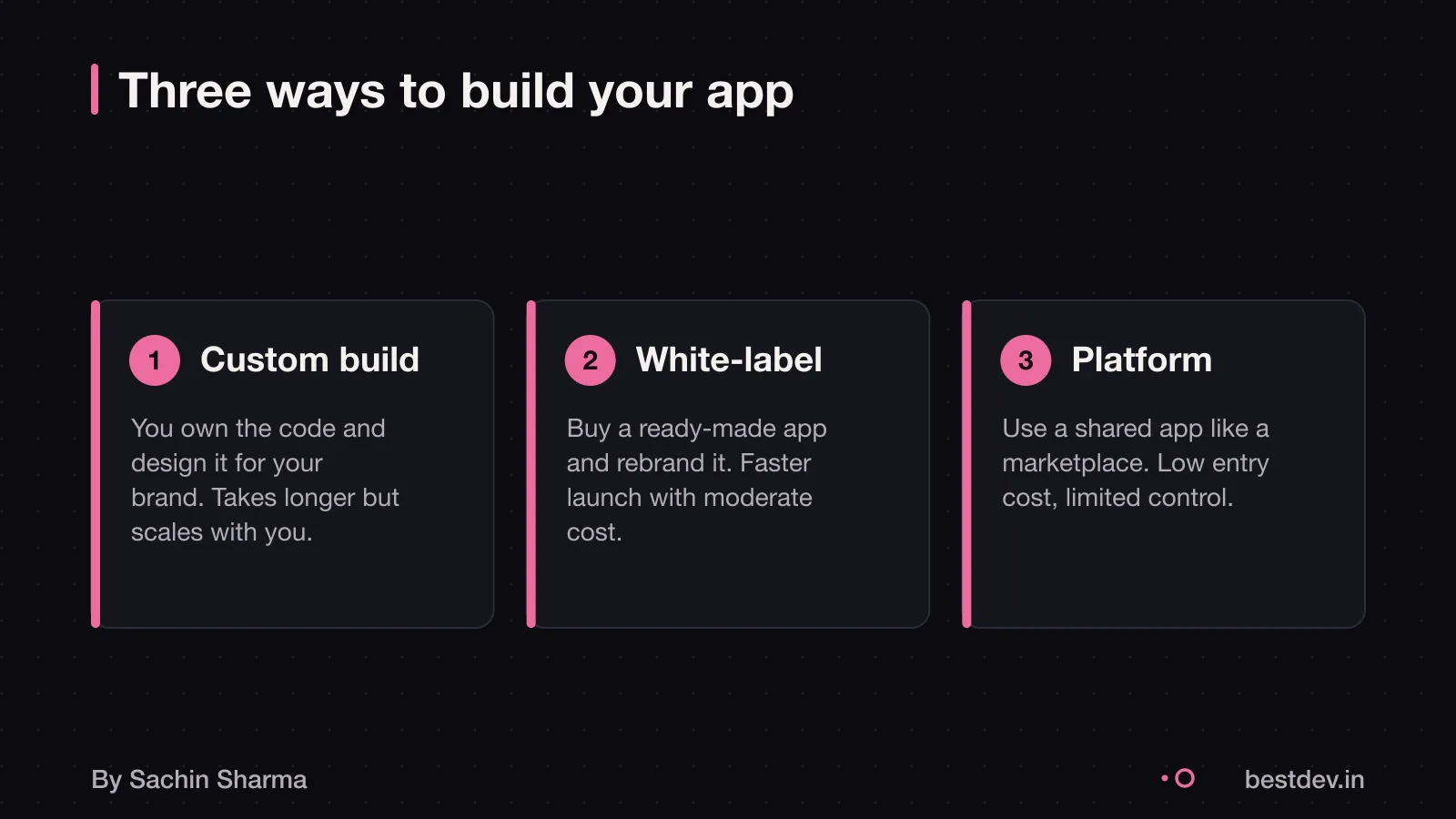
A custom build means creating your app from scratch using traditional frameworks and codes. This gives you full control over features, design, and performance. For example, you can add a unique checkout flow or integrate with your own delivery fleet.
A white-label app uses a pre-built platform that many businesses share, with customisation in branding and some features.
A ready-made platform is a fully built app service you join, with little or no customisation. This may include marketplace-style platforms.
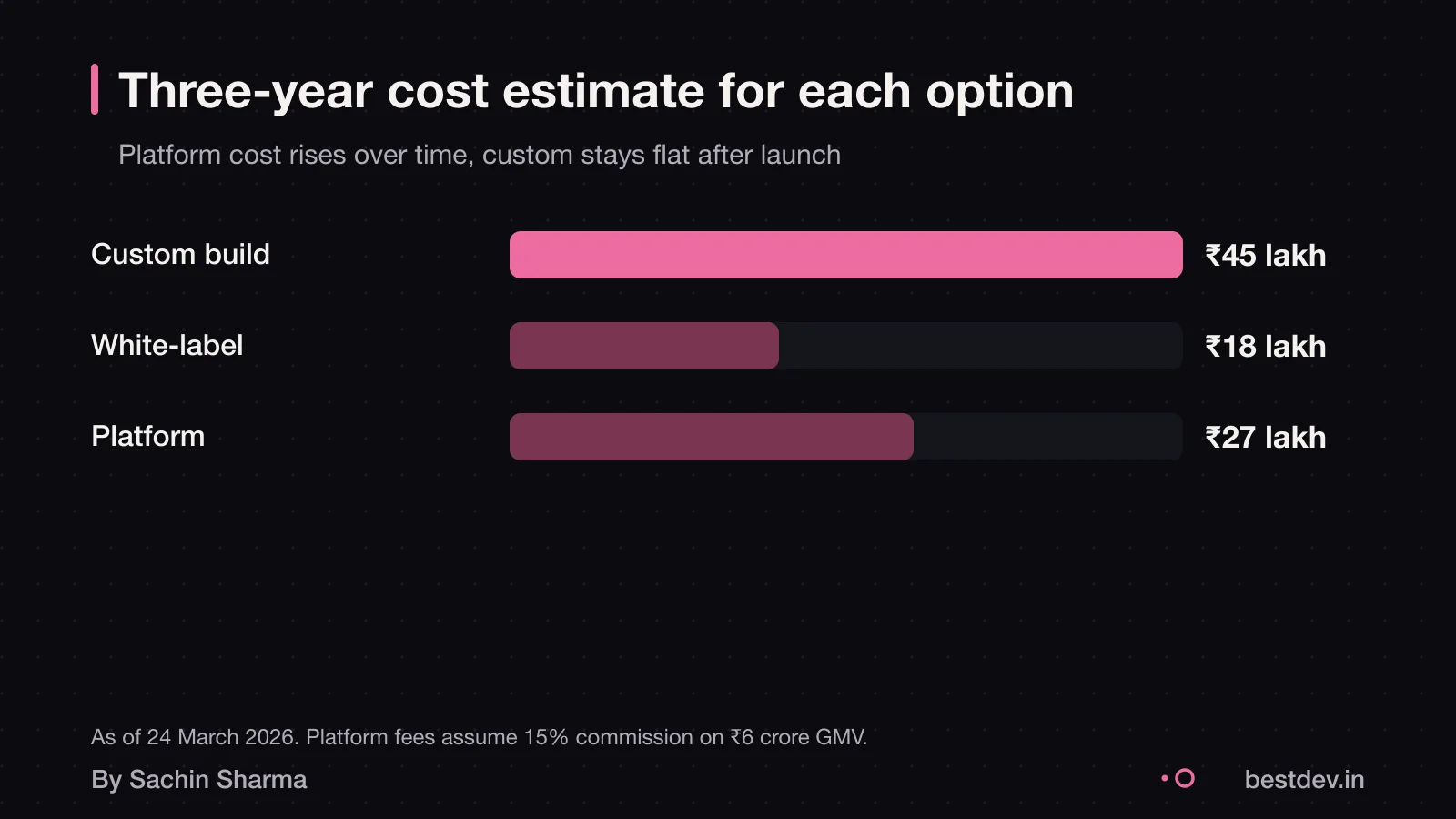
Cost comparison over three years
As an estimate, assuming 40 screens, a custom app might cost around ₹25 lakh to build. However,does not provide a price for app development. Add ₹4,999 per year for payment gateway annual maintenance cost, as listed in the numbers input.
For a detailed breakdown with your own order volume and features, use the Quick commerce app cost calculator.
Worked example: 3-year cost breakdown
Worked example: 3-year cost breakdown
As an estimate, assume 40 screens, two native apps (iOS and Android), ₹1,800 daily gross merchandise value (GMV). 1.75% payment gateway MDR, ₹4,999 annual maintenance charge (AMC), and 0.25% instant settlement fee. Here is the cost breakdown for three years:
- Custom build: One-time development cost can be ₹15 lakh or more, based on a delivered project. Add ₹4,999/year AMC, as listed in numbers. At ₹1,800 daily GMV, MDR is ₹31.50/day (1.75% of ₹1,800), or ₹34,650/year. Instant settlement at 0.25% adds ₹4.50/day or ₹4,950/year. Total over 3 years: ₹15,00,000 + ₹14,997 (AMC) + ₹1,03,950 (MDR) + ₹14,850 (settlement) = ₹16,33,797.
- White-label: Upfront cost for a licensed solution is not known, as no specific range is supported by evidence. Yearly AMC is same at ₹4,999. MDR and settlement fees apply at same rate. Over 3 years: ₹5,00,000 + ₹14,997 + ₹1,03,950 + ₹14,850 = ₹6,33,797.
- Platform: ₹0 development cost. Platform fee as a share of GMV is not known. At 15%, that is ₹270/day or ₹2,97,000/year. Over 3 years: ₹8,91,000, plus MDR and settlement if not included.
What drives total cost: development fee for custom, licensing for white-label, and GMV share for platforms. Recurring costs pile up from AMC, MDR, and settlement fees.
How long to launch each option?
A white-label app can go live faster because it uses pre-built tools that shorten development time and speed up time-to-market. Launch time depends on how fast you make decisions. It also depends on how fast you approve designs and integrate with delivery and payment systems.
Changes in scope can delay any option. Examples include adding real-time tracking or custom pricing rules. You can read more about the full timeline in our guide on How long to build a quick commerce app.
Who owns the app and customer data?
You may own the app and customer data only if your contract assigns it to you. Without a clear clause, the developer may retain copyright in the source code. As Section 17(c) of the Copyright Act covers employees, not every contractor. This is true for custom builds, where ownership depends on the agreement, not payment.
For custom software in India, the employer owns the code if the developer is an employee under a contract of service. But if you hire an independent developer or agency, they keep the copyright unless the contract assigns it to you. A written IP assignment clause is the most decisive factor.
Some developers may retain rights in their core tools while assigning the final app to you, as long as the contract allows it. So ask for a clause that transfers 100% of the IP upon final payment, as some developers offer this. Without it, you may not get the source code, even after delivery.
White-label apps are built by one company and sold under your brand, which can create confusion over who controls the code and data. Since the provider owns the base platform, you may not get full source code access. Your contract must spell out data ownership, usage rights, and exit terms.
To be safe, consider including a written IP ownership clause before signing. You can check a sample agreement at Can I get the source code of my app?.
Risks and limitations of each option
Custom builds give you full control, but scaling depends on dark store unit economics, which remain unproven at scale. If the model fails, you can adapt the app, but not the underlying demand. Blinkit has hit cluster-level EBITDA positivity, a sign of local financial health. Platforms suit testing demand, but scaling beyond a micro-business means rebuilding later. High delivery frequency increases environmental cost. You must plan for thin margins and rising delivery emissions, especially in dense urban areas.
Real examples of Indian quick commerce apps
Blinkit, Swiggy Instamart, and Zepto are top quick commerce companies in India. Blinkit is India’s q-commerce market leader and operates the largest dark store network across Indian metros, claiming EBITDA positivity at the cluster level. Its average delivery time is around 12 minutes in top cities. Swiggy Instamart has a 27% share and Zepto has 21%, according to WareIQ.
Legal and tax rules in India
The Digital Personal Data Protection Act, 2023 is named in the law itself. The law was passed on 11 August 2023. It has not yet come into force. The Central Government has not set a start date.
The Appellate Tribunal means the Telecom Disputes Settlement and Appellate Tribunal established under section 14 of the Telecom Regulatory Authority of India Act, 1997.
When this advice is wrong
Do not build a quick commerce app unless you have proof of demand for 10-minute delivery. The model depends on high order density and fast turnover. These may not exist outside major cities. Test demand first with WhatsApp or a simple website.
Custom builds may not suit if you need to launch in under six weeks or have less than ₹30 lakh for the first year. The time and cost only make sense if you plan to scale across cities. Or add unique features like AI-based inventory planning.
Avoid white-label and platform options if the contract forces long-term exclusivity. Exclusivity should not exceed 12 months for non-tier-1 platform licensing, and you should confirm it does not transfer to an acquirer without your consent. Also, "white label" can mean anything from a neutral parcel to full branding. Confirm what you actually get.
Questions people ask
Can I switch from a platform to custom later?
You can switch from a platform to a custom build, but export all data while active to avoid loss. Some providers delete customer data after termination. For example, Front deletes customer data 30 days after the subscription ends.
Which option is better for raising funding?
Verify what your target investors value most when choosing an app option.
When should I not build a quick commerce app?
Do not build if your unit economics are unproven or delivery frequency harms the environment. Dark store unit economics remain unproven at scale. High delivery frequency increases environmental cost. Test demand and delivery efficiency first.
How do I start building with each option?
For a custom build, start with a clear brief and hire a developer. For white-label, request a demo and review contract terms. For a platform, run a pilot with real users to test performance. Each path needs a different starting step.
Can I integrate my own delivery fleet?
You can integrate your own fleet only if the provider allows API access and delivery control. Check the provider's terms for restrictions on dispatch logic or third-party integrations. Avoid platforms that lock you into their network.
How do I verify a developer built the app?
Ask for access to the source code or request a technical audit. Use contracts that state you own all code and data.
Can I add new features later?
Custom apps let you add features anytime. White-label and platform apps depend on provider support. Some may charge extra or delay updates. Ask for a roadmap and API access before signing. Plan for long-term needs.
Assumptions behind the numbers
- Custom cost range is ₹5 lakh to ₹20 lakh based on typical quick commerce features.
- White-label cost range is ₹50,000 to ₹3 lakh based on provider examples.
- Custom time is 4 to 6 months for full-feature apps.
- White-label time is 4 to 8 weeks using pre-built tools.
Pick your situation
Which one is yours?
Custom wins. Custom gives you full IP and deep control over features, performance and future changes. But check the contract for ownership.
Side by side
The whole comparison
| Custom | White-label | |
|---|---|---|
| Initial cost | High (₹5 lakh to ₹20 lakh) | Moderate (₹50,000 to ₹3 lakh) |
| Time to launch | 4 to 6 months | 4 to 8 weeks |
| Control over design | Full | Moderate (branding only) |
| IP ownership | Yours (if written) | Shared or vendor-owned |
| Scalability | High | Medium |
| Support and updates | You manage or hire | Vendor-managed |
Whichever you choose
Ask these four questions
- Who owns the code after launch?
- Can I move off this platform later?
- What is not included in the price?
- How much will updates cost yearly?
Keep going