Best · How to choose
How to choose the best app development company in India
I won't name a number one, because the best depends on what you weigh. Set what matters and see which kind of team fits.
The full explanation
What an app development company does
Some mobile app development companies in India offer services like native iOS and Android app development. Custom app development, UI/UX design, web app development, enterprise mobility solutions, and app maintenance & scaling.
Some firms use Flutter, a cross-platform tool that lets developers build apps for multiple platforms from a single codebase. This can mean faster deployment and lower cost.
Apps often connect to back-end systems using an API. An API acts as a messenger between the app and the server What is an API?.
Four types of app development team in India
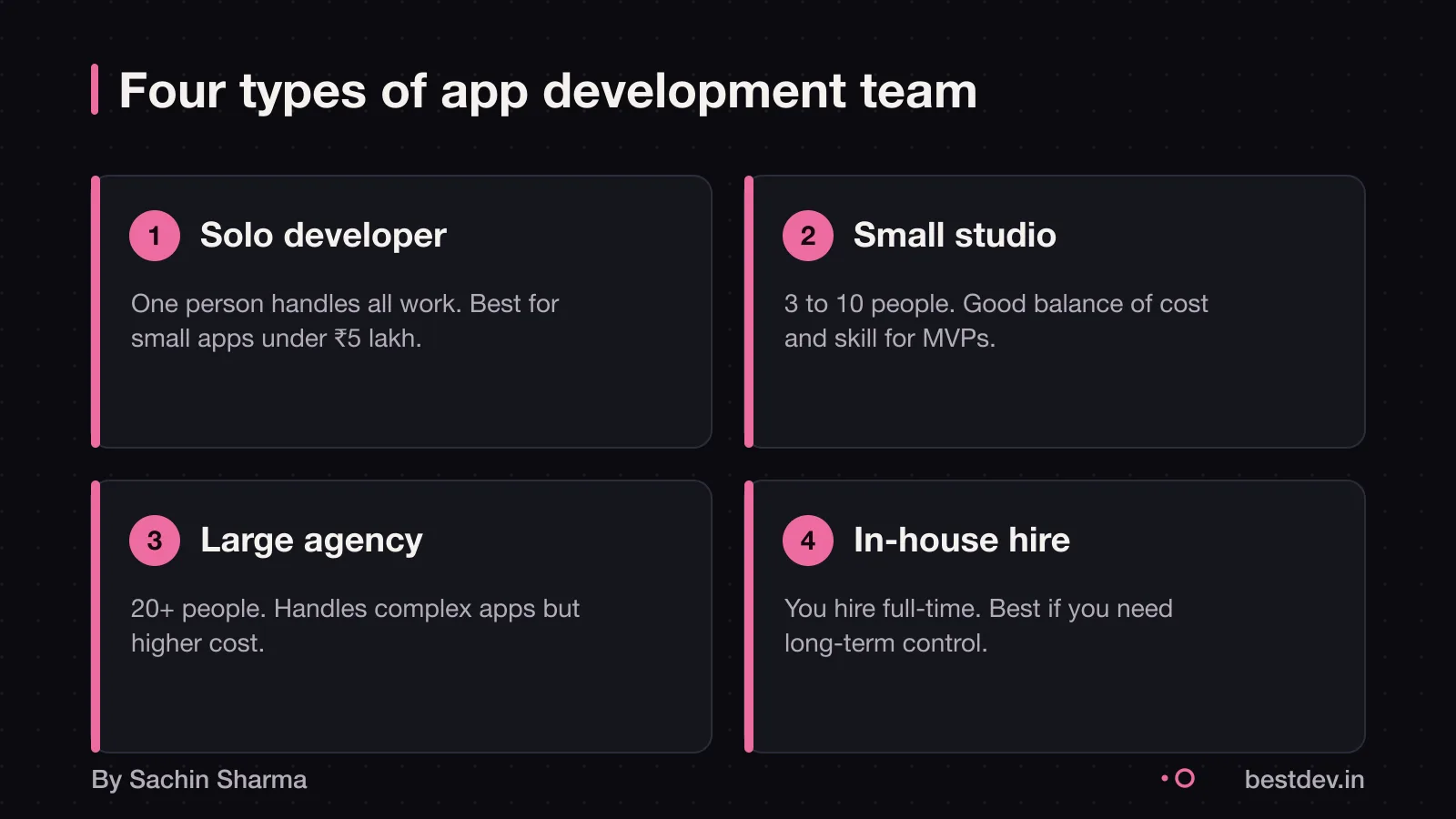
You can hire from one of three types: freelancers or micro-teams, mid-size specialist agencies, or large IT firms. Each has strengths that suit different project needs.
Freelancers or micro-teams can be a good fit when you have a small, well-defined project and want low cost and fast decisions. They move quickly but may lack backup if someone falls ill. A single developer might build a basic inventory app for ₹8 lakh.
Mid-size specialist agencies (20 to 200 people) are a good fit for most international clients who need quality, flexibility and clear communication. They balance skill depth with agility. They win when you need design, backend, and testing under one roof, with project managers who speak your time zone.
Large IT firms like TCS or Infosys work best for large, long-term projects with strict processes, such as enterprise systems. They follow rigid processes and handle large teams. They can be slow for fast-moving startups.
In-house teams may make sense if you plan to build software continuously. In-house teams involve high costs for salaries, office, and tools, but offer full control. For one-off apps, an in-house team may be unnecessary.
The trade-off is control versus cost versus speed. Freelancers give control and low cost but carry risk. Agencies balance all three. Large firms offer stability at high cost and slow pace. In-house offers long-term control but high overhead.
If you are building your first app and want a balance of trust and pace, a mid-size agency often wins. For simpler projects under ₹15 lakh, consider a skilled freelancer. For complex, regulated systems over ₹1 crore, large firms may fit.
Freelancer or agency for a first app?, this guide helps you decide based on your project size and risk tolerance.
Cost, payment and hidden fees
For a full-featured MVP with a mid-size Indian agency, a realistic budget is $25,000 to $60,000. This does not include GST, which applies at 18% on custom software development services. This budget assumes a team of 3 to 4 developers, a project manager, and a QA engineer working over 3 to 4 months. A fintech app costs 2 to 3 times more than a basic booking app because of security, compliance and data-handling work.
Custom design work such as brand-specific animations or usability testing adds ₹50,000 to ₹2,00,000+ to the base cost. Hourly rates vary. Appinventiv has Clutch-listed hourly rates of $25 to $49. One has a sub-25 dollar per hour average listed rate. A quote below market range often excludes QA, backend or source-code ownership. Always ask what is excluded.
Fair payment models split the total into 3 to 4 milestone payments. These are tied to deliverables like design approval or beta launch. Avoid full upfront payments. As an estimate, assuming a ₹2 lakh build cost, annual maintenance costs ₹30,000 to ₹40,000. For your own idea, see what drives cost and where to cut.
What does it cost to build an app in India? covers how to build your own estimate.
Timeline and what causes delays
Delays happen when scope changes, feedback is slow, or assets arrive late. Scope creep alone causes 45% of delays. To stay on track, fix your requirements early and respond to reviews within 2 to 3 days.
The team includes 3 to 4 developers, a project manager, and a QA engineer. This timeline assumes clear goals and timely decisions from you.
Delays most often come from three sources. First, scope creep, adding new features during development, can push delivery by 2 to 8 weeks. As per evidence, it is responsible for 45% of all delays. A detailed product requirement document (PRD) and a change control process in your contract can reduce this risk.
Second, slow feedback or approvals from the client can delay a project by 1 to 3 weeks. To avoid this, commit to reviewing updates within 24 to 48 hours during development.
Third, late arrival of content and assets like copy, logos, or photos can add 1 to 2 weeks to the timeline. Have these ready before coding begins.
To reduce delays, finalise your feature list, provide assets early, and respond quickly to requests. Park new ideas for version two. If your project is time-sensitive, see How long does it take to build a quick commerce app? for sector-specific timelines.
Hiring process: from brief to contract
Start by writing a clear project brief. This should cover your app’s goals, who will use it, core features, and any technical needs like offline access or analytics. A strong brief helps developers give accurate quotes and avoid misunderstandings later.
The hiring process has six steps. First, decide what you will handle in-house. Next, plan the build. Then, research developers. Compare real apps they have made. Choose a pricing model. Finally, sign a contract that protects your code and IP. Use these steps to stay in control and avoid rushed decisions.
Some firms offer a 3-day free trial or a 7-day risk-free trial, based on two examples. Even a small paid task, like designing one screen or building a login flow, shows how they work, communicate, and meet deadlines. Treat it as a real mini-project.
In the first meeting, ask how they handle unclear requirements. A good sign is if they ask follow-up questions instead of guessing. Also check if they assign a dedicated project manager. Check if they sign NDAs.
Analytics setup costs ₹50,000 to ₹1,50,000 as of May 2026. If it is not in the quote, ask why. You can use the App brief template developers can actually price to make sure nothing is missed.
How to verify proof of work
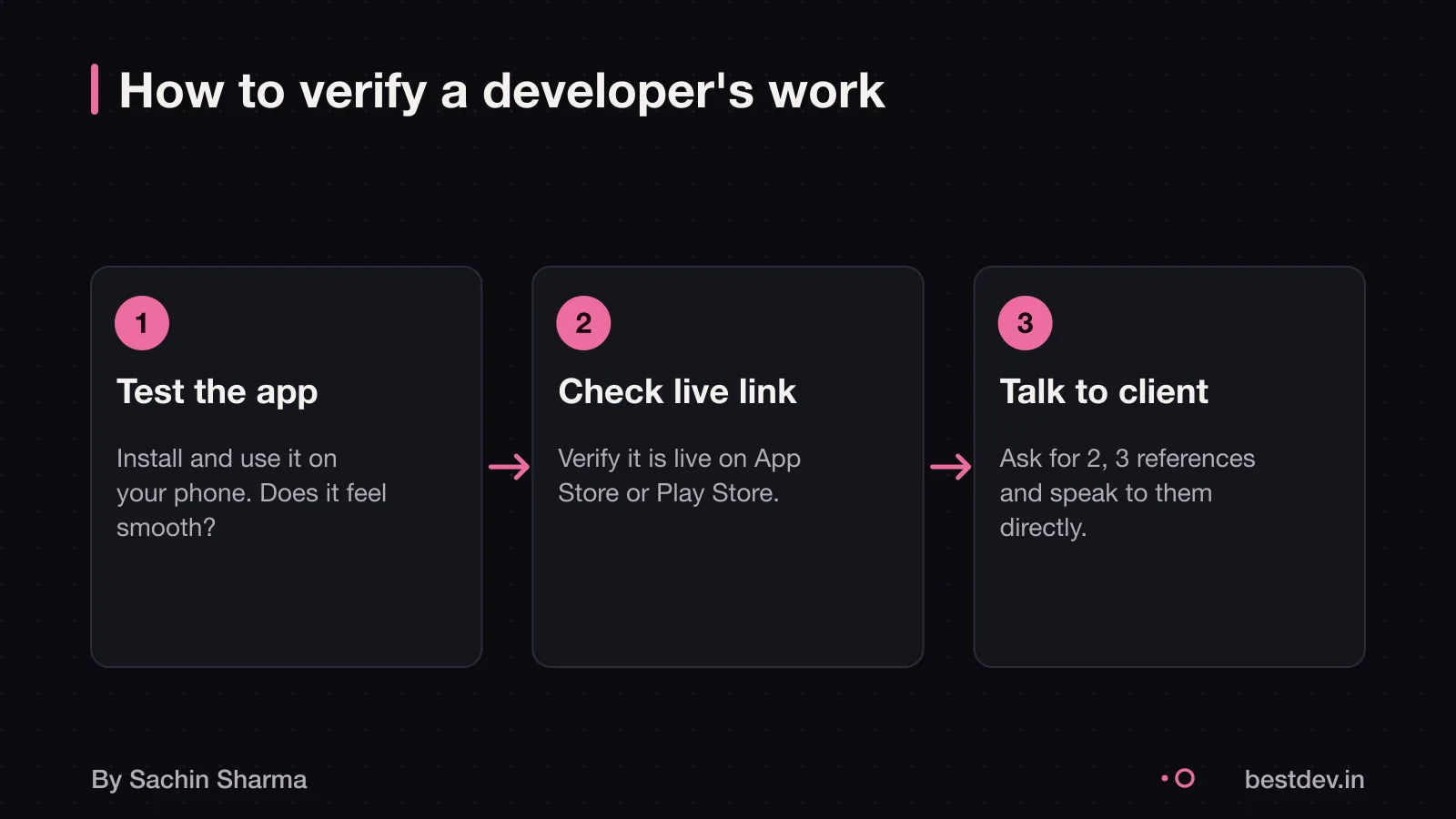
Check if apps are real by asking for live app store links, not just screenshots. Screenshots can be faked or outdated. Instead, install the apps on your own phone or tablet to test performance and features. For example, go to the Google Play Store or Apple App Store and search the app name the company gave you.
Verify client references by speaking to past clients directly. A legitimate developer should be able to provide at least 2 to 3 client references without hesitation. Call or message them and ask: Did the team deliver on time? Were there hidden costs? Would you hire them again?
Check technical depth by asking how they solved hard problems in past projects. For example, ask: How did you handle data syncing when the app was offline? Or: What did you do when the app crashed under heavy load? A skilled team will explain their fix clearly.
Assess industry knowledge by asking if they have built apps in your field. For instance, a company that has served more than 31 industry verticals may have broad experience. If they have not worked in your sector, ask how they plan to learn it.
See real shipped apps by Projects by Sachin Sharma to understand what a complete product looks like.
Ownership, legal rights and compliance
By default, the developer owns the code unless a written contract transfers it to you. This is true even if you paid for it. The Copyright Act, 1957 says the author is the first owner of copyright unless the work is made under a contract of service.
When you hire an outside developer or agency under a 'contract for service', the code belongs to them by default. A written agreement with an IP assignment clause can help ensure ownership is transferred properly. Without an IP assignment clause, you may not have full control over the app, including updating, selling or protecting it. Always ask for this clause in the contract before signing.
Data privacy is also a legal requirement. The Digital Personal Data Protection Act (DPDPA) applies to any entity that determines the purpose and means of processing digital personal data. As the app owner, you must follow the law on consent, individual rights and data handling. Non-compliance with the DPDPA can lead to penalties. Consult a legal professional for your case. For steps to follow, see the DPDP Act: consent flows an Indian app actually needs.
You should also verify that contracts cover IP ownership, data handling and dispute resolution. If a company refuses to include an IP assignment clause, walk away. This is non-negotiable. Legal advice is recommended to review contracts. This is especially true for apps handling sensitive data.
Post-launch support and maintenance
You must plan for ongoing support after your app launches. Maintenance includes fixing bugs, updating for new OS versions, and adding small features. Most development partners offer maintenance as part of the build contract. This ensures someone remains responsible after launch.
Annual maintenance costs 15 to 20% of the initial build cost. As an estimate, if your app costs ₹2 lakh to build, set aside ₹30,000 to ₹40,000 per year for updates and fixes. This range is widely cited across industry guides as a planning figure.
What happens to maintenance if the company shuts down is not known. You should ask any vendor how they handle long-term support in case of closure. Some may transfer code and access fully, but this is not standard. For a long-term project, consider how critical ongoing support is and whether you need a backup plan.
If you are building a quick commerce app or any high-traffic service, a clear maintenance plan becomes even more important. See How to build a quick commerce app.
Risks and red flags to watch for
Common risks include rushed vetting, a vague contract, and no plan for post-launch maintenance. These oversights can lead to problems after launch.
Hesitation over IP handover is a strong warning sign about the developer you are dealing with.
Overpromising is another warning sign.
Every third-party library must be maintained and checked for flaws. Ask if the team uses current frameworks.
If a team refuses to share live app links or dodges contract details, consider this a warning sign. Always verify real shipped apps, not just mockups.
Location and communication
Your app team can be anywhere in India, location does not matter if you hire remotely. Many firms, like Cyber Defence in Hisar, serve clients across the country without in-person meetings. What matters more is timezone overlap. This lets you talk live when needed. A shared working window of 2 to 3 hours is often enough for updates and quick decisions.
Remote hiring works well when teams use daily standups, shared task boards, and clear documentation. You can manage progress from any city. This is true as long as communication is structured and regular. For example, a client in Bengaluru can work smoothly with a developer in Guwahati. This is possible if both use Slack, Zoom, and a project tracker like Jira.
Timezone overlap matters most during sprint planning, reviews, and bug fixes. If your team is more than 2 hours apart, schedule key meetings in the overlapping hours. Indian development rates are 60 to 70% lower than in the US or UK for similar quality. This makes remote collaboration cost-effective.
Hiring a developer in Chhattisgarh follows the same rules. Focus on communication fit, not just location. Ask shortlisted teams how they handle updates, time tracking, and urgent issues. A good team will have a clear process. This is true even if they are far away.
When this advice does not apply
When this advice does not apply
You should not hire any company if your idea is still untested. First, validate it using no-code tools like FlutterFlow or Bubble. Build a simple version yourself to check demand. This saves money and clarifies what you need before signing a contract.
A solo developer may be better if your project is small or focused on one platform. For example, if you need only an Android app with basic features, one skilled developer can deliver faster and at lower cost than a team.
Consider in-house hiring only when you have ongoing, full-time development needs. This applies if you are launching multiple products or require constant updates. But consult a legal or HR expert first to understand payroll, compliance and long-term costs.
Questions people ask
Which option is cheaper to run over three years?
Over three years, a mid-size agency-built app may be cheaper to run. Because maintenance is often 15 to 20% of the build cost annually, according to common planning figures. This means a ₹5 lakh app needs ₹75,000 to ₹1 lakh per year for updates, security, and OS changes.
When does the other option win?
Freelancers or micro-teams may suit you if you need fast, low-cost changes and direct access to the builder. Mid-size specialist agencies (20 to 200 people) are often the best fit for most international buyers. Your choice depends on speed, budget, and risk tolerance.
Can I switch developers later?
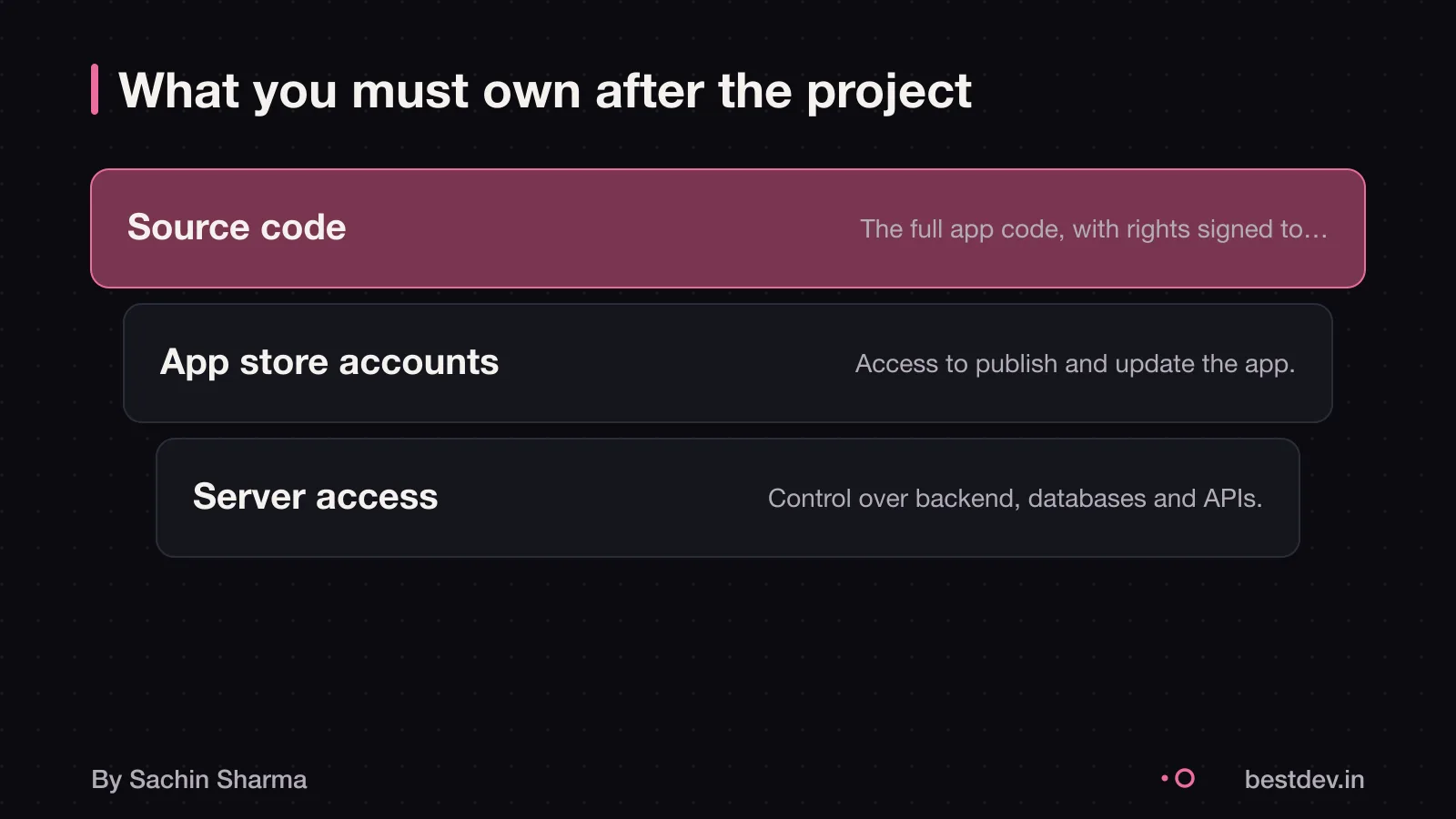
Yes, you can switch developers if you have full access to the source code, app store accounts, servers, and API keys. Ensure these are in your name from day one. A proper handover includes build instructions and a short support window from the old developer.
What if my project is delayed?
Delays often come from slow feedback (1 to 3 weeks), late assets (1 to 2 weeks), or scope creep (2 to 8 weeks). To stay on track, fix the scope early, provide assets upfront. Respond to reviews within 24 to 48 hours, as suggested by project management advice. Use a contract that limits unplanned changes.
Do I need to meet in person?
No, you do not need to meet in person. Some Indian app development companies, like Cyber Defence in Hisar, serve clients across the country remotely. Clear communication, written updates, and shared tools like GitHub and Figma make remote collaboration effective. Focus on output, not location.
How do I protect my idea?
Include IP assignment clauses in your contract to ensure you own the code. As the developer is considered the owner by default unless the contract says otherwise. This helps ensure that legal ownership stays with you, but check this for your case with a lawyer. Keep records of all agreements and drafts. Check this for your case with a lawyer.
What if I want to cancel midway?
If you want to cancel midway, check your contract for termination clauses and payment terms. Since there is no public evidence on penalties or refunds, you must rely on your agreement. Check this for your case with a lawyer.
How do I know if the tech is up to date?
Check that every third-party library is actively maintained and updated regularly. Outdated libraries can break your app or create security risks. Ask for a list of dependencies and verify their last update date. This also affects your Data safety form on app stores.
What should go in the contract?
Your contract should include IP ownership because, by default, the developer owns the code unless a contract transfers rights. It may also help to cover maintenance, changes to scope, and data privacy. Check this for your case with a lawyer. Without these, you may face legal or operational risks. Check this for your case with a lawyer. Check this for your case with a lawyer.
Can I build part of the app myself?
Yes, you can build part of the app yourself if your contract allows it. Co-development terms should be clear in writing. Make sure roles, code ownership, and integration points are clear. Use shared repositories and agree on coding standards early. This avoids conflicts during handover or updates.
Assumptions behind the numbers
- Scores reflect general tendencies observed in the Indian app development market and are not tied to specific firms.
- The scoring system assumes linear weighting of criteria; real-world decisions may involve non-linear trade-offs.
- In-house hiring scores assume access to talent and infrastructure, though evidence for this path is limited.
I won't name a number one, because the best depends on what you weigh. Set what matters and see which kind of team fits.
What matters to you
- 1Solo developer3.8
- 2Small studio3.8
- 3Large agency3.5
- 4Hire in-house3.5
Scores are general tendencies for each kind of team, set out as a starting point. They are not ratings of any named company.
Whoever you pick
Ten checks, in the order they save you
- Open two of their shipped apps on your own phone.
- Ask who will write the code, by name.
- Get the scope, and the not-included list, in writing.
- Ask for milestones you can test.
- Confirm the repository and store accounts are in your name.
- Speak to a past client.
- Ask what happens if you stop midway.
- Ask how changes are priced.
- Ask what the first month after launch costs.
- Compare the assumptions in quotes, not the totals.
Keep going