Compare
Freelancer or agency, for a first app?
Pick Flutter if you want faster time-to-market and long-term control. Choose React Native only if your team already knows JavaScript. Flutter is recommended for 80% of startup apps. It handles custom designs better and needs ~20% less maintenance over two years. Use React Native if your team has strong React or JavaScript skills.
I build apps in Flutter and benefit from recommending it. That is why this table also shows when React Native is the better fit.
The full explanation
How Flutter and React Native work
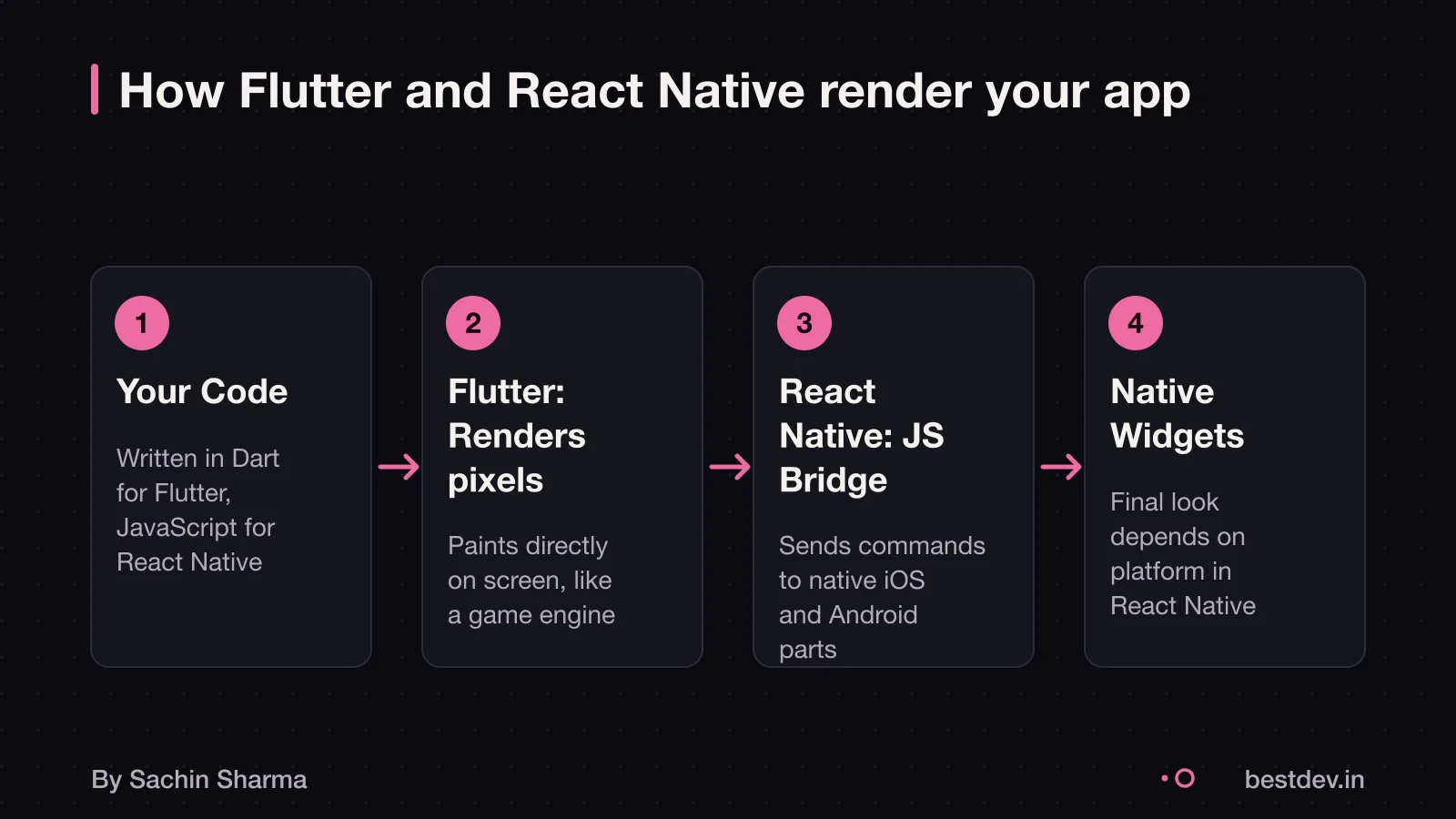
Flutter uses Dart, a programming language. Every Flutter app starts with a main function, which is the entry point for any Dart program. The Flutter SDK's runApp method runs a widget tree. Flutter compiles all the way to native code and controls each pixel on screen, which avoids performance problems caused by a JavaScript bridge.
React Native uses JavaScript or TypeScript. Earlier versions used a JavaScript bridge to talk to native modules. This could slow performance. The new architecture introduced in 2024 and 2025 (called Fabric and TurboModules) eliminated this bridge for most interactions, significantly closing the performance gap.
Flutter reuses about 95% or more of code across iOS, Android, web, and desktop. This high reuse comes from drawing its own visuals. It does not rely on platform widgets. React Native enables roughly 80 to 95% code reuse for mobile platforms. The lower end happens when apps need many custom native features.
Do I need a cross-platform app for your startup?
Industry cost guides suggest savings of 30 to 40% compared to native development. It makes sense when your startup needs a minimum viable product (MVP) quickly and you have one small team. Flutter lets one team build for both Android and iOS at once. That one thing alone saves you 30 to 40% compared to native development. Industry cost guides put savings around 30 to 40% versus parallel native builds. The main saving is in developer time and coordination. You still need to plan for design, testing, third-party services, and ongoing updates.
When is cross-platform not worth it?
Build natively for heavy 3D, augmented reality, advanced camera or audio processing, or platform-first experiences like watchOS apps. These apps rely on low-level features that cross-platform tools may not support well.
Also choose native if your team is already split into strong iOS and Android groups. Maintaining separate native apps may need platform-specific work for the same features.
Which one costs less to build and maintain?
A simple Flutter app in India costs $5,000 to $15,000. A React Native MVP costs $5,000 to $13,000. So initial build costs are similar. React Native maintenance runs 15 to 20% of the build cost each year.
As an estimate, assume a ₹7.5 lakh ($10,000) app. For React Native, annual maintenance would be ₹1.125 to ₹1.5 lakh (15 to 20% of build cost). For Flutter, maintenance could be 20% lower than React Native, based on Forrester’s finding. This adds up over time.
You can explore more about app costs in India with What does it cost to build an app in India?.
Which one is faster to build with?
A simple app takes 4 to 6 weeks to build. A well-scoped React Native MVP takes 6 to 10 weeks. Flutter has excellent hot reload that updates code in under one second. This lets you see changes almost instantly as you fix bugs or add features. React Native has hot reload that takes 1 to 3 seconds in some cases.
Which one is easier to hire for in India?
React Native has about 6 times more LinkedIn job postings than Flutter. However, the actual number of active React Native or Flutter developers in India is not published. India has a large pool of mobile developers, which may help you find talent for both frameworks. React Native has more LinkedIn job postings, which could mean faster hiring.
When does Flutter win over React Native?
Flutter may be a strong choice when your app has complex, custom UI requirements. Apps with complex, custom UI requirements benefit from Flutter’s flexibility in building unique interfaces.
Skilled Flutter developers deliver higher-quality UI faster once they are onboarded.
Flutter may suit startups that want one team to build, maintain, and update the app with minimal handoffs. If your goal is speed, control, and lower upkeep, Flutter may be a stronger choice.
When does React Native win over Flutter?
Pick React Native if your team already knows JavaScript or React. A React Native project can be handled by JavaScript developers who manage both platforms. This reduces your monthly burn rate and keeps coordination simple. React or JavaScript experience strongly favors React Native as a framework choice.
You also get a wider pool of third-party libraries. React Native shares the vast npm ecosystem with the web. You can often reuse existing web components for your mobile app. This saves time when you need standard features like charts or maps.
However, you must accept more device-specific bugs. React Native relies on a bridge to talk to the phone. This adds complexity that Flutter avoids. You may need to write custom code for specific Android or iOS quirks.
Want a number for your idea? Send one line on WhatsApp. I reply with what drives the cost and what to cut.
Still unsure between Flutter and React Native? Tell me your budget and team skills and I will say which fits.
Real apps built with each
Dream11 is listed as one of the top apps built with Flutter in 2028. Google Ads is often mentioned first when listing successful Flutter apps. Khatabook is listed as one of the top Flutter apps in 2026.
PS Digitise is a mobile app development firm. It has delivered over 50 cross-platform apps using React Native and Flutter.
Does DPDP Act affect how I build with Flutter or React Native?
The DPDP Act applies if you collect digital personal data from people in India or offer goods and services to them. It does not matter which framework you use. The law cares about data handling, not your tech stack. If you collect data from Indians, you must get clear consent. You must also allow them to exercise their rights under the Act. For example, a health-tracking app built with Flutter must explain what data it collects and why. A React Native shopping app must do the same. The rules apply the same way to both. Compliance depends on your business model and data flows. It does not depend on the code. Talk to a legal expert to make sure your app meets the DPDP Act rules.
You can learn more about how to set up proper consent flows in the DPDP Act: consent flows an Indian app actually needs.
Who owns the code in a Flutter or React Native project?
By default, the developer owns the code unless your contract says otherwise. The client who pays for the code is not its first owner under Indian copyright law. To transfer full ownership to you, the client, the contract should include a clear written clause assigning intellectual property rights.
Developers are the default owners under Indian copyright law.
For peace of mind, you can ask to see the full source code and verify it matches what was built. You can also check if it is shared in a private repository under your name. Can I get the source code of my app?
What support comes after launch?
Some developers include performance monitoring and feature enhancements as part of post-launch support. SPEC INDIA offers 24*7 maintenance and support services for React Native apps.
To budget for updates, set aside 15 to 20% of your build cost each year. For example, if your app cost ₹10 lakh to build, plan for ₹1.5 to ₹2 lakh per year for maintenance. This helps you avoid technical debt and keeps your app stable.
Post-launch support includes regular updates, bug fixes, performance checks, and occasional feature improvements. You should confirm the exact scope with your developer, as it varies by team. Some include hosting, crash reporting, and user feedback loops, while others charge extra for these.
If you are using third-party libraries, factor in extra time and cost to update them. Outdated libraries can break your app or create security risks. Always ask your developer how they handle library updates and testing after each release.
Can I switch between Flutter and React Native later?
You cannot directly switch from Flutter to React Native or vice versa without a full rebuild. A Flutter-to-React Native migration is a re-implementation, not a code port. As an estimate, you must rebuild the app from scratch in the new framework, rewriting all logic and UI.
No code carries over between the two frameworks.
You should not migrate unless you have a strong reason, such as long-term team skill alignment or critical performance issues in one framework. If your current app works and your team supports it, stick with it. Migrating too early wastes time and money.
How often React Native apps on low-end Indian devices crash is not known. Compliance risks of third-party React Native libraries in India are not known. The cost difference between React Native and native app maintenance in India is not fully known.
Worked example: cost of a startup app in India
Two third-party integrations are added. One is for payments (e.g., Stripe). The other is for notifications (e.g., Firebase Cloud Messaging). Each integration adds $500 to $3,000 to your budget, depending on complexity.
The base MVP cost is $5,000 to $13,000.
The key assumptions are: (1) the app has a simple screen flow (5 to 8 screens). (2) both apps use third-party services for payments and notifications, (3) no custom backend is included, and (4) the team is experienced. These are estimates. Your actual cost depends on feature complexity, team rates, and how much native code is needed. Costs are in USD.

When this advice is wrong
Or have strong separate iOS and Android teams, fully native development may be a better choice.
Related reading: What is an API?, What features a quick commerce app needs.
Questions people ask
Which one is cheaper to run over three years?
Flutter apps required ~20% less maintenance time over two years vs equivalent React Native apps. Forrester found Flutter apps required ~20% less maintenance time over two years compared to equivalent React Native apps. Annual maintenance for both typically costs 15 to 20% of the build cost.
When does the other option win?
React Native may be a better choice when your team already knows JavaScript or React. It may be easier to adopt for web developers. You can use the same team for your web and mobile apps, reducing coordination and training costs.
Can I switch later?
Yes, you can switch from Flutter to React Native, but it is a full re-implementation, not a port. You cannot reuse the code. You must rebuild the entire app from scratch for the new framework.
Is React Native dying in 2026?
No, React Native is not dying in 2026. It has ~126,400 GitHub stars as of 2026, and Flutter has more at ~178,600 stars. Both are actively maintained and widely used.
How much does it cost to build an app with Flutter?
A simple Flutter app costs $5,000 to $15,000. A mid-level app costs $20,000 to $50,000. A complex app costs $70,000 to $130,000+.
What if my team knows React web?
If your team knows React web, React Native is easier to adopt. Developers can use their existing JavaScript and React skills, reducing training time and errors. This speeds up your app launch.
How do I check if my developer is using Flutter well?
Check that your developer avoids intrinsic passes in layouts. These slow performance by forcing Flutter to measure widgets twice. For large lists, they should use lazy builders to render only what is visible.
Assumptions behind the numbers
- App scope is small to medium (4–8 weeks)
- Team works directly with client
- Third-party integrations are limited to 1–2
- Maintenance budget is 15–20% of build cost annually
Pick your situation
Which one is yours?
Flutter wins. Flutter controls each pixel and draws everything itself, making custom animations and visuals easier and smoother.
Side by side
The whole comparison
| Flutter | React Native | |
|---|---|---|
| Code reuse | 95% or more | 80–95% |
| Typical cost (simple app) | $5,000–$15,000 | $5,000–$13,000 |
| Hot reload speed | <1 second | 1–3 seconds |
| Developer availability in India | Fewer, but growing | 6x more job postings |
| Long-term maintenance | ~20% less effort | Higher due to bridge legacy |
| Best for | Custom UI, fast delivery | Teams with JS skills |
Whichever you choose
Ask these four questions
- Can I switch between them later?
- Who will own the code?
- What’s not included in the quote?
- Do I need a separate backend?
Keep going