Cost of building · Quick commerce
What does a quick commerce app cost?
A quick commerce app is not one app. It is a customer app, a rider app, a dark-store tool and an admin. Switch things on and watch the weeks move.
The full explanation
What a quick commerce app really is
Quick commerce delivers goods in an extremely short time frame, typically within 10 to 30 minutes. This is much faster than normal e-commerce. It meets demand for speed and convenience. The key differences are delivery speed, smaller order sizes, a narrow product range, and use of dark stores or micro-fulfilment centres in busy areas.
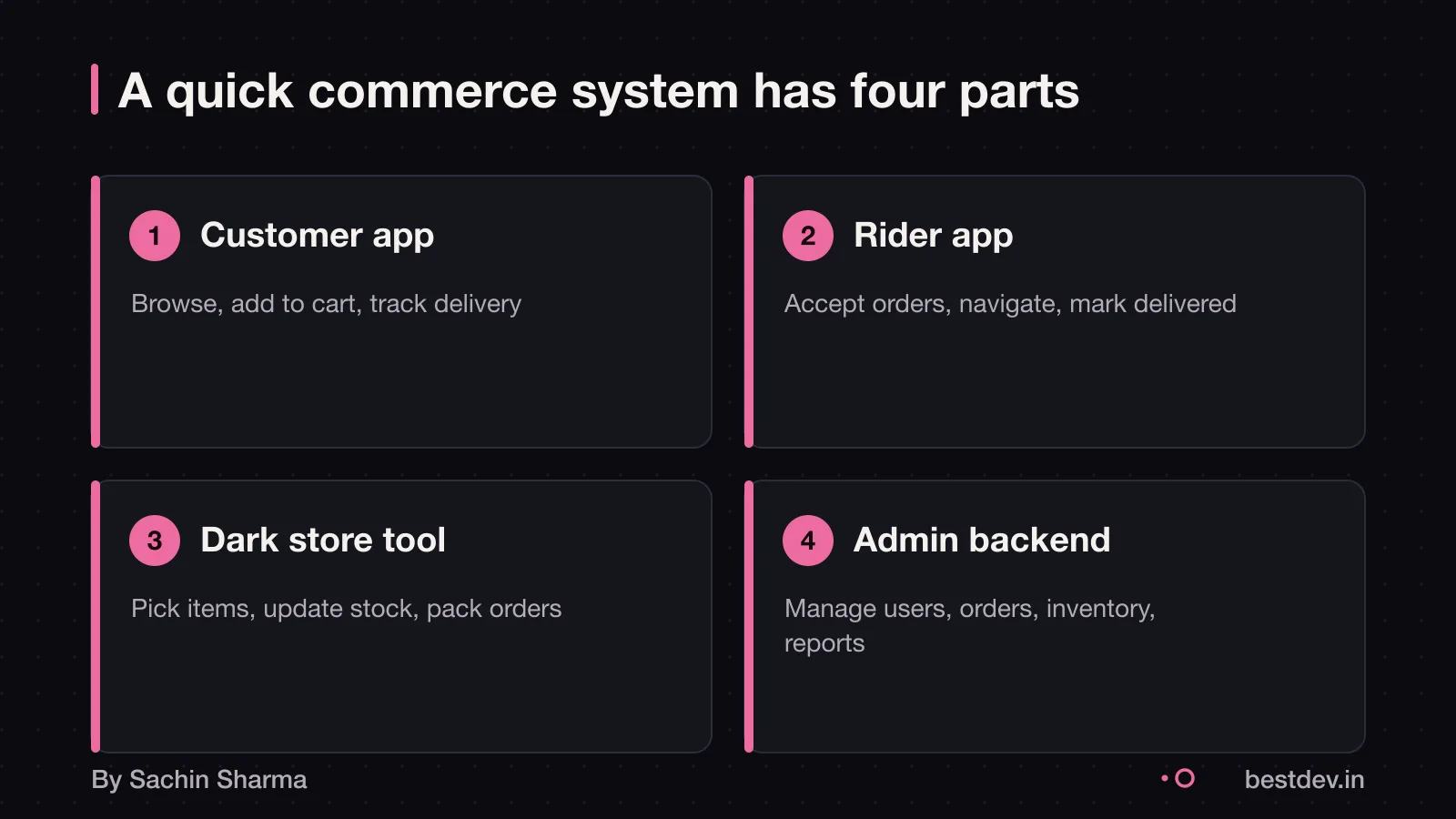
A quick commerce system has four parts. First, a customer app where users browse items and place orders. Second, a rider app to assign and track deliveries in real time. Third, an admin panel to manage inventory, orders, and staff. Fourth, a backend system that syncs stock across all parts and updates live order status.
Dark stores or micro-fulfilment centres are used in densely populated areas to support fast delivery.
The four parts of a quick commerce system are the customer app, rider app, admin panel, and backend system. You can start with fewer features, but the core system must be complete.
See the must-have features for a quick commerce app to understand what each part must do.
What features make the app more expensive?
Live updates on order location and estimated time of arrival provide transparency and build trust. Are considered a non-negotiable feature in quick commerce app development.
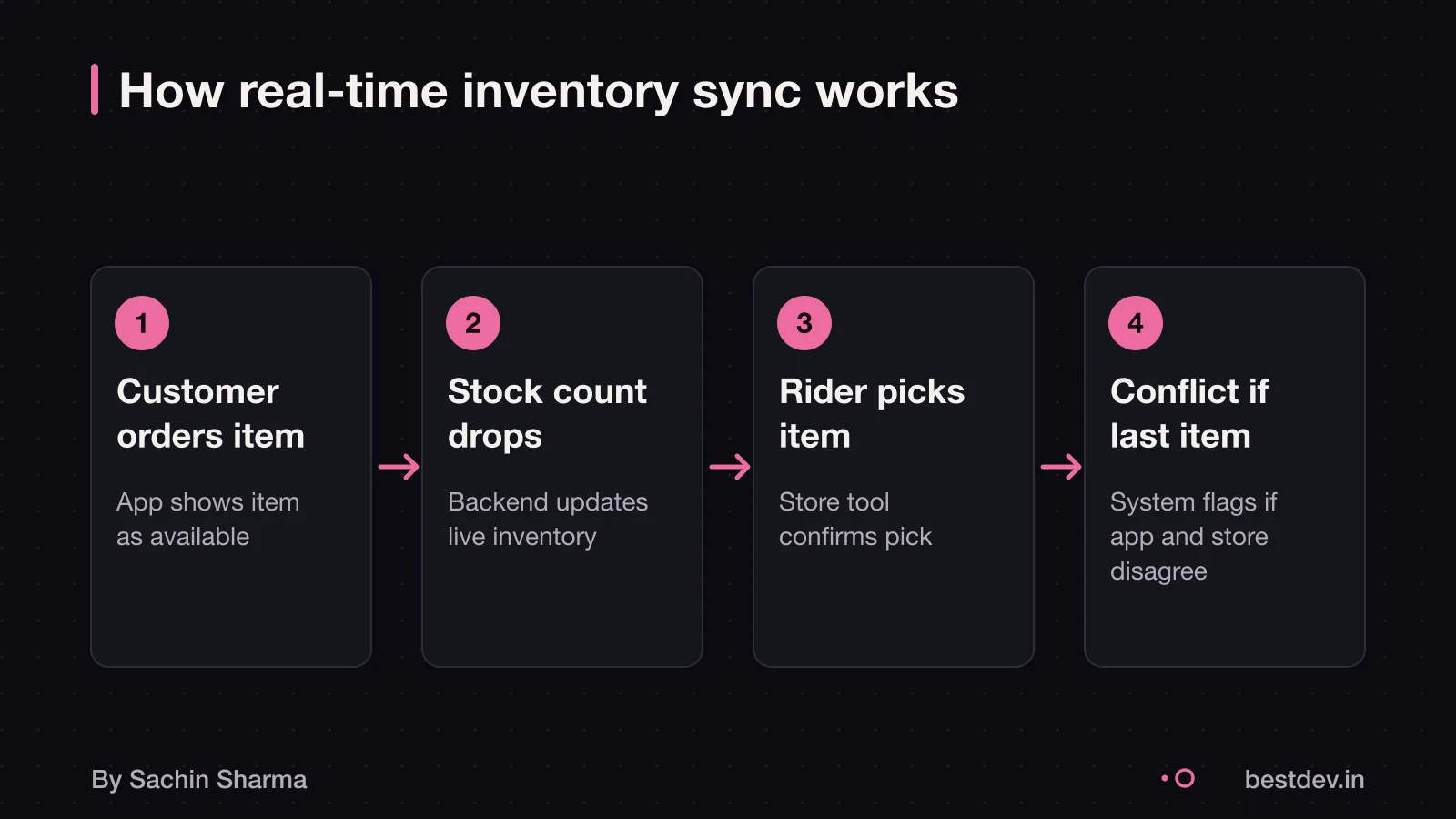
Real-time inventory sync helps prevent cancellations and stockouts in Q-Commerce apps, and supports operational efficiency. Inventory management software is needed to ensure real-time synchronization of stock levels across dark stores, which helps prevent cancellations and stockouts.
AI-powered personalized catalogs are considered a core feature for a competitive quick commerce app. These require data processing and machine learning models. For small businesses, this may add complexity early on.
smooth payment options are considered essential for a competitive quick commerce app. Integrating multiple payment gateways may require additional testing and maintenance.
For lower cost, skip AI features at first. Focus on live tracking and inventory sync. These are core to trust and delivery speed. Tech stack choices that affect cost can change long-term maintenance and scaling. See tech stack choices that affect cost for trade-offs.
Cost breakdown: what each part adds
The cost split between the customer app, rider app, and store admin panel is not known. No evidence gives a clear breakdown. You should ask developers to provide a line-item quote for each component.
As an estimate, assuming equal effort, each app (customer, rider, store) might add 20% to 30% of the backend cost. But this varies by features. For example, live tracking or real-time sync add more cost. These are only assumptions.
The cost of live order tracking, real-time inventory sync, and handling substitutions is not known. These features rely on the backend. Their cost depends on how tightly they are integrated.
How long does it take to build?
Building a quick commerce app takes 6 to 12 months from start to launch. This includes design, development, testing, and deployment. The full timeline depends on how fast your team can agree on features and fix issues.
Poor coordination slows things down. If inventory, fulfillment, and delivery teams do not share real-time data, it creates bottlenecks. For example, a rider may arrive at a store only to find the item out of stock. This delays the order and hurts trust.
Most delays come from unclear roles or changing requirements mid-way. To stay on track, define each team’s duties early. Use a shared dashboard for order status, stock levels, and rider location.
Even with a skilled team, integration between apps, customer, rider, and admin, takes time. Each must update instantly when an order is placed, assigned, or delivered.
For a detailed week-by-week build plan, see the week-by-week build plan.
What can go wrong, and how to protect yourself
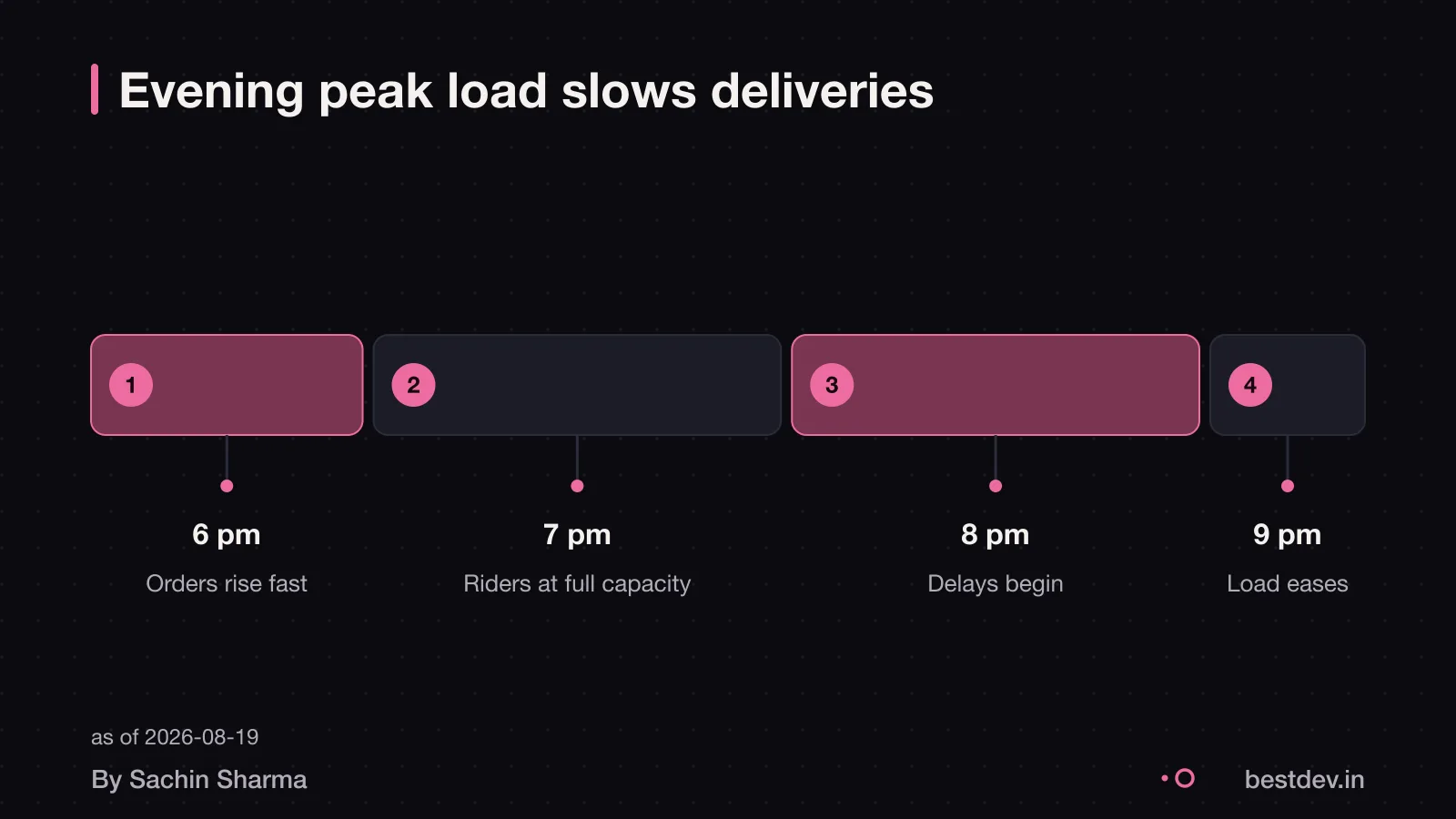
During peak shopping times, your app's service quality may drop if resources are strained. To protect yourself, test your app under simulated peak loads before launch and use scalable cloud hosting that adjusts to traffic.
If stock levels are not synced in real time, customers may order items that are already sold out. A shopper in the store might take the last unit just as an online order comes in. This hurts trust and increases cancellations. Stockouts and inaccurate inventory directly impact delivery speed and customer experience. Use a single inventory system across online and physical sales to reduce mismatches.
Riders can go offline or miss deliveries, especially during rush hours. Advanced logistics can help with timely deliveries for quick commerce, but rider availability may vary. Build in backup riders per zone and set clear service-level agreements with your team.
The Digital Personal Data Protection Act, 2023 received presidential assent on 11 August 2023. It will start on a date appointed by the Central Government in a notification in the Official Gazette. You must design consent flows and data storage to meet its rules when enforced. For help, see the guide on DPDP Act consent flows for apps.
You should own the source code of your app. Apple allows app transfers between accounts, and the app keeps its reviews, ratings, and Bundle ID during and after transfer. Confirm in writing with your developer that you will receive full source code and transfer rights. For more, read about when you can get the source code.
Can I start simpler and cheaper?
Yes, you can start simpler and cheaper by skipping custom apps and using tools you already have. Use WhatsApp for orders and Google Sheets to manage them. This works for one store and a small area. You test demand without spending on software.
You can skip the rider app by using phone calls or messaging to guide delivery staff. Many small stores do this at first. It saves the cost of building and maintaining a separate app. When volume grows, you can consider a dedicated tool.
Use existing stores instead of dark stores. Start with stock you already manage. This cuts setup cost and risk. You prove customers want fast delivery before investing in new infrastructure.
The smallest viable version is a single location taking orders via WhatsApp. Managing inventory in a shared spreadsheet, and using in-house or hired help for delivery. Add features only when delays or errors increase.
Third-party delivery services like Dunzo or Swiggy Genie can handle riders. This shifts cost from build to per-delivery fees. The fee amount is not known, but it avoids upfront tech cost.
For longer-term options, compare your path with three routes: build, white-label or use platform [compare/build-or-buy-a-quick-commerce-app/]. Each has trade-offs in control, cost, and speed.
Is it right for my city?
Yes, quick commerce can work in your city, but only if you can meet the daily order volume needed to cover costs. Tier 1 cities have about 1,300 orders a day, as reported for tier 1 cities. A dark store in a tier 2 city needs around 800 orders a day to break even. Without these numbers, the model loses money.
Quick commerce platforms already operate in Tier 1, 2, and 3 cities across India. Tier 2 and smaller cities could make up 30 per cent of quick-commerce spending. This shows growing demand beyond metros.
Spencer’s Jiffy's online business generated ₹200 crore in FY26 from 2.6 million orders. These are working models, but they run at scale.
If your city has fewer than 800 daily orders, start with a simpler delivery model. Once you hit volume, build your own app. For local support, consider hiring in smaller markets where costs are lower and talent is available.
How to check if a quote is fair
Compare quotes using the MAEUM framework. This sets a baseline for software ownership and SaaS pricing. As a guide, their published starting price for full software ownership is ₩2.5M to ₩7M+ (about $1,786 to $5,000+). For managed SaaS setups, expect an upfront cost of ₩700K+ and monthly fees of ₩490K, ₩990K or ₩1.49M.
Check a developer’s experience by reviewing their portfolio size and delivery depth. For example, Zazz lists 36 completed projects. Fulminous Software lists 13. A larger portfolio may suggest broader experience, but does not confirm tested delivery. Look for proof of full-cycle builds. Not just design or front-end work.
You can also check if the quote covers all three core parts. These are the customer app, rider app, and admin panel. Some quotes may omit features like rider logistics or real-time sync. Ask for details. Ask for a line item on live order tracking, inventory sync, and substitution handling, as these are often complex features.
To vet a developer, you can ask how many full quick commerce systems they have shipped. A fully shipped product may carry more weight than partial involvement in many projects. You may choose to review client outcomes, not just app features.
When this advice is wrong
You should not build a quick commerce app if your city has low smartphone penetration or. If your target customers do not yet expect 10-minute deliveries. The model relies on dense urban demand and fast decision-making, which may not exist in smaller towns.
It is too risky if your business cannot absorb losses during the trial phase. High operational costs from delivery fleets and dark stores can outweigh revenue in early months. Competition is rising, with more players improving delivery techniques and pricing, making it hard to stand out without deep pockets.
This advice does not apply if you are only testing demand. In that case, start with a WhatsApp-based pilot or partner with Dunzo or Swiggy Genie instead of building your own app. Focus on order volume and customer retention first, not tech ownership.
What to do next
Start with one store to test demand before scaling. Build your tech, warehouse, and delivery fleet around a single location. This cuts risk and cost while you learn customer behaviour in your market.
To prepare to hire, ask developers for proof of past apps like yours. Look at their live apps, not just demos. Insist on a delivery plan with dates and payments split by milestone. Avoid full upfront payments.
Use the one-page app brief template to clarify your features, users, and goals. This helps you compare quotes fairly.
Questions people ask
How much does a quick commerce app cost in India?
As an estimate, assuming you hire dedicated developers, a quick commerce app costs between $40,000 and $200,000 to build, depending on features and scale.
What makes a quick commerce app more expensive?
Features like real-time GPS tracking, AI-powered personalized catalogs, and smooth payment options are essential for a competitive quick commerce app. Automation level, scalability needs, and third-party services also add to the price. Each extra feature must be tested and maintained, raising long-term costs.
How long does it take to build a quick commerce app?
Building a quick commerce app takes 6 to 12 months from start to launch. This includes design, development, testing and deployment. Timelines vary based on team size, feature complexity, and how fast you make decisions.
Can I build a quick commerce app for less than ₹10 lakh?
A quick commerce app MVP starts at $40,000, with full costs rising based on features and scale. You can reduce cost by starting with a WhatsApp + Google Sheets MVP or using third-party delivery, but core systems still require major investment.
Do I need a GSTIN for my quick commerce business?
Yes, you need a GSTIN if your annual turnover exceeds ₹20 lakh (₹10 lakh for some states). This applies to quick commerce businesses selling goods. For full details on registration, invoicing and input tax credit, see our guide on GST for app businesses.
How do I handle data privacy under DPDP Act?
The Digital Personal Data Protection Act, 2023 is expected to come into force on a date to be notified by the Central Government. You must get user consent, protect stored data, and allow data deletion. For step-by-step consent design and privacy notices, see our DPDP Act compliance guide.
Can I use Swiggy Genie or Dunzo instead of building a rider app?
Yes, you can use Swiggy Genie or Dunzo for delivery instead of building your own rider app. This reduces upfront cost but means ongoing per-delivery fees. As these fees are not public, you must contact them directly to compare with in-house delivery costs.
What is the cost of live order tracking?
Live order tracking can build trust with real-time updates on rider location and arrival time. Is seen as a non-negotiable feature in quick commerce app development. The exact cost to build it is not known, but it requires constant data sync between rider. Server and customer apps, raising backend and hosting costs.
How do I test the app before launch?
Test your app for peak load, especially during high-demand periods like festivals or sales. Simulate hundreds of users placing orders at once to check if servers slow down or crash. Fix weak points before launch to avoid service failure when live.
Can I start with one dark store?
Yes, you can start with one dark store and expand later. Frameworks can be built to scale as your business grows. DMart Ready reduced its footprint to 11 cities from 18 during the June quarter of 2026. After ending operations in seven cities, as reported at the end of March.
Assumptions behind the numbers
- Backend development cost is assumed to be $50,000 to $90,000
- Hourly rate is set to $25 as a conservative default
- Each feature toggle represents an estimated week impact on development time
A quick commerce app is not one app. It is a customer app, a rider app, a dark-store tool and an admin. Switch things on and watch the weeks move.
Customer app
Rider app
Dark store tool
Admin and backend
Where it goes wrong
Three things the calculator can't see
Inventory accuracy
The app is only as good as the shelf count. Plan for how stock reaches the system before you plan screens.
Rider supply
Software does not create riders. Decide whether you build the rider app or use an existing fleet.
Peak load
Evening rush is a different test from a demo. Ask how it is tested.
Before you sign
Ask for these
- Are the customer, rider and store apps all in this quote?
- Which area and how many stores does the first version serve?
- Who owns the inventory data feed?
- How is peak load tested?
Keep going