Alternatives · Honest
Lovable alternative: when a developer beats an AI app builder

AI app builders help you test ideas fast. But some projects need a developer’s control. This page tells you when to switch.
The full explanation
What is a lovable alternative?
A lovable alternative is an AI app builder that lets you make a working app fast, with little coding. Tools like Base44, Glide, and Zoho Creator support app development with automation and integration features. They build apps from prompts and handle hosting, logins, and databases automatically. These platforms can turn spreadsheets into simple apps, such as internal tools with structured data. They promise quick results at low cost. As an estimate, Glide can turn a Google Sheet into a mobile-ready app in a few hours. But they are built on fixed templates and limited custom logic. You stay on their platform, under their rules. For deeper needs like security or custom workflows, they fall short. You can explore other tech stack choices as your needs grow.
When an AI app builder is the right choice
An AI app builder can generate a simple app or website in minutes, which may help you test an idea quickly. These tools can generate a website or app in minutes. You can see if your idea makes sense before spending more. They are safe for early testing. Nothing is live, and changes cost nothing. Small businesses can afford this. AI website and app builders promise fast development at low cost.
Use them to validate untested ideas quickly. For example, YouTube launched prototypes like YouTube Recap for user research in weeks, not quarters. You can do the same by typing your idea into tools like Softr or Glide. You get a shareable app right away. They help with rapid prototyping, design inspiration, and learning how apps work.
But this only works for early stages. Once you have real users, need secure data, or want full control, an AI builder will hold you back. If your app starts to grow, you may need to hire a developer later to rebuild it properly.

When a developer clearly beats an AI app builder
Hire a developer when your app needs user authentication, payments, data storage, complex business logic, or high user traffic. A custom-built app gives you clean architecture, strong security, and full ownership. It also offers better performance and lower long-term costs. This is true for full-stack apps that have complex backend logic, enterprise-grade security requirements, and unified data governance.
For payments, a developer is worth it.
Under India’s DPDP Act, you must protect user data and allow access or deletion. Consult a legal expert for your case.
If you use Softr, know it is not made for SaaS products, marketplaces, or consumer apps. You will hit limits fast. Custom code lets you add any feature, fix bugs, and scale to thousands of users.
Before hiring, run these checks before hiring to avoid bad fits.
Cost comparison: AI builder vs developer
An AI app builder costs $25 to $50 per month, while building a full app with a developer can cost $10,000 or more. Freelancers in India charge $25 to $60 per hour. Agency project costs are not specified here. This makes AI builders cheaper at first.
Hidden costs can change the picture. AI tools are SaaS and attract 18% GST under SAC 998315 for Indian buyers. Most foreign AI platforms do not issue Indian GST invoices, so you may not claim input credit. Also, AI-generated apps often have inefficient backends. Database read and write costs can end up 3 to 8 times higher than expected.
Over three years, a developer-built app may be cheaper in some cases. As an estimate, assuming a $10,000 app, 15 to 20% annual maintenance adds $1,500 to $2,000 each year. Total: $13,000 to $16,000. In contrast, an AI builder at $50/month costs $1,800 per year or $5,400 over three years. Hidden database costs could push it to $16,200 or more, based on database costs being 3x to 8x higher than expected. For complex apps, a developer-built app may be more cost-effective, but this depends on specific factors.
For a full cost breakdown, see our full cost breakdown page.
Time to build: AI vs developer
You can launch an app in minutes with an AI builder, but hiring a developer takes weeks. A developer needs time to understand your idea, write code, and test it. AI tools like Softr can set up an app with a frontend, database, authentication. Sample records in about five minutes, based on a finished example. Replit can generate and deploy a working full-stack app, often within an hour.
Handing over an AI-built app to a developer adds time. Budget two weeks before the new developer can ship anything customers see. This delay comes from understanding the existing app, cleaning up auto-generated code, and setting up proper workflows. If you plan to switch later, build only the core idea in the AI tool. Keep the rest simple so the handover stays smooth.
Handing over from AI builder to developer
To switch from an AI app builder to a developer, give them four clear packages: code access. Infrastructure inventory, operational docs, and context not in the code. Share full GitHub repo access. Do not use a zip file. This lets them see the full commit history. The history shows how features were built and debugged.
Next, provide a full list of all live services. These include databases, payment gateways, hosting, and domain providers. An incomplete infrastructure inventory is the single biggest source of early friction. Add login details, API keys, and any usage limits. Then, pass on operational docs like user flows, error logs, and past fixes. Finally, explain business rules or user needs that are not obvious in the code.
A developer can maintain your app if they get these four packages. Budget at least two weeks for them to review everything before they ship any customer-facing update. For small apps under 15,000 lines using mainstream tools like Next.js, Supabase, or Stripe. A skilled freelancer may be enough, if you can tolerate a one-person bus factor. This carries the risk of a one-person bus factor, where losing the developer could delay or block updates.
Use a template for handover to make sure nothing is missed.

Risks of AI-generated apps
An AI-generated app may fail in production due to hidden costs, poor code quality and security risks. Only 5% of AI prototypes make it to production; the other 95% fail validation. The rest fail validation. AI-generated code often repeats the same logic in many files with small differences. This can create technical debt. This makes updates slow and bug fixes hard.
Database costs can be 3x to 8x higher than expected. Businesses report this when using AI-built backends. You may not notice until the bill arrives.
Security is another risk. If your app handles personal data, you must protect it. For example, use encryption. The FTC expects all developers to follow reasonable security practices. But AI tools may not build in these safeguards. To check your app, ask: Does it encrypt user data? Are access controls strict? Have you tested for leaks?
If your app fails, you may lose time, money and trust. Most AI platforms give little control over the backend. So fixing deep issues can mean starting over. For long-term projects, this risk grows with every user and every line of data. If your app handles personal information, consider protecting it, for example by using encryption.
Security and compliance rules
The Act applies to the processing of digital personal data within India where the data is collected in digital form or digitised later. As of 11 August 2023. If your AI builder does not let you review or control how data is processed, it may not meet the Act’s requirements.
App stores also enforce rules. Apple’s App Transport Security (ATS) uses TLS 1.2, forward secrecy and strong cryptography for secure network connections, as per best practices. Google will automatically enforce Firebase App Check to protect the Gemini API during the guided setup workflow for AI Logic in the Firebase console. Starting early July 2026. Both rules can be hard to meet on AI builders.
If your app collects names, phone numbers, addresses or health data, talk to a legal expert. This is not legal advice.
Code ownership and export
You own the code only if your AI app builder allows export and full ownership. Some platforms allow code export, while others may lock your app inside their system. Always check the fine print before you build.
Many AI platforms generate code but tie your project to their ecosystem. This means you cannot take your app elsewhere without rewriting it. Some tools generate real React, Python, and MongoDB code that you own, with no platform lock-in. On these, you can sync with GitHub and own your code, so there is no platform lock-in.
Newly.app says some AI builders offer full source code ownership, include backend and database, and allow one-click app store deployment. They allow export of code to GitHub. But not all platforms are the same. Some only let you download a zip file, not a full repo with history.
If you plan to scale, start with a tool that gives you full code access. A zip file or no export option will force a rewrite later. For full control, look for GitHub sync and open-source frameworks.
For more, read about source code ownership and what to check before you commit.
Signs you’ve outgrown the AI builder
These signs mean the AI builder can no longer support your needs. If the tool fights you instead of helping, it is time to switch.
Another sign is when handoffs fail. Founders often believe their AI-built app is “mostly done” and ready to hand over, but the developer may see a half-finished product. Week two turns into a rescue, trust fades, and the project stalls or fails.
If your business grows but the tool does not, you are outgrowing it. Consider a freelancer or agency based on your budget and support needs.
When this advice is wrong
When this advice is wrong You do not need a developer if your AI app builder already meets Indian tax rules. Eight foreign-currency SaaS tools issue a valid Indian GST invoice, though five of those are Indian companies that quote prices in dollars. If your tool issues an Indian GST invoice, it may reduce compliance risk, but check with a tax advisor for your case. Five of these eight are Indian companies that quote their prices in dollars, so check the seller’s origin.
Also, if your investors accept AI-generated code or you have remote developers who can take over a prototype, you may skip hiring a developer early. Some teams use AI builders to launch fast, then hand off to remote engineers when scaling. But most Indian buyers still face GST and compliance gaps with foreign tools.
For edge cases like funding rules or remote handovers, ask about funding or remote teams.
Questions people ask
Which option is cheaper to run over three years?
Custom development is cheaper over three years despite higher upfront cost. Agencies charge 15 to 20% of build cost annually for maintenance, while AI builders have hidden database and scaling costs. As an estimate, assuming a $10,000 build, maintenance adds $4,500 to $6,000 over three years, whereas AI tools may exceed this with overruns.
When does the other option win?
Custom development wins for performance, long-term cost, maintenance, and competitive advantage. AI builders may help with rapid prototyping and idea validation without real users. AI tools can help test ideas quickly, but custom code supports real applications with better structure and security.
Can I switch from an AI builder to a developer later?
Yes, you can switch, but plan for a two-week handover before the developer ships customer-facing updates. Provide full code access, infrastructure inventory, operational docs, and context not in the code. Use a structured app brief to ease the transition.
What are the hidden costs of AI app builders?
Hidden costs include database overruns, app store fees, and infrastructure costs hard to predict. Businesses report database costs 3x to 8x higher than expected when using AI-built backends. App store fees are $99 per year for Apple and $25 for Google. Bubble's workload-based pricing makes pre-launch cost estimates difficult.
How do I know if my app needs a developer?
Your app needs a developer if it handles payments, user authentication, complex business logic, or high traffic. AI tools struggle with these real-world demands. Tools like Softr may not support apps that need user authentication, payments, data storage, complex logic. Or high traffic, because they are not built for SaaS products, marketplaces, or consumer apps.
Is it safe to use an AI builder for customer data?
No, it is not safe under Indian law. The DPDP Act, 2023 applies to digital personal data collected in India. The FTC expects reasonable security practices like encryption for personal data. AI builders often lack enterprise-grade security, making compliance hard. Check this for your case with a data protection officer or lawyer.
What should I ask a developer when handing over?
Ask for full code access, a complete infrastructure inventory, operational documentation, and context not visible in the code. An incomplete inventory causes the most handover delays. Use a handover checklist to ensure nothing is missed.
Can I get proof that a developer has built secure, working apps before?
Yes, ask to see their portfolio of past projects. You can ask a developer to share code, case studies, or client feedback as proof of past work. You can also request a code audit before hiring.
What integrations are hardest for AI builders?
Full stack apps with complex backend logic, enterprise security, and unified data governance may be better served by custom platforms. Examples include ERP systems, banking APIs, or internal HR tools requiring strict access controls.
What custom logic is too complex for AI builders?
Custom logic involving complex backend workflows, multi-step approvals, or real-time data syncing is too complex. AI tools struggle with applications that have user authentication, payments, or high user traffic, as these involve complex logic and data handling. Apps with complex business logic or security needs like user authentication and data storage are harder to build without developers.
AI app builders help you test ideas fast. But some projects need a developer’s control. This page tells you when to switch.
Three questions
Stay, hand over, or hire?
- 01Will real customers' money or private data pass through it?Payments, health records, ID proofs, anything you would be embarrassed to leak.
- 02Does it need to talk to other systems or have custom rules?Payment gateways, ERPs, WhatsApp APIs, your own pricing logic.
- 03Do you need to own, extend and scale the code for years?Team growth, audits, investor checks, long-term changes.
Fair to both
Where each one wins
Where builders win
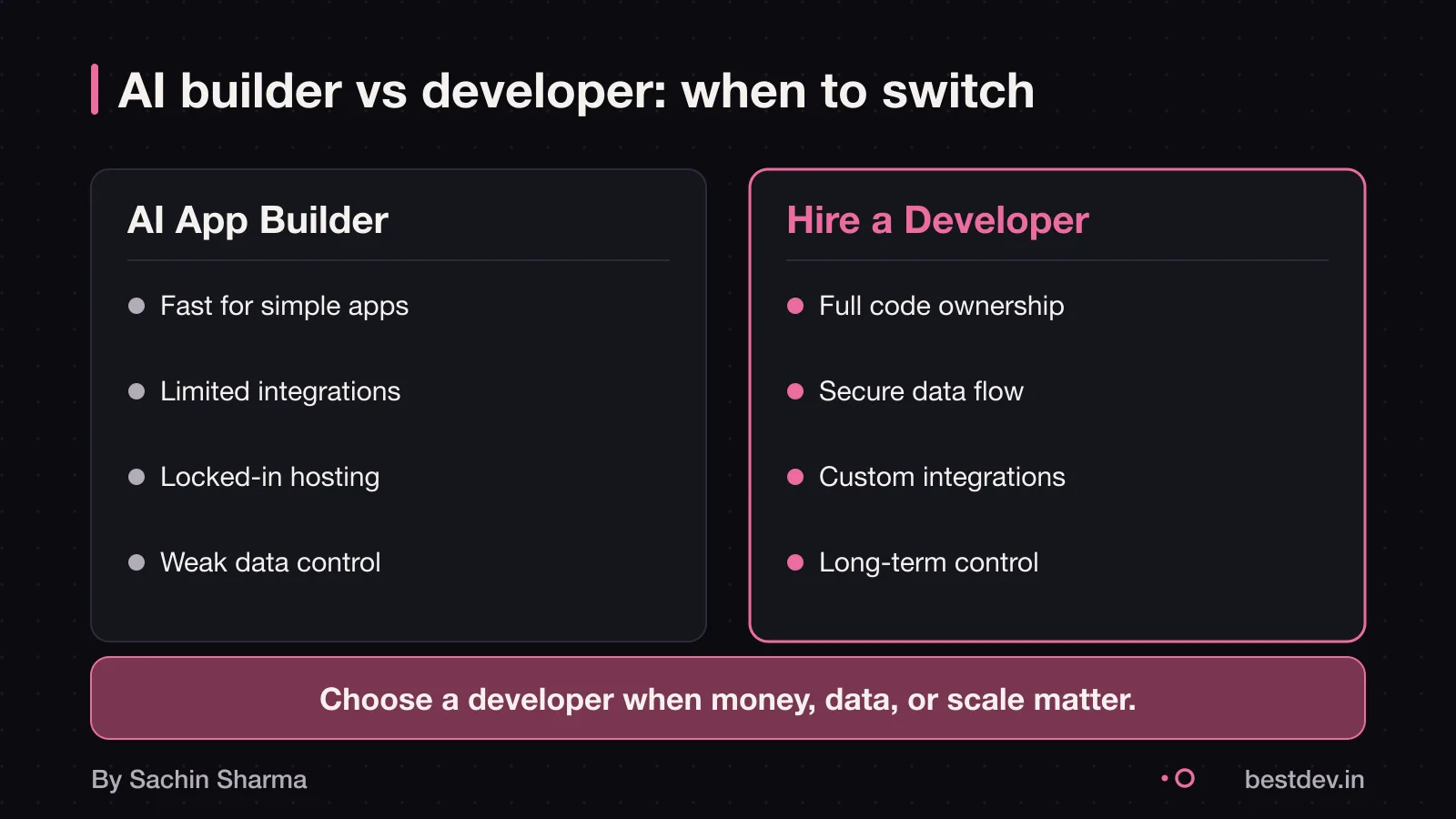
Speed to a clickable demo, and low cost at the start.
Where developers win
Data safety, custom rules, stable code, and full control.
Where both lose
An idea nobody wants. Test that first, with either path.
Keep going