Cost · Generic
What does it cost to build an app in India?
I won't hand you a number that pretends to be the market. Instead, here is the working: set the weeks, the people and the rate, and see where the money goes.
The full explanation
Typical app development cost ranges in India
As an estimate, assuming a rate of ₹83 per US dollar and typical small business app scope. Most small business apps in India cost between ₹8.3 lakh and ₹25 lakh. This range covers simple to medium-complexity apps with core features, built by a developer or small team. As an estimate, assuming a simple app costs $10,000 to $40,000. That is ₹8.3 lakh to ₹33.3 lakh using an exchange rate of ₹83 per dollar. Complex apps can cost $120,000 to $300,000 or more. As an estimate, this is about ₹1 crore to ₹22 crore at current rates. As an estimate, assuming a US dollar to rupee rate around ₹75, this is about ₹7.5 to ₹30 lakh. These figures are based on 2026 data and assume a rate of ₹83 per US dollar. Exact costs depend on scope, team and hidden inclusions.
How app development cost is calculated
App cost is weeks × people × day rate. This formula ties time, team size and hourly pay to give a total. As an estimate, assuming 10 weeks, 3 people and ₹15,000 per day, the base cost is ₹4.5 lakh. But this does not include testing, tools, or project management.
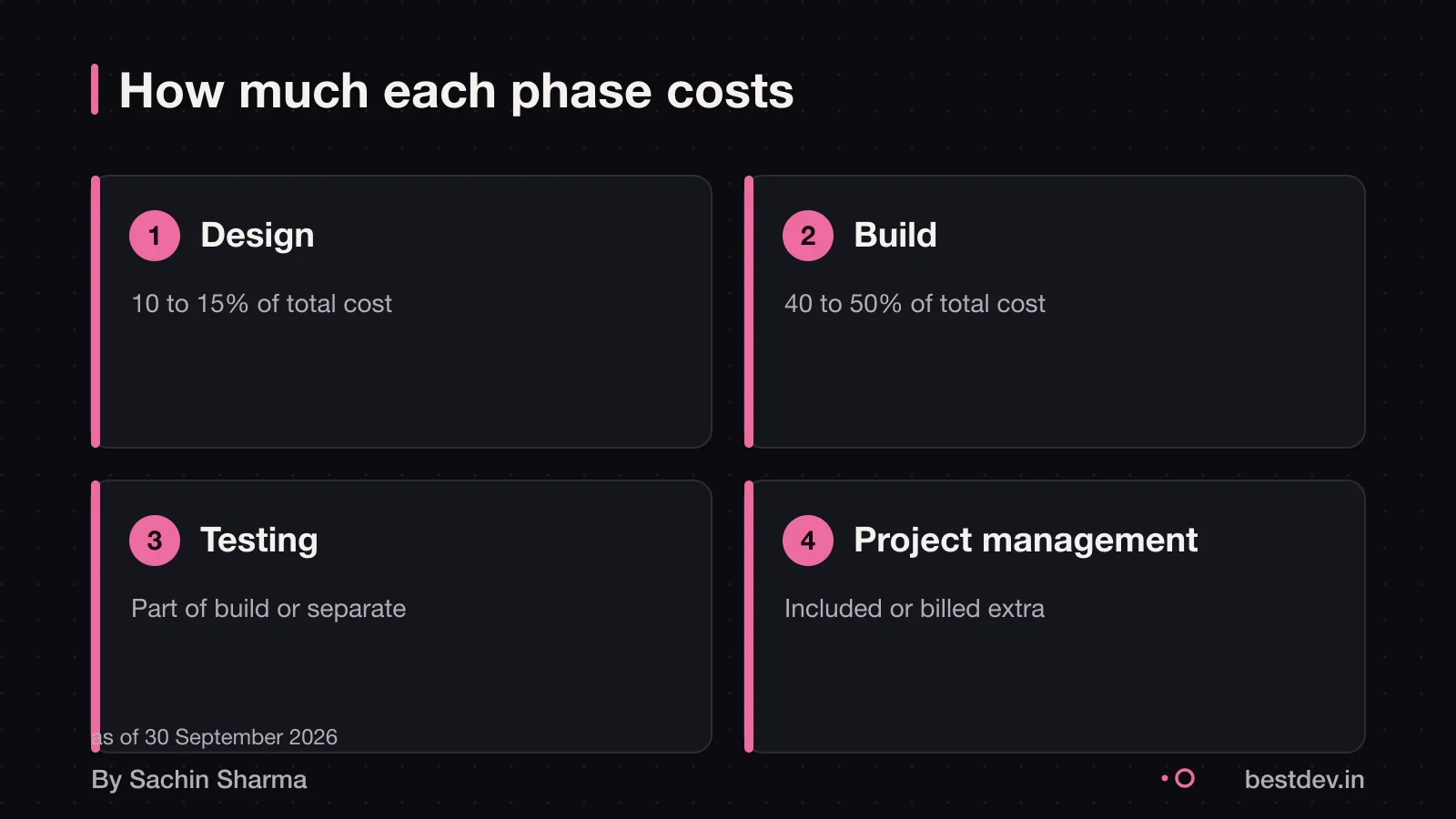
Development and integration take 40 to 50% of the budget. This covers frontend and backend code, plus APIs that link parts. UI/UX design takes 10 to 15%. That includes wireframes and prototypes. Project management can take up to 10 to 15% of the total app budget.
For example, in a ₹10 lakh app, ₹4 to 5 lakh may go to development and integration. ₹1 to 1.5 lakh to UI/UX design, and up to ₹1.5 lakh to project management. The rest may cover testing, tools, and buffer.
The exact split depends on your app’s needs. A design-heavy app may spend more on UI. A data-heavy one may need more backend work. You should ask every developer to break down their quote by these parts.
See How Flutter developer rates vary in India to understand what drives day rates.
What app development cost includes and excludes
It does not include ongoing AI model usage fees or third-party API maintenance costs. For example, an app with generative AI features may save time during development through AI-assisted coding. But adds monthly costs for model access after launch. These post-launch fees are separate from the initial build quote and are often not included in developer estimates.
A basic app build may start around $40,000, while complex apps reach $400,000 or more. Enterprise-grade systems can exceed $500,000. However, these figures refer only to development effort and do not account for long-term operating costs. You must budget separately for AI service usage, cloud hosting, and API subscriptions once the app is live. What a developer quotes as “total cost” may leave out these critical line items. Always ask what is excluded in the estimate.
Third-party and launch costs
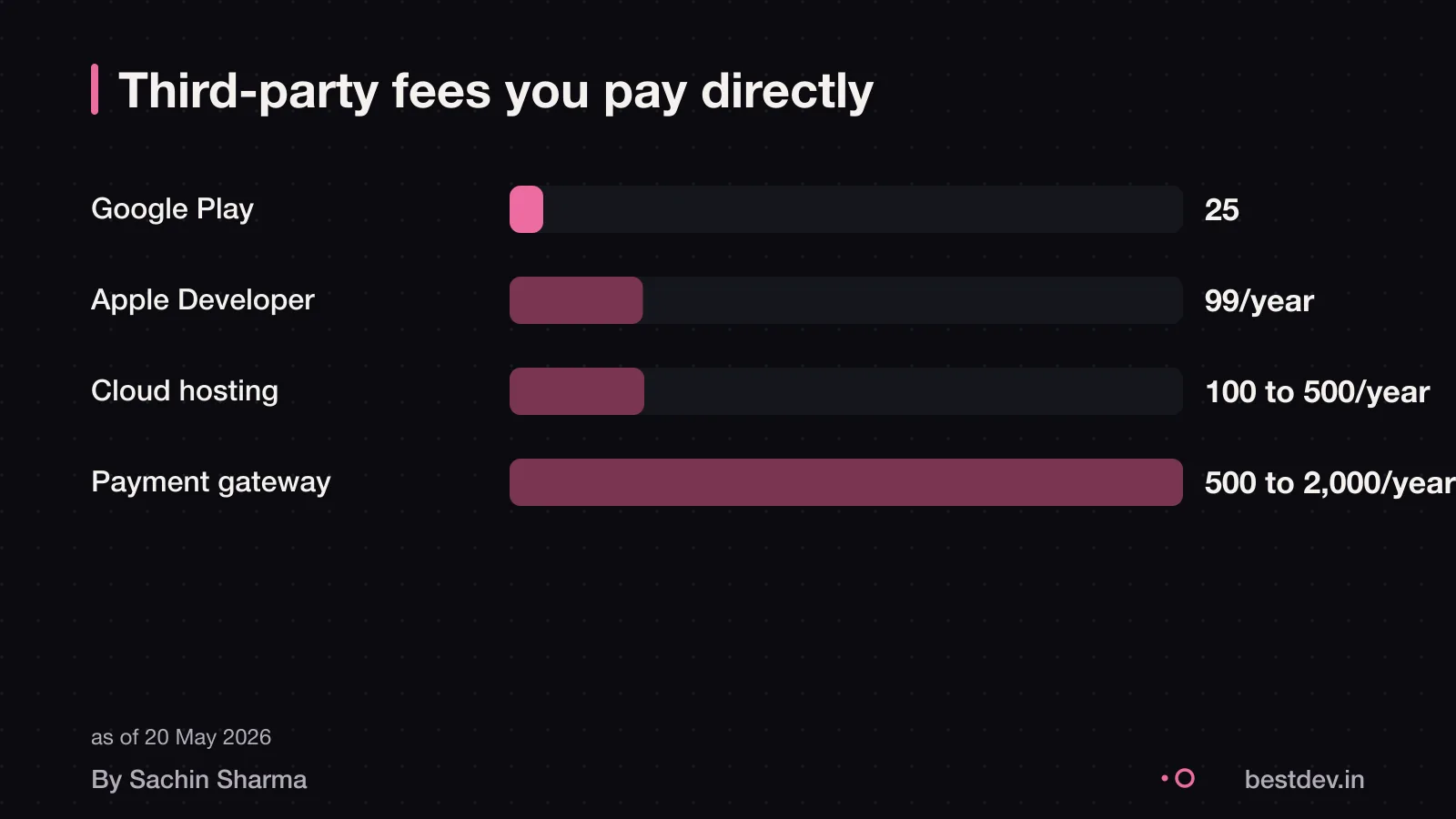
You pay extra for app stores, hosting, payment gateways and third-party APIs. These are separate from development fees and recur yearly. For example, Google Play charges a one-time $25 fee. Apple’s App Store costs $99 per year. The server component for your app can cost between $6,400 and $28,000 per year, depending on traffic and setup. Each payment gateway integration may add $2,600 or more to initial build cost. For every 10 third-party APIs used, expect $1,000 to $3,000 per year just for updates and compatibility fixes. These costs scale with usage and complexity. You must ask your developer which services your app needs.
Ongoing maintenance and support costs
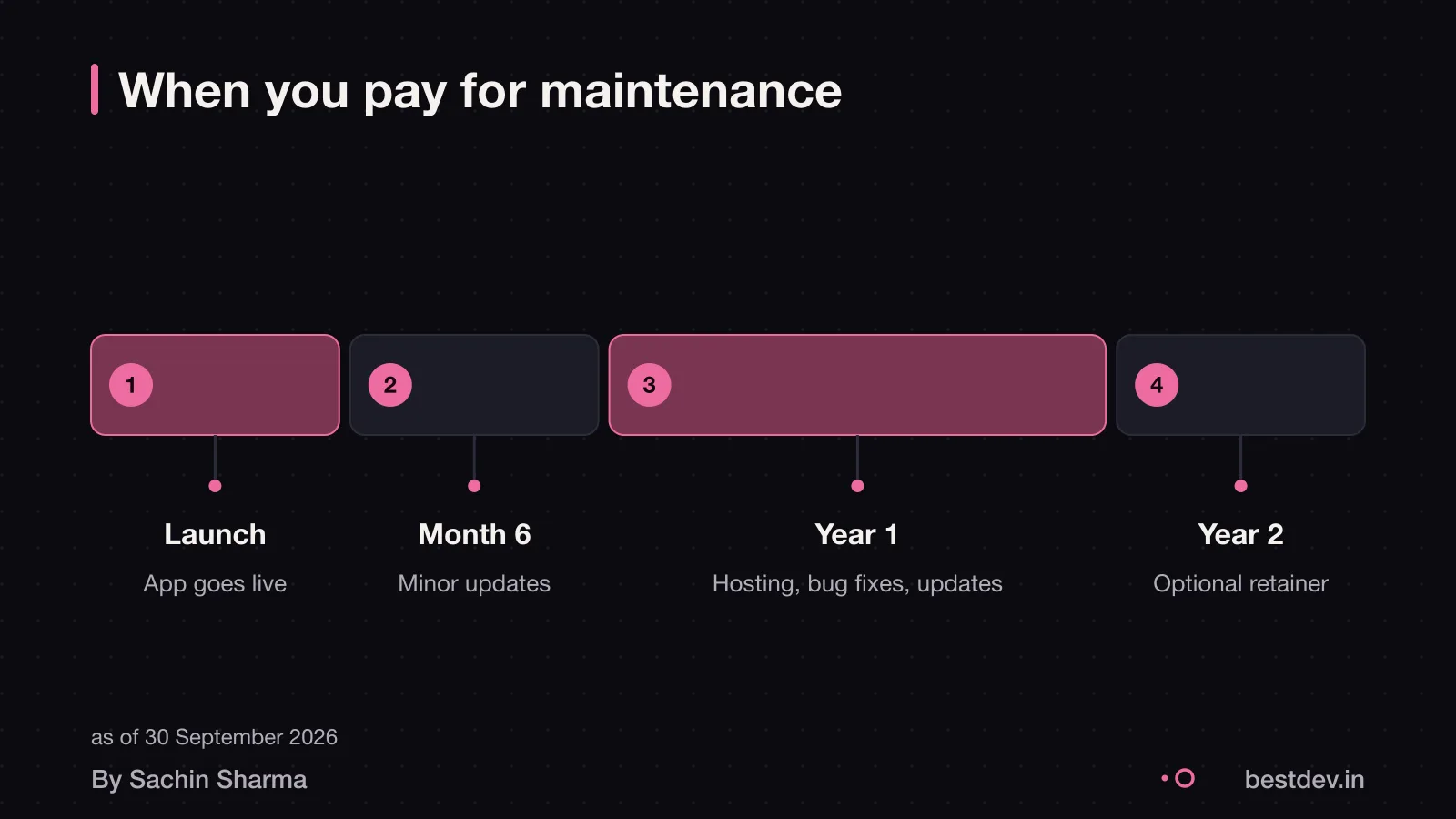
You will pay 15 to 20% of the build cost each year to maintain your app. This covers routine updates, bug fixes, server hosting, and compatibility with new OS versions. For a ₹20 lakh app, this means ₹3 lakh to ₹4 lakh per year, or ₹25,000 to ₹33,300 per month.
A monthly retainer typically includes a set number of support hours, security patches, performance monitoring, and minor feature tweaks. It does not usually cover major upgrades, new features, or redesigns. Those are billed extra. Simple apps may cost over $10,000 a year to maintain once hosting, SSL, and OS updates are added. Sectors like healthcare (HIPAA) or fintech face higher costs due to compliance: $20,000 to $80,000/year or $30,000 to $100,000+/year.
As an estimate, assuming a ₹20 lakh build cost and 15 to 20% annual upkeep, yearly maintenance is ₹3 lakh to ₹4 lakh. This aligns with the evidence but does not account for unexpected spikes from compliance or traffic load. The exact scope of a retainer varies by developer. So ask for a line-by-line breakdown of what it includes.
What increases app cost the most
Complex features raise app cost the most. Each choice you make about functionality, device support or AI use adds time and skill, which raises the price. The largest cost jumps come from AI, tablet support and landscape mode.
Adding AI features can increase cost; one source estimates a 20% to 50% rise. For example, an AI-powered app starts at $50,000, compared to $30,000 for a basic eCommerce app. If your app uses a large language model (LLM), expect to pay from about $15,000 for that feature, as a starting point. Agentic workflows cost near $40,000. These are not one-time fees but added development effort.
Supporting tablets increases the budget by up to 1.5 times. This is because layouts must adapt to larger screens, and testing takes more time. Similarly, adding landscape mode increases cost by 30%. Both changes mean more design work, extra code, and more test cases.
Other features that raise cost include real-time tracking, multiple user roles, and offline sync. These are not listed in the evidence, so their exact cost is not known. You should ask your developer for a line item on these. Adding tablet support can increase costs by up to 1.5x and landscape mode by 30%. Still, the core effort remains.
Who owns the code and accounts after build?
By default, the developer may own the source code, as copyright law often defaults to the creator. This applies even if they work for you as an independent contractor. To gain full rights, your agreement must include a written assignment of intellectual property.
A contract can assign full ownership to you on payment, rather than just grant a license to use the code. This is often called a "full assignment" clause. Without it, the developer could reuse or restrict access to the same code in future.
You must also get admin access to all linked accounts. This includes app stores, cloud hosting, and third-party plugins. Do not rely on the developer to manage these long-term. Losing access can block updates or transfers later.
For startups, founders should sign a Technology Assignment Agreement. This moves any prior inventions related to the business into the company in exchange for shares. It prevents disputes if a founder leaves or investors join later.
Legal agreements and GST rules
GST terms should reflect whether the developer is registered. As a buyer, your main risks are not owning the software and unexpected tax charges.
A written agreement should specify full ownership of the source code is assigned to you on payment. Not just licensed, with access tied to each milestone. Without this clause, the developer may keep copyright in the code after you pay, because Indian copyright law defaults to the creator. Founders building internal tools should also use a Technology Assignment Agreement to move prior inventions into the company.
You must register for GST if your annual services income exceeds ₹20 lakh. If they are GST-registered, tax is due at the earliest of invoice date, payment date, or service completion. This means GST should be charged on each milestone invoice, not just the final bill. If the developer is not registered, no GST applies to your contract.
For example, if a developer bills ₹10 lakh in milestones and is GST-registered, they must charge 18% GST (₹1.8 lakh) on each invoice. This happens as the invoice is issued.
How to verify a developer's estimate is realistic
If the quote arrives too fast, it may not reflect real work, as Sachin works directly with clients and does not use agency layers.
It may say what is not included, such as app store fees or third-party tools, as Sachin works directly with clients without agency layers.
When not to build a custom app
Do not build a custom app if your problem is already solved by tools you can buy or use today. Ask yourself: does my business need unique software, or can a ready-made tool handle it? Look at what other businesses like yours use. If they run on spreadsheets, WhatsApp, or known software, start there.
Test demand with the simplest system that works. For example, track orders in a shared sheet or manage bookings over phone calls. If it fills up, you have real demand. Then consider software.
If you need software, check off-the-shelf options first. Many tools offer booking, invoicing, inventory or customer tracking. Use them as they are, or with small changes. Only when those tools cannot do what you need should you think of custom build.
Even then, start small. Use a prototype to learn what users really want. This saves you from spending lakhs on features no one uses. Build only what proves necessary.
How to get an accurate quote
Start by writing a clear brief that lists your must-have features, user roles, target platforms and third-party tools you want to connect to. This helps developers give a quote based on real scope, not guesses. Share details like whether users need login, if data syncs offline, or if payments are in-app.
Use the App brief template to cover all parts a developer needs. A complete brief reduces the risk of hidden costs later. Ask for a line-item quote that shows cost per feature or module, not just a lump sum.
Check that the quote states what is excluded, such as server costs, app store fees or content creation. Insist on a written timeline with milestones tied to payments. Confirm whether the developer provides post-launch support or documentation.
If a quote seems low, ask what assumptions were made to cut cost. Some developers skip testing, design or edge cases to offer lower numbers. Compare quotes only after ensuring they cover the same features and risks.
When this advice is wrong
When this advice is wrong This advice is not for enterprise apps that cost over ₹25 crore. It does not apply if your app needs real-time tracking and the data on cost impact is missing [unknowns]. Agencies that quote without a discovery phase may give misleading numbers. If your project has complex compliance, multiple user roles, or deep system integrations, the risks are higher. For those cases, ask for a pilot build or a phased quote.
Questions people ask
How much does app development cost in India?
As an estimate, assuming a simple to medium-complexity app and using ₹83 per dollar. Most small apps cost between ₹8 lakh and ₹100 lakh in India. This range covers apps built by a developer or small team. For a precise number, share your feature list.
What makes app development more expensive?
AI features, real-time updates, multiple user roles, and third-party integrations raise costs. Supporting tablets can increase the app budget by up to 1.5 times, and landscape mode can add 30% more. Plan for these early.
How long does app development take and what do I pay at each stage?
A simple app takes 6 to 10 weeks. Payments are often split as 30% advance, 40% mid-project, and 30% on delivery. Milestones should match testable progress.
Does GST apply to app development?
GST applies if the developer's annual turnover exceeds ₹20 lakh. The tax point is the earliest of invoice, payment, or service completion. Check this for your case with a chartered accountant.
Who owns the app after it is built?
You own the app only if the contract assigns full rights to you. By default, the developer owns the code under Indian copyright law. Get admin access and source code in writing.
What should I check in a quote?
Check that milestones are testable, the deposit is under 40%, and exclusions like hosting or GST are listed. Vague scope or full upfront payment are red flags.
How much do I need to maintain my app?
Plan ₹15 to ₹20 for every ₹100 spent on building the app, each year. This covers updates, hosting, and bug fixes.
How can I verify a developer's estimate is realistic?
Look for a discovery phase, clear weeks per stage, testable milestones, and stated assumptions. A full quote in one call likely uses a template, not your needs. Compare with a second opinion.
When should I not build a custom app?
Do not build a custom app if an off-the-shelf tool meets your needs or if you only need a prototype. Custom apps suit unique workflows not covered by existing software. See when a developer beats an AI builder [compare/lovable-alternative/].
Assumptions behind the numbers
- Weeks per phase are estimated based on standard development cycles.
- Team size and day rate are adjustable assumptions reflecting common Indian developer rates.
- GST applicability is toggled based on turnover thresholds in India.
I won't hand you a number that pretends to be the market. Instead, here is the working: set the weeks, the people and the rate, and see where the money goes.
- Scope and design18%
- Build55%
- Testing and fixes18%
- Launch and stores9%
The weeks shown are an example of a small app, there to be changed. Fees you pay others (store accounts, cloud, SMS) are not in this total.
What moves it
Six things that move the price
- More screens or roles
Each extra user type (customer, admin, rider) is close to another app.
- Real-time features
Live tracking and chat need more design and more testing.
- Many integrations
Every payment, SMS, maps or ERP link is its own piece of work.
- Cutting to one platform first
Starting with one clear flow can be half the work.
- Using managed services
A managed backend for login and data removes weeks.
- A clear scope up front
Changes mid-build are the most expensive weeks.
Not in the total
Fees that go to someone else
Google Play developer account
A one-time registration fee, paid to Google. Check the current amount.
Apple Developer Program
A yearly fee paid to Apple. Check the current amount.
Cloud, SMS, maps, payments
Usage-based, billed by the provider to you.
Before you sign
Ask for these five things
- How many weeks per phase, and with how many people?
- What is not included?
- Which fees do I pay to others directly?
- What happens to the price when I change my mind?
- What does the first month after launch cost?
Keep going