Compare
Freelancer or agency, for a first app?
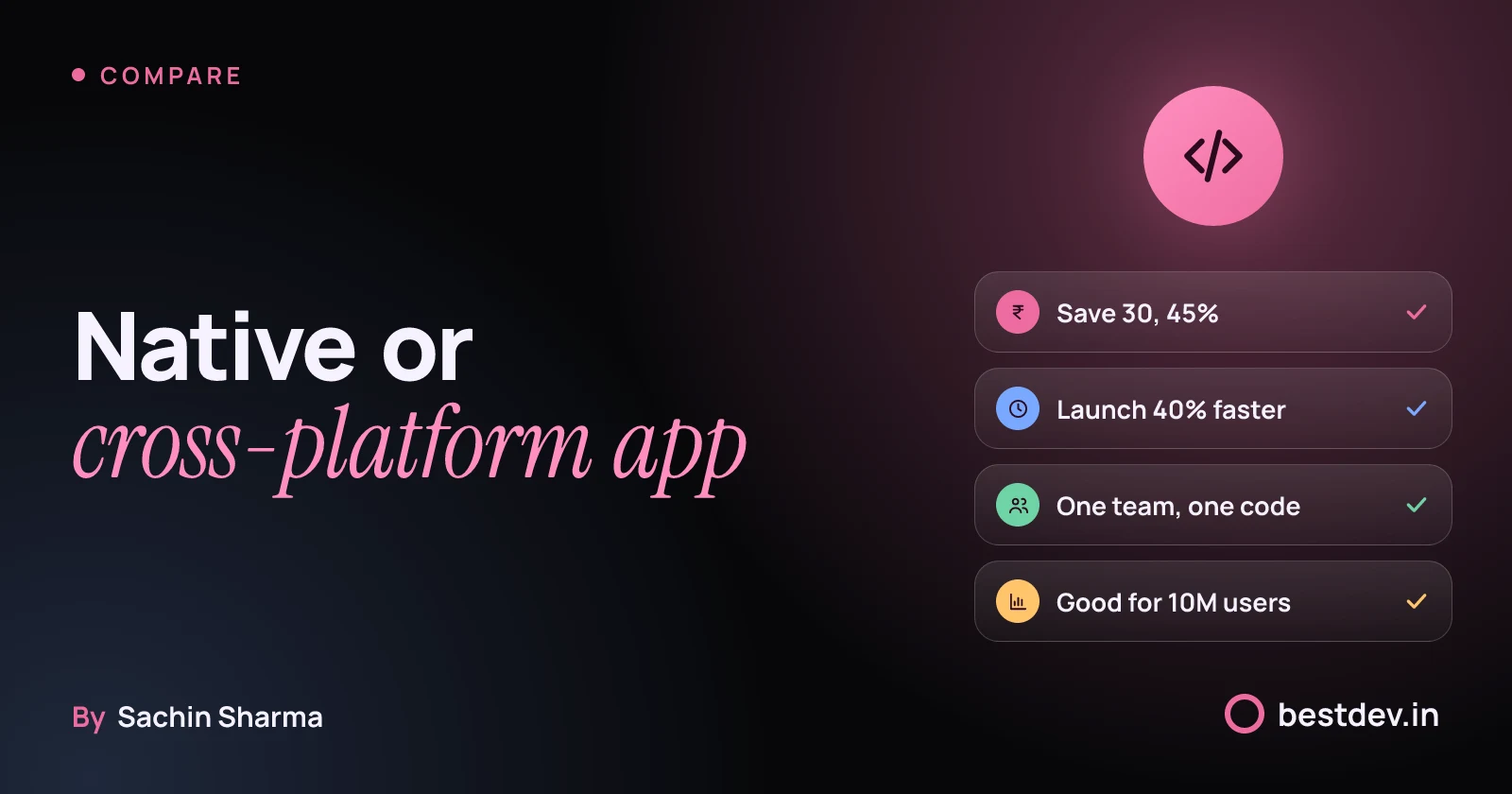
Choose cross-platform unless you need heavy device integration or expect over 10 million users. It cuts costs by 30 to 45% and speeds up delivery by 40%. Best for startups and small businesses with under $50,000 budget. Works well for content-based or simple-function apps. Native is better only for high-performance needs.
I build apps in Flutter, so I benefit from the cross-platform recommendation. That is why the table also shows when native is the better pick.
The full explanation
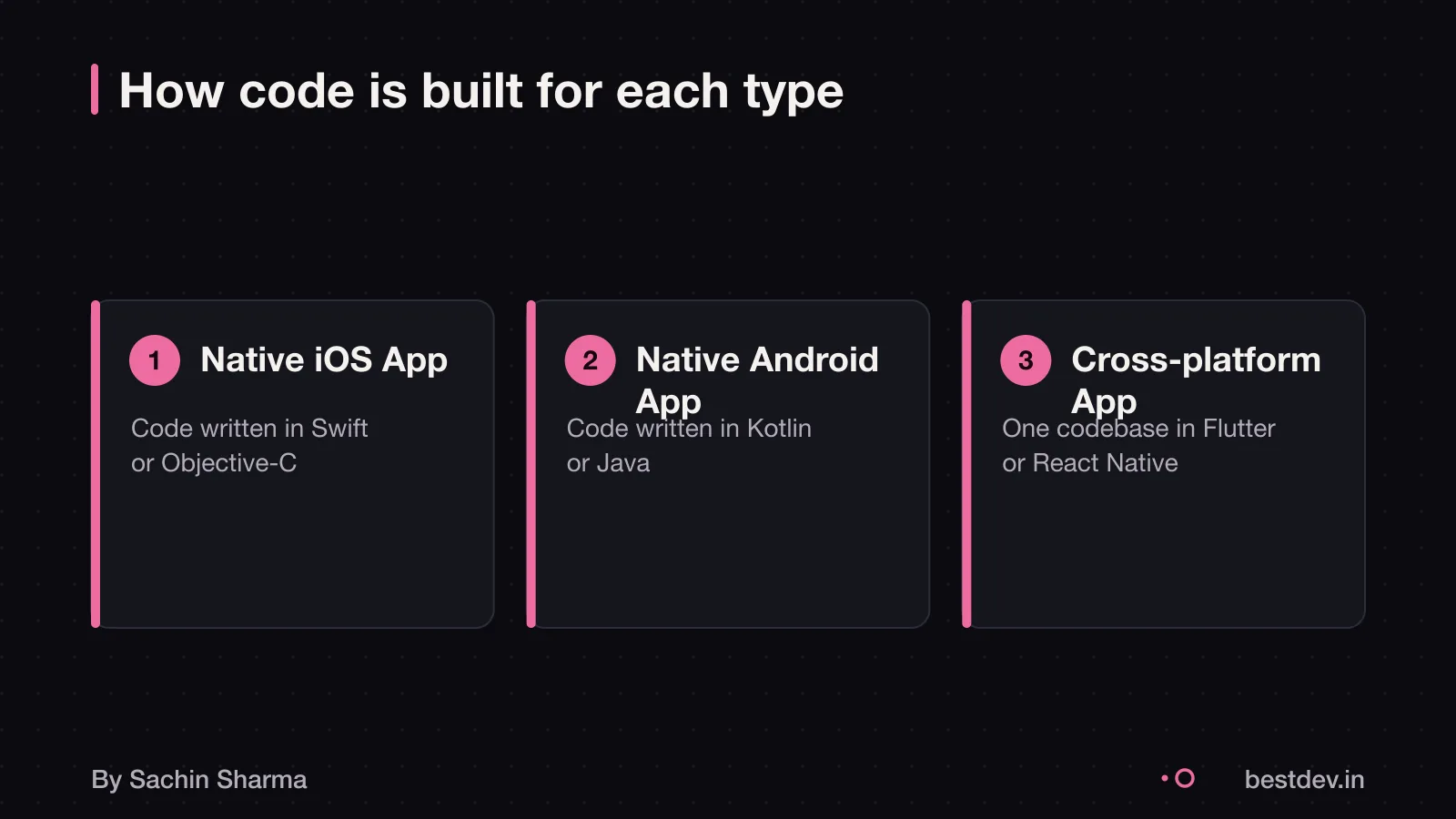
What is a native app vs a cross-platform app?
A native app is built for one platform using its official tools and language. For example, Swift is used for Apple platforms. For example, iOS apps can use Swift and
A cross-platform app runs on multiple platforms from one codebase. Tools like Flutter let you build for mobile, web, desktop and embedded devices from one codebase. You write the app once, and it works on different devices. This saves time and effort, especially for apps that do not need deep device features.
The key difference is in access. Native apps can use new platform features as soon as they are released, while cross-platform frameworks may take months to catch up. But if you need the latest device tools right away, native is better.
Is cross-platform the same as hybrid?
No, cross-platform is not the same as hybrid. Hybrid apps use web technologies such as HTML, CSS and JavaScript. Cross-platform apps, like those built with Flutter, use a single codebase for multiple platforms. Flutter compiles all the way to native code. This means Flutter does not rely on a JavaScript bridge. Because Flutter compiles to native code, it can run efficiently on devices. Flutter compiles to native code, which avoids performance problems caused by a JavaScript bridge. So while both aim to build for multiple platforms, their performance and user experience are not the same.
When does native performance matter?
Apps that need native-level performance include those with heavy computing tasks like 3D gaming, real-time video editing, or augmented reality. These apps use the full power of the device’s hardware. Native code can access this directly. Cross-platform apps run slightly slower. They use an extra software layer to work on both Android and iOS. As a result, one developer has seen apps drain 15 to 20% more battery than native apps. This extra drain happens because the app has to translate actions through a bridge. Only then can the device run them.
Poor performance has a direct impact on users. If an app feels slow or uses too much battery, 60% of users may stop using it. This is especially true in India. Many users are on mid-range phones with limited battery and memory. For example, a fitness tracker that lags during a workout can lose users quickly. A shopping app that freezes when loading images can also lose users. However, most business apps, like booking, forms, or chat, do not need this level of speed. For them, cross-platform performance is good enough. You only need native if your app must run complex tasks in real time.

When is cross-platform good enough?
Cross-platform apps work well for content-based apps or those with straightforward functionality. This approach suits startups and small businesses with budget limits or tight launch timelines.
They also help when you need faster time-to-market and do not rely on intensive graphics or deep device features. For example, a news reader, service booking app or internal business tool runs smoothly on cross-platform frameworks like Flutter or React Native.
Small teams may benefit because one developer can handle both platforms, depending on app complexity. If your app does not need advanced camera use, AR, or heavy gaming performance, cross-platform is likely good enough. For a quick commerce app, check the best tech stack for a quick commerce app[/compare/best-tech-stack-for-a-quick-commerce-app/].
How much does each option cost?
As an estimate, assuming a simple app with login, profile, and navigation. A cross-platform app costs ₹8.3 lakh to ₹37.35 lakh, while a native app costs ₹41.5 lakh to ₹83 lakh. The cost difference comes from writing one codebase instead of two. With native apps, you pay for separate iOS and Android teams to build and test the same features twice. Cross-platform tools like Flutter or React Native let one team build for both platforms at once.
A simple cross-platform app costs $10,000 to $45,000 for basic business apps or MVP versions. As an estimate, a simple native app costs $50,000 to $100,000. The 30 to 45% saving comes from using a single codebase for both iOS and Android, instead of building them natively separate. You also save on project management and faster bug fixes across platforms.
For example, a business app with forms, data display, and offline support would cost less with Flutter. You use one team, one codebase, and one testing cycle. With native, the same app needs two teams, two codebases, and double the testing time.
The current fee for app store accounts is not published. App maintenance cost for Indian devices is not known. Regional differences in developer rates are not known. These can affect total cost.
To understand how app development cost in India is built, see how app development cost in India is built.
How long does each take to build?
An MVP built with cross-platform tools like Flutter takes 8 to 12 weeks. The speed comes from writing one codebase that works on both iOS and Android. You save time during development, testing, and updates.
Cross-platform is faster because you avoid duplicating work. Instead of two teams coding the same feature twice, one team builds it once. This cuts down coordination delays and bugs from mismatched features.
Common delays come from third-party integrations, compliance reviews, and app store approvals. Not the number of screens. For example, linking to a payment gateway or getting health data permissions can stretch timelines. These delays affect both native and cross-platform apps.
If your app needs no complex integrations, you could launch a basic MVP in 8 weeks. If you face long approval cycles or need to connect with government systems, it may take longer, even up to 6 months. The development method matters less once external checks begin.
Do I need separate teams for native apps?
Native app development may require two separate teams for Android and iOS, based on some project needs. This can increase hiring needs and management effort.
Cross-platform apps use one codebase for both platforms, so just one team can build and update both versions at once. This cuts coordination time and keeps features in sync.
Without shared code, native teams must align on every update, which slows releases. For example, adding a new screen means writing, testing, and launching it twice. Cross-platform avoids this by design.
What are the risks of each option?
Cross-platform apps may not support all native features. This can block key functions like Bluetooth, camera effects or background tasks. If your app needs deep device access, you might have to build custom plugins or switch to native later. For example, a fitness app using real-time heart rate sensors may fail on one platform if the framework lacks a native driver.
Debugging is harder with cross-platform apps. A bug could come from your code, the framework itself, or platform-specific behaviour. You must test on both iOS and Android to rule out quirks. This slows fixes. In contrast, native apps have clearer error sources. But you still need to align two codebases.
Cross-platform frameworks have technical challenges that can affect performance and user experience, so teams must address them early. Also, every fix or update in native apps must be applied twice. This is once per platform, which raises long-term effort.
Which is cheaper to maintain over three years?
Maintaining a cross-platform app may reduce costs because you update and test only one codebase. For example when a new OS version is released or a security issue is found. You should plan to spend 15 to 20% of the build cost each year on maintenance. Covering OS updates, dependency upgrades, bug fixes, and store compliance. This range applies to both native and cross-platform apps, but cross-platform reduces hidden effort. With one codebase, you update and test features just once, not twice. For native apps, each platform needs separate fixes, doubling the work.
Hidden costs include hosting, maintenance, and third-party services. Hosting alone can add $100 to $1,000 per month at startup scale. You may also face surprise costs if a new OS update breaks your app. These risks are higher for cross-platform if the framework lags behind OS changes, but no data says how often this happens in India.
As an estimate, assume a cross-platform app built for ₹25 lakh. Yearly maintenance at 15 to 20% adds ₹3.75 to ₹5 lakh per year. Over three years, that totals ₹11.25 to ₹15 lakh. A native app with the same features might cost ₹50 lakh to build. Its three-year maintenance would be ₹22.5 to ₹30 lakh. This assumes no major rewrites.
Code reuse cuts long-term costs. When you fix a bug or add a feature in a cross-platform app, it works on both platforms at once. For example, if you update a payment screen, you test it once and deploy it to iOS and Android. With native apps, you write and test the same logic twice. This doubles the time and raises the chance of errors.
Can you switch from cross-platform to native later?
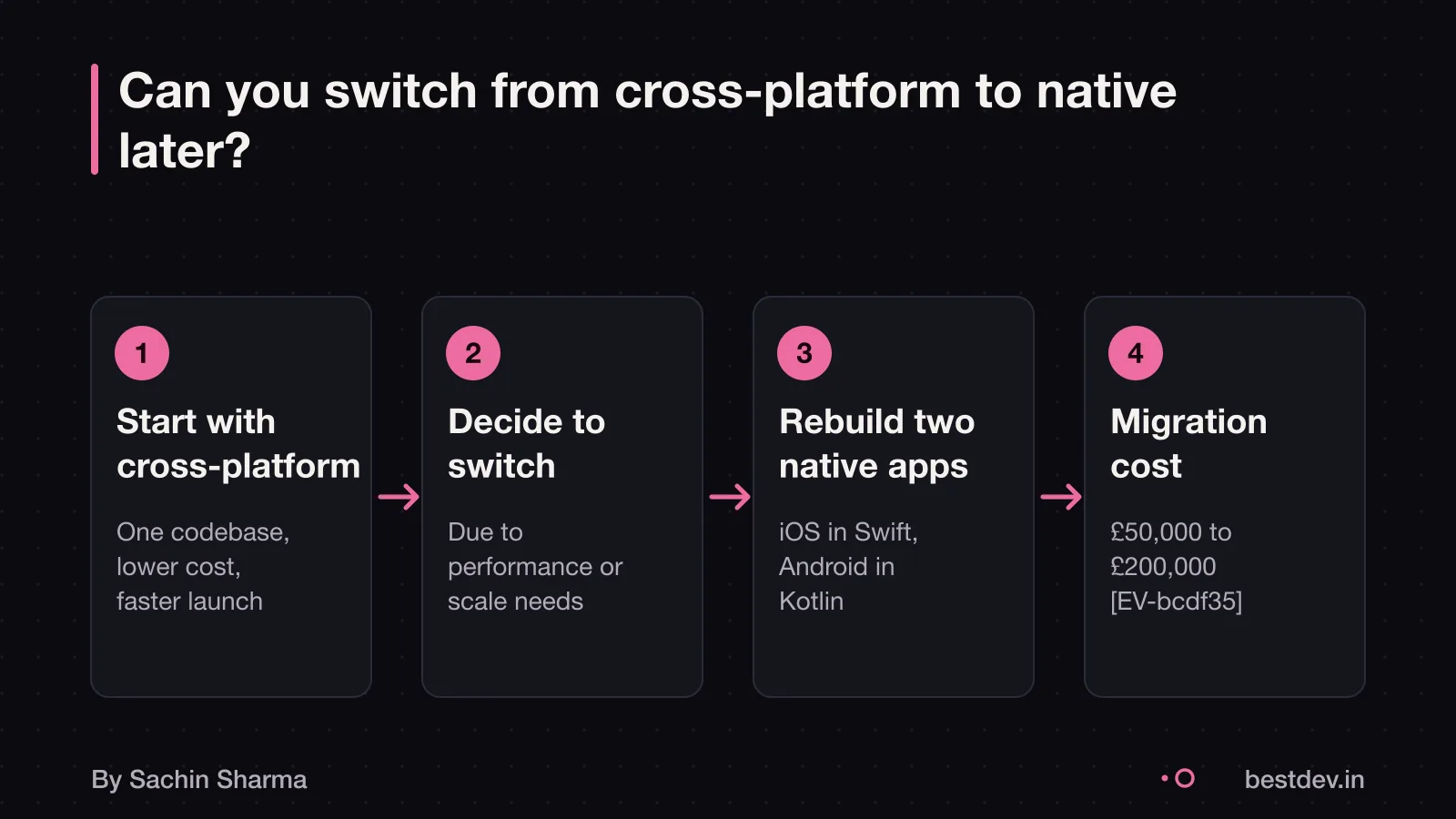
Yes, you can switch from cross-platform to native later, but it is not a simple upgrade. Migration is possible, but you must rebuild the app twice, once for iOS and once for Android, using platform-specific tools and design rules. This means writing two new codebases from scratch, even if your current app works well.
The cost of switching is high. You pay for two full native builds, including design, development and testing for each platform. There is no way to reuse most of the cross-platform code directly. As a result, the switch often costs 70 to 90% of building a native app from the start. This can add ₹30 lakh to ₹70 lakh or more, depending on app complexity.
Risks include delays, budget overruns and user disruption. If your current app has performance issues on one platform, such as slow loading or crashes on Android. It may signal that cross-platform is already limiting you. Also, if your app starts earning serious income, native performance can improve conversion and retention, making the switch more urgent.
However, the decision depends on your growth. If users are happy and revenue is growing steadily, the switch may not be worth the cost. But if scaling to millions of users reveals platform-specific flaws, native may become necessary.
Who owns the code and app accounts?
You legally own the app only after the developer signs over the rights in writing. If they were hired as an outside contractor and not as an employee. A handshake, invoice or long-term trust does not transfer ownership by itself. This is the default under Indian law when hiring an outside developer or agency.
To fully own your app, you need control over these things: the source code, the Google Play developer account, the Apple developer account. The domain name, the backend server and database, third-party accounts and API keys, and the copyright or intellectual property rights.
For example, if you use a developer to build a Flutter app. They may host the code on their GitHub and publish the app under their Play Console account. Until you sign a handover agreement and move these accounts, you do not fully own the app.
Even if the app is paid for, ownership may still stay with the developer because a handshake. An invoice marked 'paid in full', or a friendly relationship do not, on their own, transfer ownership. To prove ownership, always ask for a signed IP assignment clause in the contract.
You can check if you truly own your app by asking: Can I move the app to another developer? Can I publish updates without the original team? If not, you may not yet hold full control.
What support do you need after launch?
Post-launch support includes fixing bugs, updating for new OS versions, monitoring performance, and planning feature updates. Most top development firms offer 30 to 90 days of free support after launch. This period covers critical fixes and early user feedback issues.
After free support ends, you must pay for further fixes or updates. Some firms offer yearly maintenance contracts, while others charge per hour. These contracts may include performance checks, security updates, or help with app store rejections. However, the cost and scope of post-launch maintenance for Indian apps are not published [unknown]. You should ask your developer what happens after the free period ends and whether they offer ongoing plans.
You also need to renew your app store accounts each year. Apple charges $99 per year for its Developer Program, which may include GST for Indian businesses. You should confirm the current rate with your developer or accountant.
Who builds these apps in India?
Indian firms like PixelCrayons and ValueCoders offer cross-platform app development services. PixelCrayons has delivered 13,800 or more projects, as stated on the ValueCoders blog. ValueCoders has delivered 4,500+ projects as of 2020, according to a blog post. These firms use tools like Flutter and React Native to build apps for both Android and iOS from a single codebase.
Unico Connect's team in India has a blended hourly rate of $25 to $50 as of June 2026. This is lower than US rates, which range from $100 to $250 per hour. The rate is a blended average across junior and senior developers. Your actual cost will depend on team size, app complexity and project length.
Most Indian developers work remotely for global clients. Talent is available in cities like Bangalore, Hyderabad and Pune, but you can hire teams from anywhere in India. Remote work is standard, so location does not limit your choice. You manage progress through regular updates, not office visits.
The current fee for app store accounts is not published, so check directly with Apple and Google. Regional differences in developer rates within India are not known. When hiring, focus on clear contracts, code ownership and post-launch support.
Are there GST implications?
Yes, GST applies to software supplies in India, but the rate depends on how the software is delivered and whether it is exported. If you sell software offline, such as on physical media or through a license key. It may be treated as a supply of goods and attract GST. Software recorded on sound media, such as CDs or DVDs, carries an 18% GST rate. It is not clear from the evidence whether the 18% GST rate applies to digital delivery of software.
However, exports of software services to countries outside India or to Special Economic Zone (SEZ) units are zero-rated. This means no GST is charged on such supplies. You may be able to claim input tax credit (ITC) on expenses used to produce exported software, subject to GST rules. Cloud services used in building the exported app may qualify for input tax credit. If the export is zero-rated under GST rules and proper records are kept. To claim ITC, you must meet GST requirements, including maintaining proper records and confirming the export status of the supply.
Digital downloads without physical media may fall under different interpretations. The tax treatment can vary based on delivery method and contract terms. When in doubt, consult a GST practitioner to classify your software supply correctly.
How do you start the project?
To get a more precise estimate, a detailed discovery session may help. Avoid vague terms like “user-friendly” or “modern design.” Instead, say “a screen to log daily water intake with reminders.”
It costs $2,000 to $6,000. As an estimate, this is ₹1.7 lakh to ₹5.1 lakh at current rates. This step may help for apps with custom logic or third-party integrations.
To brief a developer well, list each screen, what it does, and how users move between them. Include edge cases, like what happens if the internet drops. Use our app brief template developers can price to cover all points.
When this advice is wrong
Build a native app if your app needs advanced AR, specialised hardware integration or extremely intensive graphics such as high-end 3D games. As native development supports deep platform capabilities and immediate access to niche hardware features, according to some sources. Some features may rely on deep platform capabilities that cross-platform tools cannot access fully.
Choose native if you expect very high user loads. The exact scale at which cross-platform fails is not known. This depends on architecture and optimisation. Without public data, treat this as a case-by-case decision.
Avoid native apps if you have budget limits. Avoid them if you need fast delivery. Avoid them if you lack access to two skilled teams, one for iOS and one for Android. However, when to avoid native apps is not clearly documented. Cross-platform is a good fit when you need faster time-to-market, have budget constraints, or your app does not require intensive graphics or platform-specific features.
Related reading: tech stack for a quick commerce app.
Questions people ask
Which one is cheaper to run over three years?
Cross-platform apps can save 30 to 45% on build cost compared to building for iOS and Android natively. You should plan to spend 15 to 20% of that cost annually on upkeep.
When does the other option win?
Native apps are better for advanced AR, specialised hardware integration, or high computing performance.
Can I switch from cross-platform to native later?
Yes, you can switch from cross-platform to native later, but it is costly and complex. You must rebuild two separate apps from scratch, one for each platform.
Is Flutter better than React Native?
Flutter and React Native each have trade-offs in performance, design and team skill. For a detailed comparison of Flutter vs React Native, see the guide on tech stack for a quick commerce app.
Do I need two developers for native apps?
Native apps often require separate developers for iOS and Android because each platform uses different languages and tools. Cross-platform can reduce this need.
What if my app needs a feature not in the framework?
If a feature is missing in the cross-platform framework, you may need to build a custom plugin, which requires native coding skills. Test key features early.
How do I own the app after it is built?
You own the app only after the developer signs over copyright in writing. A paid invoice or handshake does not transfer ownership under Indian law. Get a written assignment.
Are there compliance risks with cross-platform?
You must ensure user data is handled lawfully under India’s DPDP Act, regardless of the tech stack. Check this for your case with a data protection lawyer. Check this for your case with a data protection lawyer.
Can I build for both platforms with one team?
Yes, a single team can build for both platforms using cross-platform tools like Flutter or React Native. This may reduce cost and help keep design consistent. Native development often requires separate teams for iOS and Android because each platform uses different languages and tools.
Assumptions behind the numbers
- ₹50 lakh is the upper budget for cross-platform viability
- Most apps do not require advanced AR or hardware integration
- User base above 10 million justifies native investment
Pick your situation
Which one is yours?
Cross-Platform wins. Cross-platform cuts costs by 30 to 45%. A single team handles both iOS and Android, reducing overhead.
Side by side
The whole comparison
| Cross-Platform | Native | |
|---|---|---|
| Codebase | Single codebase for all platforms | Separate code for iOS and Android |
| Cost saving | 30 to 45% less | No overlap between teams |
| Time to market | 40% faster | Slower due to dual builds |
| Device access | Plugins cover most needs | Full access to APIs |
| Performance | Good for most apps | Best for high-load apps |
| Risk | Framework bugs, plugin gaps | Two teams, two codebases |
Whichever you choose
Ask these four questions
- Which features will I lose with cross-platform?
- How do I own the code and app stores?
- Can I switch to native later if needed?
- What does support cost after launch?
Keep going