Case study · Chhattisgarh
One platform for five brands and eight outlets
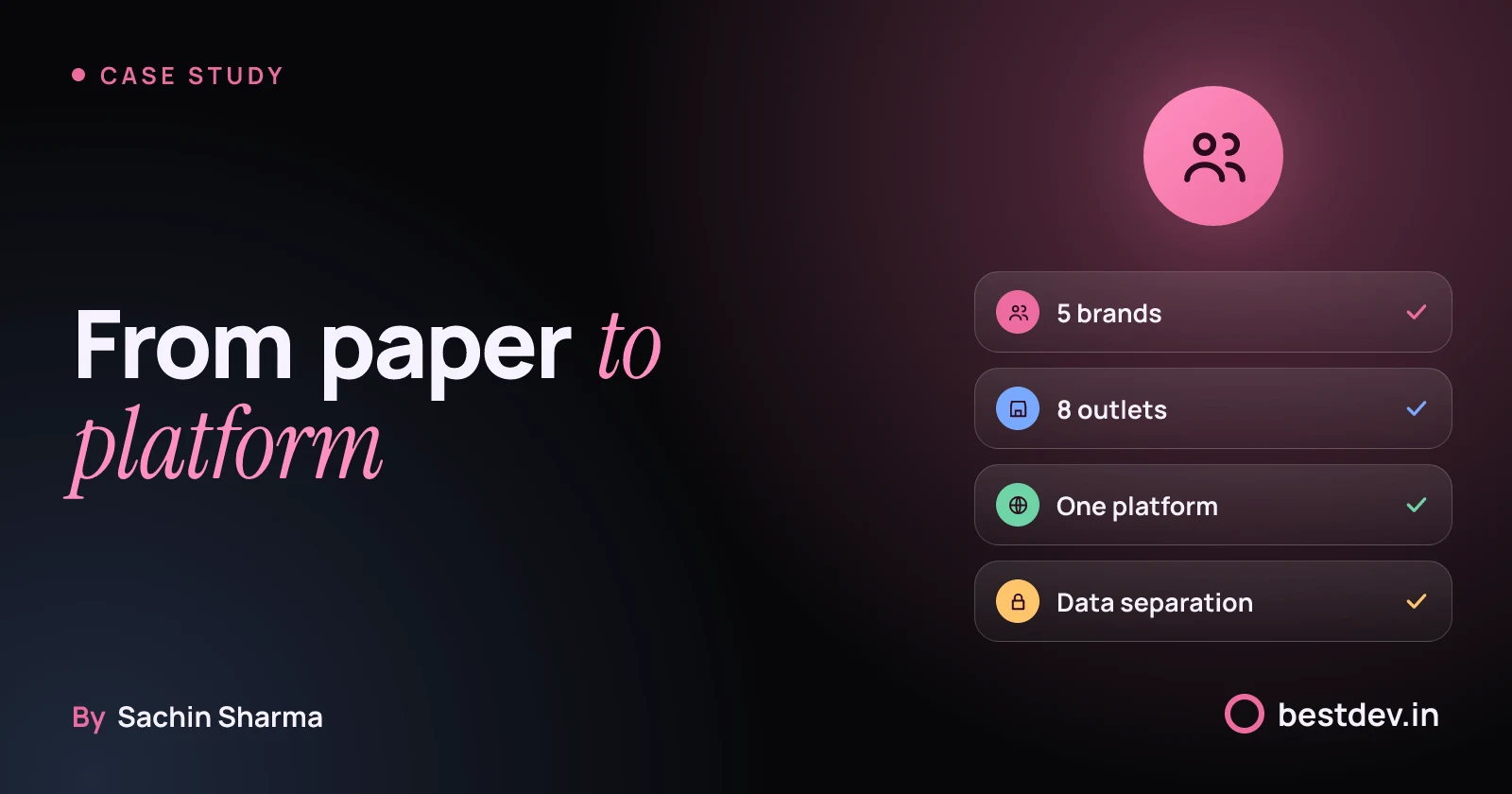
Five brands across automobile, retail and real estate, eight outlets, one real-time platform.
The full explanation
What 'paper to platform' means for a business
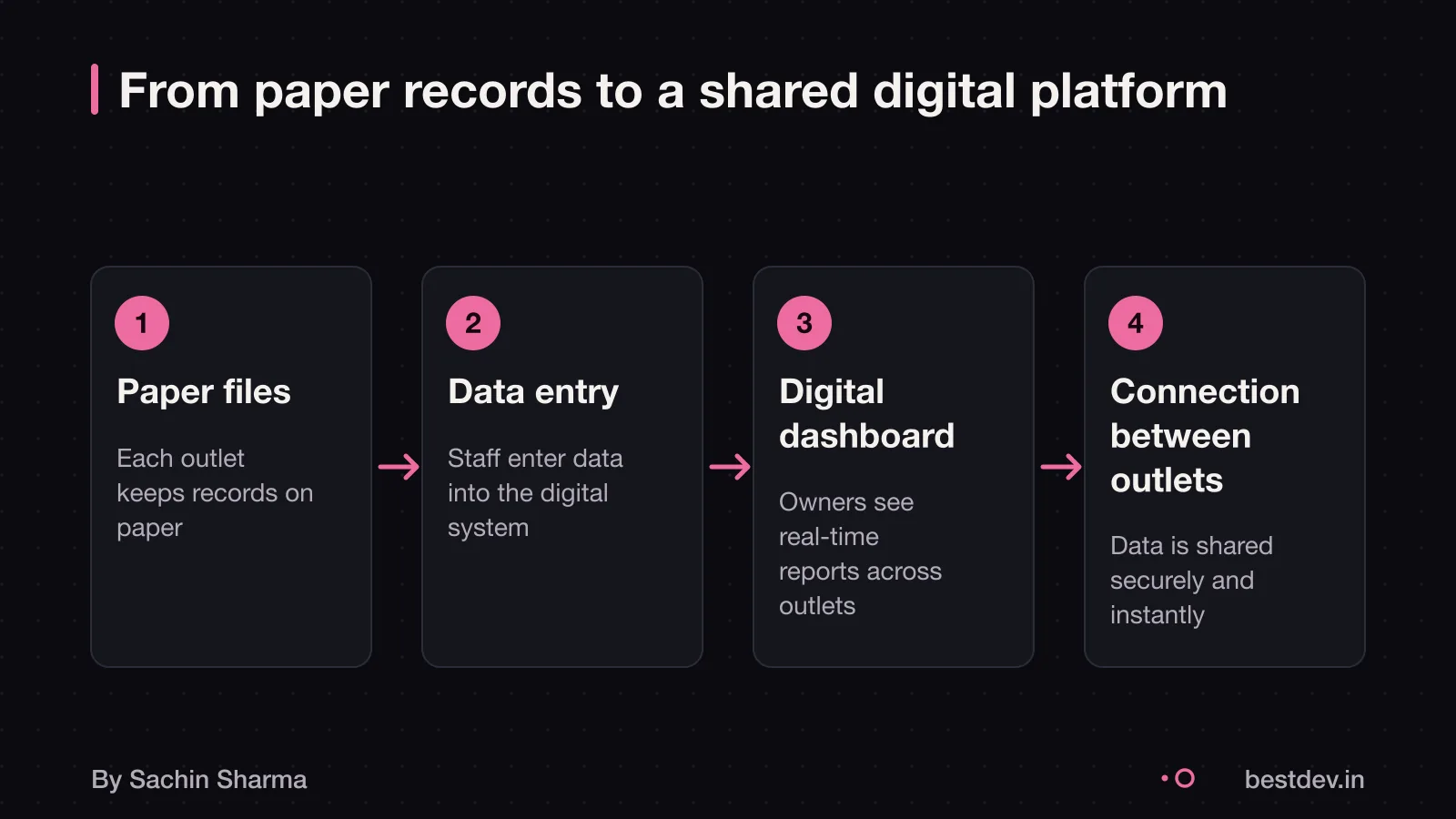
Moving from paper to platform means replacing handwritten ledgers, sticky notes, and scattered files with one shared digital system. All your outlets and brands can use this system. The digital platform holds your data in one place. Everyone works from the same information. Unlike paper, which can be lost or misread, a platform keeps records safe, searchable, and up to date in real time.
A multi-tenant platform keeps each brand’s data and settings separate, as in a project for a family-run conglomerate with five brands. This is different from paper, where each outlet keeps its own version of the truth.
Is moving from paper to platform worth it?
For organisations, a multi-tenant platform can lower the total cost of ownership. Savings often range from 30% to 60% compared to single-tenant alternatives.
These savings come from shared development, maintenance, and hosting costs across all brands. As an estimate, if building one standalone system costs ₹15 lakh, doing it five times would cost ₹75 lakh. A multi-tenant system for five brands may cost ₹30 to ₹50 lakh, depending on features. But the current cost to build such a platform in India is not published, so treat global figures with caution.
Small groups can benefit if they plan to scale. You gain faster reporting, real-time stock and sales tracking, and better compliance. For example, one family-run group with 5 brands and 8 outlets saw lead-to-delivery time fall from 2 weeks to 4 days after switching. However, savings depend on how well the system is designed and used.
Signs your business is ready for one platform
You should consider unifying your systems when manual processes cause delays in service or reporting across outlets. For example, if each brand uses paper or separate tools, and leadership lacks real-time sales or inventory views, a single platform may help.
A shared platform becomes useful when your business grows beyond one brand or outlet and you want consistent customer or staff data. If you are planning new outlets or brands, now is the time to assess a unified system.
Look at how long it takes to generate reports or respond to customer requests today. If answers take days instead of hours, this is a sign that data silos are slowing you down. Consider whether your team can describe the full customer journey across brands, if not, a shared platform could clarify it.
Cost of a multi-tenant platform
As an estimate, you may save 30 to 60 per cent in total cost compared to single-tenant setups. Based on typical results from multi-tenant solutions. This saving may come from shared infrastructure expenses, as multi-tenant solutions often have lower upfront costs. The exact build cost is not published, so there are no public price ranges. Your actual cost depends on how many outlets, brands, features and integrations you need. For example, adding real-time inventory across 8 outlets raises cost more than basic order tracking. Since public cost ranges are not available, you should ask developers for a custom quote.
How long does it take to build and roll out?
A multi-tenant platform takes 3 to 4 months for a basic version. It takes 6 months or more for a full system with compliance and custom workflows. This timeline applies if your team is ready with clear rules for data, access, and brand-level custom needs. A faster build is possible only if you skip advanced features like real-time sync across outlets or audit-ready logs.
Then comes architecture design, data separation rules, security setup, and integration with tools like billing or inventory. Testing must include real-world use across outlets to catch delays or data leaks.
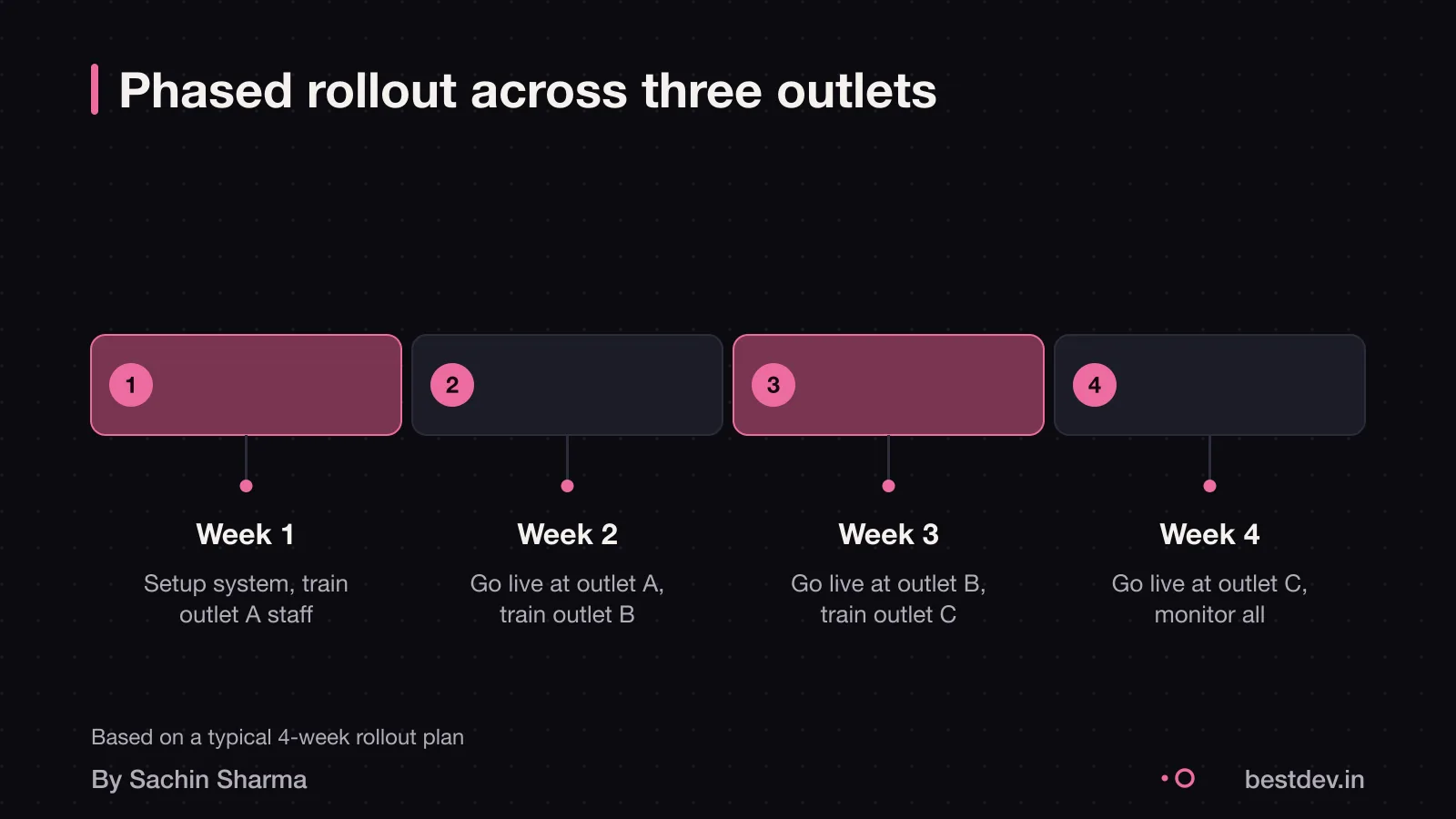
As an estimate, a full build and rollout takes 6 to 9 months when including training, data migration, and feedback cycles. This assumes one decision-maker per brand who can approve changes fast. If approvals are slow or staff resist new ways, add 2 to 3 months.
One system or separate systems for each brand?
Use one shared platform if you run multiple brands or outlets and want to cut costs, sync data fast, and manage updates in one go. A multi-tenant architecture means one software system serves all your brands, with each brand’s data, settings, and users kept separate by design. This is cheaper and faster to maintain than running separate systems.
In contrast, single-tenant architecture gives each brand its own software copy and database. You pay more to build and run each one. Syncing data across brands becomes slow and error-prone. Updates must be rolled out one by one. This increases effort and downtime.
As an estimate, assuming reuse of core features like billing, inventory, and user roles, a shared platform may reduce software costs. The exact saving depends on your setup. It also shortens lead-to-delivery time. A real case saw this fall from 2 weeks to 4 days.
But a shared system needs strong data separation rules from day one. If brands serve very different customer types or need deeply custom workflows, separate systems may fit better. This is though at higher cost and slower coordination.
How data stays separate between brands
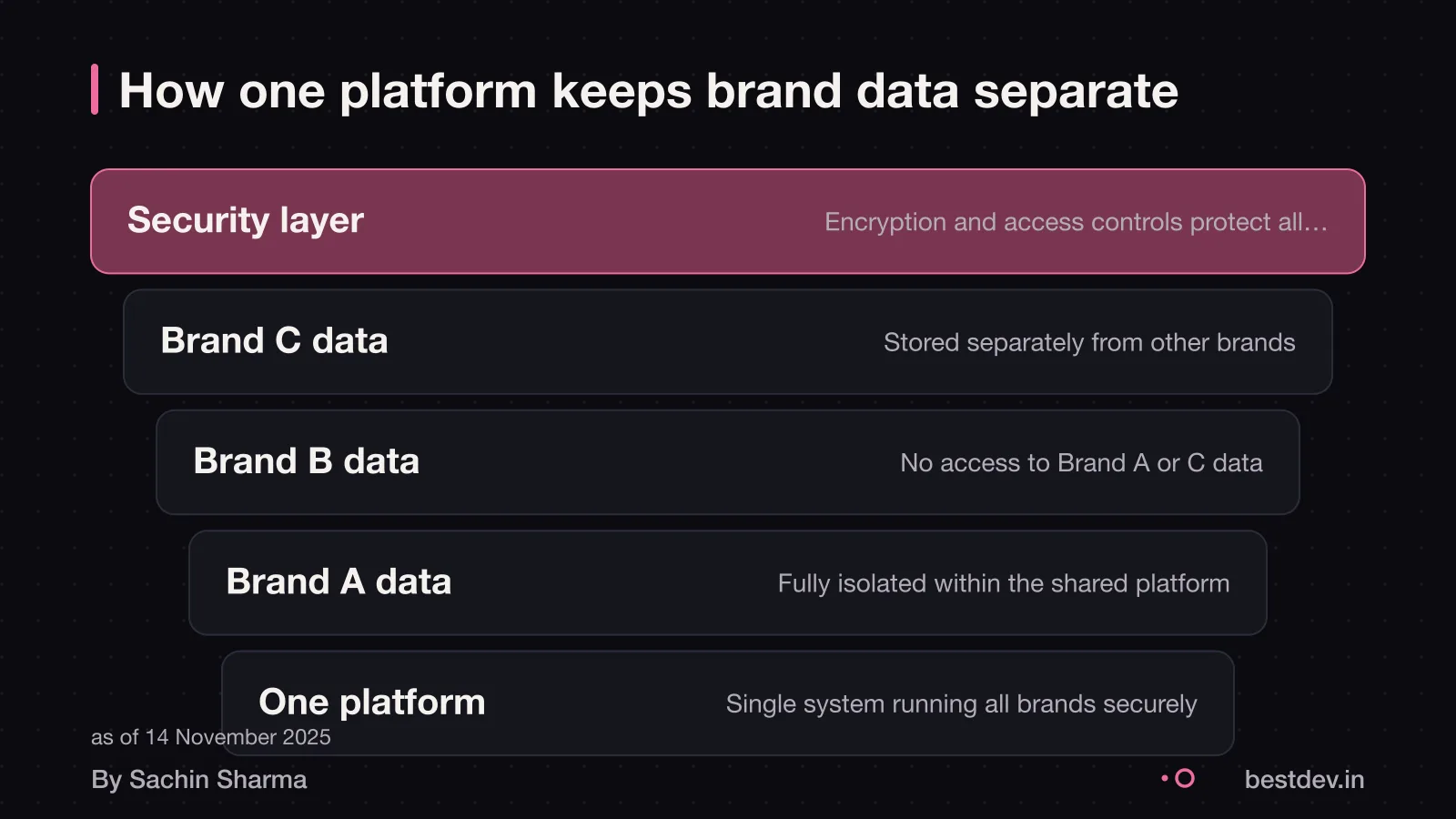
Data can stay private for each brand if the platform uses strong technical isolation methods. Banking and healthcare platforms may use row-level security, encrypted tenant-specific keys, or separate databases, with role-based access control. In some cases, systems use a separate database per tenant, which offers a high level of data separation.
For example, Red Hat OpenShift architecture distributes cluster workloads across four discrete, functional namespaces. Access is also controlled by roles. A store manager for Brand A can only see data for Brand A. This is true even if they log into the same app used by Brand B.
These methods can help meet legal rules like the Digital Personal Data Protection Act. When designed correctly, as some platforms do to meet such requirements.
Legal rules: DPDP Act and data separation
For failure to maintain reasonable security safeguards, the DPDP Act sets a penalty of up to ₹250 crore. For other violations of the Act or Rules, the penalty can be up to ₹50 crore.
When in doubt, consult a legal expert who understands both the DPDP Act and multi-business operations.
What to do first
As an estimate, the planning phase takes 6 to 8 weeks. This includes architecture and a bill of materials, based on a platform team's process.
App brief template developers can price helps you capture what matters. It covers user roles, data flows, and edge cases vendors often miss.
When this advice is wrong
Do not build a multi-tenant platform if your business lacks standard processes. As implementing a standardized ERP system can lead to time delays and negative impacts on small enterprise processes. When a business adopts a standard ERP system, it can face time delays and negative impacts on its processes. An ERP system implementation is risky and complex, so good conditions for planning are important.
This advice is also wrong if you expect quick results.
It is not the right choice if your outlets operate in silos and resist sharing data. A unified platform only works when leadership commits to one source of truth. If you are still testing digital tools in one outlet, start small instead.
If your business is stable on paper and not losing money to delays or mistakes, stay where you are. Wait until growth or complexity forces the change.
Related reading: What an API is, in plain words, DPDP Act consent flows for Indian apps.
Questions people ask
What does 'paper to platform' mean for a business owner?
It means using a single application instance that serves multiple customers, called tenants, while keeping each tenant's data, configuration, and user experience separate. This setup allows everyone to use the same platform without mixing up individual brand needs.
What do I need to decide first?
You must choose whether to build a multi-tenant platform before finalising features. This decision affects cost, security, and how easily you can scale across brands or outlets.
What can go wrong?
Risks include data leaks under high-scale use, resistance from staff, poor planning, and lack of leadership support. As an estimate, retrofitting tenant isolation later can cost 30 to 60 per cent more. Plan for change management early.
Can I move the platform to another developer later?
Yes, but only if your contract allows data portability and clear ownership. A Data Fiduciary may engage a Data Processor only under a valid contract. Check this for your case with a chartered accountant or lawyer.
How often will the platform need updates?
Updates are ongoing, not a one-off task after launch. The system must evolve to meet new business needs and technology changes. Budget for 6 to 8 weeks of planning time before building.
What should I check in the contract?
Check for data ownership, accuracy of personal data, and terms for using a Data Processor. A Data Fiduciary must ensure completeness, accuracy, and consistency of personal data. If it is likely to be used to make a decision affecting the Data Principal or disclosed to another Data Fiduciary. Check this for your case with a lawyer.
Who should be involved from my team?
Involve leadership, operations heads, and IT staff early in the process. Their buy-in reduces resistance and improves planning.
₹150 Cr+ reported annual revenue across the group. Figures are as reported by the client; I have not audited them.
The ask
Run the whole group on one system
Five brands. Eight outlets. One platform.
Automobile, retail and real estate behave nothing alike, yet one family owned all five brands. The job was one platform that could serve all of them without forcing them into one shape.
The decision
Multi-tenant from the first day
One codebase to run, five businesses kept apart.
Multi-tenant means one system serving many separate businesses, each seeing only its own data. That was the right shape here: the group gets one thing to run and improve, while every brand keeps its own customers, stock and numbers apart.
What changed
Lead to delivery in four days
Two weeks became four days.
The measure the owners cared about was the time from an enquiry to a delivery. It fell from two weeks to four days, because the work stopped waiting on someone to pass it along.
Why real time
Eight outlets, one picture
Stop asking for reports. Look at the thing.
With outlets updating a shared system as things happen, the head office stops asking for reports and starts looking at the thing itself.
If you are about to do the same
Three things to take away
- 01Pick the shape (multi-tenant, single-tenant) before the features. It is the hardest decision to change later.
- 02Choose one measure the owners already care about, and design toward it.
- 03A platform for a group is an operations project first and a software project second.
Keep going