Cost · Generic
What does it cost to build an app in India?
I won't hand you a number that pretends to be the market. Instead, here is the working: set the weeks, the people and the rate, and see where the money goes.
The full explanation
What is Flutter?
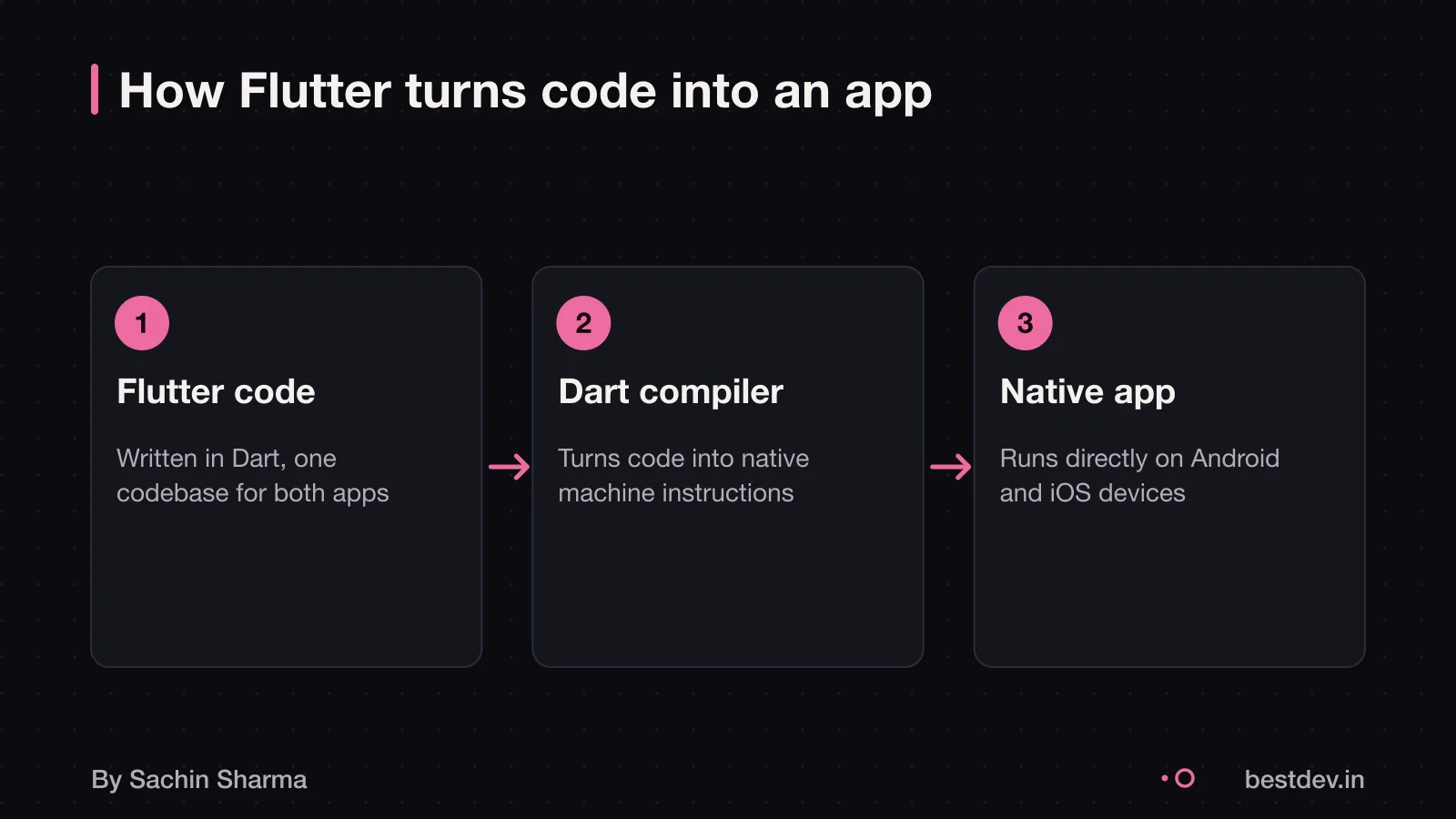
Flutter is a cross-platform tool that lets developers build apps for both iOS and Android using one codebase. It uses the Dart programming language, which is used in Flutter for modern, responsive apps. Flutter compiles to machine code for fast performance on devices.
One key feature is Hot Reload, which lets developers change code and see results almost instantly without restarting the app. This speeds up testing and fixes during building. Flutter aims to deliver native-level quality and performance across platforms.
For you, this means lower cost and faster delivery since you are not paying for two separate apps. But the real savings depend on your app’s features, not just the tech. Simple apps benefit most. Complex ones may need extra work to feel native.
Why Flutter can save money
Flutter can save you 30 to 45 percent compared to building separate native iOS and Android apps. This is because one codebase works on both platforms, so you pay for one team instead of two. For example, if a native app for each platform would cost ₹10 lakh total, a Flutter app might cost ₹5.5 to ₹7 lakh.
Long-term, Flutter also cuts maintenance costs by about 40 percent. When you fix a bug or add a feature, it updates on both platforms at once. You do not need two teams to make the same change twice. This saves time and money over the app’s life.
However, these savings assume your app does not need deep platform-specific features. If it does, some extra work may reduce the cost advantage. The exact saving depends on your app’s design and features, not just the tool.
What moves the price?
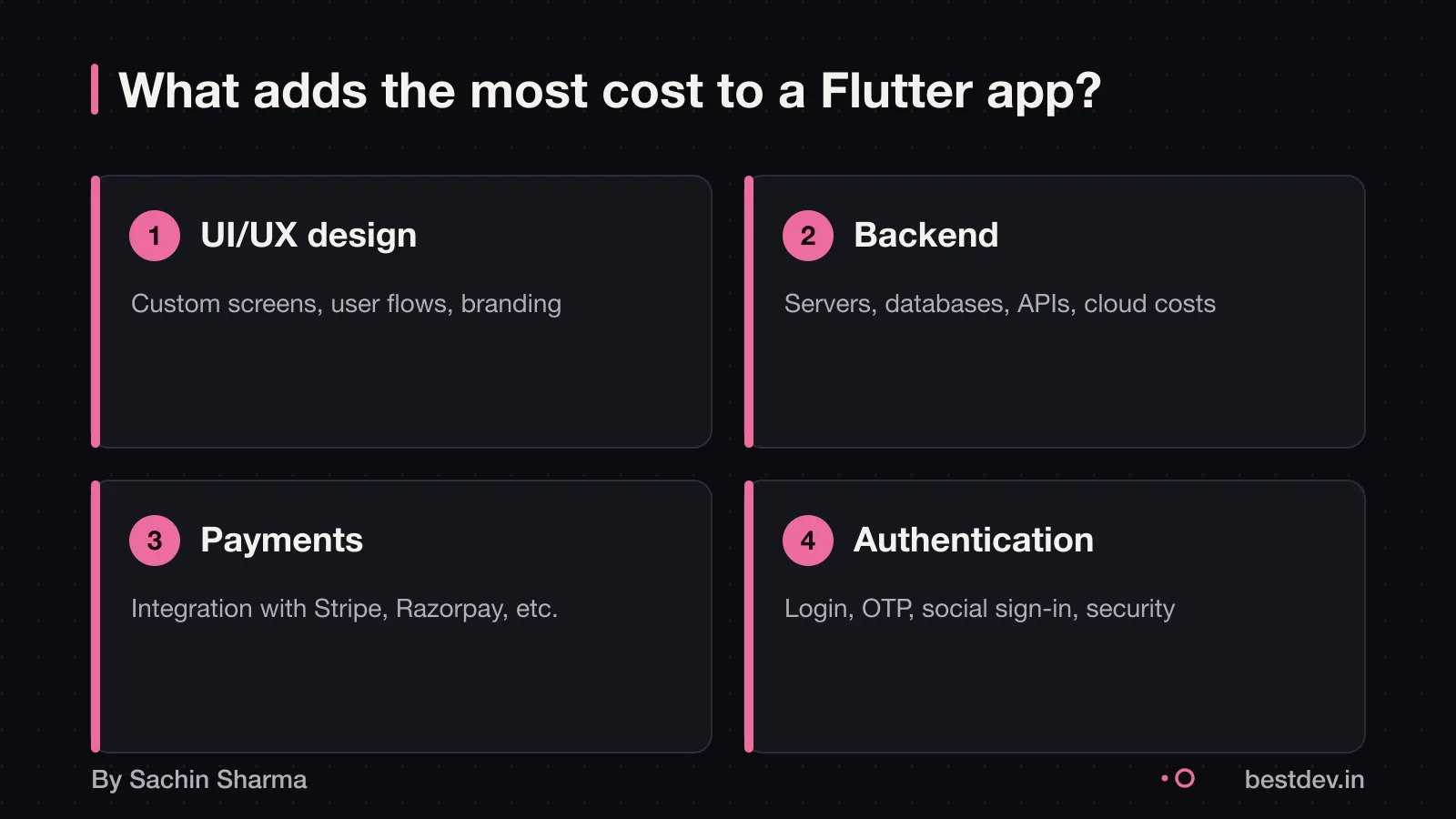
The cost of your Flutter app depends on what it does, not the framework. Complex features, custom design and backend systems add the most cost. A simple app with basic screens costs less. Custom workflows or compliance rules increase the price fast.
Features like payments and login raise costs the most. Adding payments costs $3,000 to $9,000. Login with email, social or OTP costs $2,000 to $5,000. Each extra platform, web or desktop, adds 15 to 25% to the base cost. Compliance needs, like data rules, can add 20 to 35% more.
Design affects price too. A custom design with motion graphics adds ₹4 to 16 lakh, depending on screen count. For most apps, design takes 10 to 20% of total cost. A mid-level app design costs $2,000 to $4,500.
Backend choice changes cost sharply. Using Firebase or Supabase costs $400 to $1,800 to set up. A custom backend with Node.js or Django costs $4,000 to $12,000, as of 4 June 2026. Backend changes account for 40 to 60% of maintenance effort in many production apps.
Third-party services add fees. A Google Play account costs $25 one time. Apple’s developer fee is $99 per year. Payment gateways like Razorpay need setup and transaction fees.
You can control cost by limiting features, using standard design and choosing managed backends. Compare freelancer or agency for a first app to match your budget. Learn how to integrate Razorpay to estimate gateway work. See the Flutter developer hourly rate in India to judge quotes.
How long does it take?
An MVP takes 4 to 8 weeks to build. This includes core features, basic design, and testing on one platform. For example, Loopin, a habit tracker with offline sync and user login, fits this range. A standard business app takes 8 to 16 weeks. It covers custom UI, backend integration, and multi-platform testing. A feature-rich app takes 16 to 28 weeks. The timeline depends on how many screens, third-party tools, and rounds of feedback you plan. Delays often come from late design approvals or unclear requirements. To stay on track, finalise your feature list before coding starts.
How it works
Some teams use Agile with short, iterative cycles to build and review work in small steps, as seen in the Scrum framework. Regular updates keep you informed of progress.
Some fixed-price projects are billed in stages: 50 percent upfront, 25 percent at a mid-project milestone, and 25 percent on delivery. This protects both you and the developer.
During coding, developers structure code for long-term maintainability. Testing includes performance validation and mobile device testing, with checks for system stability before release. When ready, the app is published to the App Store or Google Play, with help to meet policy rules.
Tax and legal rules
Yes, GST is charged on app development in India. Custom software development services fall under SAC code 998311 and attract 18% GST. This tax is added on top of the developer’s quoted price. Maintenance, updates, and upgrades also attract 18% GST under SAC code 998313.
The person who writes the code is the first owner of the copyright under Indian law, not the person who pays for it. If you hire an outside developer or agency, the code belongs to them by default. This is true even if you paid the full cost. The only way to get full ownership is through a written assignment of copyright. Without this document, you may not be able to update, sell, or reuse the app freely. For clarity, see our guide on can I get the source code of my app?.
You need two key legal documents. First, a service contract that clearly states the scope, timeline, and payment terms. Second, a copyright assignment clause or a separate deed that transfers all rights to you after payment. AppTeky includes code ownership from day one in their pricing, as their site states the client owns the code. Repositories and store accounts from day one., but this must still be confirmed in writing. Always ask for proof of assignment before launch. For your case, consult a tech-savvy lawyer to review these documents.
After launch: what it costs
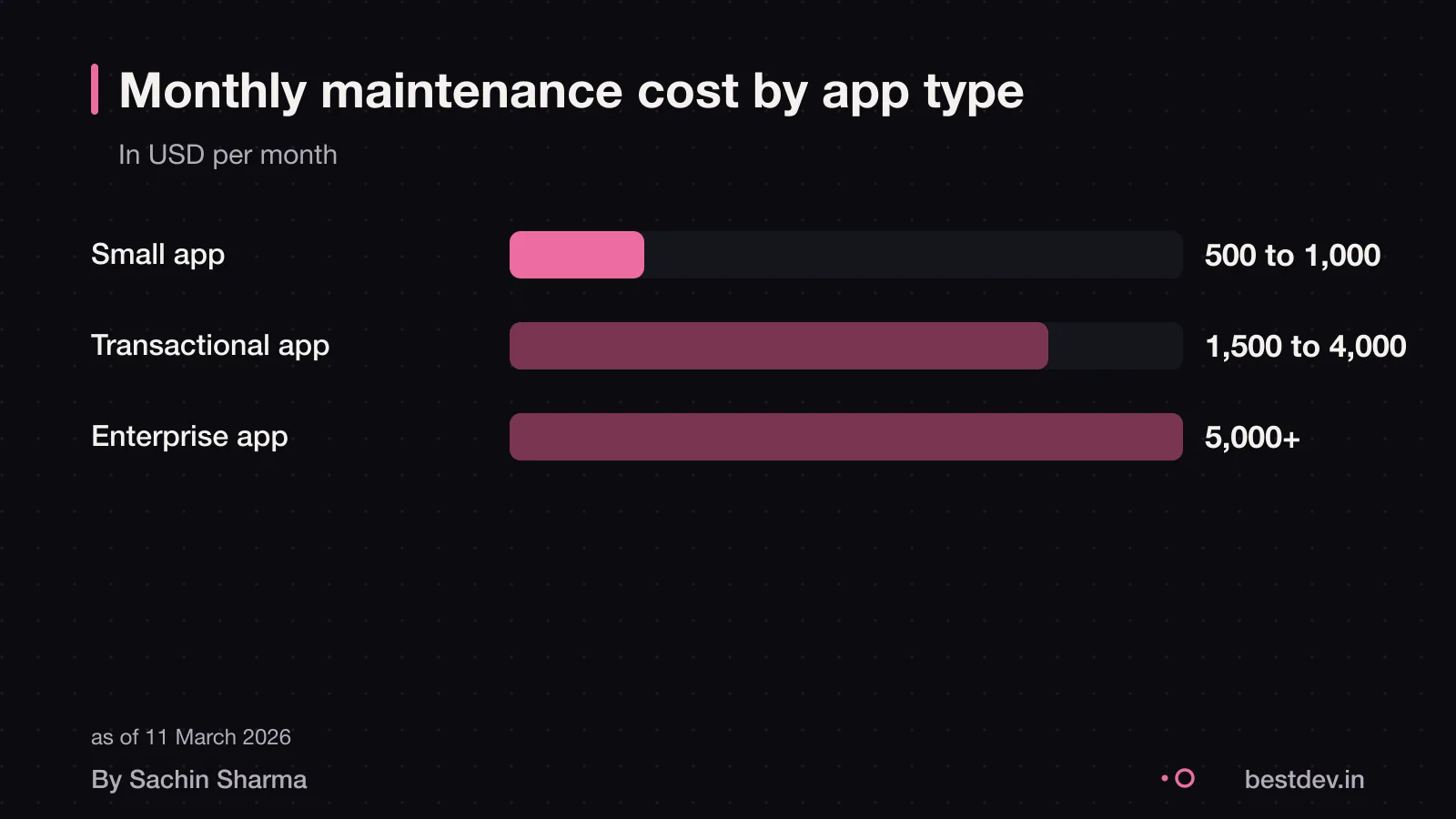
After launch, you will pay for maintenance to keep your app working well. For a small Flutter app, expect to pay between $500 and $1,000 each month for updates and support. This cost covers bug fixes, security patches, and minor improvements. For transactional apps like booking or e-commerce systems, the monthly cost rises to $1,500 to $4,000. Enterprise or compliance-heavy apps may cost $5,000 or more per month.
You need updates at least once or twice a year. Apple and Google release new OS versions every year. If you do not update, features may break, performance may drop, and security risks may grow. Regular updates help avoid costly emergency fixes later.
Support options include contacting your original developer or a third-party team. You can ask for annual update plans to add new features or improve based on user feedback. Some vendors also offer ongoing support to improve legacy apps over time. As an estimate, assuming a small app with no complex backend, monthly maintenance starts around ₹42,000 to ₹84,000. This is based on $500 to $1,000 at ₹84/USD. The exact cost depends on your app's features and how often you want to release changes.
When not to use Flutter
Choose native development over Flutter if your app needs advanced augmented reality (AR) or deep hardware integration. These features rely on platform-specific tools that Flutter does not fully support. For example, an AR app that maps indoor spaces using LiDAR sensors on iPhones works better with native iOS code.
Flutter works for basic projects like a to-do list, which can help you learn the basics. Such apps help you learn Flutter’s layout and state management without complexity. A beginner project with simple screens and local storage fits well within Flutter’s strengths.
However, Flutter’s cost advantage depends on clean architecture, stable dependencies and good code quality from the start. If the team rushes the launch, long-term maintenance may cost as much as native apps. Flutter also allows development on budget-friendly devices, which helps keep early costs low.
Worked example: a ₹5 lakh app
As an estimate, assuming 30 screens, login, payments, notifications and basic admin panel, a ₹5 lakh Flutter app includes core features for a small business. This cost fits in the "full-featured" range, which AppTeky lists as ₹3 lakh to ₹8 lakh. At this level, the app may include backend integration, user authentication, in-app payments and push notifications, as these are common in full-featured apps. A simple admin dashboard may be included, but this is not confirmed by evidence.
The cost breaks down across key parts. Design and planning take 15 to 20 percent, or ₹75,000 to ₹1,00,000. Development takes 60 percent, or ₹3 lakh, covering frontend, backend and API work. Testing and launch take 10 percent, or ₹50,000. Project management adds another 15 percent, or ₹75,000. For example, a gig work app like Aashwasan with Firebase backend and contract tracking would fit this budget.
This estimate does not include marketing, hosting or long-term maintenance. GST at 18% adds ₹90,000 to the base cost, making the total ₹5.9 lakh. You may also need to pay for third-party services like payment gateways or cloud storage. Always ask for a breakdown to see what each part covers.
When this advice is wrong
For a simple app with just one function, like a calculator or a basic form. The price may fall below ₹3 lakh as an estimate, assuming conversion from $5,000 at ₹75 per dollar. At the other end, complex apps with AI, real-time sync. Or custom backends can go beyond ₹15 lakh as an estimate, assuming high-end complexity and integration costs. The remedies you can claim depend on what you agreed in the contract. If the quote does not mention delivery dates or penalties for delay, that part of the deal is not set. Always check whether the timeline is a firm commitment or just an estimate.
Questions people ask
How much does a Flutter app cost in India?
A Flutter app in India costs ₹25,000 to ₹1.5 lakh for a focused MVP, ₹1.5 to 3 lakh for a production-ready product. ₹3 to 8 lakh for a full-featured app, and ₹8 lakh or more for a complex platform. Your actual cost depends on features, screens and complexity.
What makes Flutter app development more expensive?
Adding web and desktop support increases cost by 15 to 25 percent. Compliance scope can add 20 to 35 percent to the base build cost, depending on the regulatory environment. A custom backend may add $10,000 to $50,000 or more, depending on complexity.
How long does Flutter app development take and what do I pay at each stage?
An MVP takes 4 to 8 weeks, a business app 8 to 16 weeks. At AppTeky, payments are 50% upfront, 25% at mid-project, and 25% on delivery for fixed builds.
Is Flutter cheaper than native app development?
Yes, Flutter is typically 30 to 45 percent cheaper than building separate native iOS and Android apps. This is because one codebase serves both platforms, reducing development time and cost.
Do I need to pay GST on app development?
Yes, custom software development services are under SAC code 998311 and attract 18% GST. Software maintenance is under SAC code 998313 and also attracts 18% GST. Check this for your case with a chartered accountant.
Who owns the app after it is built?
By default, the developer owns the app's code unless a written assignment transfers ownership to you. Always get a written agreement that assigns full rights to you. See how to get the source code of your app.
How much does app maintenance cost per month?
For a small Flutter app, expect to pay $500 to $1,000 per month for maintenance. For transactional platforms like eCommerce or booking systems, it ranges from $1,500 to $4,000.
Can I build a Flutter app on a tight budget?
Yes, you can build a simple Flutter app on a tight budget. Examples include a to-do list or a basic information app. Flutter allows fast development even on budget-friendly devices.
How do I check if a Flutter developer is good?
Check their portfolio for apps like yours, ask for client references, and verify their experience with Flutter and backend systems. See the guide on how to hire a Flutter developer for your first app.
What should I ask before signing a contract?
Ask who owns the app, what the delivery timeline is, and how payments are structured. Also confirm workflows, performance expectations, and IP protection.
Assumptions behind the numbers
- Base weeks for a full-featured app: 15 weeks
- Team size: 2 people (developer and tester)
- Hourly rate: ₹800/hour (approx $10/hour)
- GST applied at 18%
- Adding web/desktop increases cost by 20%
- Compliance adds 25% to base cost
I won't hand you a number that pretends to be the market. Instead, here is the working: set the weeks, the people and the rate, and see where the money goes.
- Scope and design13%
- Build67%
- Testing and fixes13%
- Launch and stores7%
The weeks shown are an example of a small app, there to be changed. Fees you pay others (store accounts, cloud, SMS) are not in this total.
What moves it
Six things that move the price
- More screens or roles
Each extra user type (customer, admin, rider) is close to another app.
- Real-time features
Live tracking and chat need more design and more testing.
- Many integrations
Every payment, SMS, maps or ERP link is its own piece of work.
- Cutting to one platform first
Starting with one clear flow can be half the work.
- Using managed services
A managed backend for login and data removes weeks.
- A clear scope up front
Changes mid-build are the most expensive weeks.
Not in the total
Fees that go to someone else
Google Play developer account
A one-time registration fee, paid to Google. Check the current amount.
Apple Developer Program
A yearly fee paid to Apple. Check the current amount.
Cloud, SMS, maps, payments
Usage-based, billed by the provider to you.
Before you sign
Ask for these five things
- How many weeks per phase, and with how many people?
- What is not included?
- Which fees do I pay to others directly?
- What happens to the price when I change my mind?
- What does the first month after launch cost?
Keep going