Cost of building · Quick commerce
What does a quick commerce app cost?
Toggle features below to see how cost and time change. A grocery app is not just one app—it’s customer, rider, store and admin tools on one backend.
The full explanation
Start here: what you need to decide first
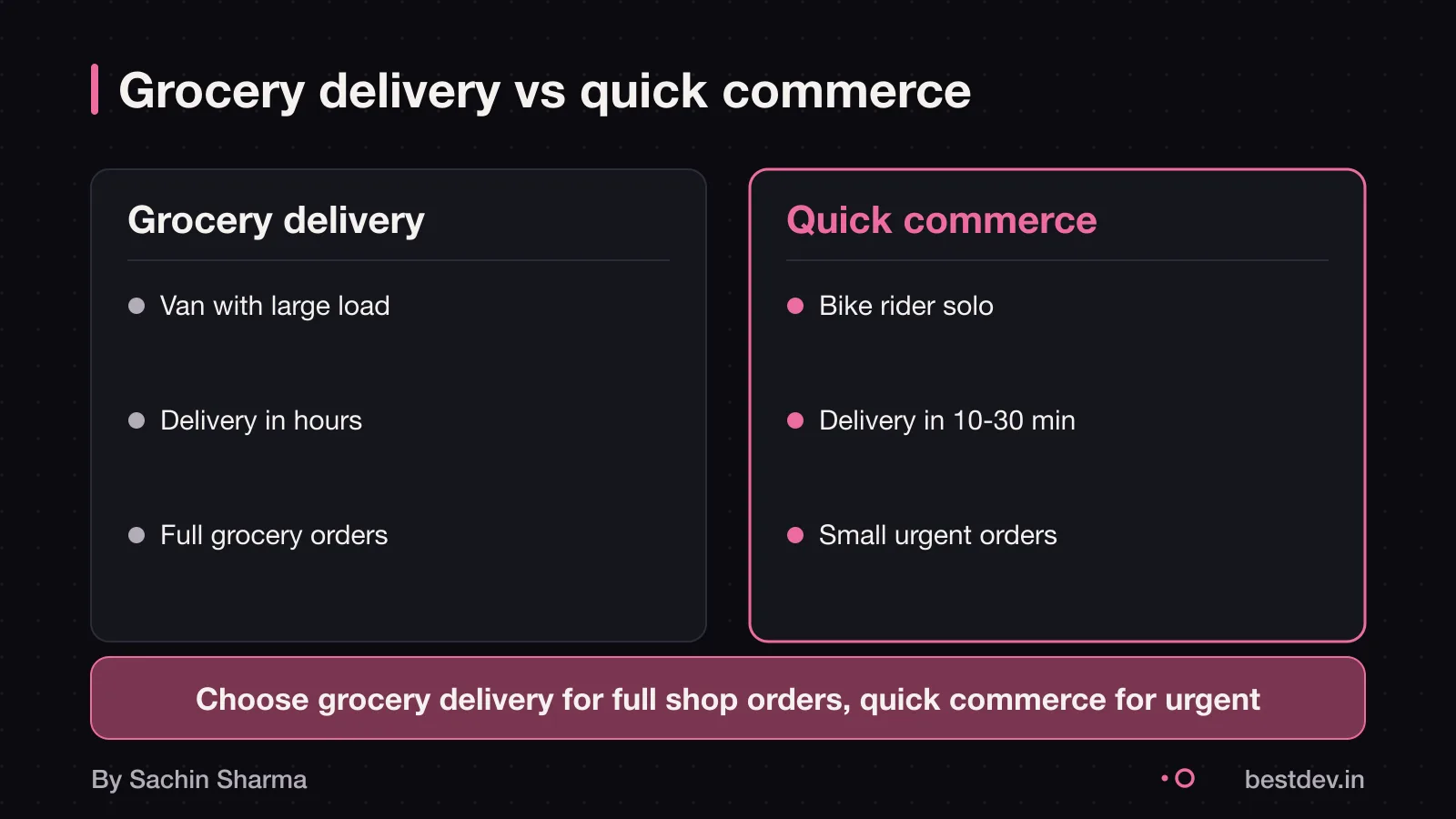
A grocery delivery app lets customers browse your inventory, add items to a cart, pay online and get deliveries from your store or warehouse. It includes a customer app, a delivery tracker and a back-office system for orders and stock. This is different from quick commerce, which promises delivery in under 30 minutes and often uses dark stores for speed. Quick commerce apps like Blinkit, owned by Zomato, focus on urgent needs and fast fulfilment.
You must choose between building a custom app or using a white-label solution. A white-label grocery app is a ready-made platform you rebrand as your own. It covers the storefront, mobile apps, picker tools and back-office systems. These platforms let you launch in weeks instead of months. They suit most small to mid-sized businesses. Custom builds offer full control but cost $250,000 to over $1 million and take 9 to 18 months before you earn revenue. That is often too slow and costly for first-time buyers.
If you run a local store and want fast, reliable delivery service without hiring a tech team, a white-label platform is the better start. If you have a large chain and want deep integration with your existing systems, custom may make sense later.
Build or buy a quick commerce app: three routes compared
Must-have features for a grocery delivery app
The customer app must let users log in. They can browse and filter items. They can add to cart and check out. They can schedule delivery. They can see order history. They can contact support and leave reviews. These features help you build trust. They make buying easy.
Your admin panel needs user, product, order, courier and payment management. It also needs tools for discounts, promotions and marketing campaigns. This lets you update stock. You can track deliveries. You can run offers.
AI features are not needed at first. Basic apps work without them. As an estimate, you can add AI later. Use it for demand forecasting, delivery routing or product suggestions. This may cut waste and boost repeat purchases. But start simple. Do this unless you have a clear need and budget.
Quick commerce app features: must-have vs later covers shared features in detail.
What drives the cost of a grocery delivery app?
The biggest cost drivers are delivery logistics, payment systems, and AI features like recommendations or route optimisation. A rider app alone adds ₹1.5 lakh to ₹2 lakh. AI route optimisation costs $15,000 to $35,000 and computer vision for inventory costs $25,000 to $60,000, based on dollar estimates. A basic payment system costs $8,000.
Core features like user accounts, product listings, and checkout are included in the base app cost. But integrations increase price. For example, syncing with your current inventory system or billing software needs custom work. The more systems you connect, the higher the cost and testing time. Each integration must handle failures safely. This includes cases when the internet drops during a payment.
A rider app is not optional if you manage your own delivery team. It includes live tracking, route maps, and cash-on-delivery reconciliation. As per one build, this module costs ₹1.5L to ₹2L. You need separate apps for customers, riders, and admins. Each has different screens, permissions, and data needs.
AI features add cost quickly. A recommendation engine costs $8,000 to $20,000. As an estimate, demand forecasting costs $20,000 to $50,000 and a substitution engine costs $10,000 to $25,000. These are not plug-in tools. They need clean data and ongoing tuning. If your store has fewer than 500 products, the return on such AI may not justify the cost.
For deeper cost drivers, see What does it cost to build an app in India?.
How long does it take to build?
An MVP with basic customer app and admin panel takes 8 to 12 weeks to build. This includes a basic customer app, admin panel, and core features only. A growth-stage app takes 3 to 6 months to build. Complex or enterprise apps take 6 to 12 months to build.
For example, a family-run business with five brands and eight outlets. Lead-to-delivery time dropped from 2 weeks to 4 days. Timelines depend on team size, feature scope, and how fast you make decisions. Delays often come from late feedback or changing requirements mid-build.
If your goal is to test demand quickly, aim for an MVP. If you are scaling across cities, expect a longer build.
Freelancer or agency: which is better?
Hire a freelancer when your project is narrow and low-risk, and you can manage product details yourself. You get direct access to the developer, fewer meetings, and less overhead. This works well if you already know the exact features you need and can guide the build.
An agency makes sense when you need a full app delivered on time, with accountability across design, coding, testing and launch. Agencies handle coordination, have backup staff, and often provide support after delivery. But they cost more. As of 2024, a local agency’s MVP for a grocery delivery app ranged from $150,000 to $300,000.
The trade-off is control versus reliability. Freelancers give you direct input but depend on one person. Agencies spread the risk but add layers of communication. If you lack technical experience, an agency may save time and reduce errors. If you are hands-on and budget-conscious, a skilled freelancer can deliver the same result at lower cost.
For most first-time buyers, the choice depends on how much you can manage versus how much you want to delegate.
Tech choices: Flutter vs React Native and backend options
Consider Flutter for your grocery delivery app. It may speed up development and save money on the Growth tier. Flutter compiles to fast machine code for ARM or Intel chips, as well as JavaScript, so it runs well on many devices. It also has Hot Reload. This lets developers see changes almost instantly, without losing state. This helps speed up testing. You can control every pixel to create custom designs that match your brand.
React Native is another option. It uses JavaScript to build apps that run on both platforms. It is easier to scale later.
The backend should match your team’s skills. Use Node.js if your team knows JavaScript. It is a JavaScript technology, like React. For real-time updates like delivery tracking, Firebase is fast to set up. Aashwasan uses Firebase. For large inventories, a custom backend with PostgreSQL or MongoDB gives better control.
The tech stack matters because it affects cost, speed, and long-term fixes. As an estimate, a Flutter build for the Growth tier saves roughly ₹3.8 lakh compared to other stacks. This saving may come from faster coding and fewer bugs across devices.
For a quick commerce app, Flutter with Firebase or Node.js can be a good fit. It balances speed, cost, and reliability. If your team already uses React, sticking with React Native may save training time.
You can compare more options in our guide to the Best tech stack for a quick commerce app in India.
Risks of building a grocery delivery app
One challenge is structuring a large product catalog so customers can find items easily. To avoid this, use clear categories, filters, smart search and product recommendations. Another challenge is convincing buyers to purchase products they cannot touch or smell. You can reduce this risk by adding high-quality images, detailed descriptions and customer reviews.
Post-launch costs and maintenance
You will pay 15 to 20% of the build cost per year for maintenance. This covers Android and iOS updates, bug fixes, security patches, third-party service upgrades and app store compliance. For example, if your app cost ₹20 lakh to build, expect to pay ₹3 to 4 lakh each year to keep it running.
Monthly running costs range from ₹18,000 to ₹85,000. These include server hosting, payment gateway fees, cloud storage, delivery tracking APIs and customer support tools. Costs rise with order volume and features like real-time inventory sync.
Support typically includes fixing bugs and keeping the app compatible with new phone OS versions. It does not include adding new features or redesigning screens. Some developers offer hourly rates for small updates. Others sell annual maintenance packages.
You can update the app later with new features like loyalty points or chat support. But each update costs extra. The cost depends on complexity. Simple changes like text or images are low-cost. Adding a new screen or integration takes more time and money. Ask your developer for a change request process before launch.
For long-term support tips, see After launch: the first month and the first year.
Worked example: cost for a growth app
It does not include the rider app, which costs ₹1.5 lakh to ₹2 lakh for route optimisation and COD reconciliation.
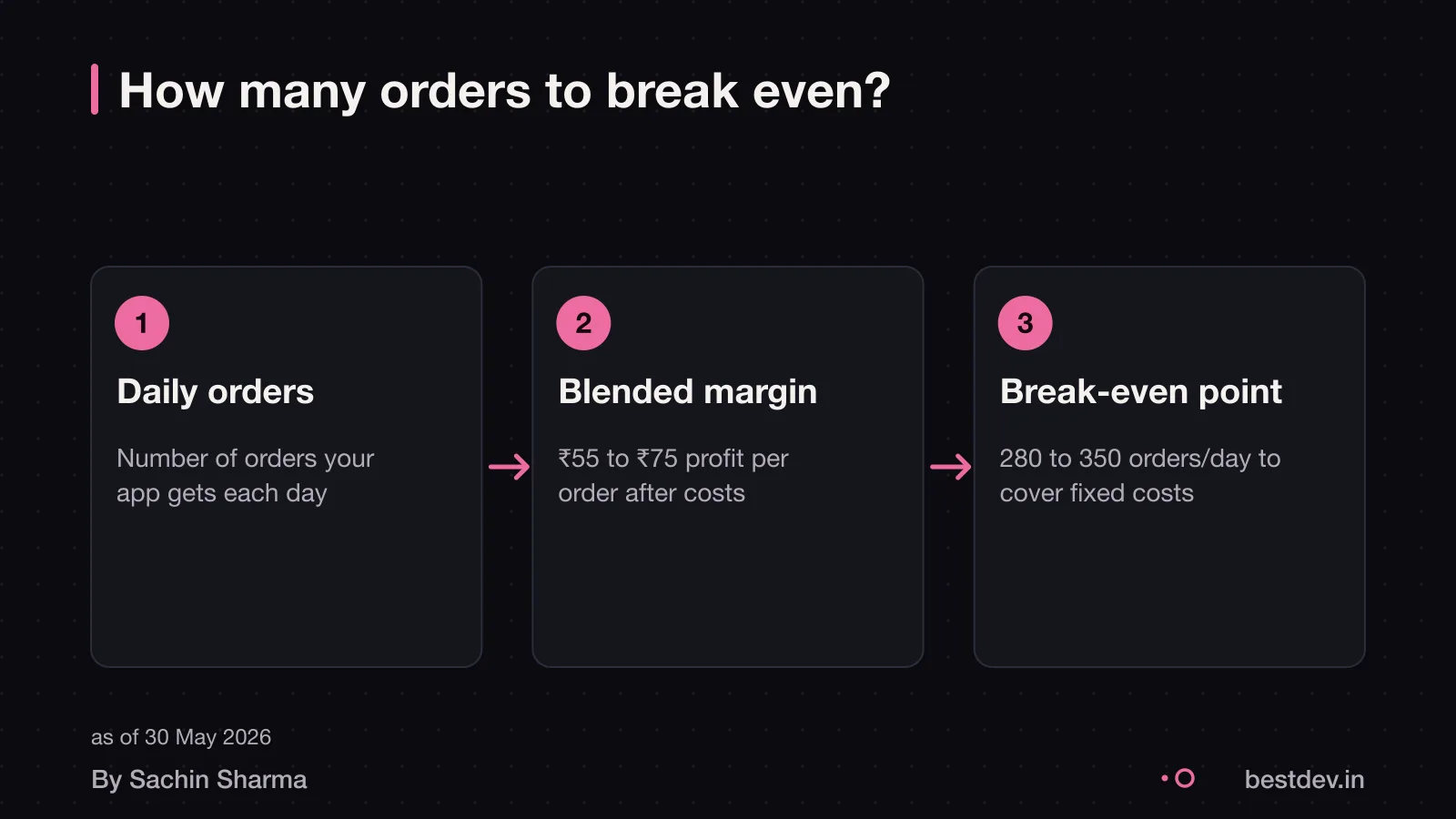
With this setup, you need 280 to 350 orders per day to break even. This assumes a blended margin of ₹55 to ₹75 per order after delivery fees and discounts. For example, you net ₹5.85 lakh in monthly gross profit. Break-even depends on your order volume, delivery radius, and local costs.
This estimate assumes: - You already have a warehouse or store and inventory. - You hire a developer directly, not through an agency. - You use Flutter for the app to cut cross-platform costs. - You handle marketing and staffing separately. - No major changes are made after launch.
The cost impact of catalogue size is not clear. The exact cost of inventory integration is not known. Moving to another developer after launch is not covered. Cost to update with new features is not known.
When building a grocery delivery app is not worth it
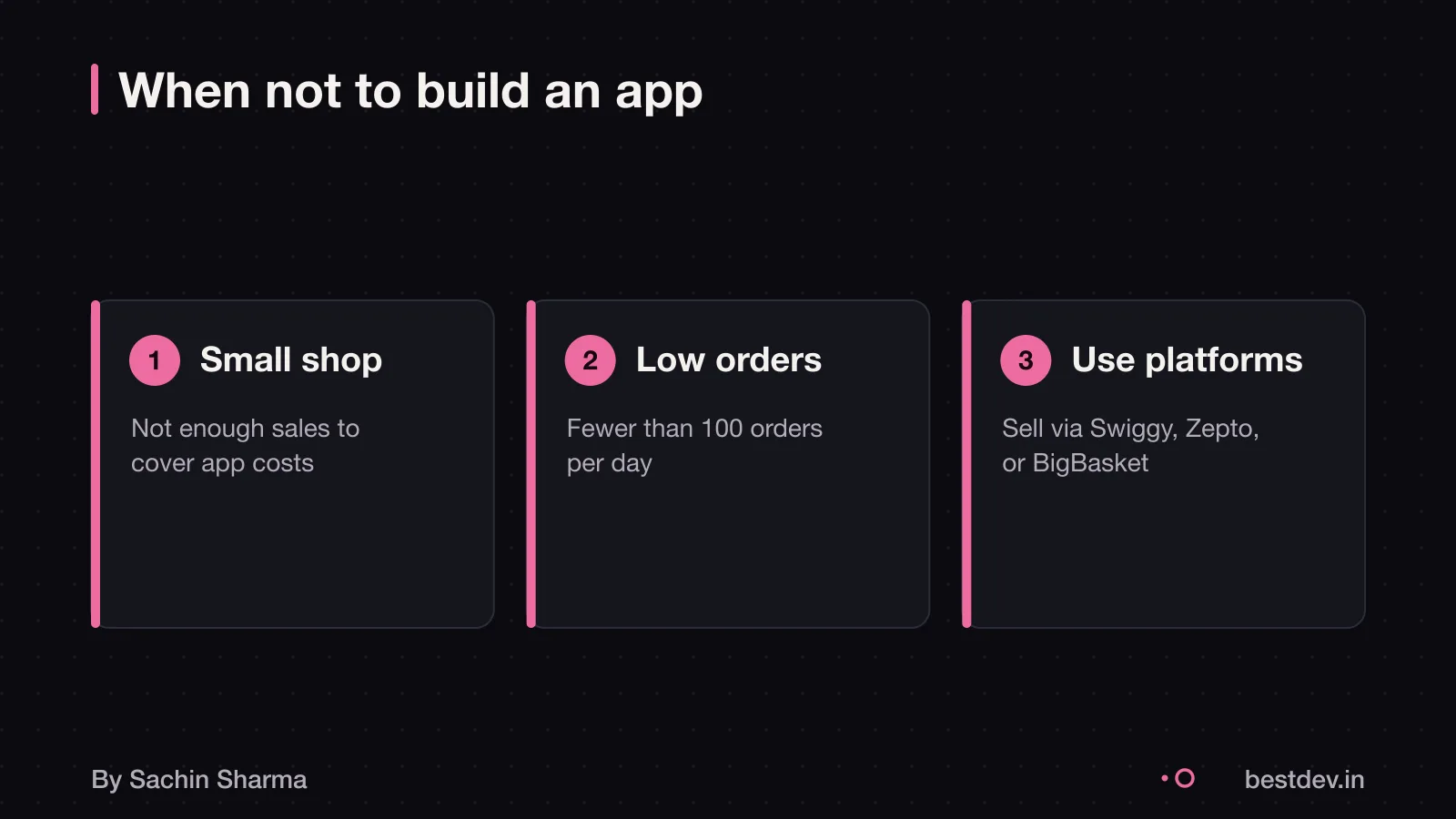
At that scale, you are unlikely to cover your costs, even with a lean build.
As an estimate, a ₹11 lakh app can make ₹5.85 lakh per month in gross profit. But falling short of the break-even range means losses.
Custom development is also not right if your workflows are standard. You lack in-house tech skills. Or you need to launch in under a year. In these cases, the time and effort outweigh the benefits.
Instead, consider using an existing platform. These ready-made solutions let you start fast. You can test demand and avoid large upfront costs. See When to use an existing platform for options that fit small businesses.
Questions people ask
What is the cost breakdown for a grocery delivery app in India?
A simple MVP app costs $20,000 to $35,000, a medium app costs $36,000 to $55,000. A complex app costs $56,000 to $120,000 or more. These prices cover the customer app, admin panel, core features, and for higher tiers, cross-platform support and advanced tools. For Indian rupees, as an estimate, $20,000 is about ₹17 lakh.
What makes a grocery delivery app more expensive?
AI features such as route optimisation, demand forecasting and computer vision are among the more expensive to build, based on current market rates. Adding a delivery partner app adds ₹1.5 lakh to ₹2 lakh, and integrating payments adds $8,000. Complex models, real-time tracking and third-party systems also increase the price.
How long does it take and what do I pay at each stage?
An MVP takes 2 to 3 months, a growth-stage app 3 to 6 months, and a complex app 6 to 12 months. Payments are usually split into milestones like design, core build, testing and launch. There is no standard split, so agree on stages and deliverables upfront.
Do I need a GSTIN for my grocery delivery business?
Yes, if your annual turnover exceeds ₹20 lakh (₹10 lakh in special category states). Custom software development and SaaS services attract 18% GST. Check this for your case with a chartered accountant.
What legal rules apply to grocery delivery apps in India?
You must comply with RBI’s data localisation rule (store all payment data in India) and KYC for wallets above ₹10,000. The Digital Personal Data Protection Act, 2023 and FSSAI registration may also apply. Check this for your case with a lawyer.
Can I build a grocery delivery app on a tight budget?
Yes, start with an MVP that includes only core features like browsing, cart and checkout. Use Flutter for one codebase on both platforms. Limit early scope and expand after launch. This cuts cost and time while testing demand.
How do I check if a developer's quote is fair?
Compare quotes only after locking scope, as the cheapest quote may miss key items like security or deployment. Check that logins, databases, payments and updates are included. Working software, not documents, is the real product.
What does app maintenance cost after launch?
Maintenance costs 15 to 20% of the build cost per year. As an estimate, assuming a $30,000 build cost, annual maintenance is $4,500 to $6,000. Monthly running costs, including cloud and SMS, range from ₹18,000 to ₹85,000.
Who owns the source code after the app is built?
You own the source code only if the contract says so. Some developers retain rights or charge extra for full ownership. Always get code ownership in writing before final payment.
Assumptions behind the numbers
- Catalogue size and delivery radius affect feature complexity but are not directly priced
- Team size affects timeline, not cost
- All cost figures assume INR conversion at market rate
- Weekly effort is a working assumption, not a market standard
Toggle features below to see how cost and time change. A grocery app is not just one app—it’s customer, rider, store and admin tools on one backend.
Customer app
Rider app
Dark store tool
Admin and backend
Where it goes wrong
Three things the calculator can't see
Inventory accuracy
The app is only as good as the shelf count. Plan for how stock reaches the system before you plan screens.
Rider supply
Software does not create riders. Decide whether you build the rider app or use an existing fleet.
Peak load
Evening rush is a different test from a demo. Ask how it is tested.
Before you sign
Ask for these
- Are the customer, rider and store apps all in this quote?
- Which area and how many stores does the first version serve?
- Who owns the inventory data feed?
- How is peak load tested?
Keep going