Cost · Generic
What does it cost to build an app in India?
I won't hand you a number that pretends to be the market. Instead, here is the working: set the features, the people and the rate, and see where the money goes.
The full explanation
What is a food delivery app?
A food delivery app lets customers browse multiple restaurants, place orders, and track deliveries in real time. It is different from a single-restaurant app, which only works for one kitchen and often lacks live delivery updates.
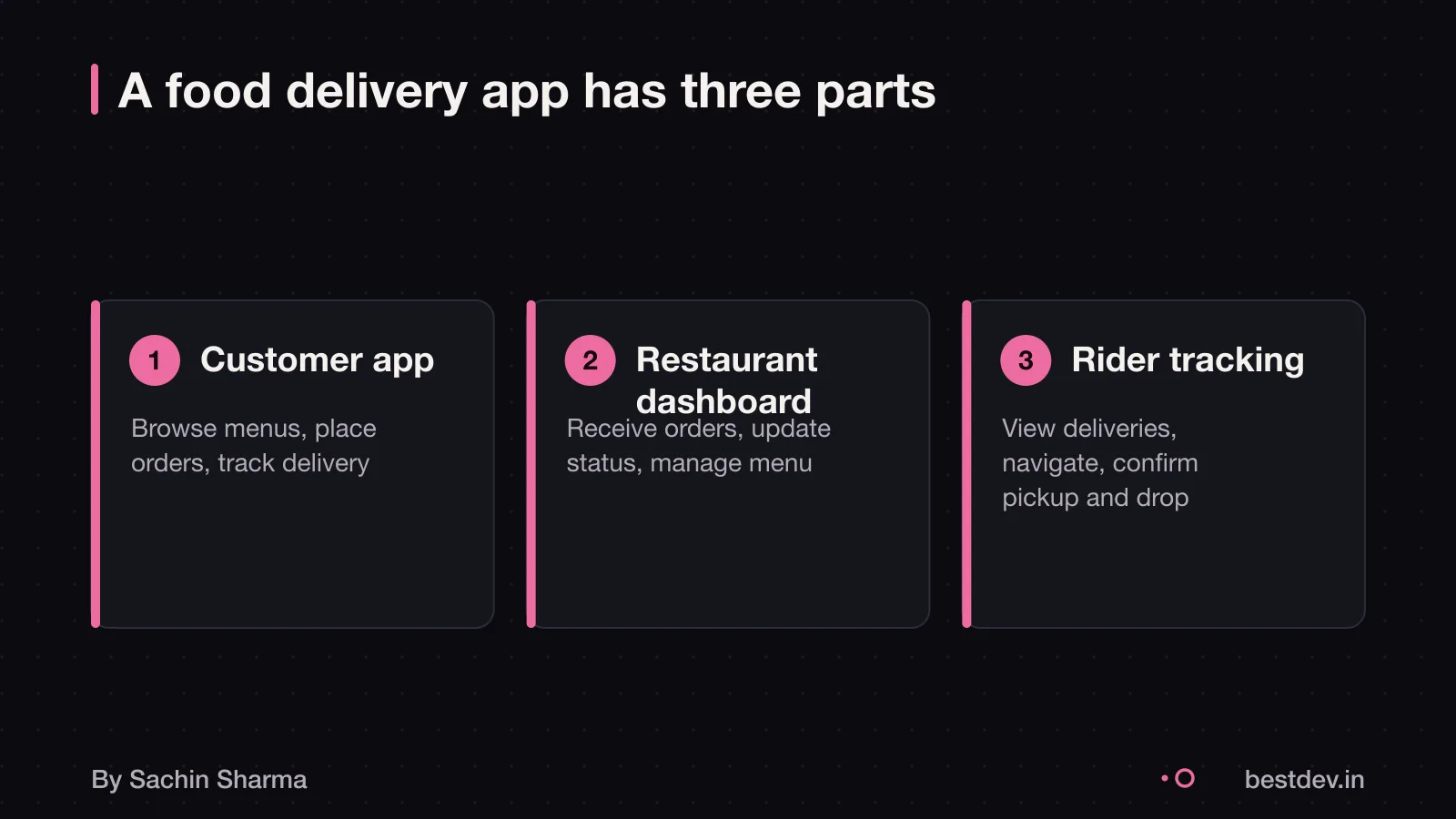
The core parts of a food delivery app are a customer app, a restaurant dashboard, and a delivery-tracking layer. These systems talk to each other so orders flow from the user to the kitchen and then to the delivery person. A single-restaurant app may only have a customer interface and a basic order printer, but not full tracking or multi-vendor support.
For a working example of these features, see the core features of a food delivery app in our guide on building quick-commerce apps.
What is the lowest cost to build a working app?
The lowest cost for a basic MVP food delivery app in India starts at ₹3.5 lakh, based on the lower end of the range. This gives you a basic MVP on one platform, as the scope lists 'Single Platform' under Basic MVP. The evidence lists a basic MVP for one platform, though it does not describe specific features. The evidence does not specify which features are included or excluded. A step up, with both iOS and Android apps plus an admin panel, costs ₹6 lakh to ₹12 lakh.
Compare this to the cost of a quick commerce MVP, which often runs higher due to tighter delivery windows and more complex logistics.
What features make it more expensive?
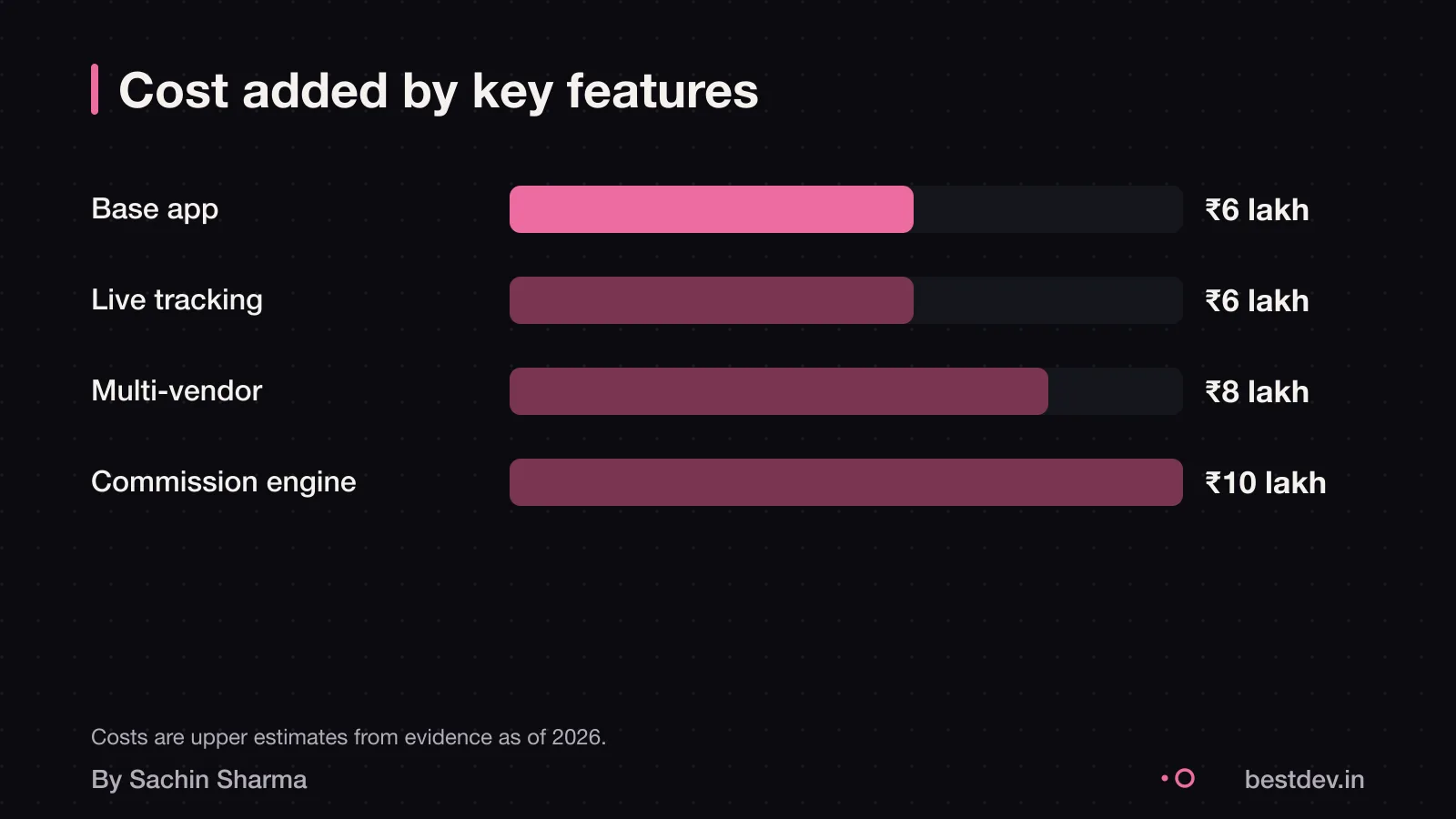
Live GPS tracking, multi-vendor management, and a loyalty engine can raise development costs, as these features add complexity and extend timelines. These add complexity, development time, and testing effort.
Real-time GPS tracking costs between $4,000 and $8,000. The cost comes from integrating mapping APIs, handling location updates every few seconds, and managing battery use on phones.
A commission engine calculates and splits payments between you, the restaurant, and the delivery rider. It must handle different commission rates per vendor, tax deductions, and payout schedules. Adding this raises the total cost because it needs secure financial logic and audit trails.
Multi-vendor management also pushes costs up. It allows many restaurants to list on your app, each with their own menus, order flow, and payouts. This needs strong role-based access, isolation of data, and scalable backend design.
As an estimate, adding live tracking and a commission engine to a base app could add ₹5 lakh to ₹10 lakh to the total cost. This assumes moderate complexity and Indian developer rates.
You can start without these and add them later. Focus first on core features like menu upload, order placement, and payment. Add live tracking and commission splits only when you have multiple vendors or riders.
For more on what to build now and what to delay, see must-have vs later features.
Custom vs white-label: which is better?
A white-label app costs less and launches faster than a custom app but gives you less control. Choose white-label if you want to test your idea quickly with a single outlet. Development takes 12 to 20 weeks. It suits businesses that need unique features or plan to scale across cities. White-label SaaS platforms like Petpooja or DotPe have a setup cost of ₹0 to ₹25,000 and a monthly cost of ₹2,000 to ₹8,000. You can launch in 1 to 2 weeks as of 17 September 2026. This model works best if you want to start fast and do not need custom branding or advanced delivery logic.
White-label is better when you are testing demand or running a single kitchen. You avoid large upfront investment. The provider handles updates and hosting. But you cannot change core features like rider assignment or loyalty rules. Custom apps let you own the code, set your own commission rates, and add AI-based dispatch or multi-restaurant pooling. These features matter if you plan to compete with Swiggy or Dunzo in a tier-2 city. For most small owners, starting with white-label and moving to custom later is a safer path.
If you are still unsure, see our build or buy decision guide for a deeper comparison.
How long does it take to build?
A custom food delivery app takes 6 to 18 months to build, while a white-label version launches in 2 to 6 weeks. The timeline can depend on how tightly you scope your features. Custom apps are built from scratch to your exact specifications, which takes 6 to 18 months to deliver.
Delays can happen when features are not clearly scoped. As edarpan.com notes, timelines depend heavily on how tightly you scope your features.
To reduce delays, freeze your feature list early.
Flutter or React Native: which tech is better?
Flutter and React Native both cut your app cost by letting one codebase run on both Android and iOS. This shared approach saves 30 to 40% compared to building two native apps. For a food delivery app, that saving can be ₹3.6 lakh to ₹26 lakh off the total build cost, depending on the feature set.
Flutter compiles code to ARM or Intel machine code as well as JavaScript, for fast performance on any device. It also runs as JavaScript where needed. This means smoother animations and quicker load times, which helps during peak order hours.
React Native works similarly but relies more on the device’s native components. Flutter gives more design control, which helps if your brand needs a unique look. React Native has a larger pool of developers in India, so hiring help may be easier.
If speed and look matter most, go with Flutter. If developer access is harder, consider React Native.
What legal and tax rules apply?
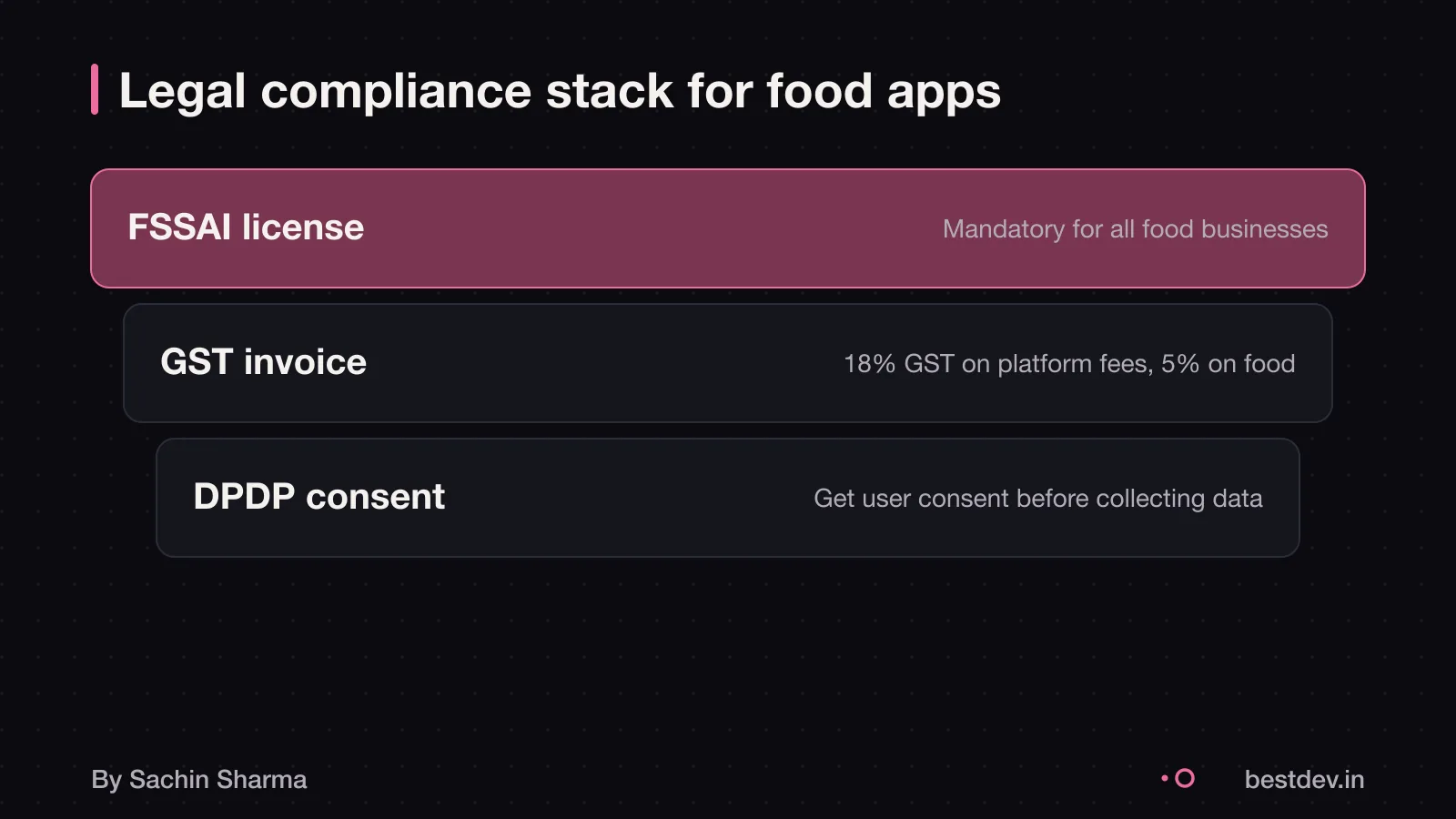
GST at 18% is applied to the platform fee, and 18% GST applies to software development services. GST at 18% is applied to the platform fee.
You need clear consent for collecting customer data, as stated by edarpan.com about India’s Digital Personal Data Protection (DPDP) Act. As an estimate, assuming standard compliance practices, your app should show a privacy policy and get active agreement when users sign up. See guidance on DPDP Act consent flows for examples.
FSSAI rules require e-commerce food platforms to display their FSSAI license or registration number on transaction documents given to customers. This may include order receipts and email confirmations. Confirm with your legal advisor.
These are legal duties. Talk to a tax expert and a food safety consultant to confirm your setup meets all GST, DPDP, and FSSAI rules. Laws change and your business model may need extra steps. Do not rely only on this guide.
Who owns the app and can you switch later?
As peryou own the entire codebase when you build a custom app. There are no licensing restrictions or dependency on a third-party platform's roadmap. As perthere are no licensing restrictions mentioned, but confirm this with your developer.
However, if you use a white-label SaaS app, you do not own the platform itself. The vendor controls it and can change features or pricing at any time, which may affect your business.
To transfer an app between developer accounts, such as moving it to another organisation on App Store Connect. You can transfer ownership when you have sold the app to another developer or want to move it to another App Store Connect account or organisation.
Building custom may give you more control, but the level of control depends on contractual and technical terms. For more, see source code ownership explained.
When should you not build a custom app?
For most single restaurants, a white-label SaaS platform (₹2,000 to ₹8,000/month) beats custom development for the first year. These platforms offer ready-made apps with ordering, payment, and basic delivery tracking. You can start fast and spend less.
Also avoid a custom app if customers in your city rarely download new apps. In many Indian markets, a Progressive Web App (PWA) combined with WhatsApp ordering works better than a native app that users refuse to install. PWAs load in browsers and need no download. As an estimate, they work on most low-end phones.
A custom app makes sense only when you need unique features like multi-vendor payouts, dynamic commission rules, or deep logistics control. If you do not need these, stick with an existing platform. For a clearer choice, read about when to use an existing platform.
Questions people ask
How much does a food delivery app cost in India?
A food delivery app in India costs between ₹10,00,000 and ₹30,00,000, as of September 2026. A basic MVP on a single platform costs ₹3.5 lakh to ₹6 lakh. A full custom food delivery app with advanced features can cost up to ₹30 lakh, based on one estimate. For a tailored estimate, share your feature list.
What makes a food delivery app more expensive?
Live GPS tracking and multi-vendor management can increase development complexity and cost. These features may add to timelines and require more testing, which could raise the price.
How long does it take and what do I pay at each stage?
A custom app takes 6 to 18 months. A white-label food delivery app launches in 2 to 6 weeks. Break payments by delivery of core modules to reduce risk.
Do I need a separate app for riders?
Yes, a rider app is a standard part of the system. It allows delivery partners to accept orders, navigate, and update delivery status. You also get a restaurant dashboard and admin console.
How do I handle restaurant settlements and rider payouts?
There is no standard solution for settlements and payouts. Ask developers how they handle payout logic, TDS, and bank transfers. You must track commissions, issue invoices, and file GST. Check this for your case with a chartered accountant.
Is there a difference in cost based on city?
Your city does not affect cost much. Developer location does. Teams in metro cities charge more. Remote or tier-2 city teams often offer standard rates. Focus on the team, not your location.
What features can I skip in version one?
Start with core ordering, payment, and basic tracking. Skip AI recommendations or multi-platform support at first, as these advanced features increase cost and complexity. Add them after launch based on user feedback. See <a href="/guides/how-to-build-a-quick-commerce-app/">core features of a food delivery app</a>.
Assumptions behind the numbers
- Base app is an MVP with one platform, one user role, minimal features.
- Team is based in India with standard senior developer rates.
- Admin panel tier affects total cost: basic, multi-module or advanced.
- Live tracking, multi-vendor and commission engine are optional add-ons.
- GST toggle applies 18% tax as per current rules.
I won't hand you a number that pretends to be the market. Instead, here is the working: set the features, the people and the rate, and see where the money goes.
- Scope and design15%
- Build62%
- Testing and fixes15%
- Launch and stores8%
The weeks shown are an example of a small app, there to be changed. Fees you pay others (store accounts, cloud, SMS) are not in this total.
What moves it
Six things that move the price
- Live tracking
Adds backend load and UI complexity. Cost: $4,000–$8,000.
- Multi-vendor support
Each vendor needs separate dashboards and payout logic.
- Commission engine
Calculating splits, handling refunds and reports adds weeks.
- Advanced admin panel
Tiered access, analytics, logs. ₹1–20 lakh depending on modules.
- MVP scope
One user type, one city, one cuisine. Cuts 40% of features.
- PWA + WhatsApp
No app downloads. Works on low-end phones. As low as ₹1.5 lakh.
Not in the total
Fees that go to someone else
Google Play developer account
A one-time registration fee, paid to Google. Check the current amount.
Apple Developer Program
A yearly fee paid to Apple. Check the current amount.
Cloud, SMS, maps, payments
Usage-based, billed by the provider to you.
Before you sign
Ask for these five things
- How many weeks per phase, and with how many people?
- What is not included?
- Which fees do I pay to others directly?
- What happens to the price when I change my mind?
- What does the first month after launch cost?
Keep going