Guide · 10 min read
How to hire a developer in India
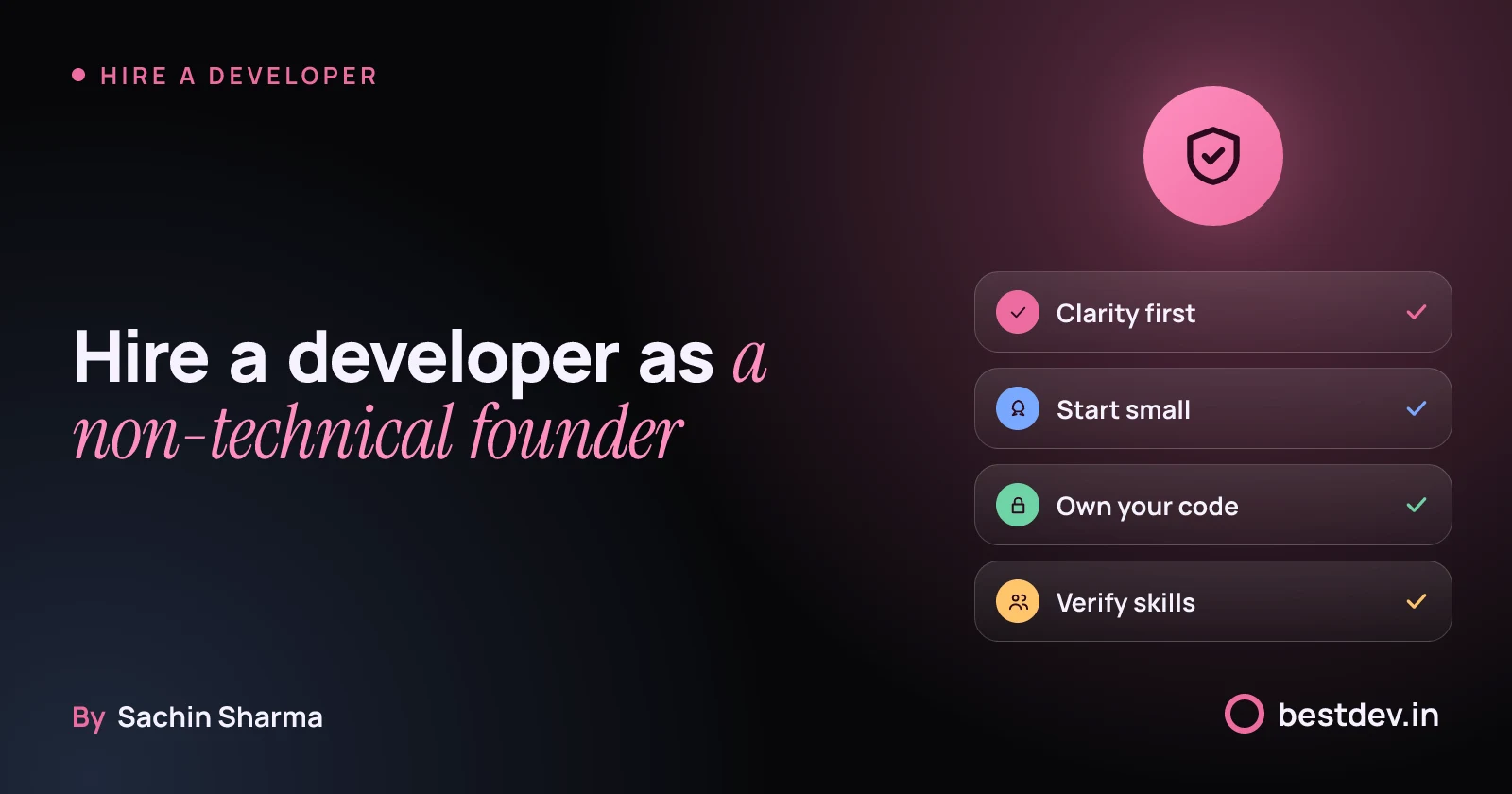
A protective, step-by-step guide for a first-time buyer. It takes about ten minutes and can save you months.
The full explanation
What is a non-technical founder?
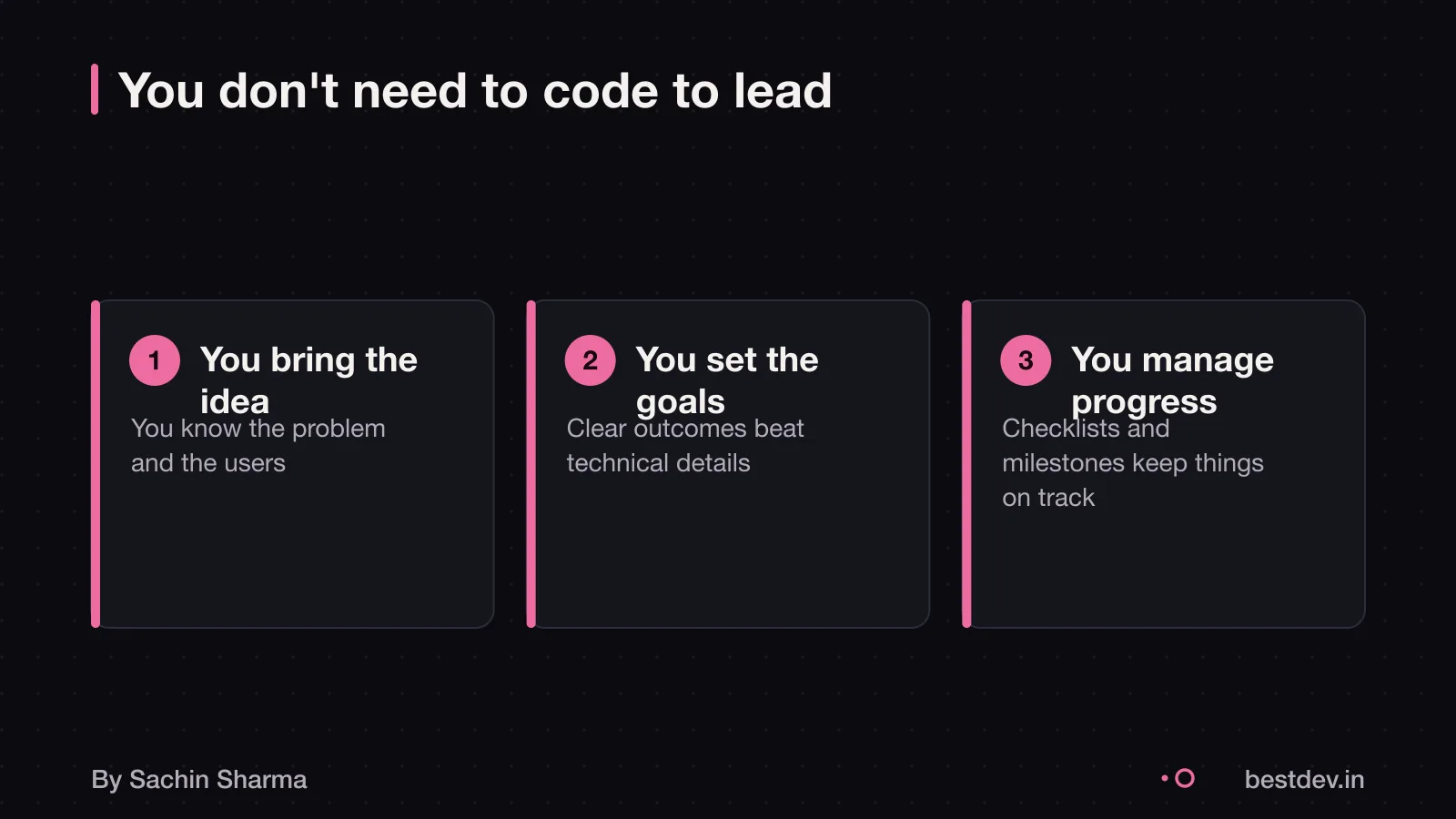
A non-technical founder is someone who does not have technical skills and cannot judge the technical capabilities of developers. This matters because you must rely on others to build your product. You need clear ways to check progress and quality without understanding the code. For example, you can ask for live demos, not code reviews. Your role is to define the goal, not the method.
Should you use no-code or hire a developer?
You can use no-code solutions to create an MVP without a developer. In 2022, you do not need a tech person to set up a good-enough eCommerce website. This works when you are testing demand and do not need advanced features.
But no-code has limits. It struggles with complex user flows, offline access, or unique algorithms. You may hit performance issues or high monthly costs as you grow. Some tools lock your data or do not allow full branding.
To decide, ask: does your product need to do something new or better than off-the-shelf tools? If yes, a developer is worth it. If you are validating an idea quickly and cheaply, start with no-code. For more, see Lovable alternative: when a developer beats an AI builder.
How much does it cost to hire a developer in India?
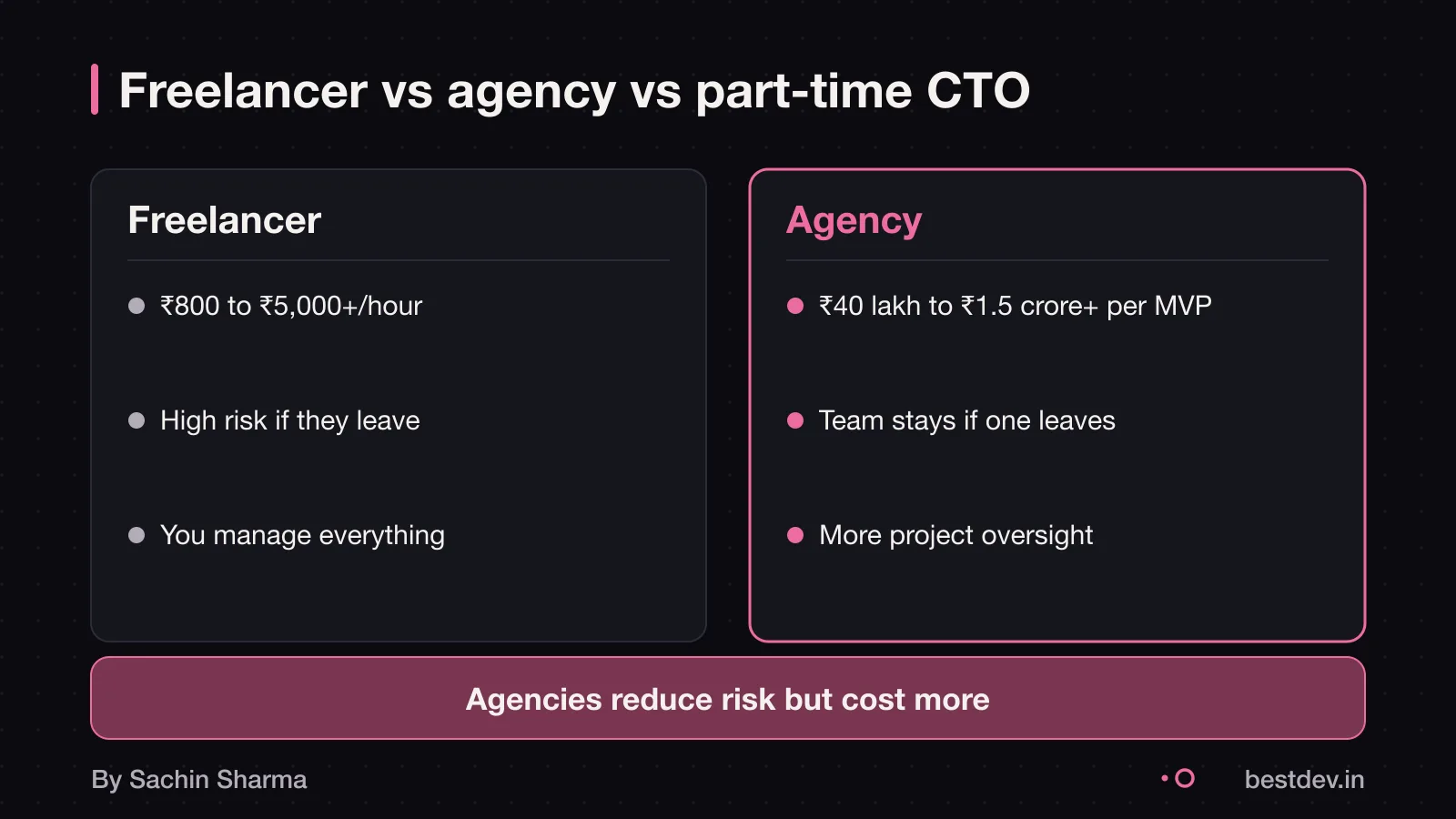
In 2026, hiring a developer in India can cost from ₹800 per hour for a junior to ₹3,500 to ₹4,500 or more for a senior expert. Freelancers may charge $5,000 to $25,000 for a full MVP. Agencies often quote $40,000 to $150,000. A fractional CTO falls in between at $15,000 to $30,000 for an MVP.
Your project’s cost depends on five main factors: app complexity, platform choice (iOS, Android, web), team model (freelancer. Agency, in-house), location of the team, and post-launch needs like updates and support. A simple app from a freelancer in a tier-2 city will cost less than a complex one built by a Delhi-based agency.
Hidden costs often come from statutory add-ons and overhead. If you hire full-time, provident fund, ESI and gratuity add 12 to 15 percent to the base salary. For contract work, project management and QA can add 18 to 30 percent more to development time. A quote of ₹8 lakh that skips the admin panel or testing is not cheaper than a ₹14 lakh quote that includes them.
Worked example: Basic delivery app
As an estimate, assume you want a basic delivery app with user and delivery agent screens, login, tracking, and payments. - 3 developers (1 mid, 1 senior, 1 junior) work for 5 months (20 weeks). - Mid-level: ₹1,800/hour, Senior: ₹4,000/hour, Junior: ₹1,000/hour. - 40 hours/week per person.
Raw dev cost: = (1,800 × 40 × 20) + (4,000 × 40 × 20) + (1,000 × 40 × 20) = ₹14.4 lakh + ₹32 lakh + ₹8 lakh = ₹54.4 lakh
Add 18 to 30 percent for project management and QA, based on industry estimates for a typical agile engagement.
Total estimate: ₹76.16 lakh Assumptions: team works full-time, all features are scoped, no delays.
Remember, a lower hourly rate does not always mean lower total cost. Clarity, speed, and fewer bugs matter more. Compare full quotes that include all features and support.
You can save by starting with a freelancer or a non-metro team, but verify their past work. For complex needs, an experienced solo developer may cost more per hour but finish faster and with fewer errors.
What does it cost to build an app in India? covers a full cost calculator for apps.
How long does it take to build a basic app?
Delays often come from scope creep, when undefined requirements expand during development. This causes 45% of delays. If you keep changing what the app should do, the timeline will stretch.
Client review delays cause 25% of delays, often due to slow feedback on design and development milestones. If you take more than a few days to review designs or test builds, work stalls. To reduce risk, set a rule in your contract. You will give feedback within 48 to 72 hours. Also, plan for third-party tools like payment gateways or government APIs. Their instability causes 15% of delays. Add a 1- to 2-week buffer for each major integration.
Key developer departure causes 10% of delays, especially in Tier 1 cities where annual developer attrition is 25 to 30%. Choose a developer or agency that promises to replace team members quickly. Test on real devices early. As an estimate, India has over 8,000 active Android models. Require a test plan covering at least 20 common devices to manage QA risks. As an estimate, device fragmentation adds 5% to delay risk. Agree on a test plan covering at least 20 common devices.
Freelancer, agency, or part-time CTO: which should you choose?
Freelancers cost $5,000, $25,000 for an MVP. An agency charges $40,000, $150,000 for an MVP. But they may not show code samples or explain their process. Agencies offer structure and backup teams. But they charge more. A fractional CTO brings technical oversight and planning. This helps if your product is complex or you plan to scale fast.
Onboarding a new developer may take time and cost more if documentation is not standardised. Solo developers rarely follow standard documentation practices. Agencies often provide better documentation and handover. But their size can slow decisions. A part-time CTO sets up systems early. This reduces future rework. Start small and verify progress weekly. For larger budgets or complex products, a fractional CTO or agency adds safety.
If you need speed, structure, and long-term alignment, the higher cost of a CTO or agency may save money over time.
Protect yourself from risks and verify skills
If a freelancer stops responding mid-project, your project could face an immediate survival crisis. This risk is higher with freelancers who do not share code regularly or leave poor documentation. To track progress, you can require daily code commits and weekly live demos. Not showing code samples or refusing client references may indicate a risky engagement.
Ask a developer if they can show you something tangible they have created, as the source suggests doing so before partnering with them. Look for apps or websites you can test yourself to see how they behave. You can check a developer's portfolio to see if they have worked on something similar to your idea. Without technical knowledge, you can verify skills by asking to contact past clients.
During screening, ask: “Can I see a working app you built?” and “Can I speak to a past client?” If they say no, walk away. Also ask how they handle handovers and document code, these habits reduce risk if they leave. For more checks specific to mobile apps, see how to Hire a Flutter developer for your first app.
Legal and contract basics for non-technical founders
A founder agreement can be legally enforceable in India if it meets the requirements of a valid contract under the Indian Contract Act, 1872. This means both you and the developer must agree freely. The work must be legal. There must be a clear exchange. An example is payment for services.
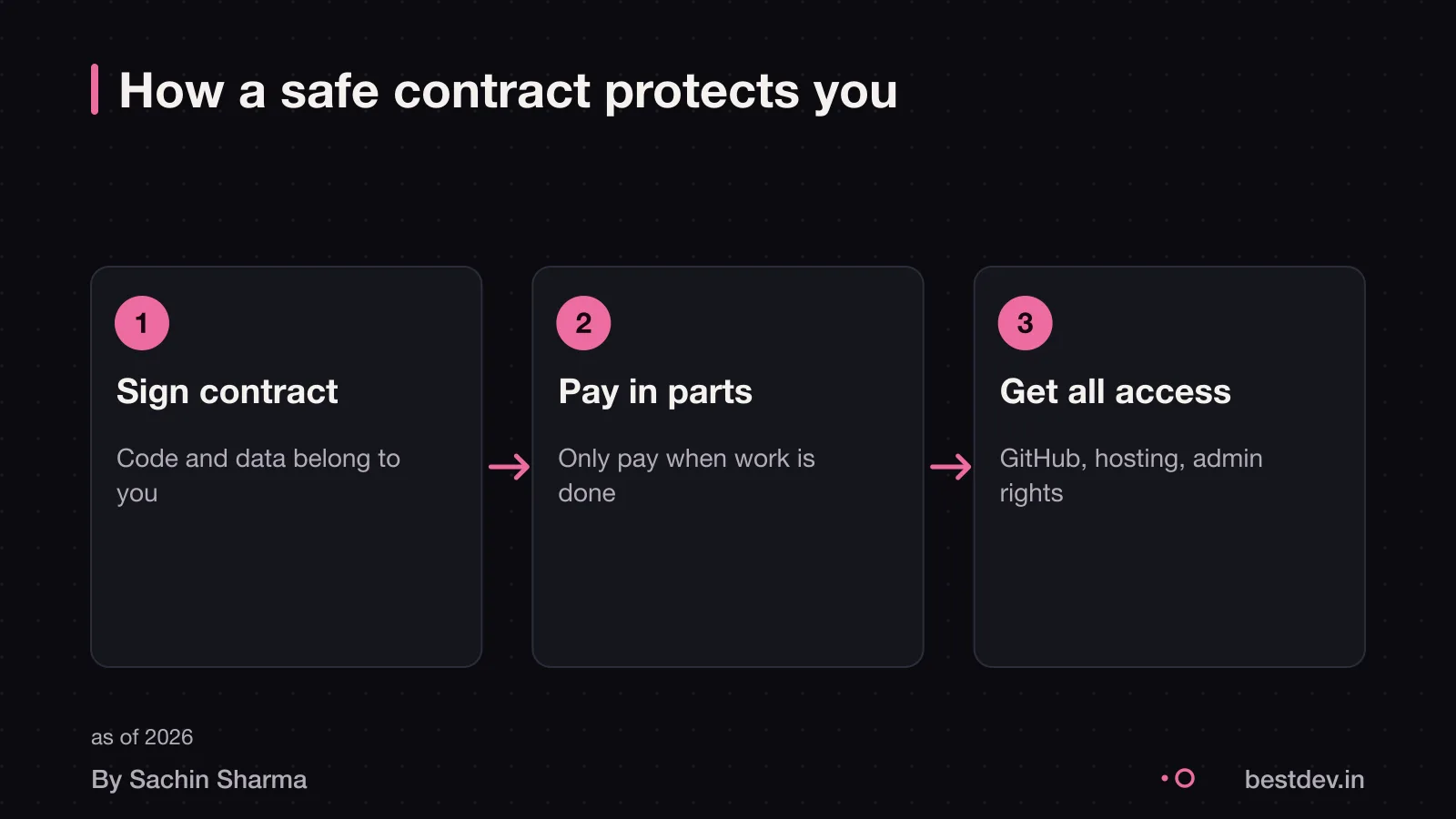
Include clauses on intellectual property, confidentiality and a handover plan in your contract, as recommended. You can secure code ownership by setting up a client-owned GitHub repository from day one. Also confirm IP ownership and confidentiality in writing before coding starts.
Make technical documentation a deliverable. For full clarity, read Can I get the source code of my app?. This page explains how to verify ownership and access.
A fair payment plan ties money to clear milestones. Do not use time or trust. It is wise not to pay more than 50% upfront before work starts, as advised by V12 Labs. Split the rest across stages like design approval, core features done and final delivery. Only pay when you confirm each step works.
After launch: support, updates and maintenance
You should expect regular updates and bug fixes after launch. As a non-technical founder, plan to budget 15 to 20% of your initial development cost each year for maintenance. This covers security patches, OS updates, minor feature tweaks, and performance fixes.
Some developers offer monthly support packs. Others charge per hour. Either way, make sure you can leave the agreement if service drops. Keep full access to your app's source code and backend systems at all times. This protects you if you need to switch help later.
Next steps and when to wait
When this advice is wrong
Wait if your idea is not clear or too small to justify custom code. More than 35% of startups fail because of a lack of product market fit. Try no-code tools first for simple apps like forms or stores [previous]. A technical co-founder may be better for high-tech ideas.
Do not hire until you can list your goals, tech needs, timeline, features and required experience level. If you cannot, start with a trial project. Use a specific brief like “need a mid-level Node.js developer to build a payment integration” so developers can respond with real quotes.
For a low-cost trial, ask for a small feature built in one week. Pay ₹10,000 to ₹25,000 as an estimate, assuming basic complexity and no third-party integrations. This tests skill and trust without big risk.
Questions people ask
What should I check before hiring a developer as a non-technical founder?
Check their tangible work and whether they explain their process clearly. Avoid those who cannot show past projects or refuse to share references. A developer who cannot show code samples is a red flag.
What is a fair way to pay a developer as a non-technical founder?
Use milestone payments tied to clear deliverables, with no more than 50% paid upfront. Freelancer platforms offer systems that release payment only when you approve the work. This protects you and builds trust.
What happens to my code and accounts if we stop midway?
You must own the GitHub repository from day one and have a handover plan in the contract. If the developer disappears, you may face a survival crisis and need an emergency audit. Always plan for exit early.
Can I hire a developer with no money upfront?
It is hard to hire skilled developers with no money upfront. Equity-only deals are risky and often fail. A better option is a small paid trial to test fit before deeper commitment. This avoids costly mismatches later.
How long does it actually take to hire a developer?
Onboarding even an experienced developer takes 2 to 4 weeks to learn your codebase, tools and process. This is true even if they start coding quickly. Plan for this ramp-up time in your timeline.
What's the biggest mistake early-stage startups make when hiring developers?
Scope creep causes 45% of delays, and client review delays cause 25% of delays. To avoid this, define requirements clearly and set a 48-72 hour review window in your contract.
How can I verify a developer's technical claims without coding knowledge?
Test their past products and check reviews on Clutch or GoodFirms, which list verified client feedback on agencies and staff augmentation providers. These steps help you judge quality even if you cannot read code. Avoid developers who resist these checks.
What should I look for in my first developer hire?
Look for someone who shows tangible work, is available for your project, and communicates clearly. Avoid those juggling many projects, as your work may stall. Commitment matters as much as skill.
Assumptions behind the numbers
- Milestone-based payment reduces risk for both parties
- Non-technical founders benefit from written agreements more than verbal ones
- Calling one past client is enough to assess reliability
- Three options (freelancer, studio, agency) cover most hiring decisions
A protective, step-by-step guide for a first-time buyer. It takes about ten minutes and can save you months.
01 · Start here
Define what you need, not features
Before talking to anyone, write one page: who the product is for, the problem it solves, and three things that must work on day one. Skip the feature list. Focus on outcomes.
This clarity helps developers price your idea and prevents scope creep. It also shows if you're ready to manage a build.
Do thisOne page. Three must-haves. No more.
02 · Decide
Pick freelancer, studio or agency
Freelancers are cheapest but riskiest. Studios offer balance. Agencies bring process and scale. Each suits a different stage and budget.
Ask who writes the code, who tests it, and what happens if they quit. These answers reveal long-term risk.
Do thisAsk who exactly writes the code, whichever you pick.
03 · Find
Shortlist three with proof
Look for shipped apps, real client names, and public profiles with history. Avoid portfolios full of generic screenshots.
Three is enough to compare how they ask questions. Good developers ask about users before asking for budget.
Do thisPrefer people who ask about your users before your budget.
04 · Verify
Test their past work
Install two shipped apps they built. Ask what they would improve. Call one past client to hear about handover and ownership.
A working app is better proof than a PDF portfolio. A past client call tells you about reliability and process.
Do thisCall one past client. It takes ten minutes.
05 · Agree
Write it down
A fair contract includes: scope, milestones you can test, change pricing, code ownership, and exit terms. Make sure accounts and repositories are in your name from day one.
Without a written agreement, even a good developer can cause problems. Written terms protect both sides.
Do thisIf it isn't written down, it isn't included.
06 · Finish
Pay against tests, not time
Pay after testing each milestone. At the end, you should have the code, keys, and a short doc on how it works.
Plan for bugs after launch. Real users find edge cases. Know in advance what fixes cost.
Do thisKeep one backup of everything, somewhere you control.
Quick answers
Should I pay a deposit?
A small deposit is normal, but never pay the full amount upfront. Tie payments to milestones you can test on a real device.
Do I need a technical co-founder?
Not for an MVP. You do need someone technical to vet your vendor, which can be a paid hour with an independent advisor.
Can I use no-code instead?
Yes, for simple apps or early validation. No-code tools can handle basic websites and forms without a developer.
How much does it cost?
Freelancers charge $5,000 to $25,000 for an MVP. Agencies charge $40,000 to $150,000. Hidden costs like QA and management can add 20 to 30 percent.
What if the developer quits?
If there's no contract or shared repo, you may lose months of work. Always insist on code ownership and regular backups.
Who owns the code?
You do, if it's written from scratch for you and stated in the contract. Work done by employees or freelancers without a written assignment may not transfer ownership.
Is hourly billing fair?
Hourly billing is fair if you can audit progress. But for fixed outcomes, prefer fixed-price contracts with clear deliverables.
Keep going