Guide · 10 min read
How to hire a developer in India
A protective, step-by-step guide for a first-time buyer. It takes about ten minutes and can save you months.
The full explanation
What a clinic app does and when to build
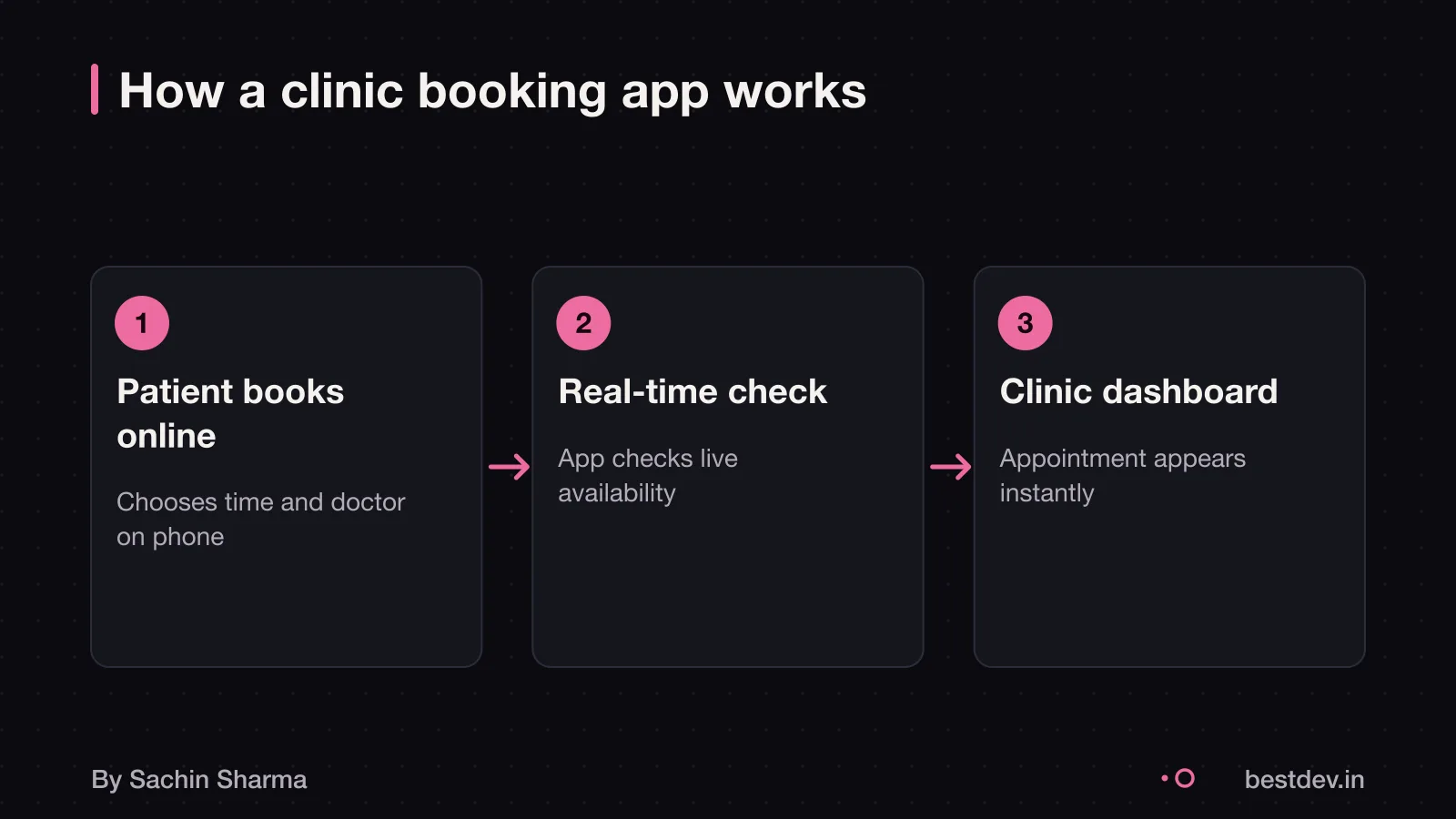
A clinic booking app lets patients book appointments 24/7 from anywhere. Patients can search doctors by specialty, location, insurance, and real-time availability. They see early availability, including last-minute cancellations, and can book them instantly.
A custom app may make sense if you need full control over data, branding or integrations. Some development firms offer easily customizable and highly secured healthcare app solutions. It also makes sense if you serve a niche patient group with unique needs, such as home visits or multi-location tracking.
But if your needs are simple, like basic online booking and reminders, you may not need a custom app. Tools like Practo or Lybrate already offer this. A developer only beats them when you need features those platforms do not allow. See When a developer beats an AI builder to compare options.
Cost: what you pay and why
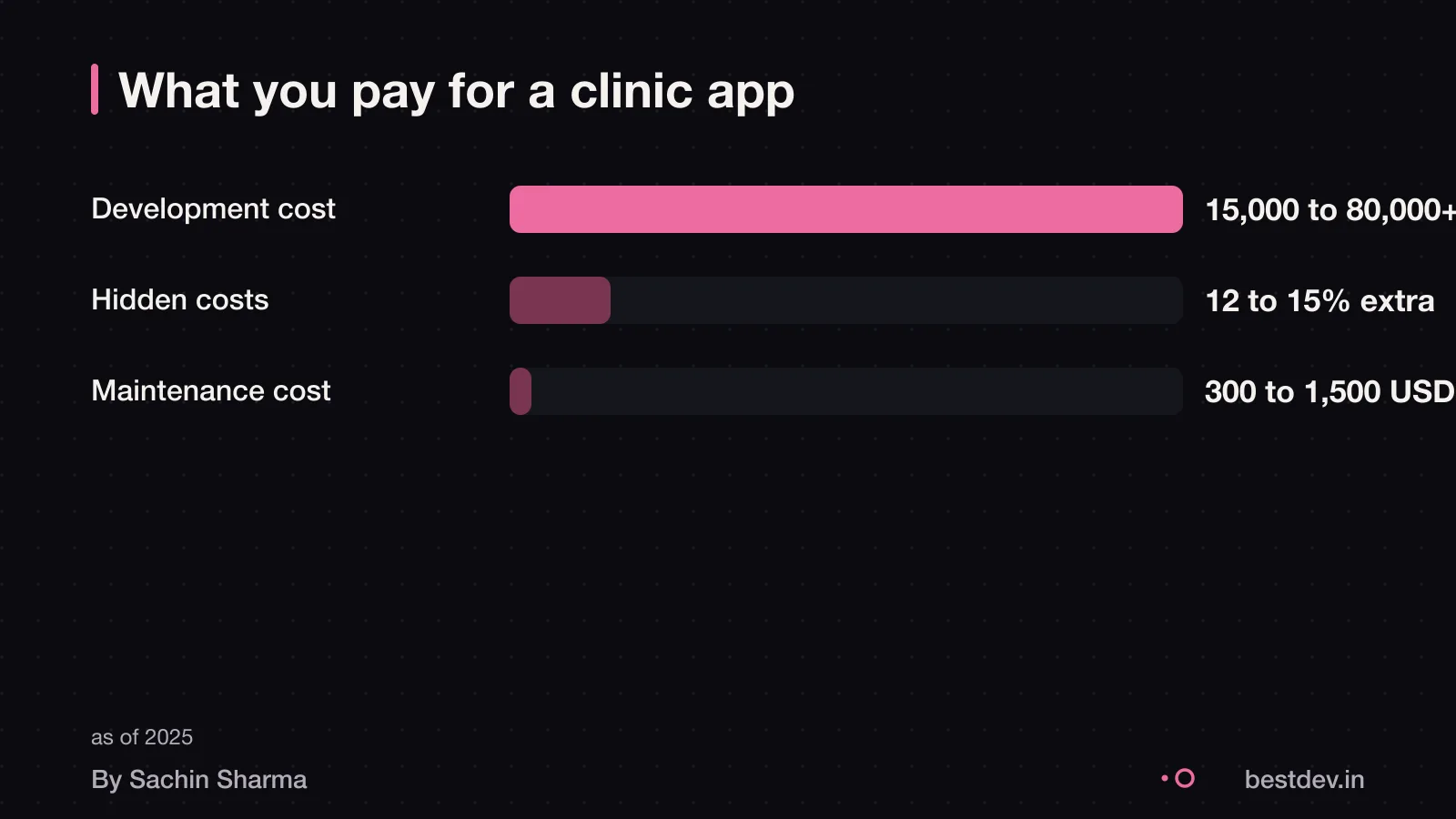
A clinic booking app can cost from ₹12 lakh to ₹64 lakh or more. Based on a range of $15,000 to $80,000+ for healthcare apps, using ₹80 per dollar. As an estimate, this assumes the app falls within the general healthcare app cost range. The main cost is developer time, which varies by platform, features like EHR integration, and design complexity.
Features that add the most cost are EHR integration, telemedicine, and multi-platform support. These require senior developers and more hours. Complex needs can raise costs by three to five times compared to simple apps. Custom or animated UI design also adds cost over basic templates.
Extra costs not always in the quote include statutory charges, API subscriptions, and testing. Statutory costs like provident fund add 12 to 15 percent to the base salary. Third-party APIs for payments or SMS may have setup and monthly fees. Testing and bug fixes are often under-quoted.
As an estimate, assuming 40 screens, one payment gateway, and a Firebase backend with no EHR integration: - Development: 3 mid-level developers × 5 months × ₹30,000/month = ₹4.5 lakh - API fees: ₹60,000 - Statutory (15%): ₹90,000 - Testing: ₹50,000 Total: ₹6 lakh
This assumes a mid-level team and no major integrations. Your cost will vary with scope and team.
Build the cost of your app to model your own case.
How long it takes to build
What you can plan for is the start delay based on who you hire. A full-time developer often needs to serve a notice period at their current job. This can take 30 to 90 days. During this time, no work happens on your app. This is time added before coding starts.
Freelancers can begin within days of hiring. They do not have notice periods. This makes them faster to start. But even experienced freelancers need 2 to 4 weeks to learn your app’s code, tools, and workflow once they start.
So the main factor adding time before coding starts is the hire type. Full-time hires bring a 30 to 90 day wait. Freelancers start in days. After onboarding, both need 2 to 4 weeks to get up to speed. The actual build time after that is not published. You should ask each developer for a timeline after sharing your full needs.
Freelancer, agency or direct developer?
Hiring a freelancer, agency or direct developer each has trade-offs in cost, control and speed. Freelance software developers in India typically charge $15 to $50 an hour through marketplaces. Senior freelancers charge $60 to $80 per hour. You save money but manage more yourself. Agencies charge more but handle coordination. They may subcontract, adding layers. A direct developer, like me, cuts out the middleman and works closely with you.
For a small clinic, a direct developer often fits best. You get clear ownership, faster fixes and no agency markup. Freelancer.in has a talent pool of over 90.3 million professionals. 80% of jobs receive bids within 60 seconds. This means talent is reachable, even if you are outside Tier-I cities. Retail brands are looking to Tier-II and III cities like Ahmedabad, Surat, and Jaipur as markets with rising consumption.
Talent is available in smaller cities. Mall developers and retail brands now target places like Jaipur, Coimbatore and Surat due to rising local spending. Lulu Group builds small-format malls for local needs. Platforms like Freelancer list India-wide talent. So location need not limit your choice.
What skills the developer needs
Your developer may need skills in Android and iPhone app development, or web technologies like PHP. HTML5 and CSS, as these are common role titles on freelancer sites. They may need skills in languages such as Java, Python, or C++, which are listed for some software developer roles. These are standard tools for any app that runs on phones or the internet.
Some developers offer UI/UX design services, as seen with Zenesys. This means clear buttons, simple steps, and readable text. Even if they do not design it themselves, they must work with someone who does.
Healthcare experience is not required. What matters more is their ability to listen, explain clearly, and build a system that fits your clinic’s workflow. Many apps fail because the developer did not understand how appointments are actually managed, not because of technical limits.
For example, a developer might use Flutter or React Native to build one codebase that works on both Android and iPhone. This can cut cost and time. I have used Firebase for storing data in a Flutter app.
You do not need someone who has built clinic apps before. But you do need someone who understands your workflow. Avoid those who push fancy tech instead of simple, reliable function.
Laws and rules for clinic apps
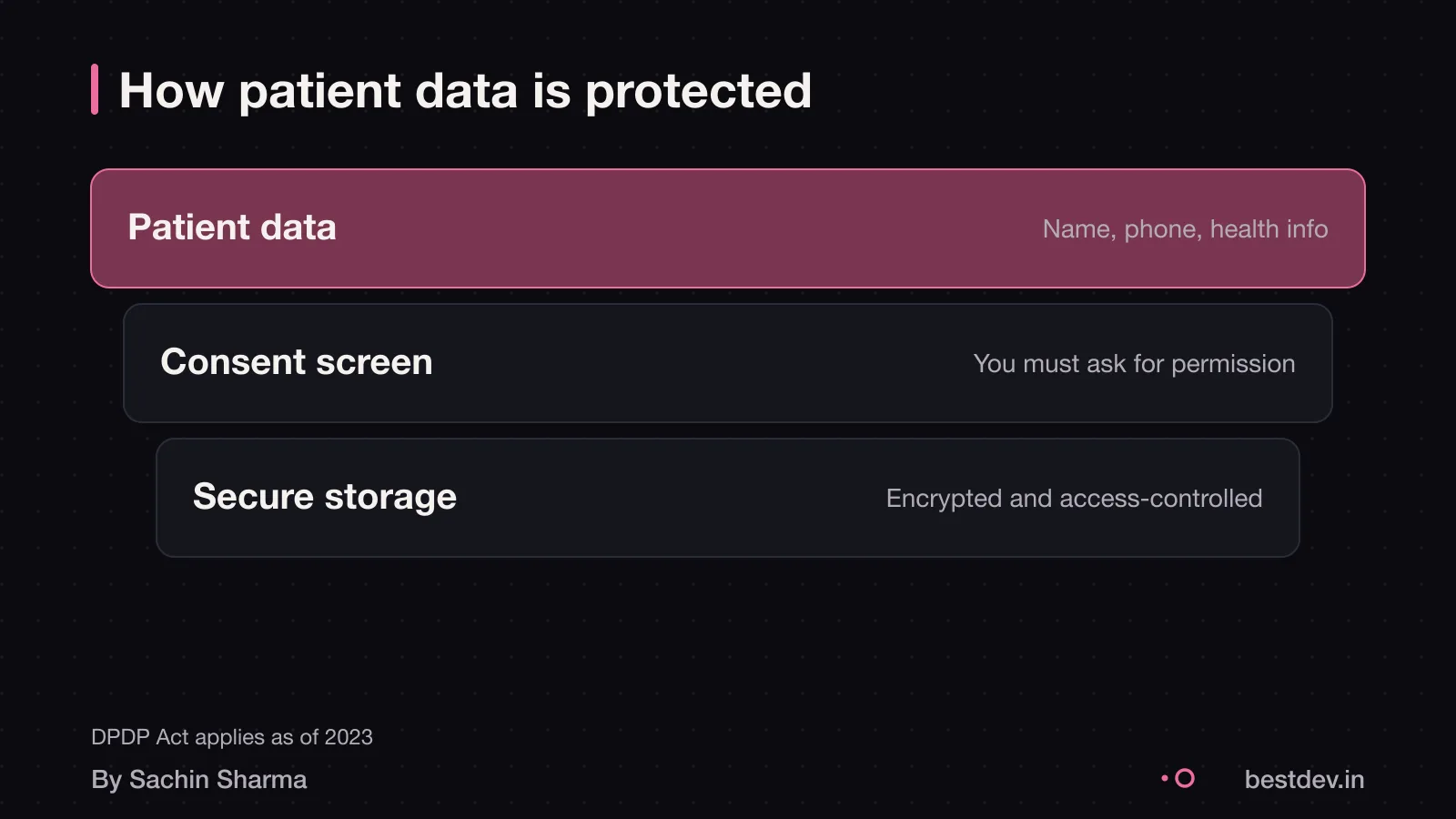
Your clinic booking app may need to follow Indian data protection rules. The Digital Personal Data Protection (DPDP) Act, 2023 is a relevant law.
The Indian Contract Act, 1872 extends to India and came into force on 1 September 1872.
Workshops on DPDP Act readiness have been run by Digital India for government departments and B2C implementation. Your app may need to follow some of these rules.
DPDP Act: consent flows an Indian app actually needs
Who owns the code and can move later
Without a clear agreement, intellectual property rights may remain with the developer or client organisation.
To move your app to another developer, the new team must check the code quality, tech stack and documentation first. Some Indian developers support legacy codebases in Java or Objective-C. But they will not take over messy or undocumented code without extra cost.
Always sign a contract that says you own the source code and can use it freely. Ask for the code early and often, not just at the end.
It is best to set this in writing before work starts.
Can I get the source code of my app? explains how to check your rights and what to ask for in the contract.
When this advice is wrong
When this advice is wrong
If Practo or Lybrate meet your needs, switching may not be worth the cost or effort.
If your budget is under ₹2 lakh, a custom app is unlikely to meet your needs without cutting key features like reminders, payments or security. Try a no-code tool like Glide or Adalo to make a simple booking form that syncs with Google Calendar. These are easier to manage.
Even if a custom app sounds right, start with a small test. Build one feature, like online booking for one doctor, and see how it works. Many clinics find that a simpler system covers 80% of their needs without the high cost of a full app.
Questions people ask
What should I check before hiring a developer for a clinic booking app?
Check that the developer has experience with healthcare apps, includes a code ownership clause in the contract, and agrees to milestone payments. For example, Concetto Labs has delivered 250+ healthcare app projects over 10+ years for clinics, hospitals, and health-tech startups. A milestone payment system ensures you only pay for work you approve.
What is a fair way to pay for a clinic booking app?
A fair way is to use milestone payments, where you pay only when each part is completed and approved. This protects both you and the developer. Freelancer supports this method as of 13 October 2026.
What happens to my code and accounts if we stop midway?
You should own the source code from the start, and have access to test accounts and developer tools. Indian App Developers can support apps built by other agencies. Get code access early to avoid delays.
Is HIPAA compliance necessary for a clinic in India?
No, HIPAA is a US law. For clinics in India, the Digital Personal Data Protection Act, 2023 applies. You must follow Indian data rules, not US ones. Check this for your case with a data protection lawyer.
How do I verify a developer's claims about past work?
Ask for live links to apps they have built, demo videos, and client names you can contact. A developer who says they have delivered 100+ healthcare projects may refer to a track record of 100+ successfully delivered healthcare app projects. Check if the apps are still live and meet real user needs.
What if my clinic only needs basic booking?
If you only need basic booking, consider a no-code tool or an existing platform. Concetto Labs offers clone solutions that are easily customizable and secure. This can save time and cost compared to a full custom build.
How do I know if the developer is good without knowing code?
Check their portfolio for live apps similar to what you need, and ask for references from past clients. Look for apps they have delivered in the healthcare space. If they have built 100+ healthcare projects, that adds confidence.
How do I verify the app works as promised?
Ask the developer for a test account and a demo video showing all key features. This lets you try the app before launch. You should be able to see booking, reminders, and patient management in action.
Assumptions behind the numbers
- Assumed 40 screens and one payment gateway for cost estimation
- Estimated cost uses typical mobile app complexity and Indian developer rates
A protective, step-by-step guide for a first-time buyer. It takes about ten minutes and can save you months.
01 · Start here
Write what you need, in one page
Most hiring problems start before the first conversation. If you cannot say who the product is for and what they will do with it in two sentences, no developer can price it, and every quote will be a guess.
Write one page: who it is for, the problem it solves, the three things that must work on day one, and two or three apps you like. You do not need designs or a feature list. Working out what to leave out is part of the job you are hiring for.
Do thisOne page. Three must-haves. No more.
02 · Decide
Choose the kind of help
There are three common shapes: a freelancer, a small studio, and a larger agency. A freelancer is usually the fastest and most direct for a clear, small scope. A studio gives you a few people with complementary skills. An agency carries process and breadth, at a price.
A fourth option is hiring in-house, which only makes sense when software is the core of your business and there is work for years.
Do thisAsk who exactly writes the code, whichever you pick.
03 · Find
Find and shortlist three
Look where proof is visible: shipped apps in the stores, a portfolio with real names, a profile with a history of work, and people your own network can vouch for.
Shortlist three, not ten. Three conversations are enough to see how people differ in how they ask questions.
Do thisPrefer people who ask about your users before your budget.
04 · Verify
Verify before you trust
Open two shipped apps on your own phone. Ask them what they would defend in that app and what they would change. Speak to one previous client, by phone.
A portfolio of screenshots proves nothing by itself. A shipped, running app and someone willing to be called is a different level of evidence.
Do thisCall one past client. It takes ten minutes.
05 · Agree
Put it in writing
A fair agreement states: what is included and what is not, milestones with something you can test at each one, how changes are priced, who owns the code and accounts, and what happens if either side stops.
Make sure the repository and the Apple and Google store accounts are created in your name from the start. It is the single easiest thing to do and the hardest to fix later.
Do thisIf it isn't written down, it isn't included.
06 · Finish
Pay, test and take it over
Pay against milestones you have tested, not against time passing. At the end, you should receive the source code in your repository, the accounts and keys in your name, and a short document on how it fits together.
Plan for the first month after launch. Bugs show up when real people use real data, and it helps to know in advance what fixing them costs.
Do thisKeep one backup of everything, somewhere you control.
Quick answers
How much should I pay up front?
Tie payment to milestones you can test. A small first payment to start is common, but avoid paying the whole amount before you have seen working software.
Do I need a technical co-founder?
Not to build a first version. You do need someone technical to ask hard questions of your vendor, which can be a paid hour with an independent advisor.
Keep going