Hire · First app
Hire a Flutter developer for your first app
Before the first call, here is what to check, in the order it hurts to skip. Tick what you have verified; the page tells you where you stand.
The full explanation
What is a Next.js developer?
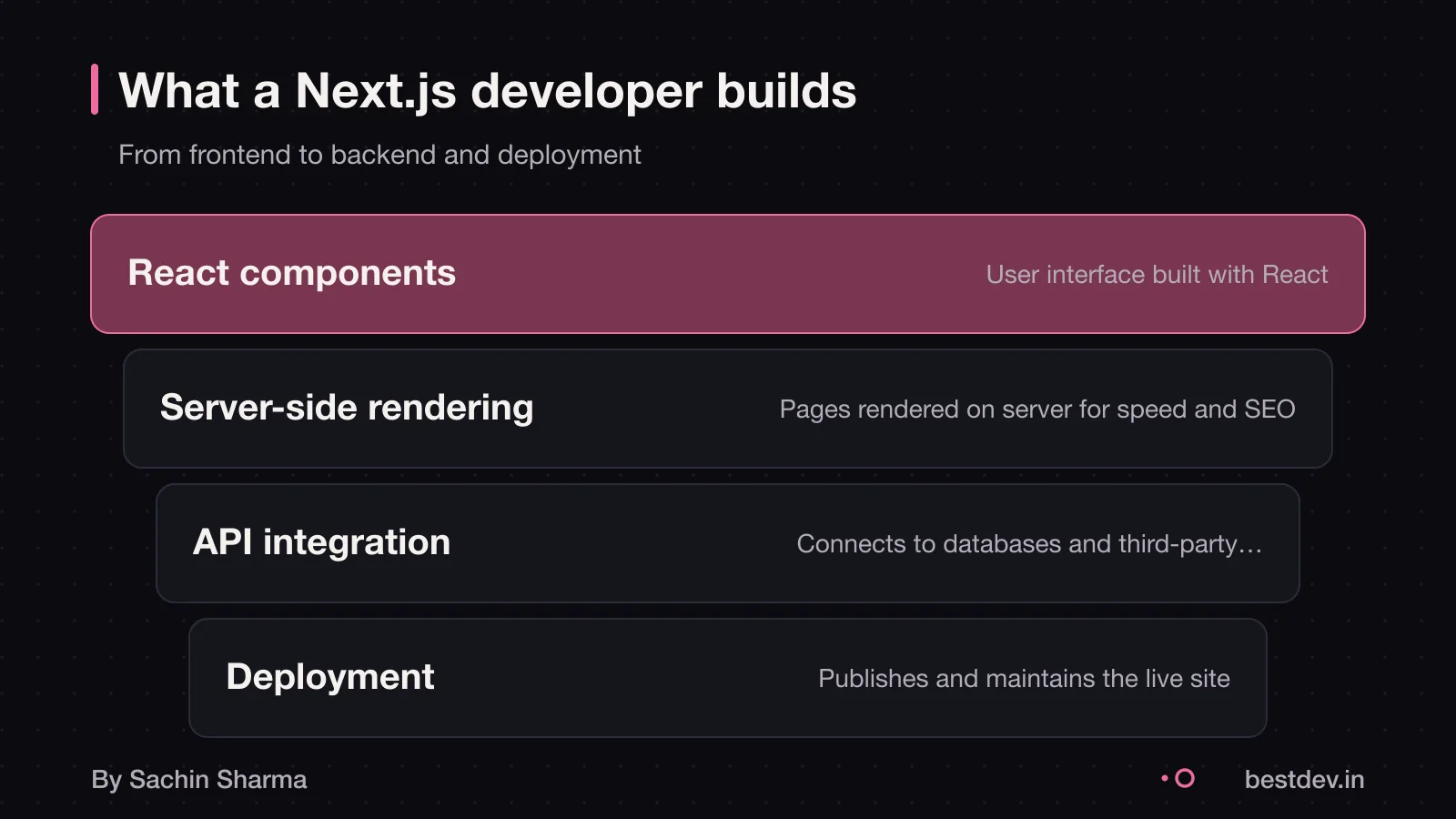
They may help with API integration, which can connect your website to other systems. While every Next.js developer is a React developer, their added skill lies in server-side rendering, routing and deployment. This can lead to faster loading pages and better performance for users.
These apps are fast and scalable.
You should understand what an API is. Developers often use APIs to link apps to other services. what an API is
Is a Next.js developer right for your web product?
A Next.js developer is right if your web product needs fast performance, SEO-friendly pages, and quick updates. Next.js automatically configures tools like bundlers and compilers, so you can focus on your product and ship faster. This suits businesses that want scalable, user-friendly websites without deep technical setup.
Next.js can be a good fit when you need both a marketing site and a web app in one codebase. It can work for e-commerce, content and media platforms, and marketplaces, where the marketing site and product share a codebase. If your business sells online or shares large volumes of content, a Next.js developer can build a fast, reliable product.
A team of senior Next.js developers built a microsite management portal from the ground up using modern frameworks and best practices. A firm automated event reservations using a high-performance marketing website built with Next.js.
If your product does not need SEO, real-time rendering, or content-heavy pages, simpler tools may be better. But if you want a modern, fast web product that ranks well and scales, a Next.js developer is a strong fit. The framework supports growth and performance without extra complexity.
What does it cost to hire a Next.js developer, including tax?
Hiring a fresh Next.js developer in India costs about ₹3.5 to ₹5.5 lakh a year. These figures are for gross annual pay. City and skill mix affect the final cost. For example, Average frontend developer salary in Hyderabad is ₹11.12 LPA. Average frontend developer salary in Bengaluru is ₹7.96 LPA. Skills beyond frontend, like full-stack or DevOps, push pay higher.
Statutory contributions add roughly 5 percent to the gross salary. This covers Provident Fund and Employee State Insurance. These are capped at lower wage levels. So they do not scale with high salaries. The claim that statutory costs are 40 to 60 percent is not correct. The 40 to 60 percent figures quoted elsewhere are agency markup.
GST applies if you hire a freelancer. GST on freelance services in India is 18% for domestic clients. Services to overseas clients qualify as exports, zero-rated under GST. GST registration is mandatory when total annual income (India + exports) exceeds ₹20 lakh. Below ₹20 lakh, registration is optional. Voluntary registration below ₹20 lakh helps claim input tax credit and issue formal GST invoices to corporate clients.
As a small business, your total cost is base pay plus roughly 5 percent for statutory costs. Add 18 percent GST only if hiring a registered freelancer in India for domestic services. For a mid-level developer earning ₹8 lakh, add ₹40,000 in statutory costs. If they are a registered freelancer, add ₹1.44 lakh GST. This is unless you are a foreign client. For a clearer picture of what your project might cost, see what it costs to build an app in India.
How long does it take and what do you need to provide?
Hiring a Next.js developer in India usually takes 1 to 2 weeks for interviews and selection. The delay after selection is often due to the notice period at the developer's current job. India has no legal rule for notice length, so it depends on their existing contract, which can be long. Some platforms, like Toptal, can match you in under 24 hours. Once matched, a trial period of up to two weeks helps you check fit.
As an estimate, a full project can take 60 days or more from start to launch, depending on size and team. The team built a working Alpha in just over 60 days, going from concept to Alpha. Test projects to assess skill take 1 to 3 weeks. Your own project length will depend on size, team, and how clear your brief is.
You must provide a clear project brief. A good brief keeps your project on time and cuts back-and-forth. It should include your business goal, list of pages, design status, integration needs, CMS preference, timeline with hard deadlines, and a budget range. Share your success metrics, like user sign-ups or page speed targets. List all content types, such as blogs, product pages, or team bios. Name every third-party tool you need, like payment or analytics systems. Specify if you have a staging site for review. Hand over designs with real text, not placeholder text like “Lorem ipsum”, to avoid rework. Say what support you need after launch, including documentation and account access.
Without it, you risk delays, scope creep, and extra cost. Use a template for your brief to cover all key points. For a full guide, see how to hire a developer in India.
Freelancer or agency: which is better for a web product?
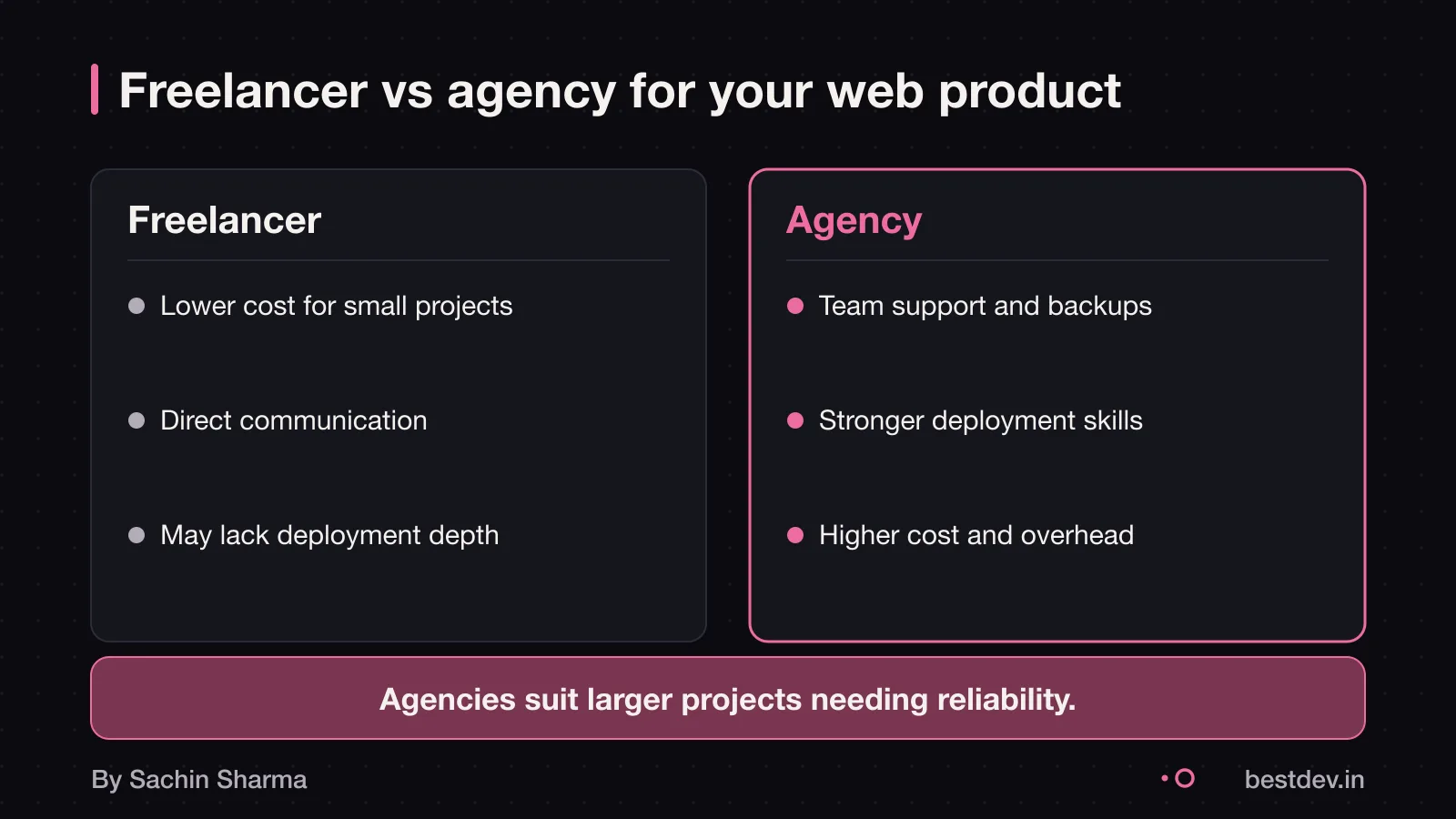
A freelancer gives you direct control and a faster start-up. An agency may offer broader support if you need it. However, agencies in India often lack depth in deployment and caching. This can hurt your web product’s performance over time. You may face issues with speed or uptime if the agency does not truly understand how to run a live site.
You deal with freelancers directly, with no agency layers. But if you hire someone as a contractor for long-term, full-time work, you risk misclassification under Indian labour rules. This could lead to legal or tax complications later.
Agencies claim faster hiring through risk-free trials. For example, Toptal says 98% of their clients hire after a trial. But their developers are often based outside India. They may be in the UTC-06:00 time zone. This may delay communication.
The trade-off comes down to skill depth versus support breadth. A freelancer with full-stack experience is often better for a small web product. Full-stack means handling both front-end design and back-end deployment.
You must verify their deployment experience. If you pick an agency, ask how they handle caching, domain setup, and server monitoring. Demand proof.
To compare your options in detail, read our guide on freelancer or agency for a first app.
How can you check if a Next.js developer is good?
A good Next.js developer should know React, server-side rendering (SSR), static site generation (SSG). API routes, and how to deploy on platforms like Vercel or Netlify. Since Next.js is built on top of React, a strong understanding of React is crucial for developers. They use these skills to build dynamic and interactive user interfaces. They should also understand SSR. This can improve page speed by generating pages on the server before sending them to the browser. Static site generation (SSG) lets developers pre-render pages at build time, as supported by Next.js.
You can verify their technical depth by asking which router they use, App Router or Pages Router. The App Router uses React canary releases with React 19 features. The Pages Router uses the React version in your project. A skilled developer will explain this difference. They will also justify their choice based on your product’s needs.
To check deployment knowledge, ask them to describe how they would deploy your app on Vercel, Netlify, or AWS. Ask for proof of deployment, such as a live link or screenshot, if possible. You can review EHR Copilot, a Next.js app Sachin built, as an example of a full-stack application.
What legal documents should you sign?
By default, the developer owns the code they write, even if you paid for it. This is true under India’s Copyright Act, 1957. The Copyright Act, 1957 says the creator owns copyright by default, even if a client paid for the work, unless a contract says otherwise. The same rule applies to freelancers. They are not considered employees under Section 17 of the Act. So, without a written agreement, you may not legally own the software, even after full payment.
To get ownership, you must sign a contract. It must include an IP assignment clause. By default, the developer retains copyright unless they assign it to you in writing. A client can receive your final files, delay or refuse payment, and still legally own everything you made. Unpaid work legally remains yours if a client agrees to such a clause. This protects the developer if you refuse to pay.
The IP clause covers only the custom code made for your project. Open-source libraries and frameworks used in the build follow their own licenses. They are not affected by your contract. Also, the developer keeps the right to use general skills, tools, and reusable components they developed during your project. Only the specific deliverable for you is transferred to you.
If a client is using work you delivered but have not been paid for. Your contract states IP transfers only on final payment, you have a real legal claim. In such cases, send a written notice. Cite the contract clause and demand payment or removal of the work. For your safety, always use a clear contract. You can read more on how this works in practice. You can also read what to ask for in the guide on can I get the source code of my app?.
What payment terms are fair?
Without a clause tying IP transfer to payment, a client may legally own the work even if they delay or refuse payment. This puts the developer at risk. With a clause tying IP transfer to payment, unpaid work legally remains with the developer. This gives you real use if a client tries to walk away without paying.
Without a clause tying IP transfer to payment, disputes over ownership can block updates or resale. In such cases, the developer holds a legal claim, not just a moral complaint. The developer can send a written notice citing the clause. They can demand payment or removal of the work.
What maintenance does your web product need after launch?
Your web product needs regular maintenance to stay secure, SEO-optimized, and user-friendly as technology and user behavior evolve. If you skip these tasks, your site may break, lose search rankings, or suffer data breaches.
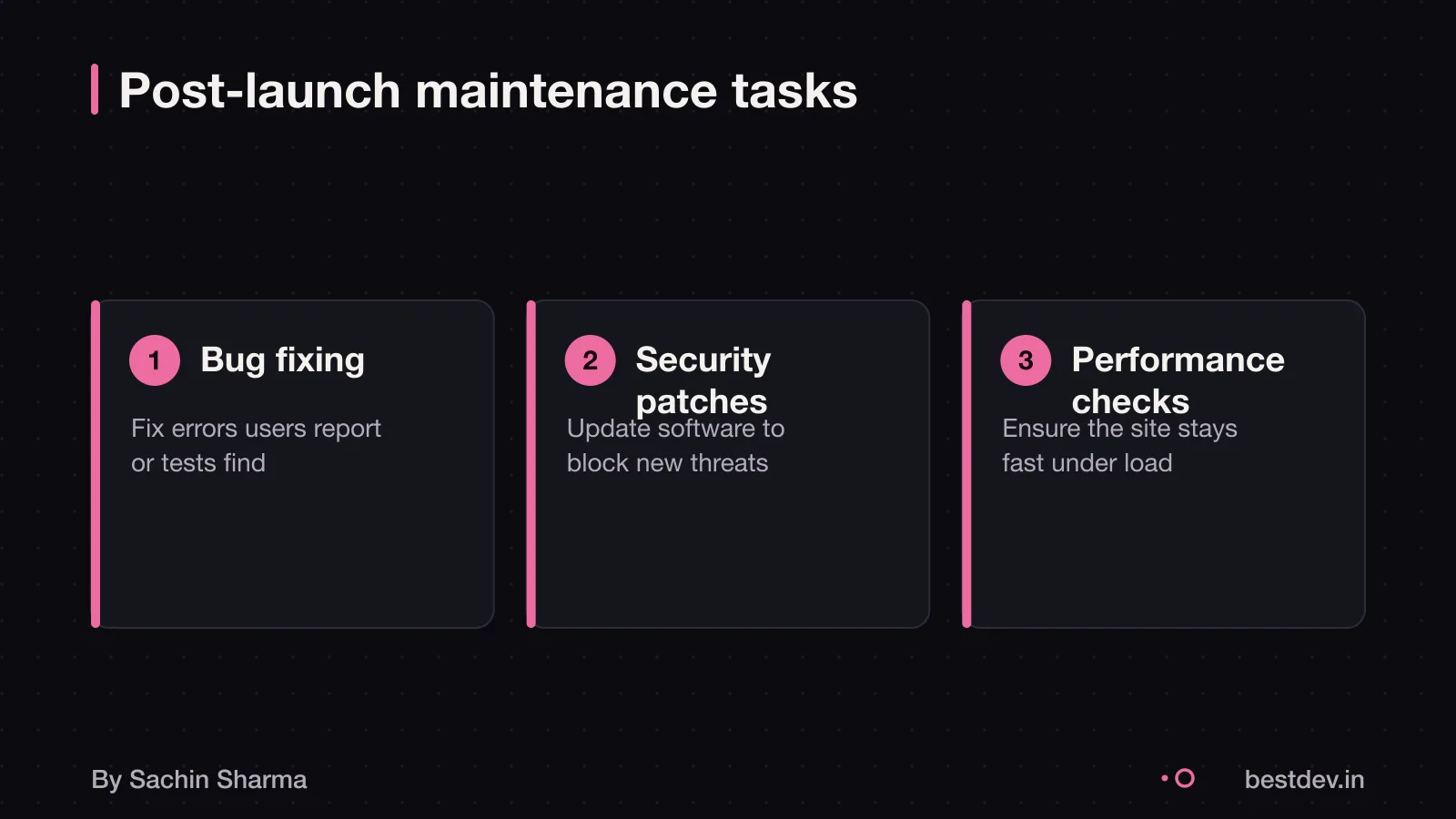
Ongoing tasks include real-time crash reporting using tools like Firebase Crashlytics. You may want to check how fast your app responds on low-end devices. Tracking memory leaks or battery drain is also part of this. You must test forms, validate backups, check cross-browser compatibility, and update third-party scripts like analytics or chatbots. Accessibility and performance scores should be reviewed regularly.
Security updates are critical. Frameworks, libraries, and dependencies must be updated regularly. Regular plugin and theme audits help spot weak points, especially if you use a CMS. Implementing firewalls and DDoS protection is part of security maintenance. Penetration tests are one of the key security activities to run.
If you do not fix bugs or apply patches, small issues can grow. Logs can be monitored and alerts set up to catch problems early, as part of a proactive troubleshooting approach. Without this, crashes may go unnoticed for days. This hurts trust and sales. For example, a broken checkout form could stop all payments without you knowing.
Maintenance also includes version-by-version performance benchmarking. Push notification systems must be checked so alerts reach users reliably. These steps keep your product stable and professional.
Can you move your web product to another developer later?
Yes, you can move your web product to another developer. You need access to your domain, hosting, and a full backup of your website files. This access lets you transfer everything without losing content or breaking links. Without it, you may have to rebuild from scratch.
To move your site, you need login details for your domain registrar, hosting provider, and any content management system or third-party tools. Ask the current developer for a complete backup of your website files. Have them send it to you. With these, a new developer can restore your site on a different platform.
Your domain name is separate from your hosting. You can keep the same web address even after switching providers. Transferring your domain to a new registrar is a low-cost process and rarely costs more than $20.
If your developer refuses to share access or backups, you face delays and extra cost. Make sure your contract requires them to hand over all credentials and data when the project ends. This is not automatic, even if you paid for the work.
Worked example: cost of hiring a mid-level Next.js developer
Statutory contributions add about 5% to the base cost. These include Provident Fund (PF) and Employee State Insurance (ESI), which apply up to certain wage limits. For a ₹18 lakh salary, 5% adds ₹90,000 per year.
For a ₹18 lakh fee, 18% GST applies to domestic clients. The total cost, including statutory and GST, could be ₹22.14 lakh.
| Cost type | Amount (₹) | Based on |
|---|---|---|
| Base salary | 18,00,000 | Estimate, not official market data |
| Statutory (+5%) | 90,000 | |
| GST (+18%) | 3,24,000 | |
| Total | 22,14,000 |
This example assumes a fixed ₹18 lakh fee. Actual costs depend on experience, city, and employment model. Freelancers outside India may not charge GST. Always confirm rates with your accountant.
When this advice is wrong
If the developer cannot handle both frontend and backend tasks, this advice does not apply. Next.js is a full-stack framework, so your developer must manage server-side logic and APIs, not just the user interface. If they lack these skills, your project may face delays or need extra hires.
This could affect disputes over payment for work delivered.
Questions people ask
What should I check before hiring a Next.js developer for a web product?
Check that the developer knows React and server-side rendering, routing, and deployment on platforms like Vercel or Netlify. Since every Next.js developer is a React developer and deployment knowledge helps get apps live. Use a test project to assess their full-stack skills. You can also verify their knowledge with a ReactJS or NextJS online test.
What is a fair way to pay for a Next.js developer for a web product?
Keep unpaid work legally yours until full payment, which gives you use if a client delays or refuses payment. If your contract says IP transfers only after full payment, you have a legal claim if the work is used without paying. Always include this in your contract.
What happens to my code and accounts if we stop midway?
By default, the developer owns the copyright to the code they wrote, even if you paid, unless your contract says otherwise. Your contract should state that ownership of custom code you paid for transfers to you. Confirm the clause covers your specific project, as it only covers custom code, design, or content you created for it. Open-source libraries remain under their own licenses and are not transferred to the client, as they are governed by their original terms. Your general skills and reusable components also remain yours, unless the contract says otherwise. Check this for your case with a lawyer.
How do I verify deployment and hosting control?
Ask the developer about experience deploying on platforms like Vercel, Netlify, or AWS. Confirm they can manage environments and roll back updates. You should get full access to the hosting account and domain after delivery. Use a checklist to verify access.
What if the project takes longer than expected?
Set clear milestones and review progress weekly to avoid delays. If scope changes, update the timeline and budget in writing. Use a contract that allows for adjustments. Communicate early if delays appear likely.
What should I do if the project takes longer than expected?
If the project is delayed, planned milestones and deadlines start to slip. Extended timelines almost always lead to higher costs. Check the contract for clauses on delays and cost adjustments.
How can I tell if a Next.js developer is right for my web product?
A Next.js developer may be suitable for building server-rendered React applications. Check their experience with frameworks like React and familiarity with deployment tools.
What if I have questions while working with a Next.js developer?
You can ask questions about Next.js on GitHub Discussions, Discord, X (Twitter), and Reddit. These platforms help you get support from the community and experts.
Before the first call, here is what to check, in the order it hurts to skip. Tick what you have verified; the page tells you where you stand.
Proof
Process
Ownership
Money
Walk away if
Red flags
- Quotes only a total with no scope
- Won't say who writes the code
- Asks for the whole payment up front
- Keeps the deployment accounts or repository
- Promises a fixed date without seeing a scope
Keep going