Compare
Freelancer or agency, for a first app?
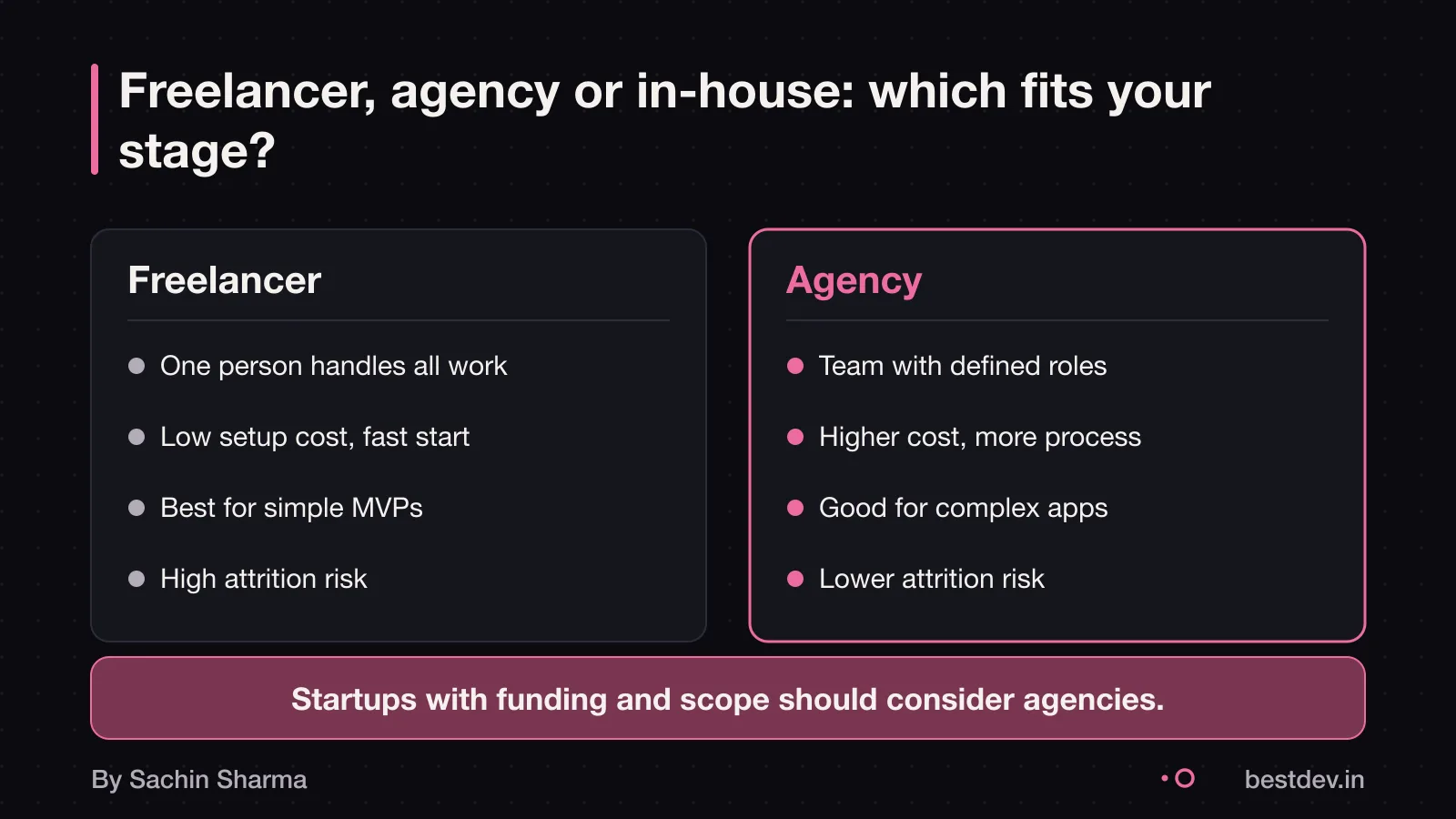
Hire a freelancer if you have a small, clear project with one main task. Choose an agency when your MVP needs a full team for design, development and marketing. Build an in-house team only after product validation and when you can fund salaries for 12 to 18 months.
I am a solo developer, so I benefit from the first answer. That is why the table below also tells you when an agency or in-house team is the better pick.
The full explanation
What are the types of app developers for startups?
A freelancer is a single developer who works on your project part-time or full-time, often remotely. They are self-employed and may work with multiple clients. Freelancer lists mobile app developers as a category of freelancers. For example, you might hire one to build your MVP quickly and affordably.
An agency is a company that provides a team of developers, designers and project managers. Agencies are especially useful when the project is too complex for one freelancer but not yet large enough to justify permanent employees. They handle coordination and quality control. This reduces your management load.
An in-house team is a group of full-time employees you hire directly. In-house development becomes more compelling when software is a long-term core capability. You should consider going in-house when development is continuous. Software must be central to your competitive advantage. You must also have enough financial runway to support permanent employees. For example, a growing startup with a core app may bring development in-house after the MVP stage.
India’s gig workforce is projected to grow to 23.5 million by 2029-30.
When is a freelancer enough for your startup?
A freelancer is the right choice when the scope is small, the requirements are clear. You have the time and skill to manage the work. They may be all you need when only one person is needed for a task. If your app has a narrow scope, a freelancer can be useful. For example, building a basic booking form or a static content site fits this model.
You should not hire a freelancer if the scope is unclear or if you lack technical know-how to guide them. Without clear requirements or time to manage the work, hiring a freelancer may not be the right call. Also, if you need multiple skills like design, backend, and QA, one person may not be enough. Freelancers are not the right choice when speed and scale depend on team coordination.
A freelancer suits founders who can act as product managers. If you are non-technical and cannot review code or timelines, this model may fail. Instead, consider a small agency that provides structure. For simpler needs, see if freelancer or agency for a first app fits your stage.
When should you build an in-house team?
Build an in-house team when your app is the core of a long-lived business. It has been validated, and you can fund salaries for 12 to 18 months. This makes sense only after you have validated the product and have predictable funding for at least 12 to 18 months of salaries. At that stage, continuous development becomes important if software is central to your competitive advantage and you can support permanent staff.
You need funding to cover salaries for at least 12 to 18 months, even if priorities shift. This financial runway lets you hire full-time developers without panic during slow months. If your startup is still testing ideas or lacks steady income, an in-house team is too risky.
Agencies fill the gap before this stage, handling complex builds that freelancers cannot manage alone. Once you scale beyond MVP and need daily updates, ownership, and deep domain focus, in-house becomes compelling. Until then, stay lean.
How much does each option cost?
Freelancers in the U.S. charge $60 to $150 per hour. Agencies charge $120 to $250 per hour. In-house developers cost the equivalent of $60 to $125 per working hour when salary and overhead are included. At ₹83 to the dollar, that is ₹5,000 to ₹12,450 per hour.
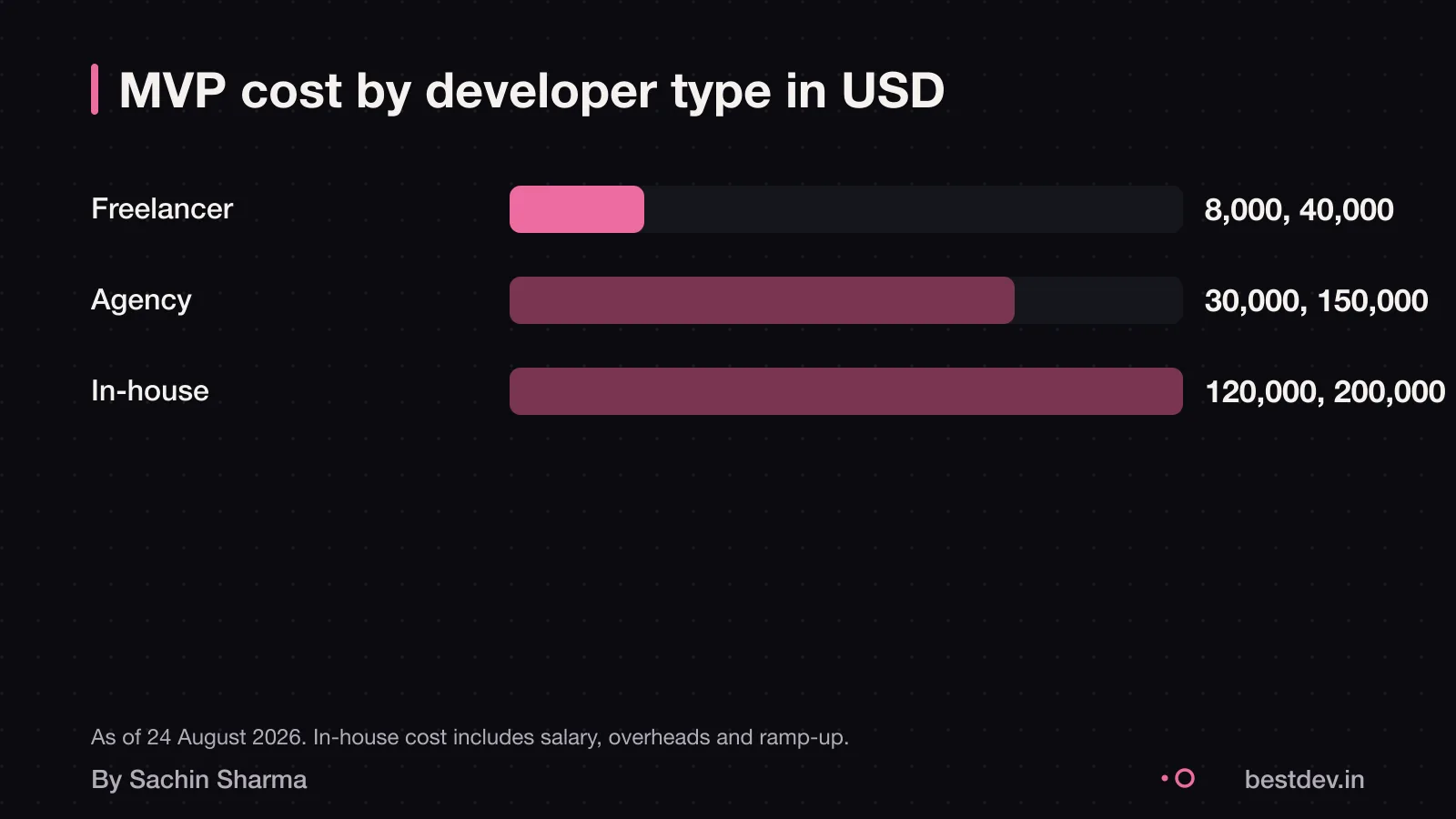
A freelancer-built MVP costs $8,000 to $40,000. Agency-built MVPs cost $30,000 to $150,000. Some functional web-based MVPs fall in the $15,000 to $50,000 range. In rupees, that is ₹6.7 lakh to ₹41.7 crore, depending on scope and team.
Several factors increase cost. A multi-tenant design adds 1.4 to 1.8 times the base cost. Offline-capable mobile apps with sync cost 1.6 to 2.2 times more. AI features depend more on your data than the model, so costs vary widely. Fixed-price projects include a 15 to 30% premium for risk, which is fair if your scope is stable.
For a clearer estimate based on your idea, see the full app development cost in India guide.
What GST and tax rules apply?
You may not have to pay GST on software development services for foreign clients if the service is treated as an export. You file a Letter of Undertaking (LUT), provided payment is in convertible foreign exchange. This is called zero-rating under GST export rules, as export of services is zero-rated under Indian law. You must file a Letter of Undertaking (LUT) with the GST department to claim this benefit.
GST registration is mandatory once your annual turnover crosses ₹20 lakh. If your turnover is below ₹20 lakh, you can operate without GST registration. If you cross it, registration is required within 30 days.
When you deduct tax under Section 194-IB, you must provide the tenant's PAN or Aadhaar. TDS applies under Section 194-I when rent payments exceed ₹50,000 per month. You must have the tenant's TAN if tax is deducted under this section.
Your bank account name must match your PAN exactly. Any mismatch can cause payment rejections or compliance holds. This matters when receiving payments via platforms like Razorpay or PayPal.
For official rules, see the GST portal and the Income Tax Department. Flutter developer hourly rate in India
How long does it take to build an MVP?
A focused MVP takes 8 to 12 weeks to go from defined scope to production release. This timeline applies to both freelancers and agencies if the scope is fixed and clear. However, agencies may start faster because they have designers, developers and QA staff ready. A freelancer might take longer if they handle design and development alone.
Delays can happen if the release scope, technical dependencies, verification requirements, or delivery conditions change. For example, an MVP with multiple user roles, payments or third-party integrations requires different engineering effort than one with a single workflow. Real-time features or AI functionality also add time.
An in-house hire takes 5 to 8 months to go from job posting to full productivity. So even if you plan to bring development in-house later, you need a freelancer or agency to build the first version fast.
Use project management tools to track progress and meet deadlines. Regular communication with your developer helps address questions and keep the project on track. India is 9.5 to 12.5 hours ahead of US time zones, which can reduce working-hour overlap with clients; plan check-ins carefully.
What are the risks of hiring a freelancer?
The main risks of hiring a freelancer are attrition and loss of continuity. Attrition means your developer may leave the project early. As of 2025, developer attrition runs at 13.2% annually. If your freelancer leaves mid-project, you may inherit a half-built app with no one who understands the code. This can delay your launch and raise costs.
Replacing a developer costs 50 to 200% of their annual salary on average. After launch, updates based on user feedback are common, and there is a big chance the freelancer may not be there for you. Some freelancers also lack long-term commitment. This is especially true if they take a full-time job or move to another client.
Freelancing platforms can attract scammers. So you must check reviews, portfolios and past work carefully. Always sign a contract that covers code ownership, deadlines and payment terms. Use milestones and regular check-ins to reduce risk. For longer projects, consider a retainer or shared calendar to keep alignment.
Who owns the code and accounts?
Under Indian law, the author of a freelance or independent contractor arrangement retains copyright unless there is a valid written assignment to the client or commissioner. Under Indian law, the author usually keeps copyright unless a written agreement assigns it to you. This is true even if you paid for the work. To own the code, your contract must include a written copyright assignment signed by the developer.
For in-house developers, works created in the course of employment may vest in the employer. As Section 17(c) of the Copyright Act, 1957 relates to works made during employment. If an employee creates software outside the course of employment and without business resources, the corporation’s claim of ownership may be invalid.
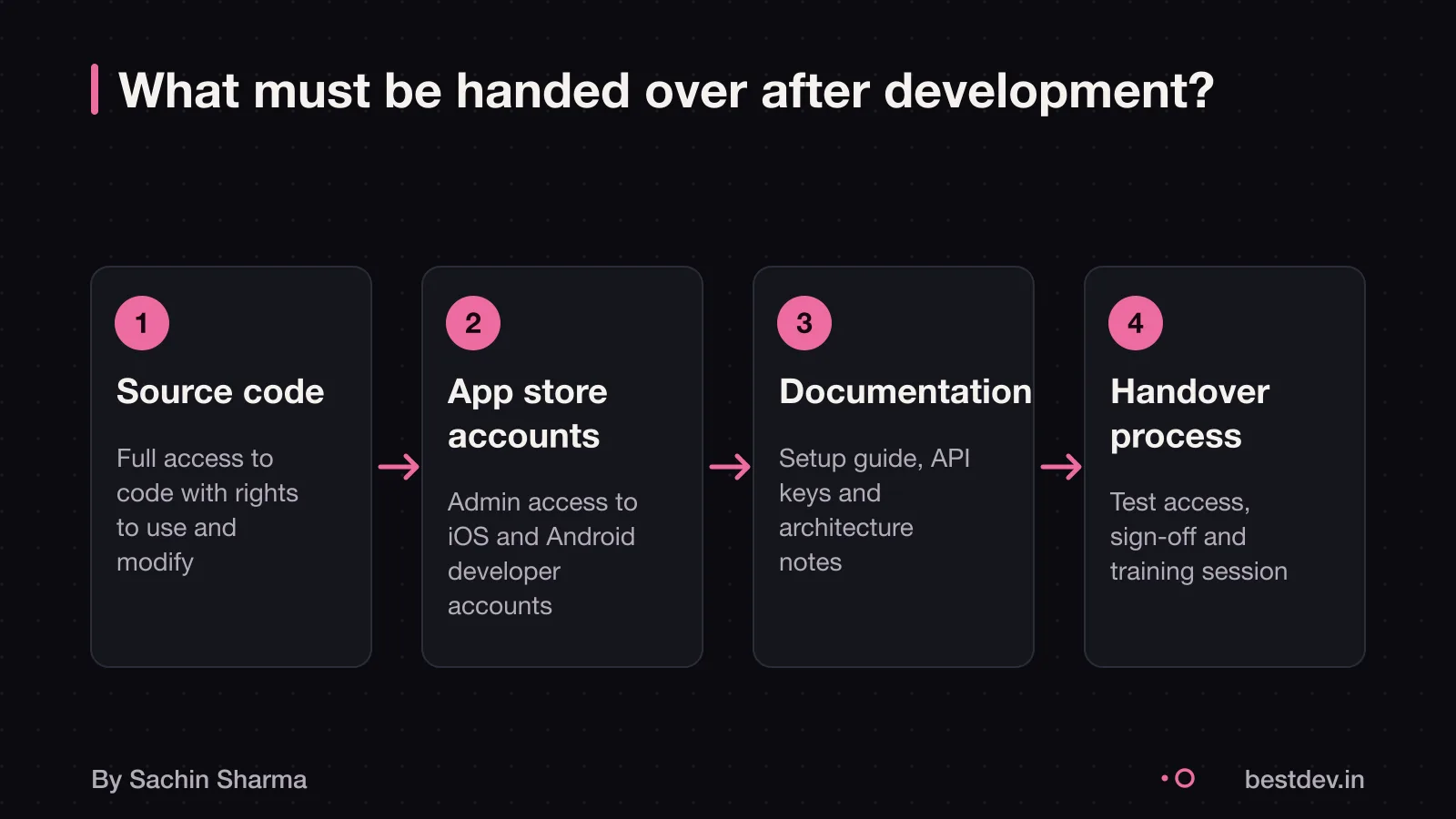
Your company should own all key accounts: source code repository, Apple Developer. App Store Connect, Google Play Console, domain registrar, cloud hosting and analytics.
Include a clause requiring documentation in the code repository for setup, architecture and deployment. This ensures another developer can take over if needed.
Use mainstream, well-documented technologies so you are not locked into one developer. You should own the code if an agency builds your app, but only if the contract says so, according to Navelo Software.
If you need help checking a contract, can I get the source code of my app explains what to look for.
What support comes after launch?
You get app store updates, bug fixes and server checks each year. The cost is 15% to 25% of the build cost. It covers small fixes, security patches and updates for new iOS or Android versions. Without this, your app may stop working or get removed from app stores.
Who handles support depends on who you hired. Freelancers rarely offer formal maintenance. So you must hire them again or find someone new. Some agencies may include a period of free support after launch. Ask each agency about their policy. After any free period, they may charge a fee. The structure and cost vary by agency. Some agencies may offer a dedicated developer for ongoing work. Confirm with the agency directly. In-house teams can handle updates if they have the time and skills. This depends on team capacity and expertise.
Codeventures offers help to build a local or remote technical team once you have funding or revenue. They may use user testing experts to assess the usability and effectiveness of the app after development. Codeventures furnishes analytics data to help refine your business strategy.
As of now, the exact cost of yearly maintenance is not published in the evidence. You should ask each developer you consider: “Do you offer post-launch support? What does it cost? What is included?” If you are not technical, get a developer friend or advisor to review the support plan with you.
How to start the conversation with a developer
Start your first message with a clear goal. Say what your app should do in one sentence. For example, "I want an app that helps therapists track patient sessions and auto-generate notes." This helps the developer understand your vision fast.
Your brief should include the problem you are solving, who your users are, and what the app must do. List key features, like user login, payment, or offline access. Mention if you need Android, iOS or both. Add any design or data privacy rules.
Include your timeline and budget range. If you do not have one, say you are exploring. Ask for a breakdown of cost and time. Ask what they need from you to give an estimate.
Use our app brief template to cover all points. A clear brief saves time and avoids confusion later. It also helps you compare quotes from freelancers, agencies or in-house teams.
When should you not hire a developer yet?
When should you not hire a developer yet?
Do not hire a developer if you have not yet found basic product-market fit. As a rule, do not invest heavily in custom software before you have clear proof that customers want your product. If your current solution, like a manual process or no-code tool, is working well enough, improving it may not be urgent.
A complete redesign or rebuild may be needed when your core product offering has drastically changed or your target audience has shifted completely. Also, seek help only when your current look or function harms conversions, or when preparing for a funding round that demands maturity.
Avoid building anything custom if a simple, off-the-shelf tool can solve the problem today. Many startups waste time and money coding features that are already available.
Questions people ask
Which one is cheaper to run over three years?
The right question is not which option is cheapest, but what the total cost is over three years including management, overhead and risk. This includes hidden costs like delays, rework and knowledge loss. Compare all three models on full lifecycle cost, not just hourly rates.
When does the other option win?
In-house wins when software is a long-term core capability. Agencies win when the project needs multiple roles and you lack a team. Freelancers win for narrow, standalone tasks. Early-stage projects benefit from external partners for strategic input.
Can I switch from a freelancer to an agency later?
Yes, you can switch, but only if your freelancer used well-documented, mainstream tools. Poor documentation or rare tech makes handover hard and costly. Plan for continuity from day one by requiring clean code and setup guides.
What should I ask in the first meeting with a developer?
Ask if they have verified their identity on their platform. Check if they report suspicious requests like free work or off-platform moves. These steps reduce risk and build trust early in the relationship.
How do I protect myself from scope creep?
Define the project scope clearly with deliverables, timelines and expectations. Use project management tools to track progress. Communicate regularly to stay aligned. This keeps both sides on the same page and reduces surprises.
What happens if my developer stops working?
If your freelancer leaves, you could lose half your project knowledge, especially in small teams. To reduce risk, keep full documentation in the code repo. Use common tools so others can take over.
Is a hybrid team (freelancer + agency) a good idea?
Yes, around 65% of companies use hybrid models that mix in-house and external talent. This works well when you need specialist help on top of core staff. It balances control and flexibility.
How much does app maintenance cost per year?
As an estimate, app maintenance costs 15% to 20% of the initial build cost per year. This assumes regular updates, bug fixes and minor feature changes. For a ₹10 lakh app, expect ₹1.5 to ₹2 lakh yearly. Check this for your case with a software developer.
Assumptions behind the numbers
- Focused MVP scope with 10-15 screens
- Standard web or mobile tech stack (no AI or offline sync)
- Clear requirements and minimal back-and-forth
- Payment in USD or stable forex
Pick your situation
Which one is yours?
Freelancer wins. Nothing is lost between a salesperson and the person writing code. A clear scope is the case where one skilled person is fastest.
Side by side
The whole comparison
| Freelancer | Agency | |
|---|---|---|
| Who writes the code | The person you speak to | Often someone you never meet |
| Cost shape | ₹6 lakh to ₹30 lakh fixed or hourly | ₹25 lakh to ₹1.2 crore with overhead |
| Time to start | Quick, if they have capacity | Slower to staff, steady once started |
| Main risk | One point of failure | Hand-offs and who is really on it |
| Breadth | Deep in a few things | Many specialisms available |
| Accountability | One name | A company and a contract |
Whichever you choose
Ask these four questions
- Who exactly will write my code?
- What happens to my code if we stop midway?
- What is not included?
- What does support cost after launch?
- Can I see past client work?
- How do revisions and changes work?
- What if I want to switch vendors later?
Keep going