Cost · Generic
What does it cost to build an app in India?
I won't hand you a number that pretends to be the market. Instead, here is the working: set the features, the team and the platform, and see where the money goes.
The full explanation
Do you need a custom app?
A clinic booking app lets patients pick a service, choose a date and time, pay if needed, and get instant confirmation. It prevents double-bookings. It is a digital tool that helps patients schedule and manage medical visits with clinics easily.
If you run a small practice, a custom app may not be worth it. A standard platform already solves the problem, and you may not gain much from custom software. Off-the-shelf platforms get you live fast, but they have per-seat fees and limited data ownership, along with rigid workflows.
As the clinic owner, you should give timely feedback. Slow decisions from you can delay development. You need final text, images, and legal terms when they are required; missing content and assets can delay work. A private practice or single clinic can use a simple app.
Try no-code AI builders like NxCode, where you describe what you want in plain English, the way you'd explain it to a new employee. Compare off-the-shelf tools and no-code AI builders to see what fits your clinic’s size and goals. AI app builders vs hiring a developer

What does a clinic booking app cost?
The cost depends on features and scope. This type of app works on mobile browsers. It suits clinics with one service and low patient volume.
For a tightly scoped MVP with 3 to 5 core features, one platform and no complex backend, expect to pay ₹3 to 5 lakh. The exact cost depends on how many screens you need. It also depends on whether you use AI for reminders. It also depends on if the app must work offline.
One platform and no complex backend. To understand what drives your cost, see how app costs are built from weeks and rates [/cost/app-development-cost-in-india/].
What features increase the cost?
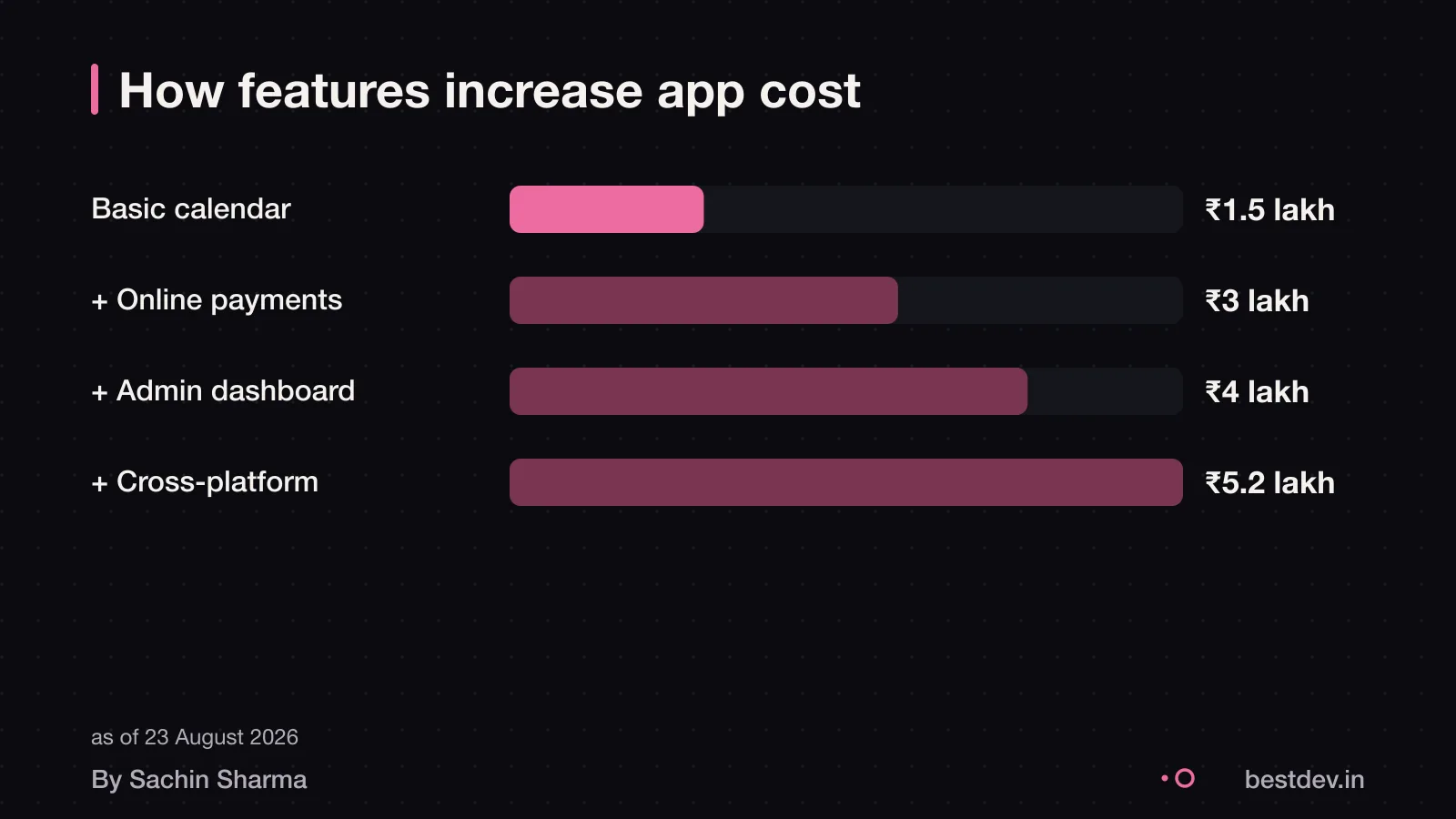
A clinic booking app costs more when you add payments, an admin dashboard, or real-time features. These features are not all needed at launch. Start with core booking and patient records. Add payments and dashboards later if your clinic grows. This keeps early costs low.
Must-have features include appointment scheduling, doctor availability, and patient registration. These form the base app. Nice-to-have features include online payments, SMS reminders, and GPS tracking. They add value but also cost. For example, an admin dashboard adds $5,000 to $10,000. Online payments need PCI compliance and are part of a feature-rich app that typically costs ₹3 to 10+ lakh.
Integrations also raise costs. Linking to lab systems or EHR software requires secure APIs. Each integration may add ₹50,000 to ₹2 lakh, depending on complexity. As an estimate, real-time GPS tracking costs $4,000 to $8,000. That is high for a small clinic. Delay it until demand justifies the cost.
You can cut costs by using ready-made tools. For example, WhatsApp reminders are cheaper than built-in SMS. Google Forms can collect patient data at first. Later, build custom tools when volume grows. For more on what to build now or later, see Must-have vs later features.
Cost of adding online payments
As an estimate, adding online payments to a clinic booking app raises the cost by ₹50,000 to ₹1.5 lakh. This covers linking a payment gateway and extra testing for secure transactions. The larger cost range comes from whether your app handles partial payments, refunds, or insurance claims.
Payment gateway fees in India have five parts. First, MDR (Merchant Discount Rate) or TDR (Transaction Discount Rate) is a cut taken per transaction. Second, a platform fee charged by the gateway provider. Third, 18% GST is applied on the MDR, not on the patient’s payment. Fourth, an annual maintenance cost (AMC) or one-time setup fee. Fifth, costs for failed payments, which some providers pass on to you.
Note that since January 2020, UPI and RuPay debit transactions carry zero MDR at the bank level. This means you pay no transaction fee for these modes, though the gateway provider may still charge a platform fee. Always check the full fee structure before choosing a provider.
For a technical guide on setting this up, see How to integrate Razorpay in Flutter or Next.js.
Is GST charged on development?
Yes, GST at 18% is charged on software development services in India. As an estimate, assuming a 18% tax rate, you should add GST to the base development cost when budgeting. For example, if a developer quotes ₹3 lakh for the app, the final invoice with GST will be ₹3.54 lakh. GST at 18% applies to custom software development as it is considered a service. Keep your technical scope tight to avoid change orders, as each addition also carries GST. Note that GST also applies at 18% to payment gateway fees, but only on the service fee, not the transaction amount. For legal certainty, consult a tax advisor on your specific case.
Developer hourly rates in India
Indian firms charge $10 to $40 per hour for software development. This range applies when the client is based in India and the project is managed locally. The rate depends on the firm's size, location, and the developer's skill level.
As an estimate, senior Flutter developers in India charge $34 to $50 per hour.
Senior Flutter developers in India earn between ₹21 lakh and ₹45 lakh per year. This annual salary helps explain the base cost of hiring full-time talent. Hourly rates for freelance or contract work are often calculated from these salaries, plus overheads like tools, taxes, and business costs.
Rates vary by experience. Entry-level developers charge less, while those with 6 to 10 years of experience command higher fees. Client type also affects pricing. Indian startups and small businesses often pay lower rates than US or European clients, who require stricter compliance and documentation.
For a more detailed view, see the Flutter developer hourly rate in India guide, which breaks down what each rate includes.
How long does it take to build?
A simple app takes 4 to 6 weeks to build. This timeline applies to apps with core features like appointment scheduling, calendar sync, and patient notifications. Medium complexity apps take 2 to 3 months. These need extra time for testing and integration.
As an estimate, assuming standard features and no custom design. AI-powered app builders can create a basic booking app in hours to a day, based on a 2026 trend. These tools work best for clinics that need only simple, standard features and do not require custom design or deep integrations. However, most clinics still choose custom development to match their workflow.
The exact time depends on how fast you make decisions, provide feedback, and share content like clinic hours and doctor names. Delays often come from slow replies, not coding speed.
Ongoing maintenance cost
Your clinic booking app will need regular updates and fixes after launch. Ongoing maintenance includes security patches, compatibility updates for new phone or OS versions. Bug fixes, minor feature tweaks, and compliance checks for data privacy laws. These tasks keep your app safe and working smoothly for patients.
As a rule, plan to spend 15 to 20 per cent of your initial development cost each year on maintenance. For a ₹3 lakh app, that means ₹45,000 to ₹60,000 per year. Some providers charge a monthly retainer: ₹15,000 to ₹30,000 per month for prompt support and updates.
One source estimates the yearly cost after the first year at ₹23,000 to ₹75,000. This range may suit simpler apps. The actual cost depends on how often you update the app. It also depends on how many users report issues. It also depends on whether your developer charges hourly or under a contract. Always ask for a maintenance plan before launch.
Legal and compliance requirements
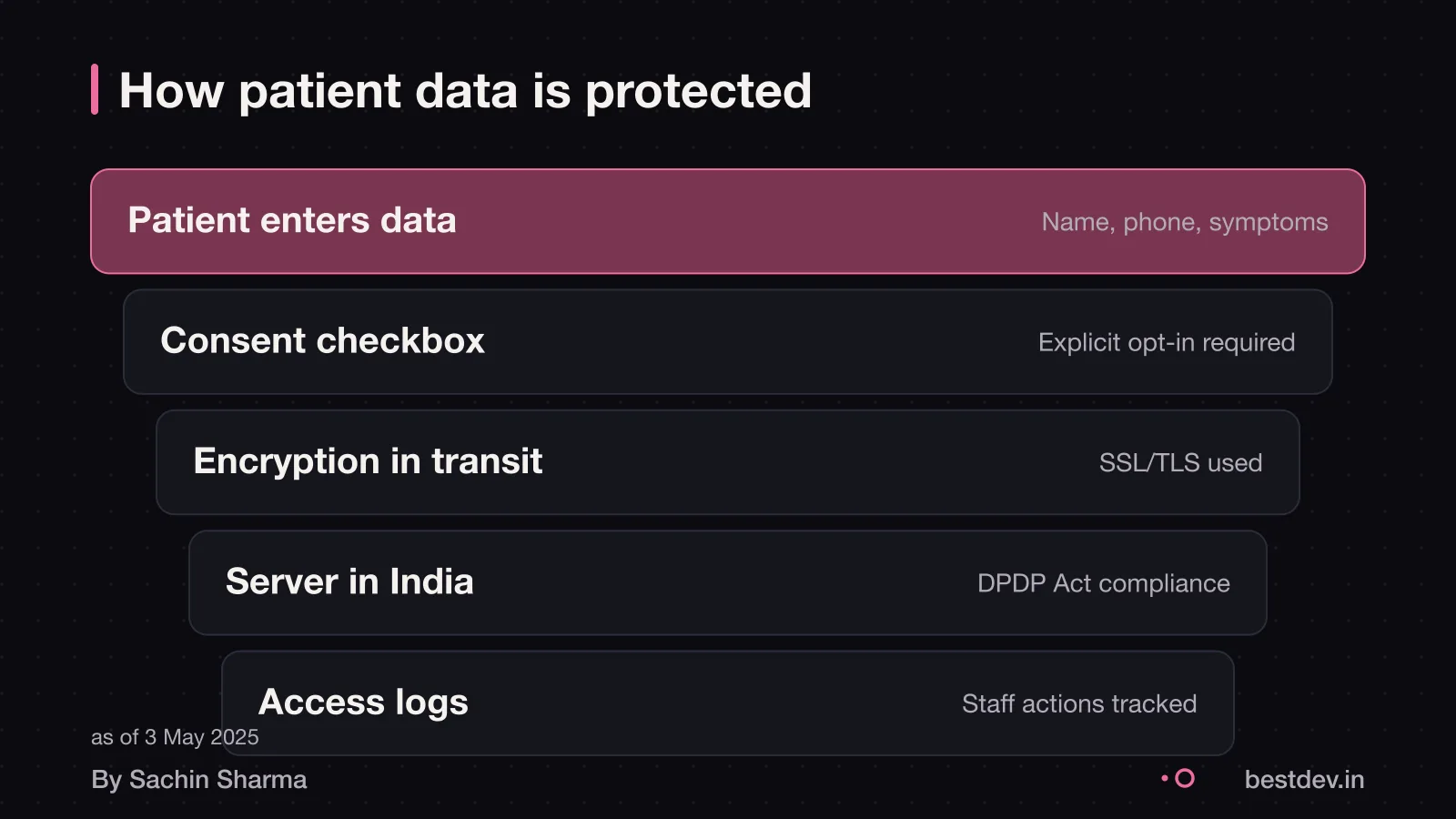
Yes, the Digital Personal Data Protection (DPDP) Act applies if your clinic booking app collects patient data. You must get clear consent before collecting personal data, as required by India's Digital Personal Data Protection Act. You must have clear consent, a privacy policy and data handling processes if you collect personal data.
The Digital Personal Data Protection Rules 2025 were published on 14 November 2025. If you collect personal data, you must follow India's data protection rules.
You need a privacy policy and consent if your app collects personal data, as required by India's Digital Personal Data Protection Act. Consent should be clear and not hidden in long notices.
For step-by-step help, see the DPDP Act consent flows for Indian apps and Software for pharmacies in India: what to digitise first. Legal advice is recommended for your specific case.
Who owns the app code?
You may not own the app code unless your contract transfers ownership. The developer is considered the owner of the source code by default unless a contract clearly transfers the rights to someone else. To gain full ownership, your agreement should include an IP assignment clause, as without it you may not gain full ownership of the software. Without this clause, you may not be able to update, move, or resell the app later.
This is especially true when hiring freelancers or independent contractors. The “work made for hire” doctrine typically does not automatically apply to code developed by freelancers or independent contractors. Unless a specific agreement says so. Without a specific agreement, the freelancer usually retains the initial copyright. Always ask for a written IP transfer in the contract before signing.
To avoid this, make sure your contract includes: “All source code, documentation, and intellectual property rights shall be assigned to the client upon final payment.”
Can I get the source code of my app? explains how to verify handover and store code safely.
Who builds these apps?
You can hire a freelancer, an agency, or build an in-house team. Each has trade-offs in cost, control and risk. An in-house team has a fixed cost of ₹15 lakh per year, with hiring risk. This has a high fixed cost, so it suits long-term product companies.
Freelancers are cheaper but need more oversight. Agencies offer structure but may charge more. In-house gives full control but comes with hiring and management costs. Your choice depends on budget, how complex your app is, and how much time you can spend managing the build.
To verify a developer’s experience, do not rely on websites or promises. Instead, look for substance. Industry experience helps but is not always needed. Instead, check for substance. Ask for live demos or downloadable apps they’ve built. Download at least three apps from their portfolio. Use each for 10 to 15 minutes to test performance. If they refuse to show code or detailed case studies, that is a red flag. Poor communication early on often means bigger problems later. You can also test a live demo like Amelia’s clinic booking system to see how a working system looks.
When not to build a custom app
Use an off-the-shelf tool if your clinic is small and your booking process is simple. Off-the-shelf tools like Calendly and Acuity can get you live fast. You avoid large upfront development fees and long wait times.
A custom app makes sense when your workflow is unique or you are growing fast. But if you are just starting, off-the-shelf tools reduce risk.
Signs you are overbuilding include adding features you do not use today. Examples are multi-location support, staff shift management, or complex reporting. These raise cost and delay launch. Stick to core needs: appointment slots, patient details, and reminders.
Also, do not build custom if you expect to change systems often. A simple tool lets you switch easily.
Next step: get a real quote
Next step: get a real quote Start with a clear message that lists your clinic's size, the number of doctors, and whether you use any digital tools today. A short list helps developers give a fair price. Avoid phrases like “a simple app” or “like Practo”, as they lead to vague quotes. Instead, use a one-page brief that describes your needs in plain terms.
A well-written requirements document can save more than any discount might offer. The right setup depends on how your clinic manages appointments today and which steps take the most time.
Questions people ask
How much does a clinic booking app cost in India?
A clinic booking app can cost ₹1.5 lakh to ₹10 lakh or more, depending on features. Based on pricing tiers from WavX Solutions as of 23 August 2026. A simple web app with calendar, basic booking and single service costs ₹1.5 lakh to ₹3 lakh. A standard app with payments, reminders and admin dashboard costs ₹3 lakh to ₹6 lakh.. A feature-rich app can cost ₹3 lakh to ₹10 lakh or more. A simple web-based version starts at ₹1.5 lakh. Apps with payments and dashboards range from ₹3 lakh to ₹6 lakh. A feature-rich app with payments, notifications and admin dashboard can cost ₹3 lakh to ₹10 lakh or more.
What makes a clinic booking app more expensive?
Costs rise with payments, admin dashboards, notifications, and third-party integrations such as maps, WhatsApp Business APIs and CRMs. Using Flutter for both platforms costs about 30% more than a single native build, but is cheaper than two separate native builds. Each extra integration, like WhatsApp or CRM, can add ₹50,000 to ₹2 lakh.
How long does it take to build a clinic booking app?
A simple app takes 4 to 6 weeks, while a medium-complexity app takes 2 to 3 months. Timelines depend on features like payments or admin access. AI builders may speed this up, but custom logic still takes time.
Is GST charged on app development in India?
Yes, GST at 18% applies to software development services in India. You must add this to your base budget. The same rate applies to payment gateway fees, but on the service fee, not the transaction amount.
Do I need to comply with the DPDP Act for patient data?
Yes, the Digital Personal Data Protection Act applies if your app collects patient data. You must get clear consent, publish a privacy policy, and follow data handling rules. Check this for your case with a privacy lawyer.
Who owns the app after it's built?
You do not automatically own the app code unless the contract assigns it to you. By default, the developer owns the source code as the creator. An IP assignment clause must transfer full rights to you.
How much does maintenance cost per year?
Maintenance costs 15% to 20% of the initial development cost each year. This covers updates, bug fixes, and compliance checks. As an estimate, assuming a ₹5 lakh app, maintenance costs ₹75,000 to ₹1 lakh annually. Annual maintenance costs range from ₹23,000 to ₹75,000 after the first year, based on a fixed-fee model.
Assumptions behind the numbers
- Base cost assumes a single platform and no admin dashboard
- Adding payments increases cost by ₹1.5L to ₹3L
- Admin dashboard adds 2 to 4 weeks of work
- Cross-platform doubles the build effort
- Freelancer rate is $20/hour, agency is $35/hour
I won't hand you a number that pretends to be the market. Instead, here is the working: set the features, the team and the platform, and see where the money goes.
- Scope and design18%
- Build55%
- Testing and fixes18%
- Launch and stores9%
The weeks shown are an example of a small app, there to be changed. Fees you pay others (store accounts, cloud, SMS) are not in this total.
What moves it
Six things that move the price
- Adding online payments
Payment gateway setup and testing adds cost.
- Admin dashboard
A dashboard to manage bookings and users increases scope.
- iOS and Android both
Building for both platforms adds 30% to cost.
- Freelancer over agency
A solo developer may charge less than an agency.
- One platform first
Start with Android or iOS alone to cut cost.
- Using AI app builder
Tools like NxCode can reduce build time.
Not in the total
Fees that go to someone else
Google Play registration
A one-time fee paid to Google. Check the current amount.
Apple Developer Program
An annual fee paid to Apple. Check the current amount.
Hosting and SMS
Monthly cloud usage and SMS bills paid to providers.
Before you sign
Ask for these five things
- How many weeks per phase, and with how many people?
- What is not included?
- Which fees do I pay to others directly?
- What happens to the price when I change my mind?
- What does the first year after launch cost?
Keep going