Service
Mobile app development in Flutter
Add AI features like chatbots, voice or image recognition to your app with clear scope, testable milestones and ownership of code and data.
The full explanation
What counts as an AI feature in an app?
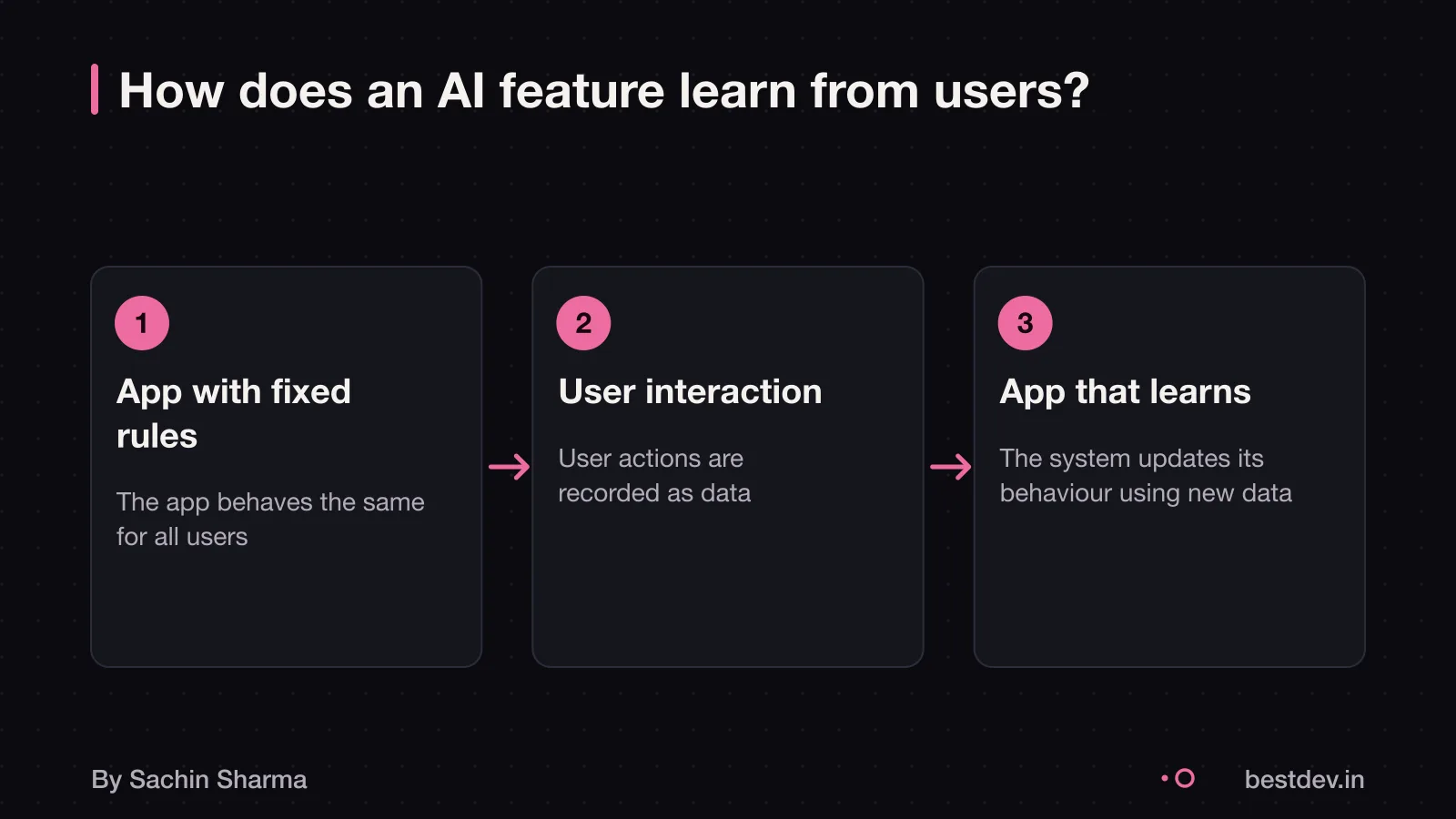
An AI feature in an app is one that learns from data and makes decisions, not just one that follows fixed rules. Simple automation runs the same way every time, like sending a bill on the first of each month. AI can change its behaviour based on new data, such as suggesting different products to different users.
AI can handle tasks that fixed rules cannot, like understanding the mood of a customer message or summarising long reports. It does this by interpreting information and recognising patterns. For example, a chatbot can learn from past support chats to answer new questions it has not seen before.
Yes, an AI feature can learn from user data, but only if it is designed to do so. It uses structured, semi-structured or unstructured data to improve over time. For instance, a recommendation engine might track what users click to suggest better content later.
To connect AI to your app’s data, you may need what an API is. This allows the AI to pull in user behaviour, sales records or other inputs it can learn from.
Is an AI feature the same as a machine learning model?
No, an AI feature is not the same as a machine learning model. AI is the broader idea of machines acting like humans, while machine learning is one way to achieve it.
Machine learning lets systems learn from data without step-by-step programming. For example, a chatbot that improves replies over time uses ML. But not all AI uses ML. A simple rule-based bot that answers FAQs using fixed scripts is AI, but not ML.
Vendors often use "AI" and "ML" interchangeably to sound advanced. This can mislead you into thinking a feature is smarter than it is. Always ask if the system learns from data or just follows rules. If it does not learn, it is not using machine learning.
When does adding an AI feature make sense?
AI makes sense when your business problem has patterns too complex to write down or that change over time. For example, spotting shifts in customer mood from support chats or predicting slow sales days. If the rules are clear and stable, a simple code system works better and is easier to check. Use AI when fixed logic cannot keep up.
AI can work even if you have only a few thousand records. Traditional machine learning does not always need millions of data points. It can find trends in small, high-quality sets like repair logs or invoice notes.
Do not use AI just because it seems modern. It adds cost and complexity. Use it only when it solves a real gap: automating time-consuming tasks, finding hidden insights, or improving decisions with data. If a rule-based system can do the job, start there. You can always upgrade later.
What problems do AI features solve in Indian apps?
AI features help Indian apps solve real, local problems like messy addresses, low credit visibility, and supply chain chaos. They work best when you have data, even if it is imperfect. For example, Snapdeal is building AI to handle messy addresses and make smarter decisions. This shows AI can handle Bharat-scale data problems that rule-based systems cannot.
In healthcare, AI supports doctors by analysing medical images and patient records. It can identify conditions like cancer in medical images and records. Systems then use these insights to assist diagnosis and monitor patients in real time. Cropin applies similar logic in agriculture. It uses satellite data, weather, and farm inputs with AI to predict crop health and supply risks.
A government-backed repository from the India AI Impact Summit 2026 listed more than 110 Indian AI startups. Non-profits working in healthcare, agriculture, climate, financial inclusion, mobility and public services. Google’s 2026 India AI accelerator also picked 20 startups focused on healthcare, climate, legal tech, and physical-world AI.
Meesho is using AI to transform online shopping in India, from cart to checkout. Myntra is using AI across customer experience, merchandising, and fulfillment at scale. Lenders like Hero FinCorp and Navi are using AI in their lending processes. This includes shifting from credit scores to context, and embedding AI as infrastructure. Legease is an AI legal-document platform built with Flutter.
How much does an AI feature cost in India?
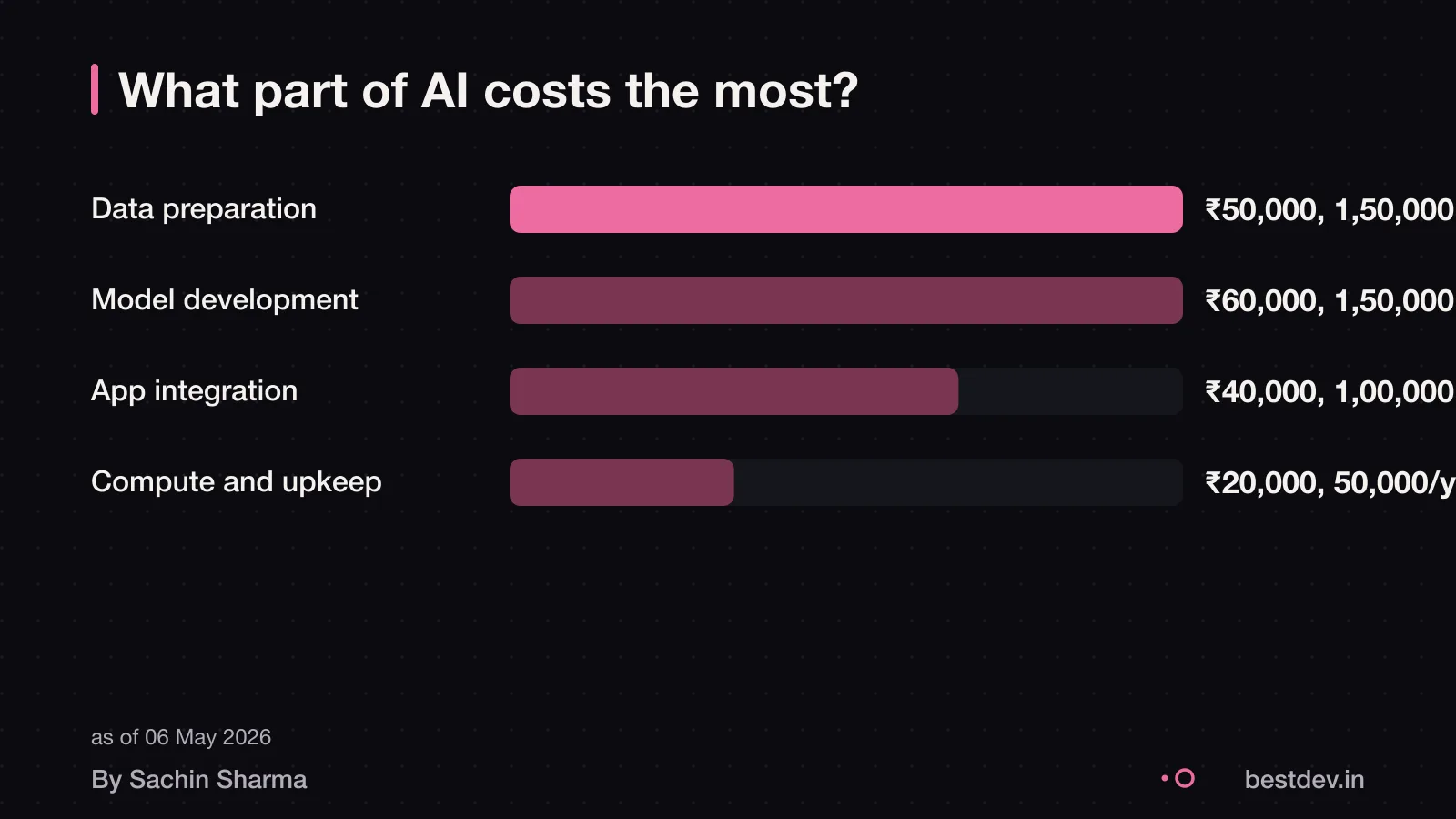
The price varies by feature type. This range covers common features like chatbots, voice recognition, and image scanning. But most of the cost comes from integrating the feature and preparing your data. It is not about building from scratch.
The biggest price drivers are data readiness, integration effort, and ongoing upkeep. These help keep the AI accurate. Four main costs add up: preparing your data, integrating the feature, model usage, and upkeep after launch. The model license itself is usually the smallest part. Teams that quote only the model cost often face budget overruns later.
As an estimate, a basic AI chatbot costs ₹50,000 to ₹1,50,000. Voice recognition costs ₹40,000 to ₹1,00,000. These are one-time build costs. But upkeep is usually needed. Accuracy drifts over time.
Compute costs are a common surprise.
Four habits help control cost. First, use off-the-shelf tools for common tasks. Second, build custom only where it adds value. Third, keep the feature scope small. Fourth, include upkeep in the initial budget.
how app development costs are built explains how AI cost fits into your overall app budget.
How long does it take to build an AI feature?
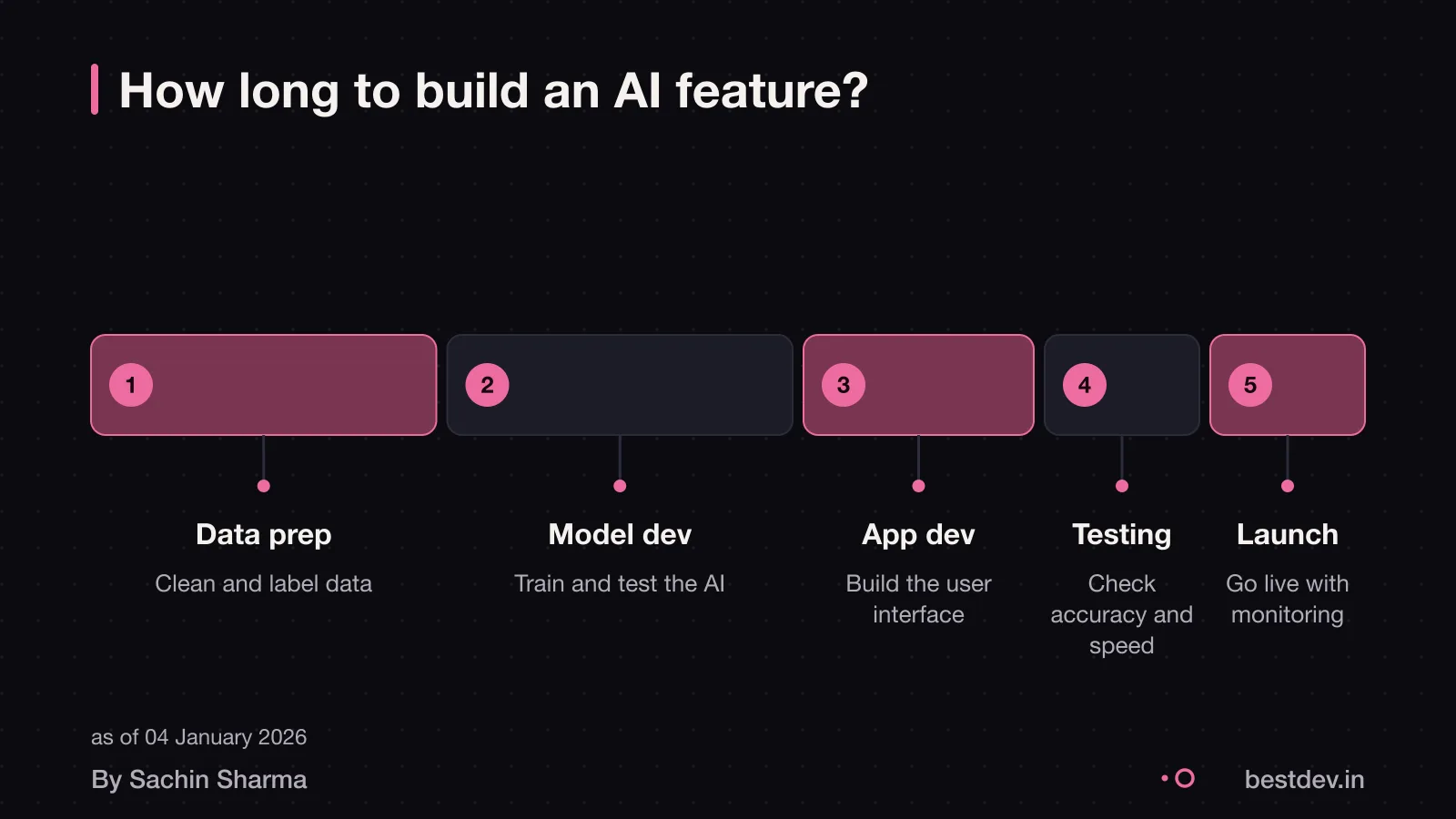
A simple AI prototype takes 2 to 6 weeks to build. This is enough to test your idea using existing AI models or APIs. For example, a chatbot that answers five common customer questions using a pre-trained language model can be ready in this time.
An AI MVP (minimum viable product) takes roughly 2 to 4 months. It takes longer because it must work with real users, live data, and collect feedback. For instance, a recommendation engine that learns from actual user clicks and updates daily needs more setup than a prototype.
Data preparation and model setup can take significant time. Data preparation alone can take 2 to 8 weeks. Cleaning messy customer records or labelling past support tickets takes effort. Model development or selection typically takes 2 to 6 weeks. App development can take 4 to 8 weeks, depending on feature scope and integrations. Testing and deployment usually take 2 to 4 weeks more.
What can go wrong, and what is not known?
- Plan for monthly reviews and updates.
- Ask to see a small working version before paying more than 30% of the cost.
- Ask for a warranty clause that covers rework or partial refund.
- A safe start is to agree on a two-week trial with a clear goal and exit option.
Related reading: consent rules under India's DPDP Act, how Legease uses AI in legal documents, when you can get the source code.
Questions people ask
What should I check before hiring for AI feature development?
Check that the team has expertise in machine learning, data science, and software engineering. Ask if they have built AI apps before, as experience helps avoid common mistakes. Confirm in writing who owns the code and data once the work is done.
What is a fair way to pay for AI feature development?
Pay in milestones tied to working features, not hours. For example, pay 30% on prototype, 40% on testing, and 30% on delivery. Budget ₹50,000 to ₹1,50,000 for an AI chatbot or ₹60,000 to ₹1,50,000 for image recognition. Add 15 to 20% per year for upkeep.
What happens to my code and data if we stop midway?
It depends on your contract. Ask for a clause that gives you the source code if the project stops. Also ask for a data deletion clause to remove your business or customer data from their systems. Without this, you may lose access.
How do I know if the AI feature is accurate?
Test it with real user scenarios before launch. For example, if it sorts support tickets, run it on old tickets and check if the labels match what staff would do. Watch for accuracy drift over time, which can drop by about 15 percent within a year without retraining.
Do I need to comply with India's DPDP Act for AI?
Yes, if your AI uses personal data. You should get clear consent and explain how the data will be used. Because some AI tools may use inputs to train models by default unless you opt out, as of 2026. Some AI tools use inputs to train models by default, so check the settings. Check this for your case with a chartered accountant or lawyer.
Can I use an existing AI model instead of building one?
Yes, using pre-trained models or APIs saves time and data. For example, use Google's Vision API for image scanning instead of training your own. This works well if your needs are common, like text or voice recognition. Clean data speeds this up.
What team size is needed for an AI feature?
One person can build a small or learning-focused AI app. But a production-level feature usually needs a team with skills in machine learning, data science, and software engineering. For business-critical apps, a team reduces risk and delays.
Assumptions behind the numbers
- Data readiness: 4 weeks (adjustable)
- Team size: 2 people (developer and data handler)
- Upkeep period: 2 years (typical for small businesses)
Add AI features like chatbots, voice or image recognition to your app with clear scope, testable milestones and ownership of code and data.
The deal
What is in it, and what is not
- 01Written scope with AI functions
Chatbot dialogues, voice commands or image labels defined in plain language, with fallbacks and version two items named.
- 02Design and flow mockups
Core AI interaction paths drawn before code, so changes stay cheap and expectations match output.
- 03AI model and integration
Model trained or adapted to your use case, integrated into your app with offline or retry logic if needed.
- 04Test builds at milestones
Working feature on your device at each stage: scope, core flow, full feature and store-ready version.
- 05Code and model handover
Repository in your name, trained model files, and documentation on how inputs map to outputs.
How it runs
Four milestones, each one testable
- 1AI scope and data plan
You can test: Defined AI feature, data sources and success criteria agreed.
- 2Prototype with sample data
You can test: Basic AI function working on your device with placeholder or sample inputs.
- 3Integrated and tested
You can test: AI feature linked to app flow, tested with real or synthetic data.
- 4Live and documented
You can test: Model deployed, store builds submitted, code and docs handed over.
Fit
Right for you, and not
Right for you if
- You have a clear problem AI can solve better than rules.
- You can provide or collect the data needed to train the model.
- You want to talk to the person coding and training your model.
Look elsewhere if
- You need a large team for unrelated features at the same time.
- You expect a one-line brief to produce accurate AI behavior.
- You need hardware-specific AI like robotics or AR overlays.
Price
How it is priced
Base cost comes from published ranges for common features, with a 40% buffer for compute overruns and 15–20% yearly upkeep. Exact price depends on data readiness, team size and upkeep years. Adjust sliders to see impact.
Before you sign anything, with anyone
Five questions to ask
- Who owns the trained model and the data it processes?
- Is the AI logic baked into the app or called via an API?
- What happens if the model behaves unexpectedly?
- Can I test the AI with my own data before launch?
- What compute and hosting costs will I pay directly?
Quick answers
Questions
What kind of data do I need?
Structured data like spreadsheets works well for classification. For chatbots, sample dialogues. Voice and image need clean, labelled examples. Quality matters more than quantity in small models.
Can I update the model later?
Yes, but retraining requires planning. Budget 15–20% of build cost yearly for upkeep and tuning.
Do I own the AI model?
That must be agreed. Some developers retain model rights. Ask for ownership of trained weights and logic in your contract.
Keep going