Compare
Freelancer or agency, for a first app?
Start with a website unless your customers need daily access without internet — that’s when an app wins. A responsive web app lets you test interest first.
I build both apps and websites. I benefit if you choose either, but I advise starting with a website to reduce risk.
The full explanation
What is the real difference between a website and an app?
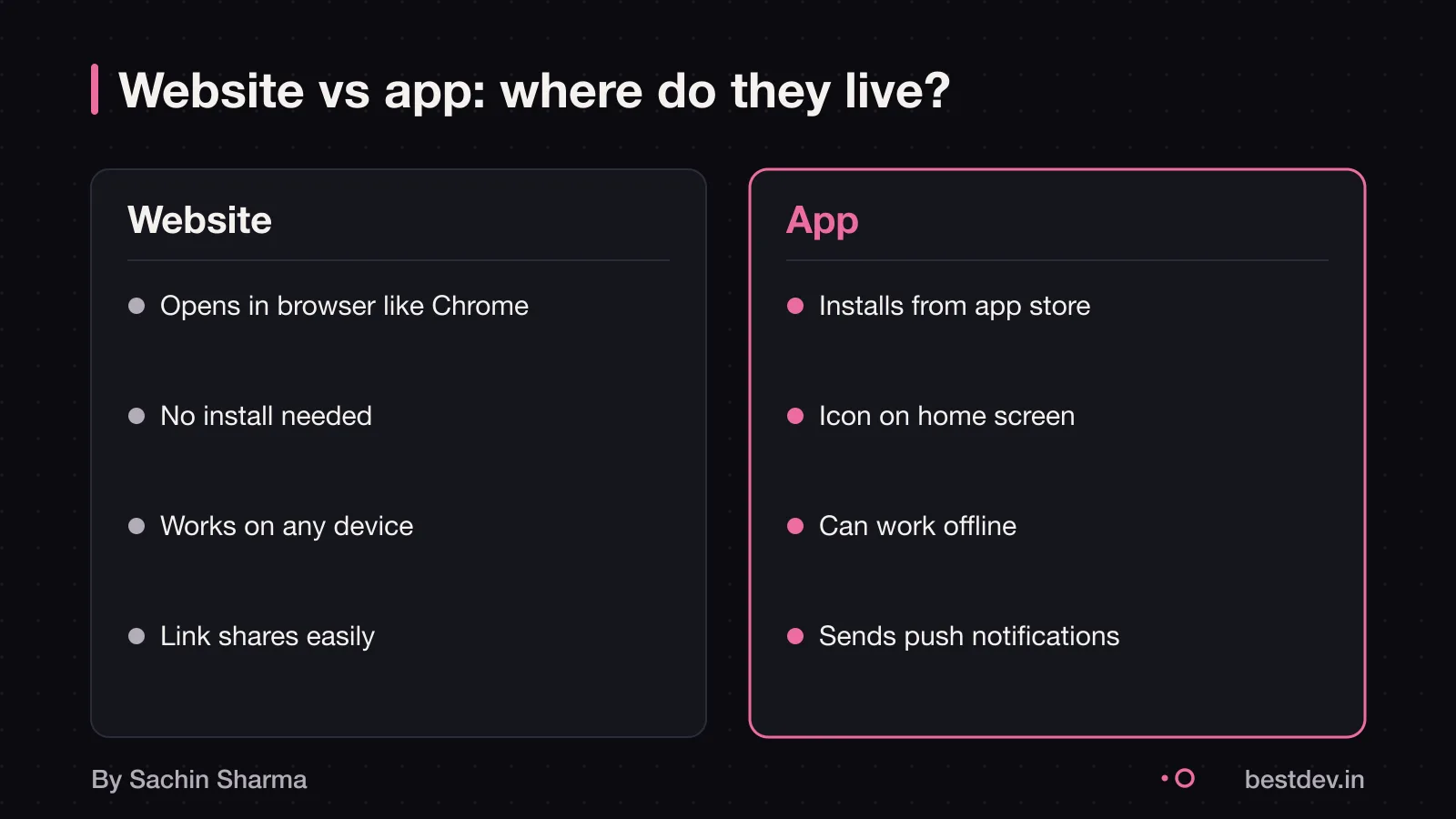
A website runs in a browser and usually needs internet to work. You reach it by typing a URL or clicking a link. It works on any device with a browser, from phones to laptops. The content lives on a server and loads each time you visit.
A mobile app is software you install from the Google Play Store or Apple App Store. It runs on your phone and can work without internet. Some use cross-platform tools like Flutter, which can be used to build mobile apps.
A Progressive Web App (PWA) is your website with an app-like shell. It can install on the home screen, send push notifications, and work offline. It uses a thin native container that loads your live URL, similar to a WebView. This is different from a native rebuild. Which recreates your site as a mobile app using platform code or a cross-platform framework like React Native.
Websites are easier to find on Google Search, social media, and affiliate links. This gives them an SEO advantage that helps your business show up in search results. Apps rely more on app store ratings and paid ads for discovery.
For example, a food cart with a website can appear when someone searches “best vada pav near me.” That same cart needs ads or word-of-mouth to get downloads if it only has an app. You can learn What an API is to understand how both talk to servers.
When each wins
When a website wins
A website is easier to find and rank on search engines. This makes websites better for global reach and attracting new customers.
If you run an online store, a website lets visitors compare products. They can read long descriptions and view many images without downloading anything. You can update prices, stock or content instantly. There is no app store approval delay. Fast updates matter when you run time-sensitive offers or news.
Websites work on any device with a browser. You do not need to build separate versions for Android and iOS. This cuts cost and effort. For most small businesses in India, a website is enough to start and grow.
When an app wins
An app wins when your service is used daily and needs offline access or device features. If customers use your product every day, an app stays on their phone. It is easier to open.
Some apps use geolocation, push notifications, and local data storage to improve user experience, especially in areas with poor internet.
Native apps are faster because they cache data on the device. They do not reload pages each time. On tablets or foldable phones, adaptive apps give a better experience. Users on large screens spend 9 times more in dollar value than phone-only users.
Retailers use websites to attract shoppers. They use apps to retain them. If your goal is long-term engagement, not just discovery, an app may be worth the extra cost. For more details on what a Flutter app includes, see What a Flutter app includes.
Which costs more to build?
A simple mobile app MVP in Delhi NCR costs ₹50,000 to ₹1,50,000. This range covers a simple app, with key factors including the number of screens and backend complexity. The cost can rise with more third-party integrations such as payment gateways or maps. For example, adding a payment gateway means testing each one like Apple Pay, Google Pay or Stripe, using their SDKs and sandbox environments.
A basic website’s cost is not published in the evidence. As an estimate, assuming a 5-page static site with contact forms and SEO setup, costs may start lower than an app. But dynamic features may increase the price, though exact figures are not in the evidence.
Both website and app development attract 18% GST in India. This tax applies to development services; confirm exact scope with a tax professional. Hosting, maintenance, and SaaS tools also carry 18% GST.
Apple charges $99 per year for a developer account. Google charges a one-time $25 fee for the Play Store. These fees are separate from Indian GST, which applies to development services.
Hidden costs include backend servers, third-party API subscriptions, and updates for OS changes. Maintenance is ongoing and not included in the initial build cost.
Which costs more to run over three years?
A website costs less to run over three years than an app. Hosting, domain, and email are paid yearly.
For a website, Squarespace hosting is $276 per year. A.com domain is $15 per year. Google Workspace email is $72 per user per year. Over three years, this totals $1,089 (₹90,750 at ₹83/$).
An app has extra fees. These are in addition to any hosting for backend services. Over three years, Apple’s fee alone is $297. This makes app running costs higher.
Maintenance and updates are not priced in the evidence. These depend on how often you change features or fix bugs. You may need a developer for updates, which adds cost. As this data is not published, you should ask your developer for a maintenance quote.
How long does each take to build?
A basic business website takes 2 to 3 weeks to build in India. This assumes you reply to approvals within a day. A landing page takes 5 to 10 days to build. E-commerce sites take 3 to 8 weeks. In contrast, a native mobile app built by an agency takes 2 to 6 months.
Delays happen when feedback is slow. If you take a week to reply to approvals, a 3-week website can take 7 to 8 weeks to ship. Slow feedback overall can add 1 to 3 weeks to any project.
Scope creep is another major delay. Adding features mid-build can push timelines by 2 to 8 weeks. This risk is higher with apps, as they involve more screens, permissions, and platform rules.
To avoid delays, fix your scope in writing before work starts. Set a 24-48 hour turnaround for every review. If new ideas come up, park them for phase two. For faster results, start with a website unless your service needs offline access or daily use.
How to hire a developer in India to avoid common delays from miscommunication or slow processes.
What do Indian users actually do?
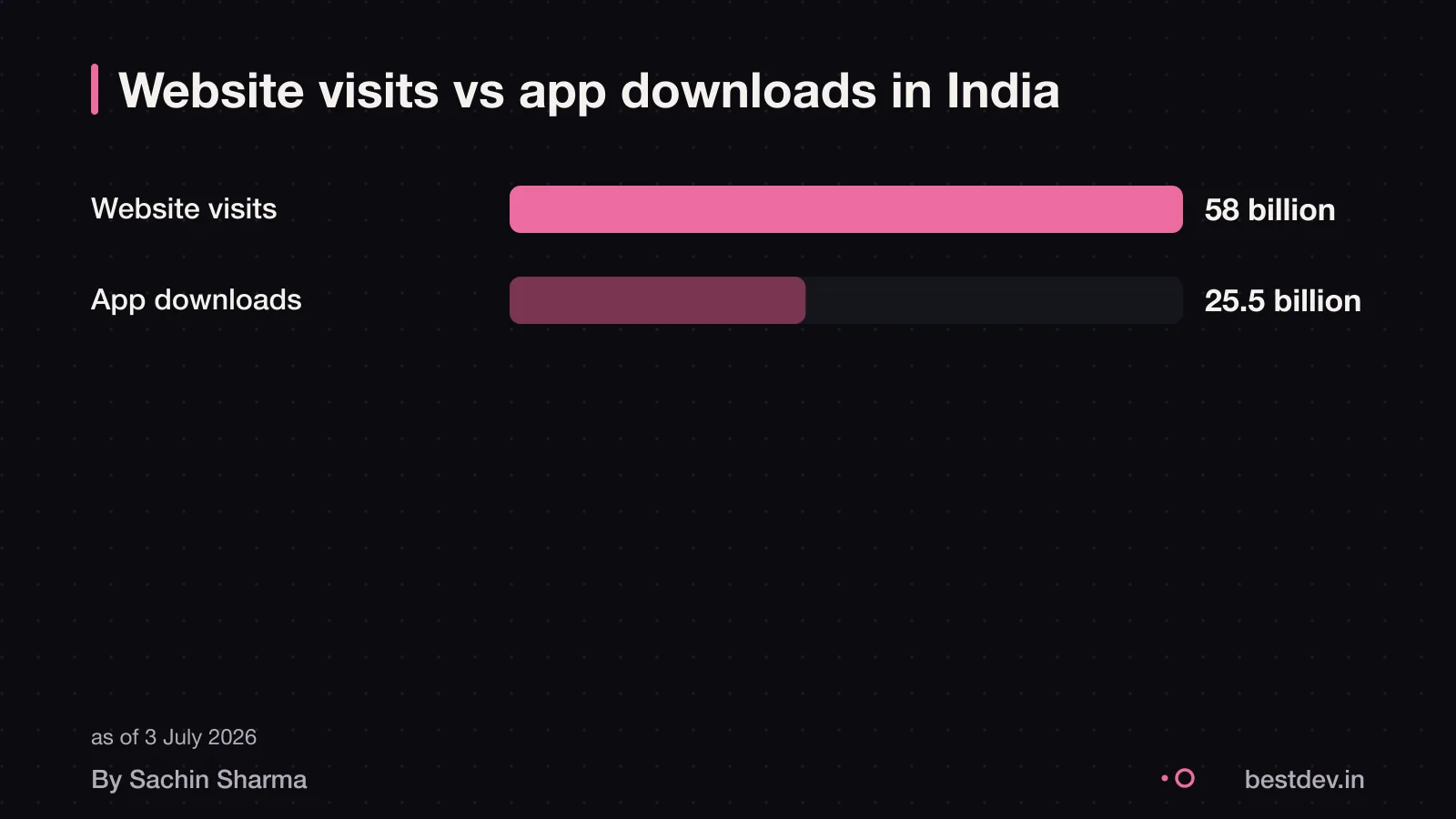
Indian users visit websites far more than they download apps. India had 25.5 billion app downloads in 2025, according to a report covering that year. In the same period, India recorded nearly 58 billion e-commerce website visits. Website traffic grew 28% year-on-year, faster than any other major market. E-commerce app downloads in India grew only 6% between Q2 2025 and Q1 2026. This shows websites are gaining ground faster than apps.
Fashion and beauty businesses see strong growth on websites. India averaged nearly 1.4 billion monthly visits to fashion e-commerce sites in early 2026, the highest globally. Traffic to e-commerce websites in the beauty sector surged 116% year-on-year. These sectors rely on discovery and visuals, which websites support well through search engines and social sharing. Most users still browse on browsers first, even if they later install an app.
What legal and tax rules apply?
You need a GSTIN if your yearly revenue in India exceeds ₹40 lakh. This rule applies even if you sell online or through an app. Without a GSTIN, you cannot claim input tax credit or issue valid tax invoices.
See our guide on DPDP Act consent flows to understand what your app must do.
Apple’s App Store rejects apps that are just repackaged websites. If your app does nothing more than show your website in a browser window, it will likely be rejected. Apple reviews apps to ensure they offer real functionality or content not already available in browsers. The review process takes less than 48 hours for 90% of submissions, typically.
Penalties for breaking the DPDP Act can be severe. Fines go up to ₹250 crore per violation category. These penalties apply regardless of whether you run a website or an app. Tax penalties for not registering under GST when required include fines and interest on unpaid tax.
Legal advice varies by business type and data use. Talk to a lawyer if you handle sensitive data or expect high revenue. Do not rely only on this summary for compliance.
Can I switch from website to app later?
Yes, you can start with a website and add an app later. Use your user analytics to decide when to move, as user behaviour can guide your next step.
When you move, map old URLs to new ones. Update internal links. Submit a new sitemap.
Set up server-side 301 or 308 redirects from old pages to new ones. Avoid chains of redirects. Go straight from old to new. Keep these redirects active for at least one year to protect your search ranking.
Keep your branding, tone, and core service consistent. Users should feel it’s the same business, just a new way to access it. Track bounce rate, DAU/MAU ratio, and retention after the switch. Monitor how users respond.
When should you not build either?
Build a website only when you have real customer interest. If you have no customers yet, start with WhatsApp or social media. These tools let you talk to buyers, test your idea, and take orders without code or cost.
Many small businesses in India use WhatsApp as their first online presence. You can share photos, prices, and offers. If customers reply and buy, you have demand. Then a website makes sense.
If your idea is untested, do not pay for software yet. Use a Google Form or Instagram post to see if people respond. When ten or more ask to buy, you have a signal. Then start building.
A website helps when you need to show trust, take online payments, or scale support. An app comes later, when users need daily access or offline use. Until then, keep it simple.
How to hire a developer in India if you are ready to start building.
Worked example: Which should a food cart pick?
Worked example: Which should a food cart pick?
A food cart could consider a website to help customers find it online. Retailers will increasingly use websites to attract shoppers and apps to retain them.
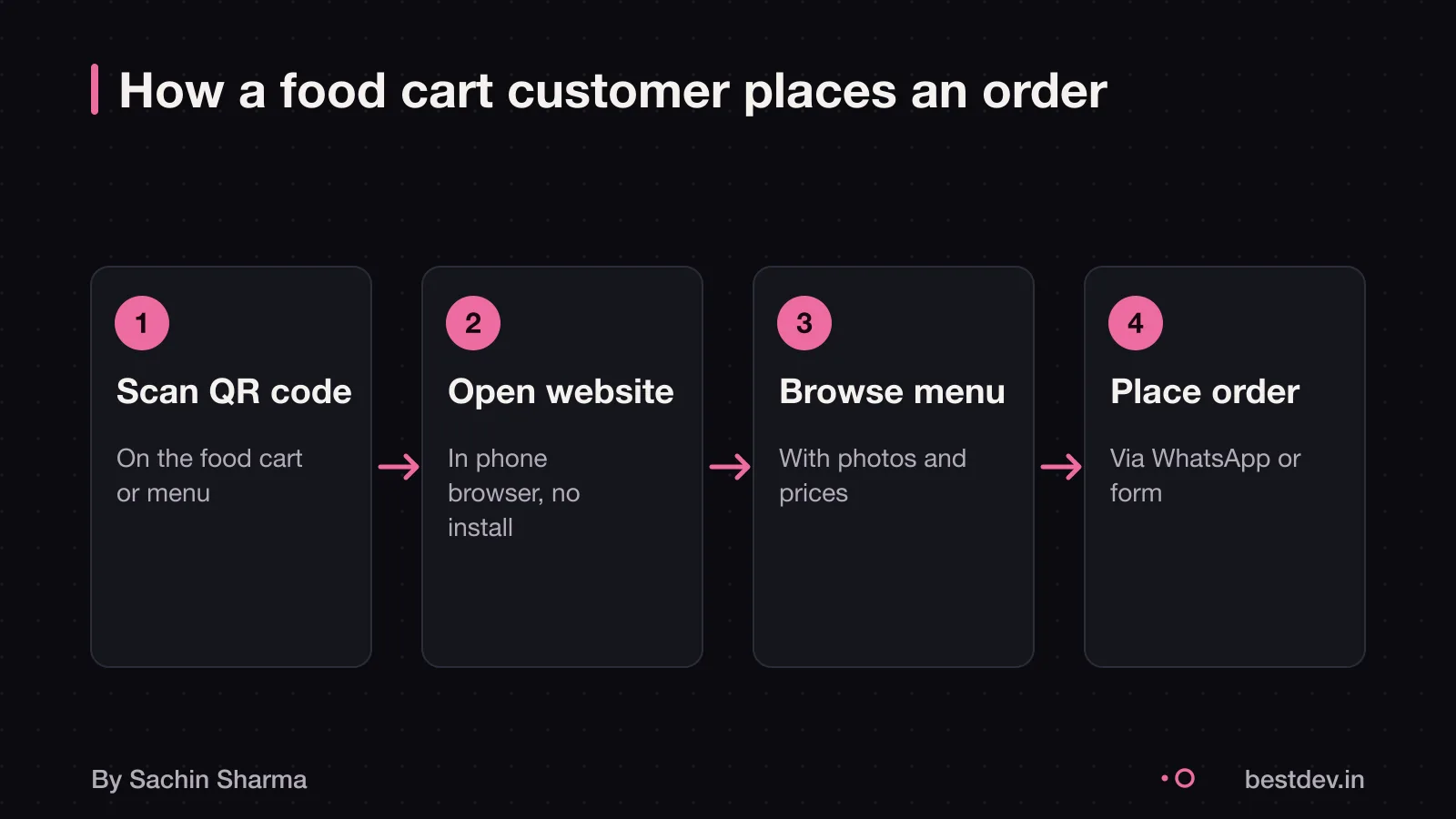
An app is not needed at first. Apps work best when customers use them daily, like for ordering or loyalty points. But most food cart visitors come once or twice a week. A website with a menu, location map and contact form meets their needs without extra cost.
A website typically takes 2 to 3 weeks to build, while an app takes 2 to 6 months, as of 2026. You can add features later based on real user behaviour. For example, if analytics show repeat visits from the same users, you can build an app for loyalty rewards later.
Start with a responsive web app, a website that adjusts to different screens. If retention grows, consider an app. If traffic stays low, improve the website first.
What to do next: building a business website may take 2 to 3 weeks. Share it on WhatsApp, Google Maps and social media. After 60 days, check which pages are visited most and whether users message or call you. Use that data to decide on an app.
When this advice is wrong
Start with an app if your customers use your service daily. Frequent users stay longer and spend more in apps. An app makes sense when daily access is key.
Choose an app if internet is unreliable for your users. Websites need constant internet. Apps can work offline and sync later. This helps in areas with weak or no connectivity. It keeps your service usable at all times.
Pick an app first if you already have a loyal user base. Existing customers are more likely to download an app. They use it regularly.
Questions people ask
Which one is cheaper to run over three years?
A website is cheaper to run than an app over three years. Hosting, domain, and email costs add up to about ₹30,000, while app store fees and maintenance push app costs higher.
When does the other option win?
An app wins when your service needs daily use, offline access, or device features like camera or GPS. Apps can help retain users and improve engagement on devices like tablets and foldables.
Can I switch later?
Yes, you can switch from a website to an app or vice versa. Use user behaviour data to decide, and maintain redirects for at least a year.
Do I need GST registration for my website or app?
Yes, if your annual revenue exceeds ₹40 lakh, you need GST registration. E-commerce sellers must register regardless of sales volume. Check this for your case with a chartered accountant.
Is a PWA as good as a native app?
A PWA feels like a native app but lacks some features. It installs to the home screen and works offline, but iOS limits PWA capabilities.
How do I decide between app and website for my business?
Start with a responsive website and monitor bounce rate, DAU/MAU ratio, and retention. Let user behaviour guide your decision.
What if I start with a website and later need an app?
You can build an app later using insights from your website’s user data. This reduces risk and justifies the app investment.
Are there businesses that should start with an app?
Yes, if your service is used daily, needs offline access, or uses device features heavily. Apps that work well on large screens see higher user engagement, and users spend 9 times more in dollar value than phone-only users.
What hidden costs should I know about?
Apple charges $99 per year, Google a one-time $25 fee. GST at 18% may apply to development costs. Maintenance costs are extra.
How can I test my idea before building?
Launch a responsive web app first. Track bounce rate, retention, and DAU/MAU ratio to see if users engage deeply.
Assumptions behind the numbers
- Website cost range is estimated as ₹25,000–75,000 based on typical landing/business site pricing.
- App cost range taken from evidencefor Delhi NCR.
- Time to build website and app taken fromandrespectively.
Pick your situation
Which one is yours?
App wins. Apps offer faster load and smoother interactions for daily use. They also allow push notifications.
Side by side
The whole comparison
| Website | App | |
|---|---|---|
| Runs on | Browser via URL | Device after install |
| Offline use | Possible with PWA setup | Built-in with caching |
| Notifications | Limited (browser only) | Full support (push alerts) |
| Initial cost | Lower (₹25,000–75,000) | Higher (₹50,000–1,50,000) |
| Time to launch | 2–3 weeks | 2–6 months |
| SEO and sharing | High (link-based) | Low (app store only) |
| Updates | Instant (server-side) | Via app stores |
Whichever you choose
Ask these four questions
- Can I convert my website to an app later?
- Will my users lose data if we switch platforms?
- What features work only in apps?
- How do I track user behavior on a website?
Keep going