Cost · Generic
What does it cost to build an app in India?

I won't hand you a number that pretends to be the market. Instead, here is the working: set the weeks, the people and the rate, and see where the money goes.
The full explanation
What is an MVP, and how is it different from a full app?
An MVP is the smallest, simplest version that solves the core problem and teaches you something. A full app has many features, polished design and smooth performance. An MVP focuses on one core problem and skips the rest.
An MVP can be as simple as a landing page, a Figma mockup or a cardboard prototype. For example, you could test demand for a delivery app with a landing page or a Figma mockup showing how it works. Then ask if people would sign up. You can test interest with a landing page or mockup, no code needed. The goal of a quick, cheap MVP is to test whether your idea has any life in it.
If you do build a basic app as your MVP, it should do just one thing well. Like letting users book a service or save a habit. You can add more later, once you know people want it. This saves time and money. Compared to building a full app no one uses. For how external tools like payment or maps work in your MVP, see What is an API?.

Do you actually need an MVP, or can you test cheaper?
An MVP is worth it when you must test a product idea before spending heavily on features no one wants. Around 35% of startups fail because there is no market need. Building an MVP first helps you test your core assumption with real users, reducing risk. It is the right choice when your idea is unproven and you need fast, real-world feedback.
But you do not always need to build software to test your idea. Many founders validate demand using landing pages, pre-orders, or manual services before writing code. For example, you could run a small ad campaign to a mockup and see if people sign up. If no one cares, you save the cost of development.
An MVP makes sense for small businesses when the risk of failure is high. The cost of being wrong must be more than you can afford. It lets you spend a little to learn a lot. Yes, you can build an MVP on a limited budget by focusing on one problem and launching in phases. This keeps costs low and learning fast.
Still, ask yourself: can you test the idea without any app at all? If yes, do that first. Only build when you need real user interaction that a mockup cannot give. When a developer beats an AI builder explores when custom work adds value over faster tools.
What does an MVP cost in India in 2026?
A directory costs ₹2 lakh to ₹5 lakh. A marketplace MVP costs ₹5 lakh to ₹10 lakh.
Freelancers charge ₹2.5 lakh to ₹5 lakh for MVPs, with higher risk but suitable for simple MVPs. They suit simple projects with lower budgets. They offer a balance of cost and quality.
A landing page MVP tests interest. It uses a single page and a call to action. A directory lists items or people. It includes search and filters. A marketplace adds payments, user accounts, and order tracking. This raises cost. Freelancers may cut corners to meet low rates. Agencies spread risk across teams. But they charge more overhead.
For example, a food delivery MVP has user login, restaurant listings, cart, and payment. It falls in the marketplace range. A simple habit tracker has offline sync and reminders. It costs less, near the directory tier.
The exact cost to add user login or payments is not stated in the evidence. You should ask each developer for a line item on these features.
You can compare MVP costs for different app types to understand price ranges.
What makes an MVP cost more or less?
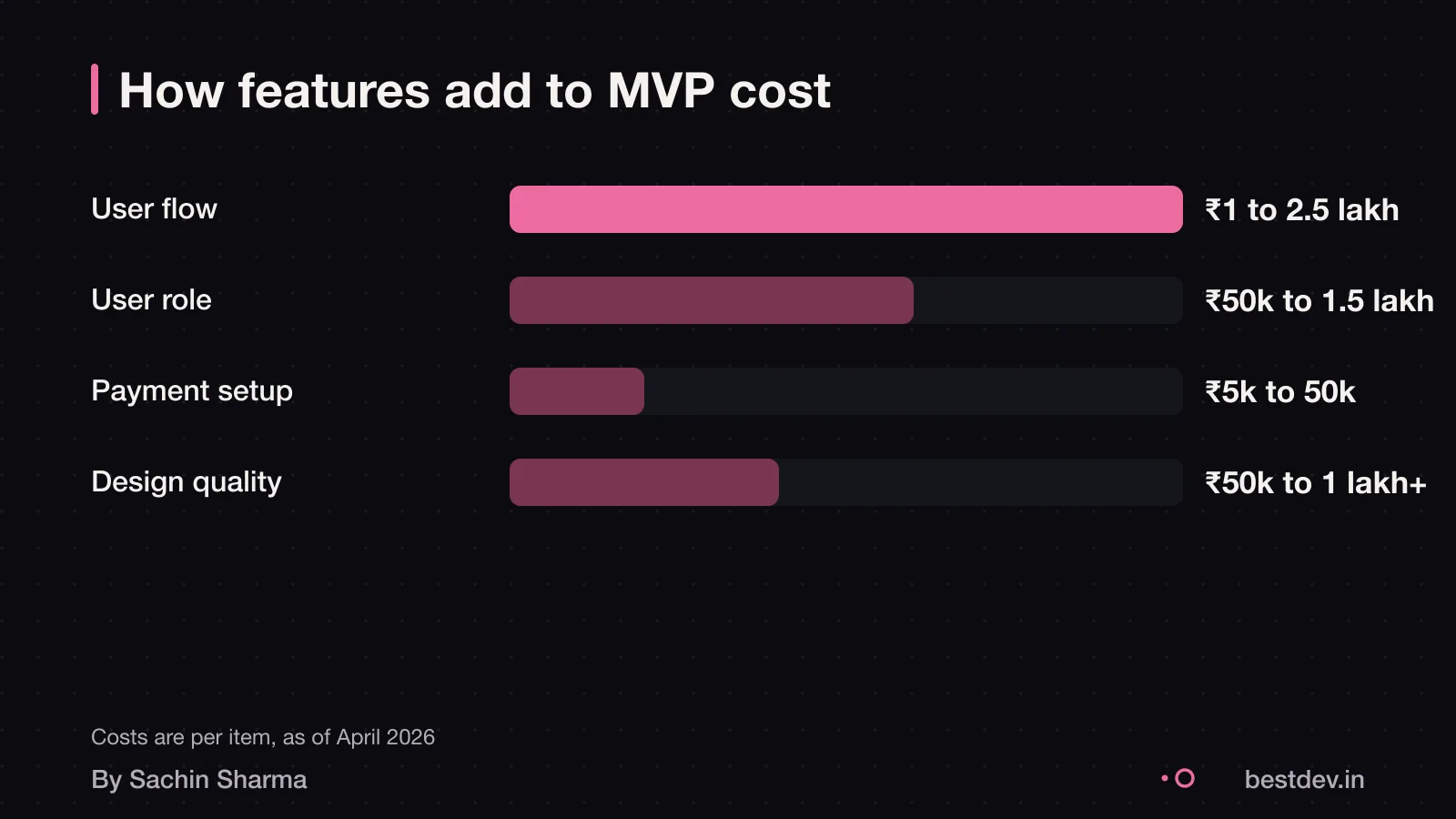
The cost of your MVP can depend on user flows, roles, and tech choices. Each core user flow adds ₹1,00,000 to ₹2,50,000 to the MVP cost. For example, a delivery app with sign-up, order placement, and tracking counts as three flows. Each additional user role that needs a separate interface and permissions adds ₹50,000 to ₹1,50,000.
Your tech stack also changes the price. Simpler stacks using proven tools like Flutter for mobile or Next.js for web can lower costs and speed up delivery. Complex or rare technologies may raise prices due to fewer developers and longer testing. Your tech stack choice is one of several cost drivers, along with scope and team structure.
Team structure affects budget too. Freelancers may charge less but could miss deadlines. Agencies add overhead but often bring process and QA. A single developer like me works directly with you, cutting delays. Simpler MVPs focus on one function, such as user signup and data submission, and cost less. Moderately complex ones include multiple flows, backend links, and basic dashboards, raising the price.
What is included in a standard MVP price quote?
A standard MVP quote in India covers coding, design, and project management. These are the core tasks needed to build the app you can test with users. Most quotes do not include testing and quality assurance (QA) as part of the base cost. As an estimate, testing and QA can add $2,000 to $15,000 to your total.
Discovery research, such as user interviews and market analysis, is also not part of most standard quotes. As an estimate, a discovery phase costs ₹50,000 to ₹1,00,000. This depends on how deep the research goes. This step helps you shape the right product before writing code. But many skip it to save money.
For example, if you want a habit-tracking app like Loopin, the quote will cover the screens, the app logic, and the project plan. It will not cover checking every user path for bugs. Nor will it pay for talking to 20 potential users before design.
If you need full confidence in your idea, ask for discovery and testing as separate line items in your quote. You can also learn what to expect from a developer. Read more on how to hire a Flutter developer for your first app [/hire/hire-a-flutter-developer-for-your-first-app/].
How long does it take to build an MVP in India?
A basic app takes 2 to 4 weeks, while a SaaS or B2B product takes 3 to 6 weeks. MVPs are faster than full apps because they test only the core idea.
Delays happen when the brief is unclear. A vague brief leads to five rounds of questions, each taking 1.5 days, adding 7.5 days before work starts.
Scope has the biggest impact on time. Over-scoping can double the timeline and cost for every extra feature. Ship with fewer features.
MVP development timelines are significantly shorter than full-scale app development. See how long it takes to build a quick commerce app for more details.
Who should build your MVP: freelancer, agency, or no-code?
A freelancer, agency, or no-code tool can build your MVP, each with trade-offs in cost, speed, and risk. Choose based on your budget, tech skill, and how complex your idea is.
A freelancer may charge ₹2.5 lakh to ₹5 lakh for an MVP. This is cheaper than most agencies, but you take on more risk in quality and timelines. Freelancers work best when your MVP has simple features, one user role, and clear goals. You must manage them closely, as delays or miscommunication are common.
They offer better project management, design, and testing than most freelancers. This makes them a safer choice for apps with multiple screens, user roles, or integrations. Big agencies charging ₹15 lakh and above may be overkill for most MVPs.
You can build your MVP using no-code tools like Bubble, which has a basic plan at $29 per month. As your app grows, costs for a no-code platform like Bubble may rise to $115 per month or more. No-code works if your idea has low logic, no custom code, and you can learn the tool. It gives you full control but limits what you can build.
Each option has its place. Freelancers suit simple MVPs on tight budgets. Agencies suit founders who want reliability and support. No-code suits hands-on founders with time and simple ideas. Compare all three by asking what is included, how long it takes, and what happens if things go wrong.
For help choosing, see our guide on Freelancer or agency for a first app?.
What are the risks and how do you check a quote?
A vague brief leads to an expensive quote because uncertainty raises costs. To avoid this, give a clear scope that focuses only on your core risk. When comparing two quotes, do not just look at price. Instead, compare product complexity, core feature scope, technical requirements, user expectations, and business objectives. A cheaper quote may cut corners or miss key features.
Your contract must be certain to be enforceable under Indian law. Avoid vague terms like "and more" or "full-featured". For a five-figure experiment, use a simple, one-page agreement that is honest and clear. Make sure it includes a written assignment clause so you legally own the code after delivery. A written assignment clause is required to transfer copyright under Indian law. Without it, the developer may still hold rights to your app.
You should own your accounts, data, and code from the start if you are building a business you are staking your livelihood on. Check that the quote includes handover of source code, admin access, and third-party accounts. If a developer refuses to sign over ownership, that is a red flag. Other red flags include no written contract, promises of unrealistic timelines, or pressure to pay 100% upfront.
For example, two quotes may both say ₹5 lakh. But one includes only three user flows and a written assignment clause, while the other promises ten features but no ownership transfer. The second is riskier. Always read the scope line by line.
How to hire a developer in India covers the full process, including background checks and milestone planning.
Who owns the code and accounts after delivery?
By default, the person who writes the code owns the copyright, not you. A paid invoice or handshake does not transfer ownership unless there is a written agreement. To gain ownership, you must have a written assignment of copyright. This should be signed before or at delivery.
Ownership transfer should happen only after the corresponding payment clears. You should receive access to the code repository, all passwords, API keys, and app store accounts. Do not accept a one-time zip file. You need ongoing access to rebuild and re-publish the app yourself. Insist on GitHub access from day one for code ownership.
At handover, you should get: access to the code (preferably via GitHub). All account logins (hosting, domain, app stores), API keys and where they are stored. You should also get a plain-English guide to the system. You should also get a short window for the developer to answer questions. For Apple, app transfers require at least one live version and the developer’s cooperation.
If you want to switch developers later, you can move the app out of their account only through a formal transfer. It needs their active help. To avoid future issues, get a clear handover plan in writing before work starts.
Can I get the source code of my app? explains how to secure your rights and what to ask for in the contract.

What happens after MVP delivery?
After delivery, the original developer should offer a support window of 2 to 4 weeks to answer your questions. This helps you or a new team fix small issues or understand how the code works. Support does not cover new features or major changes.
For a ₹5 lakh MVP, that is ₹50,000 to ₹75,000 per month. This covers updates, minor bug fixes, server monitoring, and security patches. Maintenance is not included in the initial quote and must be budgeted separately.
You can add new features later, but each one adds cost and time. The price depends on complexity, design, and integration needs. Post-launch maintenance is one of the biggest cost drivers for an MVP. Plan for both support and ongoing costs before launch.
See real examples of delivered work in Projects by Sachin Sharma.
When this advice is wrong for you
When this advice is wrong for you
Do not build an MVP if your idea is untested and you have no way to get real user feedback. An MVP helps most when you can test it with actual customers, as lack of market need is a common cause of startup failure. If you cannot reach users, start with a landing page or survey instead.
If you have a large budget and need all features from day one, a full product build may make more sense than an MVP. This advice focuses on low-cost testing, not full-scale development.
If you are in a regulated industry like health or finance, basic MVPs may not meet legal rules. You might need compliance steps early, such as data audits or licensed workflows, which change cost and design. Talk to a legal expert before starting. Talk to a legal expert before starting.
Questions people ask
How much does MVP development cost in India?
An MVP in India costs ₹50,000 to ₹1.5 lakh for a landing page, ₹2 lakh to ₹5 lakh for a directory. ₹5 lakh to ₹10 lakh for a marketplace as of April 2026. Freelancers charge ₹2.5 lakh to ₹5 lakh, while mid-tier agencies charge ₹5 lakh to ₹12 lakh. The final cost depends on your app's type and features.
What makes MVP development more expensive?
Each additional core user flow adds ₹1,00,000 to ₹2,50,000 to the MVP cost. Each new user role that needs a separate UI and permissions adds ₹50,000 to ₹1,50,000. Other cost drivers include platform choice, tech stack, team structure, and compliance needs.
How long does MVP development take and what do I pay at each stage?
A basic app MVP takes 2 to 4 weeks, a SaaS or B2B product MVP takes 3 to 6 weeks. You typically pay a 20% to 50% deposit upfront. Payments follow milestones like approved designs or working builds. A small amount may be held back for 30 to 90 days after launch to help ensure post-launch bugs are fixed.
What should be included in an MVP?
A simple MVP includes one core feature like user signup and data submission. A moderately complex MVP adds multiple user flows, backend integrations, and basic analytics. A SaaS MVP must have user auth, billing, and database links. Keep only what tests your idea.
How do I know if I need an MVP or a full app?
Build an MVP if you need to test whether your idea works with real users. A full app is for scaling once you know the market wants it. An MVP can be a landing page, mockup, or app with one feature. Start small to avoid waste.
What are the legal requirements for MVP development in India?
Your contract must be certain and in writing to be enforceable. A written assignment clause is needed to transfer code copyright from the developer to you. Even a simple one-page agreement is enough for early experiments. Check this for your case with a lawyer.
How do I protect my idea when hiring a developer?
By default, the developer owns the code they write, not you. To protect your idea, get a written assignment of copyright signed before or at delivery. This ensures you own the code, data, and accounts from the start. Check this for your case with a lawyer.
Can I build an MVP on a low budget?
Yes, you can build an MVP on a low budget by focusing on one problem and using no-code tools. Platforms like Bubble cost $29 per month for a basic plan, and may cost $115 per month or more as your app scales. This lets you test your idea without heavy coding costs. See if a no-code tool fits your needs.
What if my MVP fails?
Around 35% of startups fail because there is no market need. But an MVP helps you learn this early, before spending more. Use feedback to improve or pivot. Failure at this stage saves money and time. Learn what users actually want.
Assumptions behind the numbers
- User flows: 1 to 5
- User roles: 1 to 3
- Has payment gateway: yes/no toggle
- Has auth system: yes/no toggle
- GST included: yes/no toggle
- Developer day rate: ₹10,000 to ₹25,000
I won't hand you a number that pretends to be the market. Instead, here is the working: set the weeks, the people and the rate, and see where the money goes.
- Discovery and scope11%
- Design22%
- Build44%
- Test and fix11%
- Handover and launch11%
The weeks shown are an example of a small app, there to be changed. Fees you pay others (store accounts, cloud, SMS) are not in this total.
What moves it
Six things that move the price
- More user flows
Each extra core user flow adds ₹1,00,000 to ₹2,50,000.
- Extra user roles
Each role needing separate UI adds ₹50,000 to ₹1,50,000.
- Adding auth or payments
Payment gateway setup costs ₹5,000 to ₹50,000. Auth systems add backend work.
- Fewer platforms
Cutting to web-only or Android-first halves the work.
- Clear scope upfront
Avoiding changes mid-build saves costly weeks.
- Using ready components
Managed services for auth, payments and cloud reduce custom work.
Not in the total
Fees that go to someone else
Payment gateway setup
One-time fee of ₹5,000 to ₹50,000.
Annual maintenance
AMC for services like payment gateway: ₹2,400 to ₹9,999/year.
App store fees
Google Play: $25 one-time. Apple: ₹6,000/year.
GST on fees
18% GST applies on top of transaction fees.
Before you sign
Ask for these five things
- How many weeks per phase, and how many people?
- Is GST included in the quote?
- What is not included in the base cost?
- Will adding auth or payments change the price?
- What happens if I change scope mid-way?
Keep going