Cost · Generic
What does it cost to build an app in India?
I won't hand you a number that pretends to be the market. Instead, here is the working: set the weeks, the people and the rate, and see where the money goes.
The full explanation
What is a cloud kitchen app?
A cloud kitchen app is a digital platform designed for food businesses that operate without dine-in facilities. It helps manage orders from home delivery, takeaway and in-car dine-in services. You can manage multiple kitchens through a single interface, with separate tabs for each kitchen. A cloud kitchen POS can bring orders from DoorDash, Grubhub, Uber Eats and direct orders into one dashboard with auto-acceptance, as one example shows.
Why build your own app instead of using Swiggy or Zomato?
You lose money on Swiggy and Zomato because they take a cut of each order. Swiggy 22% to 28% and Zomato 18% to 25%. As a result, most cloud kitchens get 70% to 95% of their orders from these platforms. This means you depend on them for sales, but your profits are lower on every dish sold.
You can keep more profit with direct orders. Operators who move orders to their own channels usually see 25% to 40% better margins on those sales. Without platform commissions, more of the customer’s payment goes to you. This extra margin helps cover app development costs over time.
With your own app, you gain full control over branding, customer data and promotions. You are not limited by Swiggy or Zomato’s interface or rules. You can offer loyalty rewards, collect feedback and re-engage users through push notifications. You also own the customer relationship, which makes repeat sales easier.
For a balanced view, read: Build or buy a quick commerce app: three routes compared.
App or website: which tech choice fits your cloud kitchen?
A website is enough for most cloud kitchens starting out. It lets customers order directly, avoids Swiggy or Zomato commissions, and improves margins by 25 to 40% on those orders. You may keep control over branding with a commission-free platform, as Restroworks states it help owners with control and branding.
An app adds value only when you need features like offline access, push notifications, or loyalty tracking. For most, this is not worth the extra cost. Native apps cost more because they need separate code for iOS and Android.
Cross-platform tools like Flutter can reduce costs and shorten development time by using one codebase for both platforms. Flutter also supports web and desktop deployment from the same codebase.
You can order through WhatsApp or Instagram, but those are not scalable. They work for testing demand, not for growth.
No-code tools can speed up application creation for simple needs. They help when developer resources are limited. But if you need to connect to your POS system or inventory, you may need custom coding. As no-code tools might not support links to internal systems. Start with low-code if your app might grow complex, to keep your options open.
For most cloud kitchens, a mobile-friendly website built with a cross-platform framework is a good start. It costs less, works faster, and covers most needs.
You can compare full tech stack options for quick commerce apps: Best tech stack for a quick commerce app in India.
To decide what to build first, see what features matter most: Quick commerce app features: must-have vs later.
Cost drivers and cheapest start options
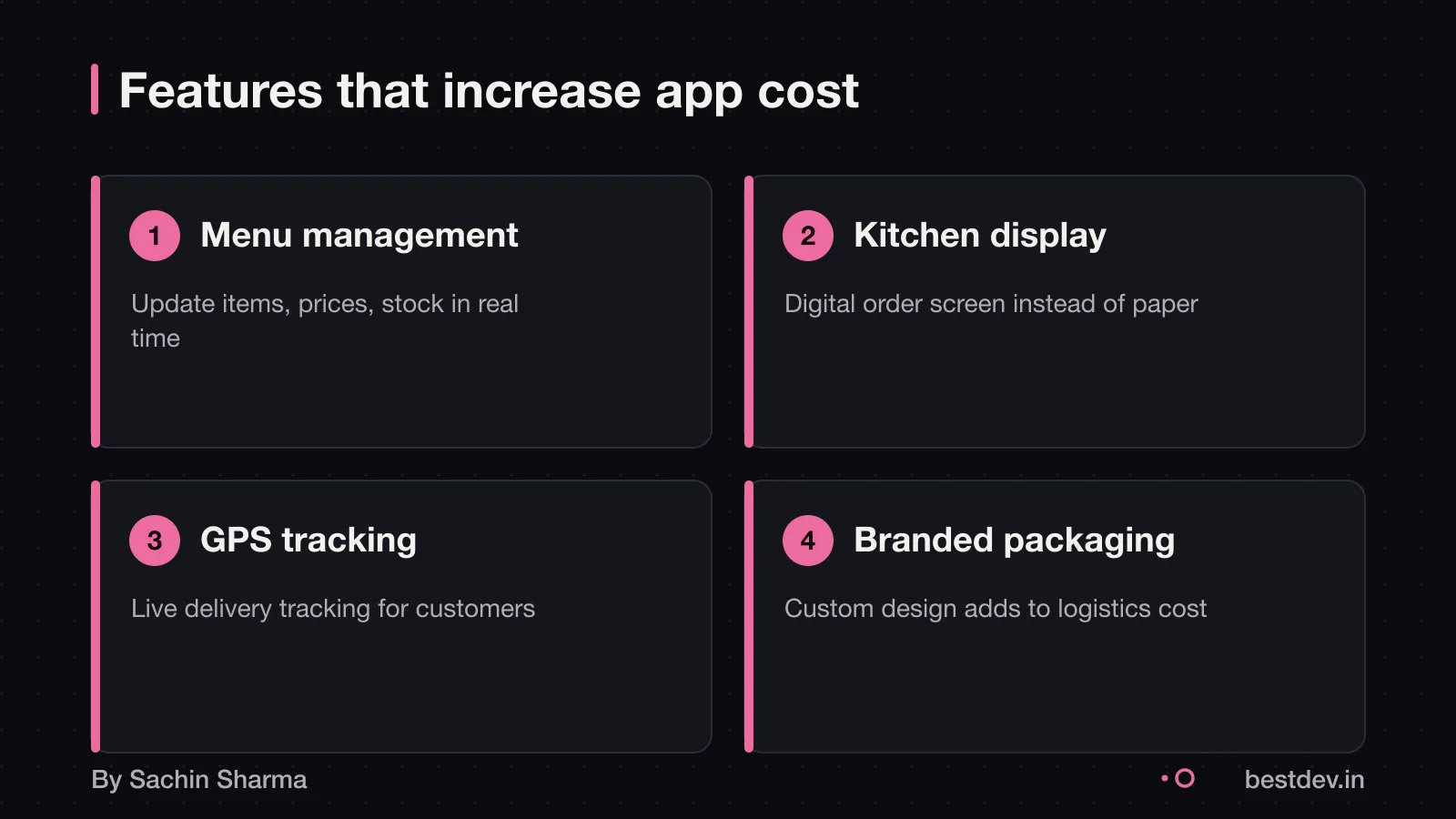
Single-brand apps cost less compared to multi-brand or aggregator platforms. Infrastructure cost can increase depending on expected user traffic and scalability requirements. Menu management allows adding or editing items, pricing and availability. A real-time kitchen display system (KDS) can support error-free and prompt kitchen service. Live delivery tracking uses GPS to show customers where their food is. Packaging should keep food in good condition and be kind to the environment.
You can start with a minimum viable product (MVP) to test demand. An MVP with core features costs between ₹3.5 lakh and ₹6 lakh. White label apps are cheaper, priced between ₹1.5 lakh and ₹5 lakh, and are ready-made but customisable. Starting with an MVP helps you avoid overspending before knowing if customers want your food. You can save money by using third-party delivery APIs instead of building your own fleet system. A modular design lets you add features like loyalty or analytics later, keeping initial costs low.
Does GST apply to app development?
Yes, GST at 18% applies to app development services in India. As an estimate, assuming standard billing practices, this means the 18% GST is included in the invoice unless the service is exported. You may be able to claim input tax credit on GST paid, depending on your GST registration and use. If you are in the IT sector, you may get complete access to input tax credit on all business inputs. As taxgarden.in says IT companies get complete access to input tax credit on all business inputs. For full details, consult your GST practitioner. Confirm with your GST practitioner. Confirm with your GST practitioner. For example, if you pay ₹10 lakh for the app, ₹1.8 lakh is GST. Confirm with your GST practitioner. Confirm with your GST practitioner. For IT-related services supplied in India, 18% GST applies. Tax rules depend on your specific case. So talk to your GST practitioner before finalising the budget.
How long does it take to build?
A basic app may take 2 to 4 months to develop. This includes core features. A custom app may take 4 to 6 months to build, based on one project timeline. Advanced platforms may take 6 to 12 months to develop. White label apps can be ready in 7 to 14 days. These are pre-built solutions with your brand added. They save time but offer less custom control. Native apps may take more time to develop because they need more planning for deployment. For a faster launch, start with a website. It can go live faster than an app and handle most order needs. If you need a full app, use a week-by-week plan to track progress. See how long it takes to build a quick commerce app for a detailed timeline.
Risks and how to verify developer quotes
The biggest red flag is when a developer will not show you actual code or detailed case studies from their portfolio. Poor communication is another serious warning sign. If they take days to respond during the initial conversation, vanish for stretches without explanation, or give vague answers to direct questions, walk away. Initial conversations and basic project discussions should typically be free. Be cautious if a developer charges for a basic portfolio review or initial project discussion.
A good portfolio does more than show app screenshots. It explains the problem the app solved, the developer’s approach, and results after launch. Look for diversity in the apps built, as developers who have only built one type of app may struggle with your specific requirements. You should be able to download and test the apps they have made. Check if they still work.
Review each portfolio item with these standards before deciding.
Legal, GST and compliance
You need FSSAI registration or license if you run a food business in India, as required by law. Without it, you cannot legally sell food. You also need local permits like food handler and health department clearances. These are separate from your app but must be in place before launch.
The Digital Personal Data Protection Rules 2025 were published on 14 November 2025. It requires clear user consent before collecting data like phone numbers or order history. You must explain what data you collect and why. For help with consent flows, see our guide on DPDP Act: consent flows an Indian app actually needs.
Who owns the source code? In India, the developer owns it by default under copyright law. Even if you pay for development, you do not automatically own the code. The "Work Made for Hire" rule only applies to employees, not freelancers. To own the code, you must sign a written contract that says so.
The developer charges you 18% extra or includes it in their quote. You may be able to claim input tax credit on business inputs if you are registered under GST and meet the criteria. But consult your tax advisor to confirm if your case qualifies. Laws can change and your situation may differ. Laws can change and your situation may differ.
What does app maintenance cost?
This covers bug fixes, server updates, security patches, and minor feature improvements. The exact cost depends on how many orders your app handles and how often you update the menu or offers. This does not include adding new features like delivery tracking or loyalty programs, which are billed separately. Always ask your developer for a breakdown of what their support fee includes.
Is it worth it for a small business?
Yes, small restaurants can afford a custom app if they start with a minimum viable product (MVP). An MVP includes only core features like menu display, order placement and payment. Cutting initial costs; as an estimate, such an app may start from ₹3.5 lakh. This approach reduces risk and lets you test demand before spending more.
Building your own app is worth it if you aim to improve margins. Orders taken directly through your app avoid Swiggy or Zomato commissions. Swiggy charges 22% to 28%, Zomato charges 18% to 25%, as of 21 January 2026. You typically see 25 to 40% better margins on direct orders.
The margin gain makes the app worth it for most small kitchens, but only if you drive enough orders through it. As an estimate, you need at least 200 to 300 direct orders per month to justify the build cost within 12 to 18 months. The app also gives you control over branding and customer data, which third-party platforms do not.
When should you not build a cloud kitchen app?
When should you not build a cloud kitchen app?
Do not build a custom app if Swiggy and Zomato bring 70 to 95% of total orders, as they do for some restaurants. Instead, use a simple website for direct orders to save money and possibly gain 25 to 40% better margins on those sales. As seen in some operators who shift orders to direct channels.
A low-cost website with QR code ordering may be a better fit.
Do not build if you want to avoid technical upkeep. Apps need updates, security patches, and compatibility fixes.
Questions people ask
How much does a cloud kitchen app cost in India?
A basic cloud kitchen app costs ₹2.5 to 5 lakh, a mid-level one ₹5 to 12 lakh. An advanced multi-brand system ₹12 to 30 lakh. The final price depends on features like multi-brand support, delivery integration, and scalability. For a custom quote, share your menu size and order volume.
What makes a cloud kitchen app more expensive?
Costs rise with multi-brand support, real-time kitchen display systems (KDS), delivery partner integrations, and scalable backend infrastructure. Adding features like dynamic pricing, CRM, or fleet management also increases cost. Start with core features and add later to manage budget.
How long does it take to build a cloud kitchen app?
A basic app takes 2 to 4 months, while an advanced platform can take 6 to 12 months. Building a food delivery app from scratch may take 4 to 6 months, as one provider states. A white label app can be ready in 7 to 14 days, according to one provider. Timelines depend on feature complexity and team size.
Do cloud kitchen apps require delivery partner integration?
Yes, some cloud kitchen apps integrate with delivery platforms like DoorDash and Uber Eats to pull orders into one dashboard. This avoids missing orders during peak times but adds to development cost and complexity. You can start without it if you focus on direct orders.
Is backend infrastructure expensive?
Backend cost depends on expected user traffic and scalability needs. A small kitchen with low orders pays less, while high-volume operations need solid servers and databases, raising cost. Cloud hosting with auto-scaling helps manage this based on demand.
Can small restaurants afford custom cloud kitchen apps?
Yes, small restaurants can start with a minimum viable product (MVP) to reduce initial cost. Direct orders through your app can improve margins by 25 to 40% compared to third-party platforms. As seen in operators who shift orders to direct channels.
Which technology stack is best for cloud kitchen apps?
Flutter or React Native are best for cross-platform apps, cutting cost and time. For simple needs, no-code tools can speed up development. Flutter allows one codebase for mobile, web, desktop, and embedded devices.
Is ongoing maintenance necessary?
Yes, ongoing maintenance is needed for security updates, server costs, and feature improvements, costing ₹5,000 to ₹20,000 per month. Skipping this risks app failure or data breaches. Budget for this from launch, not just the initial build.
Can one app manage multiple kitchen brands?
Yes, one app can manage multiple kitchen brands with separate menus, branding, and analytics. But this costs more than a single-brand app due to added complexity in design, backend logic, and reporting. Use only if you operate more than one brand.
Should startups build a full-feature app immediately?
No, startups should start with an MVP to test demand and avoid overspending. Use a modular architecture to add features later as needed. This reduces risk and lets you refine based on real user feedback.
Assumptions behind the numbers
- Team size: 3–5 people (frontend, backend, designer, QA, product manager)
- Daily rate: ₹1,500–3,000 per person
- Total weeks: 12 to 20 weeks for mid-level app
- Backend cost scales with traffic (not fixed)
- KDS and tracking are optional add-ons
I won't hand you a number that pretends to be the market. Instead, here is the working: set the weeks, the people and the rate, and see where the money goes.
- Discovery and Planning13%
- UI/UX Design19%
- Development50%
- Testing and Fixes13%
- Launch and Stores6%
The weeks shown are an example of a small app, there to be changed. Fees you pay others (store accounts, cloud, SMS) are not in this total.
What moves it
Six things that move the price
- Multi-brand or aggregator support
Supporting multiple brands increases backend complexity.
- Kitchen Display System (KDS)
Real-time KDS adds design, logic and testing effort.
- Live order tracking
GPS-based tracking needs extra integration and testing.
- High traffic or scale needs
Backend cost rises with expected load and scaling.
- Single platform first (MVP)
Building for one OS cuts early cost and time.
- Using ready-made modules
White label or pre-built components save weeks.
- Clear scope and design freeze
Fewer changes mean fewer costly mid-project pivots.
Not in the total
Fees that go to someone else
Google Play Developer Account
One-time fee of ₹2,500 (as of May 2026). Paid directly to Google.
Apple Developer Program
Annual fee of $99 (~₹8,000). Paid directly to Apple.
Cloud hosting and SMS
Usage-based. Billed monthly by AWS, GCP or Twilio.
Payment gateway charges
2% to 3% per transaction. Charged by Razorpay, Stripe etc.
Before you sign
Ask for these five things
- How many weeks per phase, and with how many people?
- What is not included in the quote?
- Which fees do I pay to others directly?
- Does the backend scale with traffic?
- Is KDS or tracking part of the first version?
- Can we start with one platform?
- What happens to the price if I change my mind mid-way?
Keep going