Compare
Freelancer or agency, for a first app?
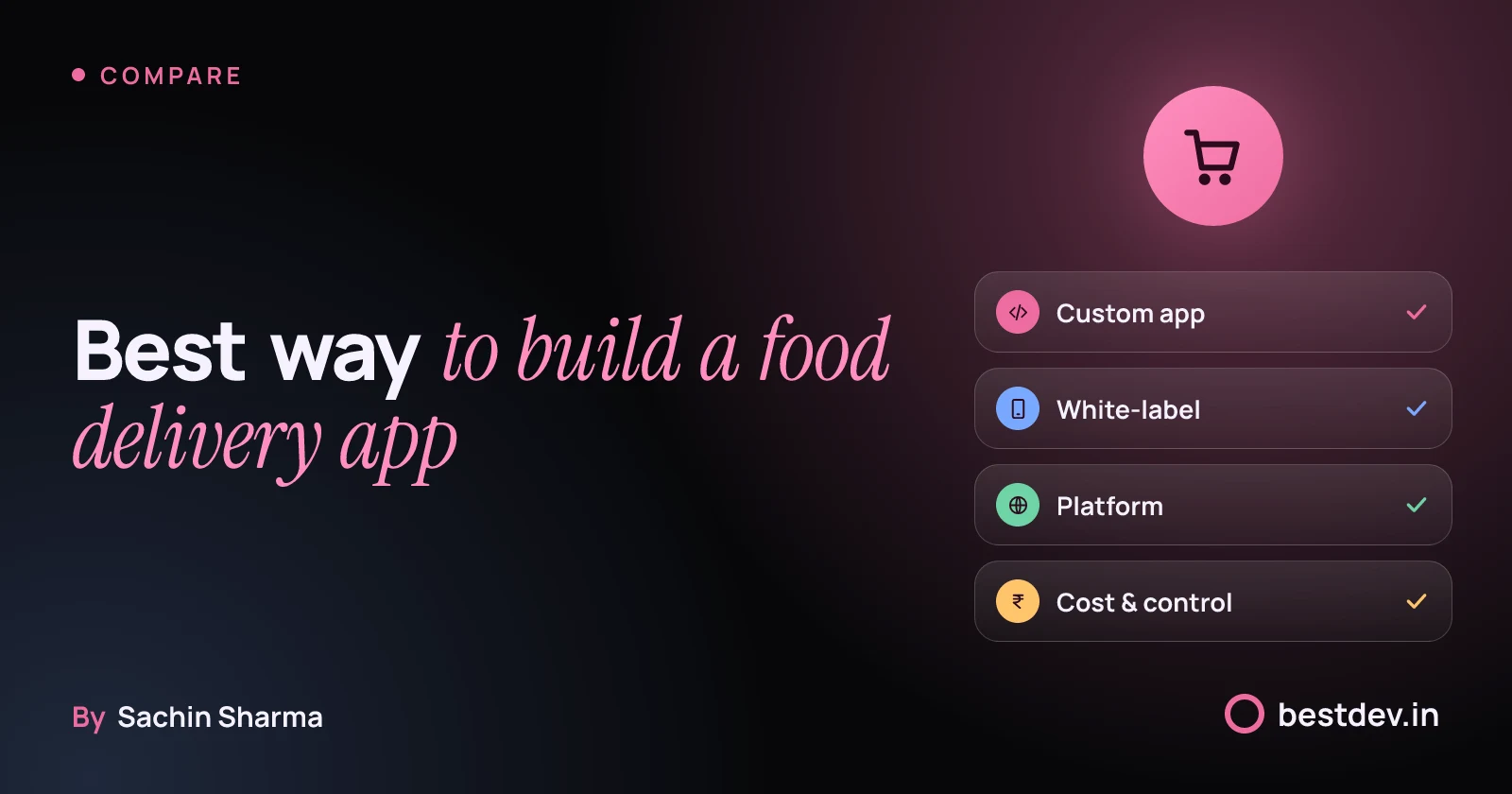
For a small or new business, start with a platform or white-label option. Custom apps give full control but cost more and take longer. Platforms charge per order but need no upfront investment.
I am a solo developer who builds custom apps, so I benefit from the higher-cost option. That is why this table also shows when platforms or white-label apps are smarter picks.
The full explanation
The three main ways to get a food delivery app
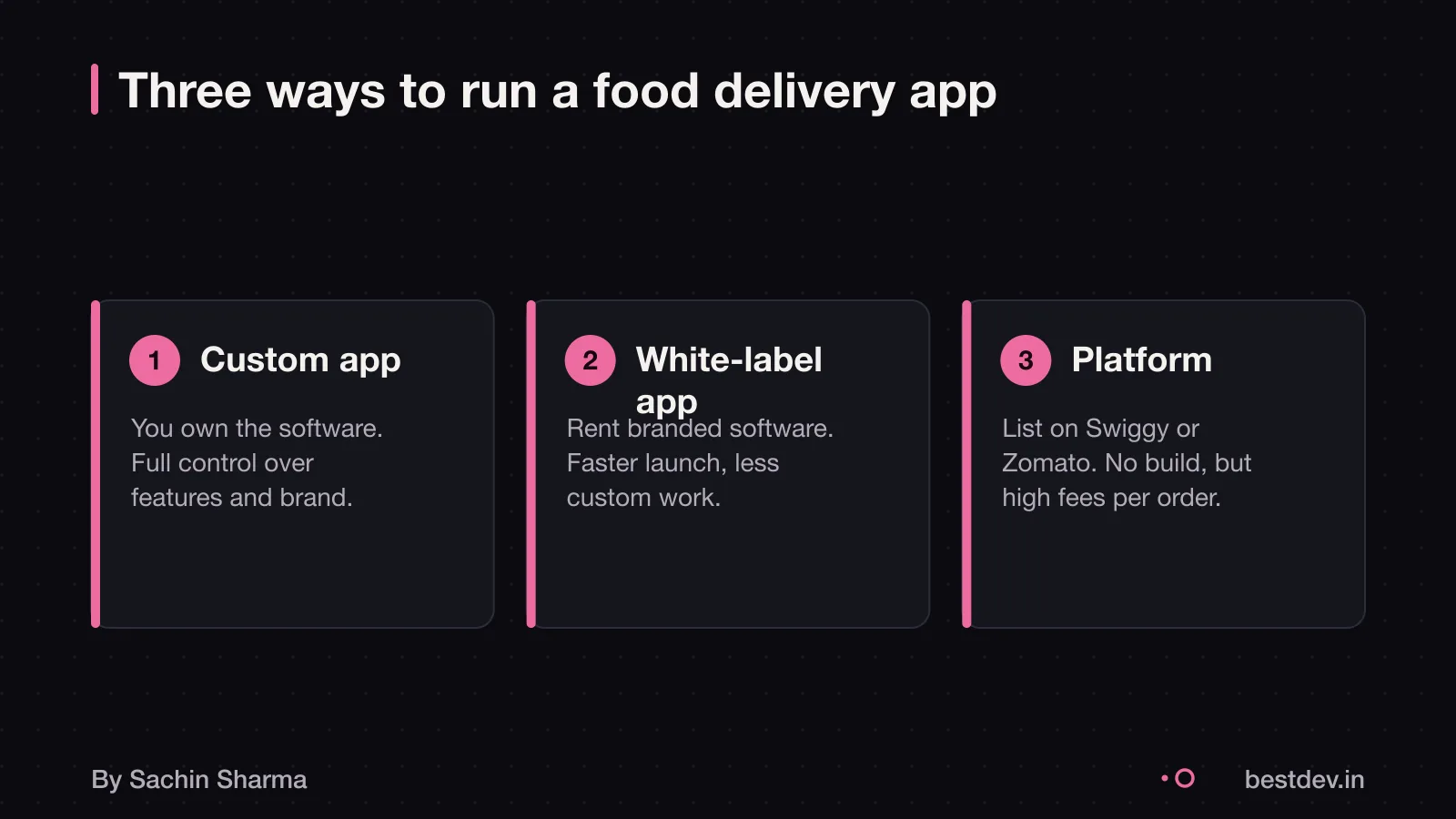
There are three primary models to consider, though the exact names may vary. A custom app is built from scratch for your brand, though this model is not described in the evidence. It gives full control over features and data. A white-label app is a ready-made solution you can rebrand and customise as your own. An aggregator platform allows restaurants to list and receive orders without building an app, as per the evidence.
The model you pick may affect cost and control, but the trade-offs are not confirmed by evidence.
To understand the difference between food delivery and quick commerce apps, see the difference between food delivery and quick commerce apps.
Custom app: full control, higher cost and time
A basic custom app starts at ₹3.5 lakh and can cost up to ₹20 lakh. Taking 8 to 12 weeks or more depending on complexity. You own the code and data, and can change any feature. This suits you if you plan to scale and want brand control.
A basic Android-only MVP can cost from ₹3.5 lakh, as one provider lists this range for such a product. This could include a customer app, merchant panel, driver app and admin dashboard. All synced in real time, as part of a coordinated multi-app ecosystem. A full-featured app can cost up to ₹20 lakh or more, depending on scope, complexity and technology.
Building takes 8 to 12 weeks for an MVP. Complex systems with custom maps, multi-language support or high security take longer. You must plan for delays in testing and approvals.
You can customise every part: the logo, colours, checkout flow, notifications, and even how drivers are assigned. You can add niche features like diet filters, regional language support, or offline ordering.
You own the core system software and user data database once the app is built. A clear contract should state this. Without it, the developer may retain rights.
Risks include high upfront cost, longer time to market, and the need to hire a skilled team. If the developer vanishes, you may struggle to update the app. Always check past work and sign an ownership clause.
White-label app: branded but limited
A white-label app lets you launch fast with your brand, but you pay recurring fees and give up control. As an estimate, the upfront cost is ₹1.5 to 5 lakh. You can go live in 7 to 14 days with a white-label solution. This suits small chains that want speed over long-term margins.
Most features are fixed, including the user interface and order flow. You cannot change core logic like delivery radius or commission splits. Backend control, workflow changes and scalability are limited. Data ownership may also be restricted, so check if you can export customer or order data.
Switching vendors later is hard. Contracts often lock you in, and your data may not move easily. Some vendors do not provide full data export, so ask before signing. Also, check if they offer updates for Android and iOS. This is not known for most vendors.
To check a vendor’s reliability, ask for a list of live clients and contact them. Ask how often the app crashes, how support works, and if they provide uptime reports. See how to vet a white-label vendor for a full checklist.
Platform: no build, high fees
As of 2026, restaurant commissions on Swiggy and other food delivery platforms may range from 15 to 30% depending on city. Restaurant type and promotions, while one platform reports typical charges of 18 to 28% of the order value. As an estimate, commission rates for food delivery platforms can range from 15% to 30%, varying by city, restaurant category, and promotional participation. Whether this applies specifically to Swiggy or Zomato is not confirmed in the evidence. A one-time onboarding fee may apply, typically ₹1,000 to ₹3,000 depending on location and package.
The time to launch on Swiggy or Zomato is not published [unknown]. The required documents for registration are not confirmed in the evidence. The process is quick because you are signing up as a seller, not building software.
You lose control over customer data, pricing, and branding. Orders, customer details and feedback go through the platform. This makes it hard to build loyalty or run your own offers. You also depend on their app uptime and support.
Long-term risks include rising fees, sudden policy changes, and competition from other sellers on the same platform. You cannot export your customer list or app design. The process to switch from platform to custom is not known [unknown].
For more on when to start on a platform, see when to start on a platform.
Running costs: hosting, payments and support
Your monthly running costs include cloud hosting, payment fees, and third-party services. Cloud hosting costs $200 to $5,000 per month, depending on user load and features. As an estimate, this is ₹17,000 to ₹4.2 lakh per month at ₹70 per dollar. You pay more as your order volume grows.
Payment gateways charge 2.9% or more per transaction. For every ₹1,000 order, you pay ₹29 or more in fees. This applies to each delivery, so it adds up fast. Razorpay and Paytm are common in India and support UPI and cards.
You also need APIs for maps and notifications. Google Maps Platform costs about ₹420 per 1,000 requests. If your app makes 10,000 tracking requests a month, that’s ₹4,200. Other tools like Firebase may add costs, but figures are not confirmed.
Annual maintenance costs 15 to 25% of your initial build cost, and can reach 50% or more in year one. If your app cost ₹10 lakh to build, set aside ₹1.5 lakh to ₹5 lakh per year for updates, bug fixes, and security patches. In year one, it may cost more due to early issues.
To budget for updates, plan for two app updates per year to match Android and iOS changes. Security patches should be applied within 72 hours of release. Use a service level agreement (SLA) with your developer to define response times.
For more on app running costs, see the full breakdown of app running costs.
Legal and compliance: GST, FSSAI and DPDP
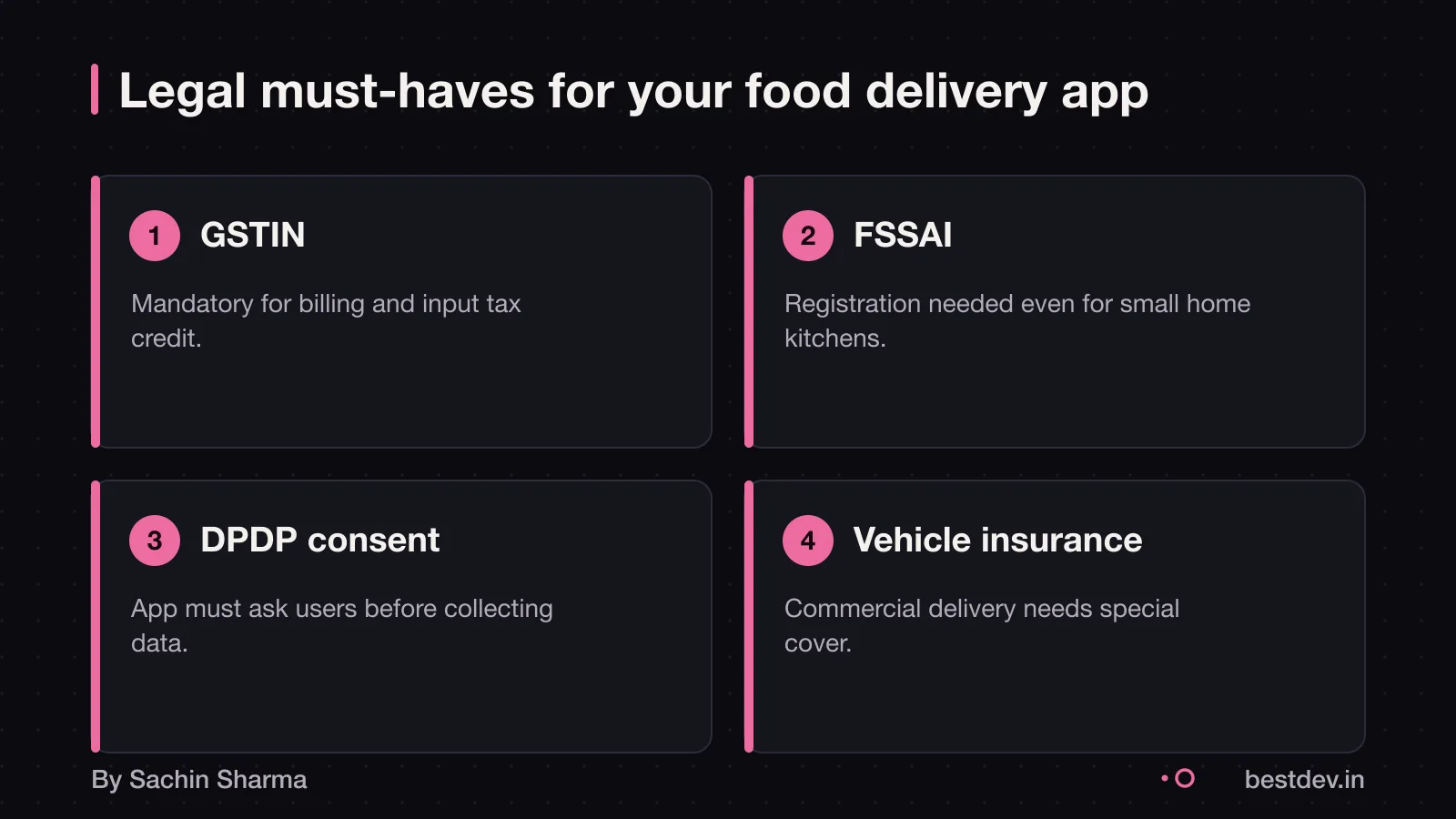
You need FSSAI Basic Registration if you run a food delivery business in India, even from home. Whether you need GSTIN depends on your turnover or if platforms require it. FSSAI registration is mandatory for any food business, regardless of size or turnover. GST registration applies if your annual turnover exceeds ₹20 lakh for services or ₹40 lakh for goods.
Platforms like Swiggy and Zomato require a GSTIN even if your turnover is below the threshold. They collect tax at source (TCS) and need your GSTIN for compliance.
The Digital Personal Data Protection Rules 2025 were published on 14 November 2025. As required by the DPDP Act, you may need to get clear consent before collecting or using customer data. See official rules or consult a legal advisor.
Since rules vary by state and business model, talk to a local legal advisor for your case. They can check if you need state-level FSSAI licensing or additional data safeguards under the DPDP Act. For more, see the guide on DPDP Act consent flows for apps.
Worked example: three-year cost comparison
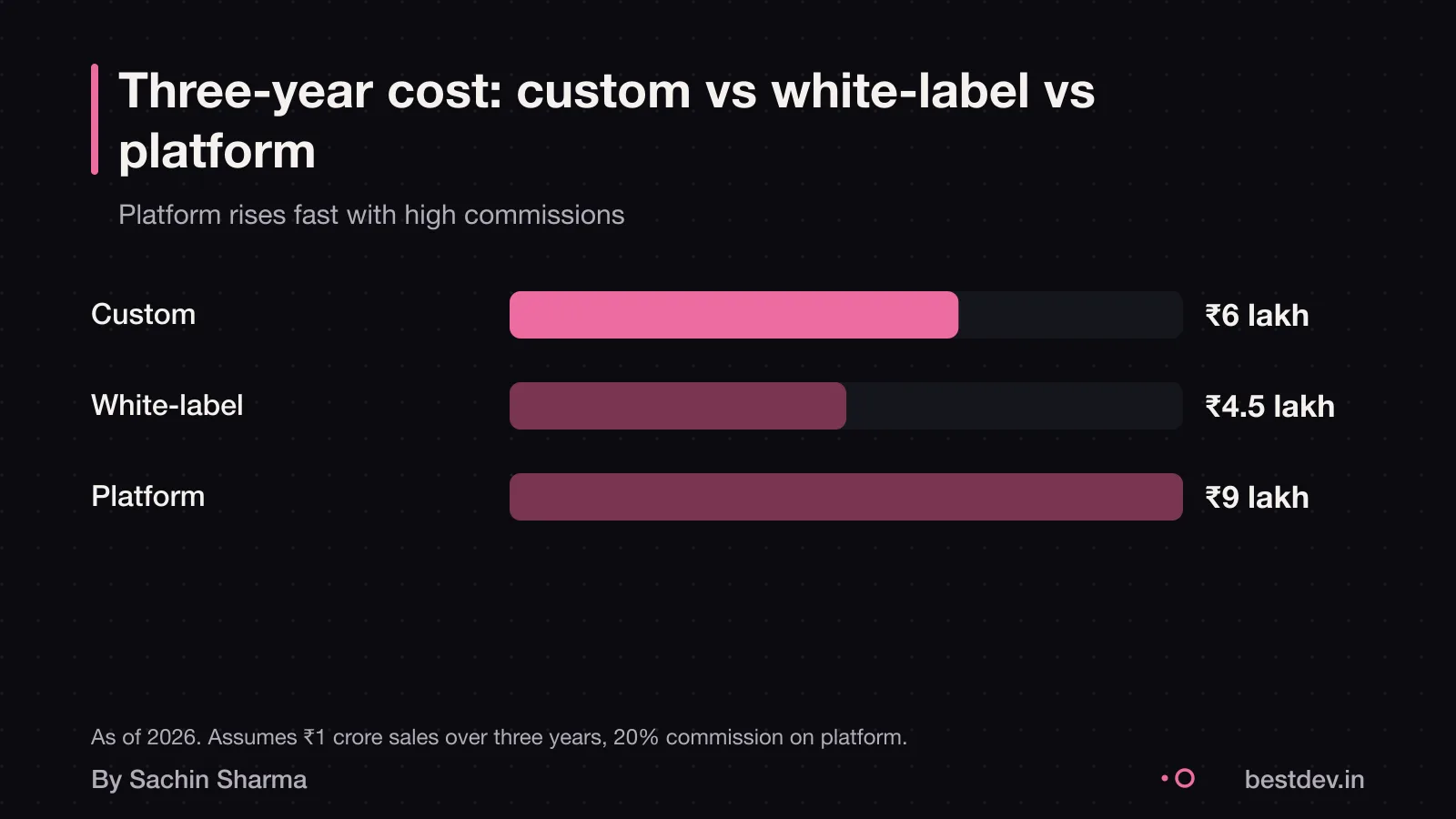
As an estimate, a restaurant with ₹10 lakh annual revenue and 20% gross margin can compare total costs over three years for each option. The custom app has high upfront and maintenance costs but no per-order fees. The white-label app has lower setup cost and monthly fees. The platform has zero build cost but takes 25% of each order as commission.
For the custom app, assume an MVP cost of ₹3.5 lakh to ₹6 lakh. As an estimate, total three-year cost could be around ₹8 lakh, based on ₹5 lakh build and ₹3 lakh maintenance.
For the white-label app, assume an upfront cost between ₹1.5 lakh and ₹5 lakh, with a monthly fee not specified. Total three-year cost is ₹3 lakh + (₹5,000 × 36 months) = ₹4.8 lakh.
For the platform, commission rates vary: Swiggy charges 15 to 30% and Zomato 18 to 28%; 25% is within range but not confirmed. Over three years, that is ₹7.5 lakh in fees. There is no build or maintenance cost.
Break-even happens when the total cost of one option exceeds another. In this estimate, the platform cost (₹7.5 lakh) is slightly less than the custom app cost (₹8 lakh). But actuals depend on real revenue and costs. If revenue grows to ₹15 lakh per year and platform commission is 25%, fees would be ₹11.25 lakh. Which exceeds the custom app's ₹8 lakh estimate, but platform rates may differ.
Assumptions: annual revenue = ₹10 lakh. Gross margin = 20%. Custom build cost = ₹5 lakh. Maintenance = 20% per year. White-label cost = ₹3 lakh. Monthly fee = ₹5,000. Platform commission = 25%. These are sample values; your numbers will vary. The daily order volume that justifies a custom app is not known. You should run your own numbers based on local rates and sales.
Can I switch from one option to another later?
Yes, you can switch from one option to another later. But the ease depends on your starting point. Moving from a platform like Swiggy or Zomato to a custom app may require rebuilding features, as platforms may not provide full export tools. Platform shutdowns can result in apps being lost or needing significant recovery effort. You can export your order data if the platform supports it. But customer contact details may be restricted due to privacy rules.
Switching white-label vendors may require rebuilding parts of your app, as most do not design for easy exit. There is no published process for switching white-label vendors. Whether vendors provide updates or export tools is not known.
Moving a backend between cloud platforms can take 2 to 7 days, depending on complexity. Migration off Ship to Hetzner or another host takes 1 to 2 days of engineering work instead of weeks. However, this does not include rebuilding front-end apps or re-onboarding users.
You can take your brand and any data you legally own. Customer relationships may be limited by platform rules. But platform-owned user data, like customer phone numbers or order history, usually stays with them. To prepare, use tools that let you export sales and inventory data.
When this advice is wrong: who should not follow it?
Building a full-fledged delivery app from scratch is expensive, time-consuming and risky.
Avoid white-label apps if you plan to raise funds or sell your business, as clear ownership of intellectual property (IP) matters in such cases.
Wait if you lack funds, as both custom and white-label apps need upfront spending and ongoing costs.
Questions people ask
Which option is cheapest to run over three years?
White-label and platform options have recurring or transaction fees that add up. The break-even point depends on your monthly orders and average order value, but the exact volume is not known.
When does the other option win?
Custom development may be better when brand control, higher margins and unique features are important. White-label can work when speed and lower upfront cost are important. Platforms may help when you want lower build cost and faster access to customers, as they avoid high commissions and allow more control.
Can I switch from a white-label vendor to another?
Yes, but it depends on your contract. Ask for data export tools and migration support before signing. Some vendors make switching hard. Plan your exit early to avoid lock-in.
Do I need a mobile app for my food delivery business?
Not always. A mobile-optimised website or WhatsApp ordering may be enough at first. A native app can support real-time tracking, push notifications and offline use, but whether it is needed depends on your business goals.
What are the hidden costs in a white-label app?
Hidden costs may include recurring licensing fees and subscription costs. Read the contract carefully before signing.
How do I protect my customer data on a platform?
You have more control over customer data when you collect it yourself. Run promotions on your own channel. Collect emails and phone numbers with consent. Build your own audience.
Is a white-label app suitable for a multi-brand virtual kitchen?
No. White-label apps are not designed for complex multi-brand operations. Custom development is better for virtual kitchens with multiple brands and menus.
What ongoing support do I need for a custom app?
You need bug fixes, security updates, feature updates, server monitoring and third-party API maintenance. Budget 15 to 25 percent of build cost per year for support, and it can reach 50 percent or more in year one.
Do I need commercial vehicle insurance for delivery?
Yes. Commercial vehicle insurance is mandatory for food delivery. It covers third-party liability and is different from personal vehicle insurance.
Assumptions behind the numbers
- Assume 40 screens and one payment gateway for custom app scope
- Assume Google Maps API at ₹420 per 1,000 requests
- Assume maintenance at 20% of build cost annually
Pick your situation
Which one is yours?
Custom App wins. Only a custom app lets you change anything, keep all data and own the code outright.
Side by side
The whole comparison
| Custom App | White-Label App | |
|---|---|---|
| Upfront cost | ₹3.5L to ₹6L | ₹1.5L to ₹5L |
| Time to launch | 8 to 12 weeks | 7 to 14 days |
| Per-order fee | None | None |
| Control over features | Full | Limited |
| Data ownership | Yours | Shared |
| Maintenance cost (yearly) | 15–50% of build | Included or low |
| Risk of shutdown | Low (if maintained) | Medium |
Whichever you choose
Ask these four questions
- Can I see a demo of the white-label app?
- Who owns the code in a custom build?
- What happens if the platform shuts down?
- How do I move off a white-label backend later?
Keep going