Cost · Generic
What does it cost to build an app in India?
I won't hand you a number that pretends to be the market. Instead, here is the working: set the weeks, the people and the rate, and see where the money goes.
The full explanation
What is a milk and dairy delivery app?
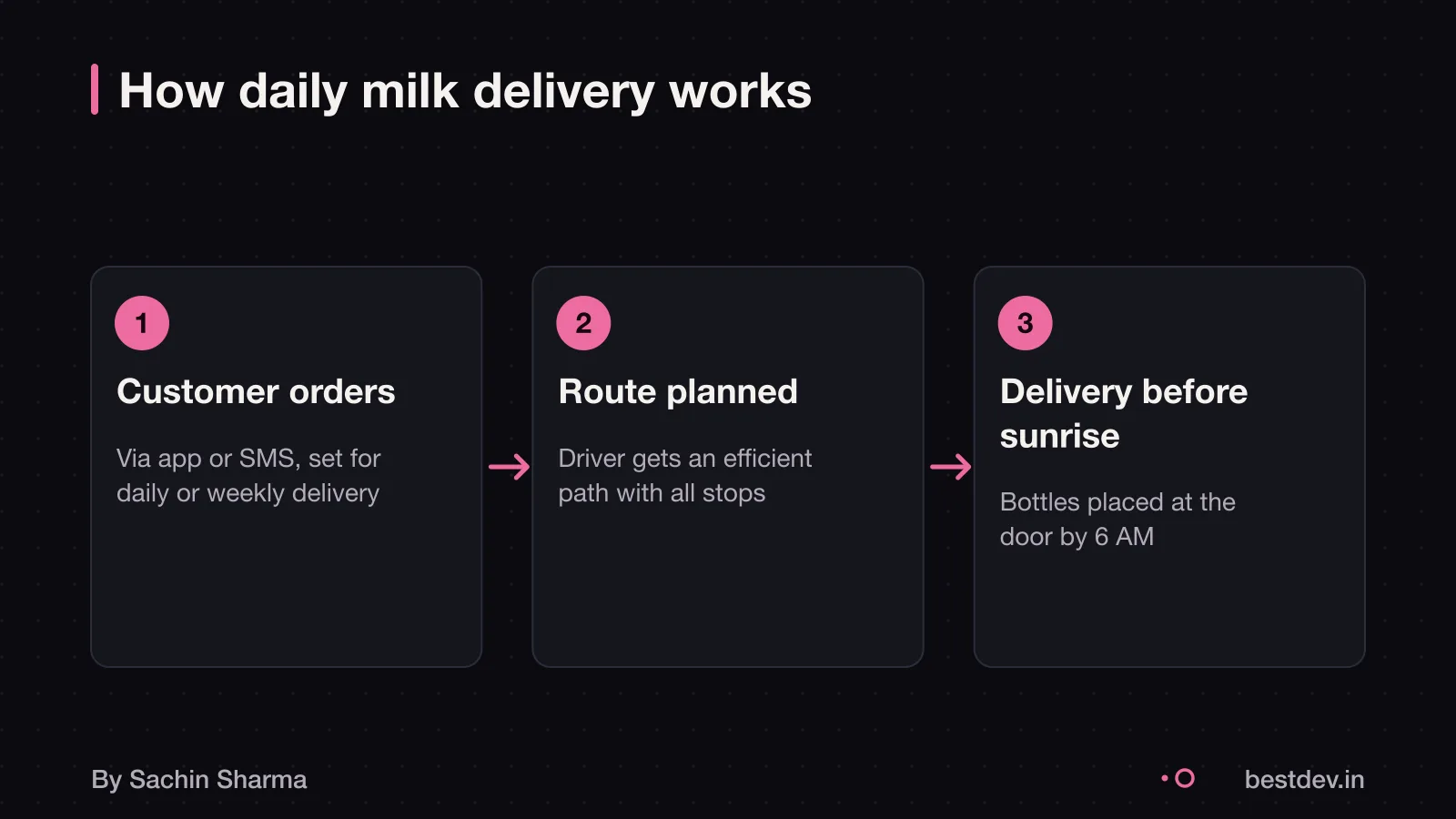
A milk and dairy delivery app can help manage subscriptions and customer relationships for dairies. It lets customers subscribe to regular delivery of products from a catalog. This means managing milk subscriptions, morning routes and doorstep collections on one platform. The app improves efficiency in dairy operations by reducing costs and increasing productivity. It combines subscriptions, route planning, collection and customer access on one platform, avoiding the need to stitch separate tools together.
What features drive the cost?
A basic milk and dairy delivery app has core features such as user registration, product browsing, subscriptions, order management, and payment integration.
Mid-level apps add real-time delivery tracking, push notifications, analytics dashboards, and a separate app or panel for delivery partners. These raise the cost because they need more screens, roles, and live data flow. For example, a dairy with many daily deliveries may need accurate timing and route updates to avoid delays.
AI-powered demand forecasting can analyse historical orders, seasonality, customer behaviour, and weather to predict demand for milk delivery apps.
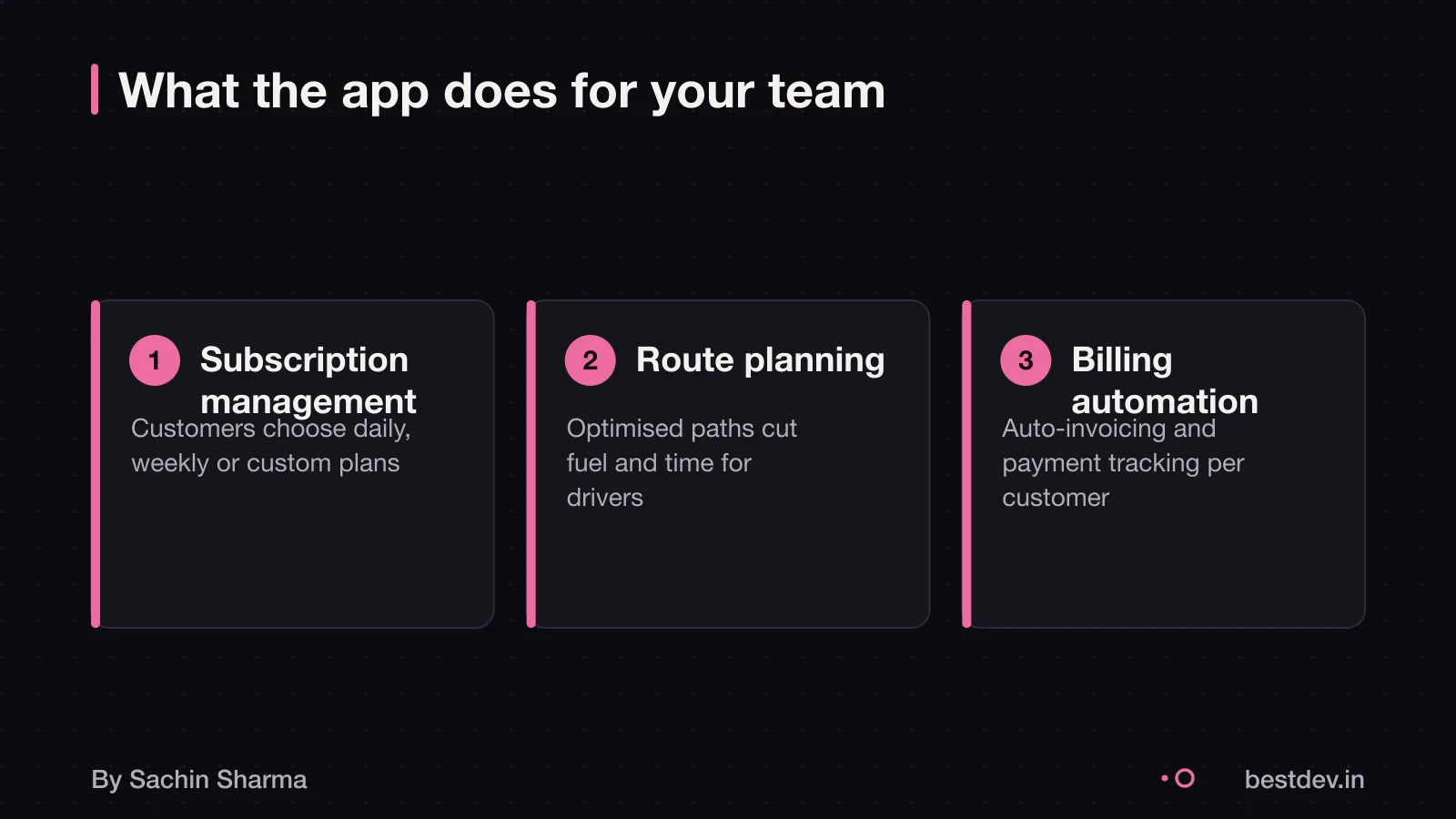
Subscription logic, route planning, and billing automation are the main cost drivers. Handling paused or skipped deliveries requires complex backend rules. Using Google Maps raises third-party costs; cheaper mapping tools may lower fees but need custom integration. You can start with an MVP and add features later. Most dairies begin with subscriptions and payments, then add tracking or forecasting once live.
How much does each part cost?
As an estimate, a custom milk and dairy delivery app costs between ₹7.5 lakh. ₹67 lakh or more, based on development costs of $10,000 to $90,000 or more. This depends on features, team type, and automation needs. As an estimate, assuming 40 screens and one payment gateway. The cost falls into three ranges: $10,000 to $25,000, $25,000 to $50,000, and $50,000 to $90,000 or more. As an estimate, basic apps cost ₹7.5 lakh to ₹18.5 lakh, mid-level apps ₹18.5 lakh to ₹37 lakh. Advanced systems ₹37 lakh to ₹67 lakh or more.
| App Type | Cost Range (₹) | Key Features |
|---|---|---|
| Basic | 7.5 to 18.5 lakh | User login, product listing, cart, order tracking, one payment gateway |
| Mid | 18.5 to 37 lakh | Subscription logic, delivery scheduling, admin dashboard, basic analytics |
| Advanced | 37 to 67 lakh or more | Route optimisation, multi-outlet support, automated billing, digital wallet, offline sync |
Freelancers may charge less but often lack experience in dairy-specific logic. Agencies in Tier-1 cities charge more due to overheads. They do not always offer better quality. As of 11 March 2026, using cost ranges from $10,000 to $90,000 cited across three sources. As per one provider, most dairy businesses they work with spend between $25,000 and $50,000.
How long does it take to build?
A custom milk and dairy delivery app takes 3 to 6 months to build. This timeline depends on how complex your subscription rules, billing cycles and delivery routing are. For example, if you offer weekly plans with mid-cycle changes, it adds time to design and test.
You can launch faster with a white-label app. Platforms like Shopaccino offer ready-made apps with core features such as subscriptions, digital wallets and route management. Shopaccino's core features can go live in 5 to 10 days. Rekart typically takes about a week with fully assisted migration.
To stay on track, finalise your pricing plans, delivery zones and payment methods before coding starts. White-label apps reduce this risk because they are pre-built and tested.
Who should build your dairy app?
Hire a product studio if you want a reliable, long-term app. They cost more but understand dairy workflows like subscription changes and route shifts. A freelancer might seem cheaper. But 90.3 million freelancers on Freelancer.in means wide quality gaps. Eighty percent of jobs get bids in 60 seconds. Speed does not mean skill. Agencies offer teams. But some outsource quietly. This adds delay.
They use tools like Flutter and Firebase, as seen in apps such as Aashwasan and Wally. Freelancer.in lets you pay only when happy. This helps control risk. A solo developer might miss edge cases due to limited bandwidth or experience.
Check past work. Ask for examples of live apps they built for daily delivery or subscription models. Visit the apps as a user. Ask how they handled refunds, paused deliveries or route changes. If they cannot show dairy or FMCG apps, it may be uncertain whether they can handle yours.
You need someone who treats your app as a product. Not a one-off project. That means planning for updates, user feedback, and billing errors from day one.
Freelancer or agency: pick by situation, your choice depends on budget, risk tolerance, and how much you can manage.
What legal and compliance rules apply?
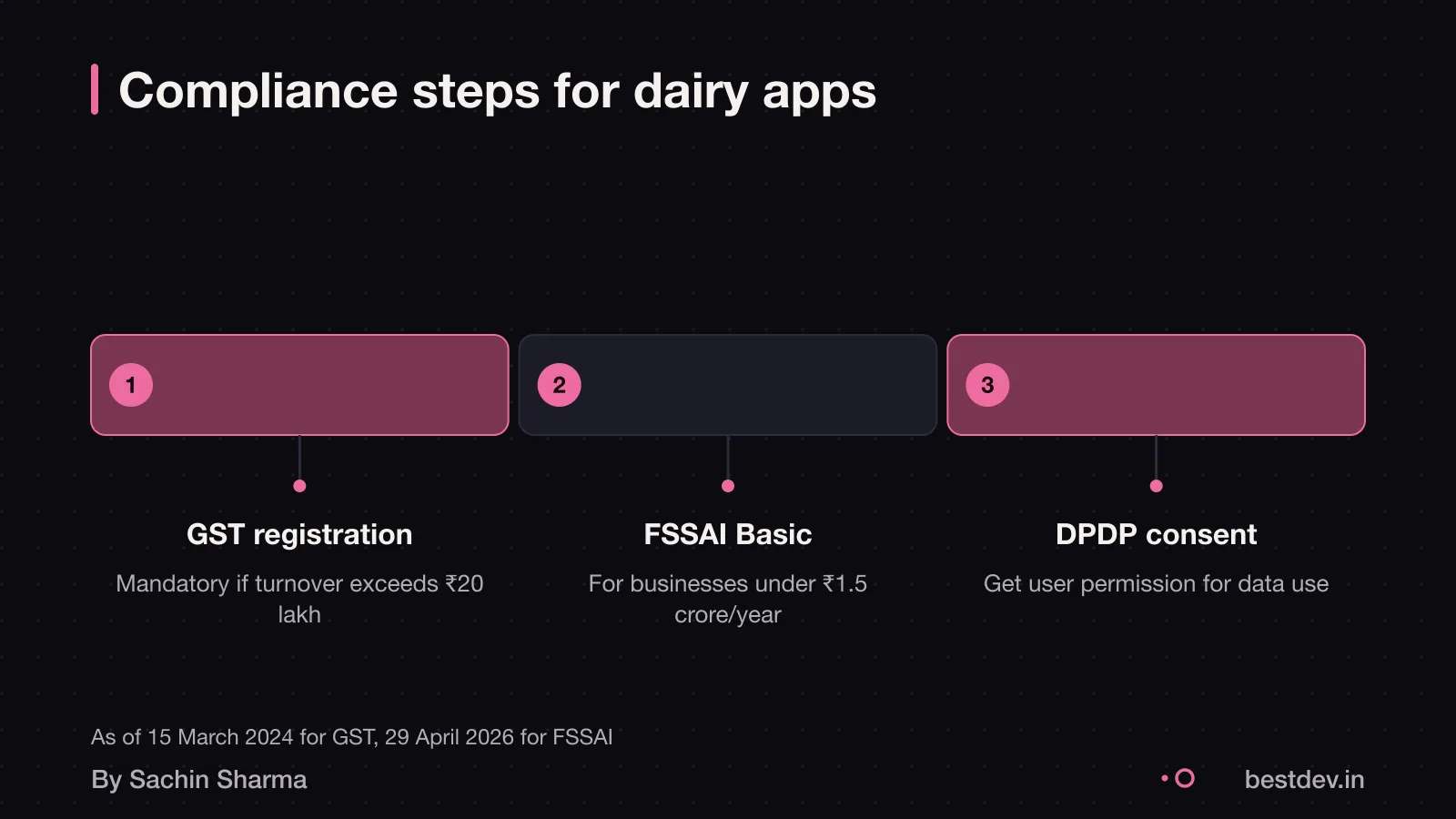
Yes, you need GST registration if your annual service turnover exceeds ₹20 lakh (₹10 lakh in Northeast states). This rule applies even if your app only manages subscriptions and delivery, as it is part of service delivery. Register early, as delays can block payment gateway setup.
All dairy businesses that sell dairy products must have a valid FSSAI registration or license, no matter how small. FSSAI regulates and supervises food safety across India. If your annual turnover is ₹1.5 crore or less, you may qualify for FSSAI basic registration. Based on one example for a local milk vendor; confirm with official sources. For higher turnover or on-site processing, a higher-level FSSAI license may be required; confirm with a local advisor. Confirm with a local advisor.
DPDP Act: consent flows an Indian app actually needs explains how to build compliant data screens. Always consult a local CA or legal advisor to confirm rules for your location and scale.
Who owns the app after it's built?
You own the app unless the contract says otherwise. To be safe, insist on a contract that states you own the source code and backend systems. This right lets you switch developers later without losing control.
A clear agreement should include full transfer of code, access to servers, and no licensing traps. Look at the contract before signing, if it does not spell out ownership, ask for it to be added.
What happens after the app launches?
After launch, you need regular maintenance and customer support to keep the app working well. Maintenance includes bug fixes, server management, security updates, and technical support. You must also update the app to stay compatible with new Android and iOS versions. These updates help performance and let you add new features when needed.
Bugs may appear after launch due to device differences or network issues. Your developer should fix these quickly. Ask them how long they take to respond to issues. Some include a 30-day warranty for free fixes. After that, maintenance is usually billed yearly.
Customer support tools keep your users happy. Many dairies use WhatsApp or phone calls for quick help. You can also add in-app chat or email support. Some platforms like Shopaccino automate customer support along with billing and delivery scheduling.
You should plan for 15 to 20% of the initial build cost each year for maintenance and support. This covers small fixes, server bills, and minor updates. Major upgrades, like changing subscription logic, cost extra. Always confirm what is included in your developer’s support package.
What can go wrong during development?
Scope changes, such as adding new features or changing delivery rules after development begins, can lead to cost overruns. Any change to the scope requires updates to the budget, timeline, and project plan, which can push costs higher.
Third-party integrations can delay projects. External services and APIs may introduce risks that affect timelines. If your app relies on an external billing system and the vendor replies slowly to queries, your team may sit idle. Asynchronous responses from vendors add hidden delays, especially when testing fails and fixes take days.
You must use Google Play’s Billing Library version 8 or later by 31 August 2026. If you are releasing a new app or updating an existing one. As of 31 August 2026, using an older version may lead to rejection of your app update.
When this advice is wrong
Do not build a custom app if simpler tools may work better for your needs.
A white-label app lets you launch faster using a pre-built platform with limited customization, which you can brand as your own. They may reduce cost, though you lose full control over design and logic.
Cheaper alternatives include Shopaccino, which offers a ready-to-deploy milk delivery app and may have lower development costs than custom apps.
For small dairies, these platforms handle subscription and delivery complexity without custom code. If your business is growing and you plan to add unique features later, start with a white-label solution and switch when needed.
Questions people ask
How much does a milk and dairy delivery app cost in India?
As an estimate, assuming conversion at ₹75 per USD, a custom milk. Dairy delivery app costs between ₹7.5 lakh and ₹67.5 lakh, depending on features and complexity. This range comes from estimates of $10,000 to $90,000. As an estimate, assuming conversion at ₹75 per USD, mid-level apps fall in the ₹18.75 to 37.5 lakh range. Based on the reported $25,000 to $50,000 cost for dairy business apps in the USA and UAE. For most small dairies, a white-label solution cuts cost and time significantly.
What makes a milk and dairy delivery app more expensive?
Advanced features like AI demand forecasting, real-time GPS tracking, and a separate delivery partner app increase cost. Complex billing for variable subscriptions and integrations with external tools also add to the price. These features suit larger dairies with high delivery volumes.
How long does it take to build a milk and dairy delivery app?
A custom app takes 3 to 6 months to build. A white-label platform like Shopaccino can deploy core features in 5 to 10 days. Rekart, a ready-made solution, deploys in about a week with fully assisted migration. Time depends on how much custom logic you need.
Do I need a food safety license for my dairy app?
Yes, you need a valid FSSAI license to sell dairy products through your app. If your turnover is ₹1.5 crore or less per year, apply for Basic Registration. For higher turnover, you need State or Central FSSAI licensing. Check this for your case with a food safety consultant.
Can I build a dairy app on a tight budget?
Yes, use a white-label platform like Shopaccino or Rekart to launch fast and affordably. These cost less than custom development and include core features like subscriptions and route management. You save on development time and avoid high upfront costs.
What is the cheapest way to start a milk delivery app?
Start with a white-label solution such as Rekart or Shopaccino. Avoid custom development unless you need unique features like AI forecasting or custom billing logic.
How do I avoid cost overruns when building the app?
Freeze your feature scope early, as changes increase cost and delay launch. Get third-party integrations reviewed for risk before development starts. Sign a fixed-scope contract and avoid mid-project additions unless budgeted.
What ongoing costs should I expect after launch?
Plan for annual maintenance at 15 to 20% of the initial development cost. Add payment gateway fees (2 to 3%) and $99 per year for Apple’s App Store. These costs keep the app secure, updated, and functional across devices.
Can customers pause or skip deliveries in the app?
Yes, pausing or skipping deliveries is a standard feature in dairy apps. Customers can reduce quantity, pause supply during holidays, or resume later through the app. This flexibility supports daily or weekly subscription models.
Who owns the app code after development?
You own the app and its source code unless the contract says otherwise. Always get full access to the code, backend systems, and documentation. This allows you to switch developers or update the app independently later.
Assumptions behind the numbers
- Assuming 40 screens and one payment gateway (UPI only)
- Team size: 1–3 people
- Daily rate: ₹1,500–3,000
- Feature level: basic to advanced
I won't hand you a number that pretends to be the market. Instead, here is the working: set the weeks, the people and the rate, and see where the money goes.
- Discovery and planning11%
- UI/UX design17%
- Development56%
- Testing and QA11%
- Deployment and launch6%
The weeks shown are an example of a small app, there to be changed. Fees you pay others (store accounts, cloud, SMS) are not in this total.
What moves it
Six things that move the price
- Adding delivery tracking
Real-time location sharing adds design and backend load.
- Multiple user roles
Admin, delivery partner and customer views are almost separate apps.
- Subscription variants
Daily, alternate-day, custom plans multiply logic paths.
- Using ready-made tools
Platforms like Rekart or Shopaccino reduce custom work.
- Fewer integrations
Skipping SMS, maps or advanced analytics saves weeks.
- Fixed scope upfront
Clear boundaries prevent costly mid-project changes.
Not in the total
Fees that go to someone else
App store fees
₹7,500 one-time for Google Play. ₹7,500/year for Apple.
Payment gateway
2–3% per transaction. Billed directly by provider.
Cloud hosting
₹2,000–5,000/month depending on usage.
Before you sign
Ask for these five things
- How many weeks per phase, and with how many people?
- What is not included in the quote?
- Which fees do I pay to others directly?
- Can I start with fewer features and add later?
- Who will maintain the app after launch?
Keep going