Cost · Generic
What does it cost to build an app in India?
I won't hand you a number that pretends to be the market. Instead, here is the working: set the weeks, the people and the rate, and see where the money goes.
The full explanation
What is a pharmacy delivery app?
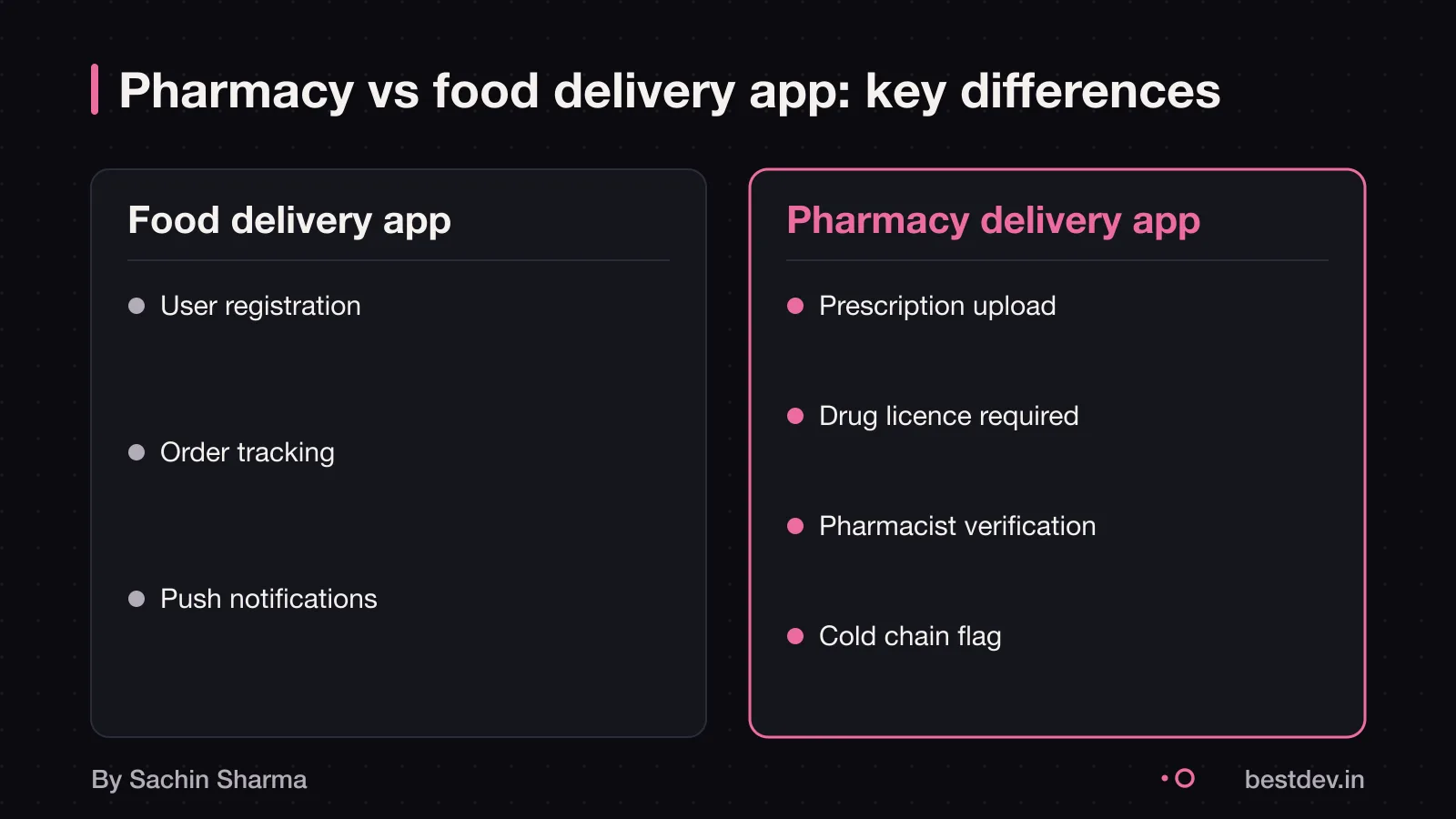
A pharmacy app must let users upload prescriptions, unlike a food or grocery app. E-pharmacies serve 20,000+ pincodes, so some users may be able to get medicines online.
Unlike regular delivery apps, it requires users to upload a valid prescription before buying regulated drugs. This means the app must verify and store medical documents securely. This adds complexity. For example, if someone needs diabetes medication, they upload their doctor’s prescription. They place the order. The pharmacy checks it before dispatch. The e-pharmacy market in India was $0.5 billion in 2019 and is projected to reach $4.5 billion by 2025.
Must-have features in a pharmacy delivery app
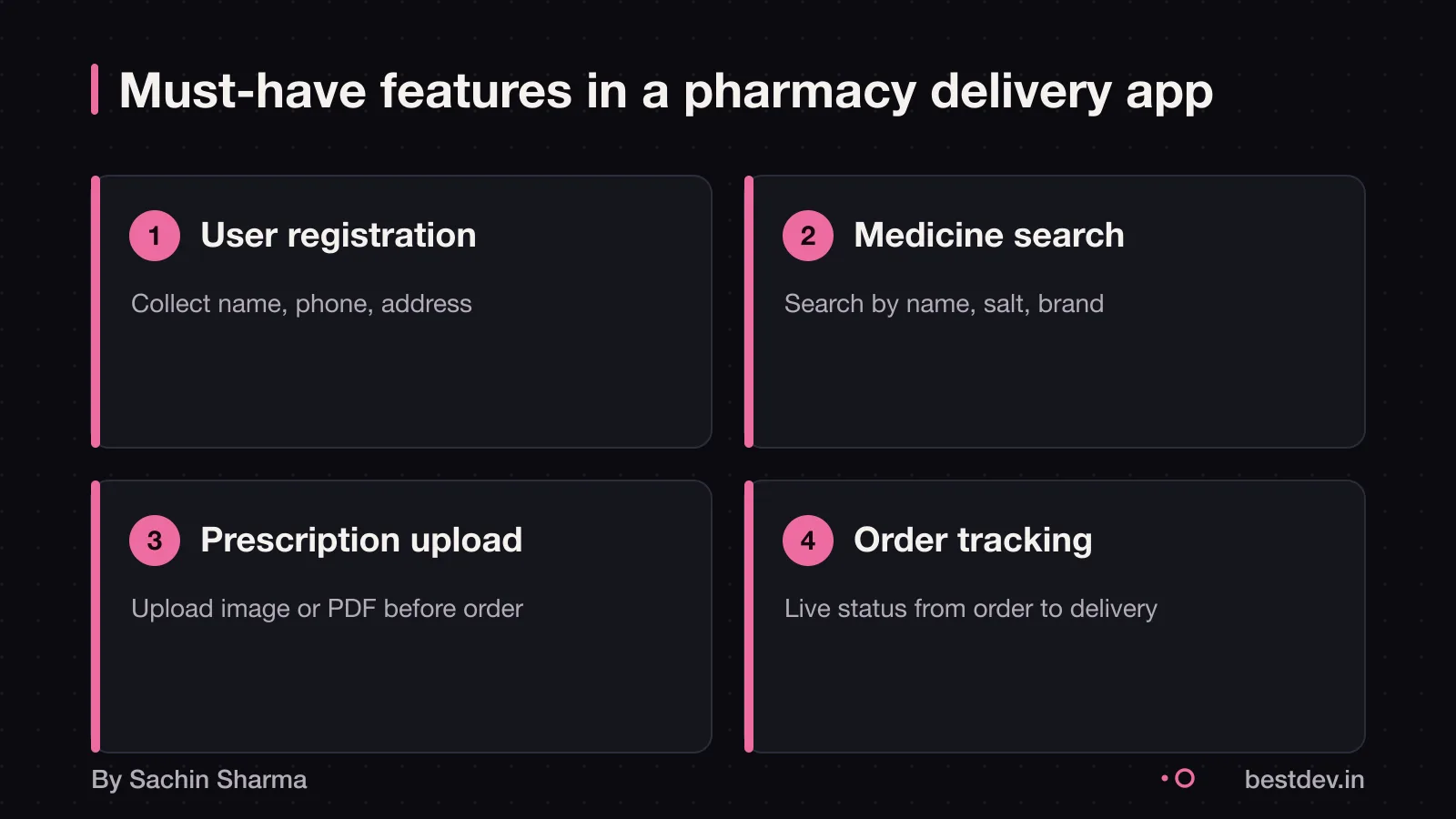
A pharmacy delivery app typically lets users browse medicines, upload prescriptions, place orders, make payments, and track deliveries. Some of these features support legal and safe service delivery, but the necessity of each depends on your business model and compliance requirements.
User registration with mobile OTP or social login adds convenience for customers, though it increases development time.
Prescription upload is a non-negotiable feature for any legitimate pharmacy app, as stated by industry practice. As an estimate, assuming compliance with data privacy norms, you should store prescription uploads securely and be ready for audits.
Medicine search that supports brand names, generic names, and symptoms can help users find what they need quickly.
Order tracking and push notifications keep users informed on delivery status.
For the pharmacy side, digitising inventory and order management comes first What software to digitise first in a pharmacy. You can start there before building a full delivery app.
What makes a pharmacy delivery app more expensive?
App complexity is the single biggest cost driver. This includes features like role-based access, session handling, and password resets. A login involves more than just a screen.
API and third-party integration, such as prescription upload, may add ₹50,000 to ₹3,00,000 to development cost. Notifications for order confirmations, delivery updates, medicine reminders and promotional offers keep users engaged and informed. These notifications are sent after events like order confirmations and delivery updates.
Legal compliance adds cost. A drug licence can cost approximately ₹3,000 to ₹10,000. DPDP Act compliance for data privacy could cost ₹60,000 to ₹2,40,000 for a light-data app. Check with a legal advisor for your case. As an estimate, storing medical data securely could mean higher server and encryption costs. The exact cost is not known. Skipping certain legal requirements may lead to penalties under the DPDPA. The DPDPA has penalties up to ₹250 crore for serious failures like poor security safeguards. Check with a legal advisor. Because of app complexity, prescription handling, and legal compliance, you should expect higher costs even in a basic version.
Cost breakdown by app component and feature
A custom pharmacy delivery app has three main parts: a customer app, a delivery app and an admin panel. Each has a different cost and role. You need all three for a working service.
The frontend development costs ₹1,00,000 to ₹4,00,000 to build. Features like medicine filters and prescription upload may increase the cost. A simple version starts at ₹1 lakh.
The delivery app costs ₹75,000 to ₹2,00,000. It helps delivery agents accept orders, see the best route and mark deliveries as done. It helps delivery personnel access optimized routes through GPS tracking. This app runs on the agent’s phone and must be light and fast.
The admin panel is the control centre. It manages users, pharmacies, orders, payments, prescriptions and analytics. It may help support compliance with healthcare rules. As an estimate, features like inventory tracking or sync with pharmacy stock systems may add cost.
Some medicines require strict temperature ranges. Insulated packaging and special transport are needed. This adds time and coordination. Plan for extra logistics and checks.
If you run a pharmacy, start by digitising your inventory.
Cost of compliance and verification
AI-powered prescription reading increases cost, though it can improve efficiency. Without this feature, you cannot verify patient needs or meet safety rules. For example, a basic system lets users upload a photo. A pharmacist checks it before dispatch. An advanced version uses AI to read and categorise prescriptions automatically. This cuts processing time but raises cost.
For a light-data app, 40 to 80 developer hours are planned. At ₹1,500 to ₹3,000 per hour, that is ₹60,000 to ₹2,40,000. This covers consent flows, data access logs, and user rights management. The DPDP Act applies to apps that process digital personal data collected in digital form or later digitised. Check with a legal expert for your case. You can reduce this cost by limiting data collection to only what is necessary. For example, do not store prescription images longer than needed unless required by law.
If you plan to store medical records long-term, the cost will likely be higher than the range shown here, as server and security needs grow. However, the exact cost is not known. See the DPDP Act: consent flows an Indian app actually needs for implementation steps.
Legal requirements: drug licence, GST and DPDP Act
Yes, you need a drug licence to run a pharmacy delivery app in India. The Drugs and Cosmetics Act, 1940, along with the Drugs and Cosmetics Rules, 1945, applies to businesses that sell medicines. You must obtain a drug licence in every state where you operate. Without it, your service cannot legally dispense or deliver medicines.
GST at 18% applies to platform fees, as per Razorpay's model.
The DPDP Act applies if your app collects personal data in digital form within India. It also applies to data processing outside India if the processing is connected to offering goods or services to people in India. You must build consent flows, allow data access and deletion requests, and protect data by design.
How the DPDP Act applies to your app explains how to implement these features. The full list of documents needed for legal operation is not known, so consult a legal expert in pharmaceutical e-commerce. They can confirm if your model meets state-level drug licensing rules and data protection duties.
Risks and challenges in pharmacy delivery apps
The main risks in a pharmacy delivery app are delivery delays, inventory mismatches. Low user trust due to concerns about medicine authenticity, prescription privacy, and payment security.
Last-mile delivery is unreliable due to traffic, wrong addresses, or unavailable customers. This delays deliveries and damages trust. To reduce delivery delays, consider real-time GPS tracking, training delivery staff on follow-up protocols, and allowing users to reschedule deliveries.
Manual stock updates in pharmacies can delay real-time inventory in aggregator models, leading to order cancellations that frustrate users. To reduce inventory mismatches, consider syncing your app with live inventory systems or updating stock every two hours. For an MVP, limiting your catalogue to high-demand items may help reduce errors.
Users may not trust your app with their prescriptions, payment details, or health data, especially at first. To build trust, consider showing verified pharmacy licences, using SSL encryption, and displaying customer reviews.
Prescription privacy is a legal and ethical risk. A professional should advise on compliance with data protection laws such as the DPDP Act, 2023. Consider encrypting prescription data and allowing users to delete uploads. A professional should advise on data protection practices.
To reduce risks, consider starting with a small service area, partnering with a few verified pharmacies. Running regular checks on delivery success rates and data logs.
Worked example: budget for a mid-level pharmacy delivery app
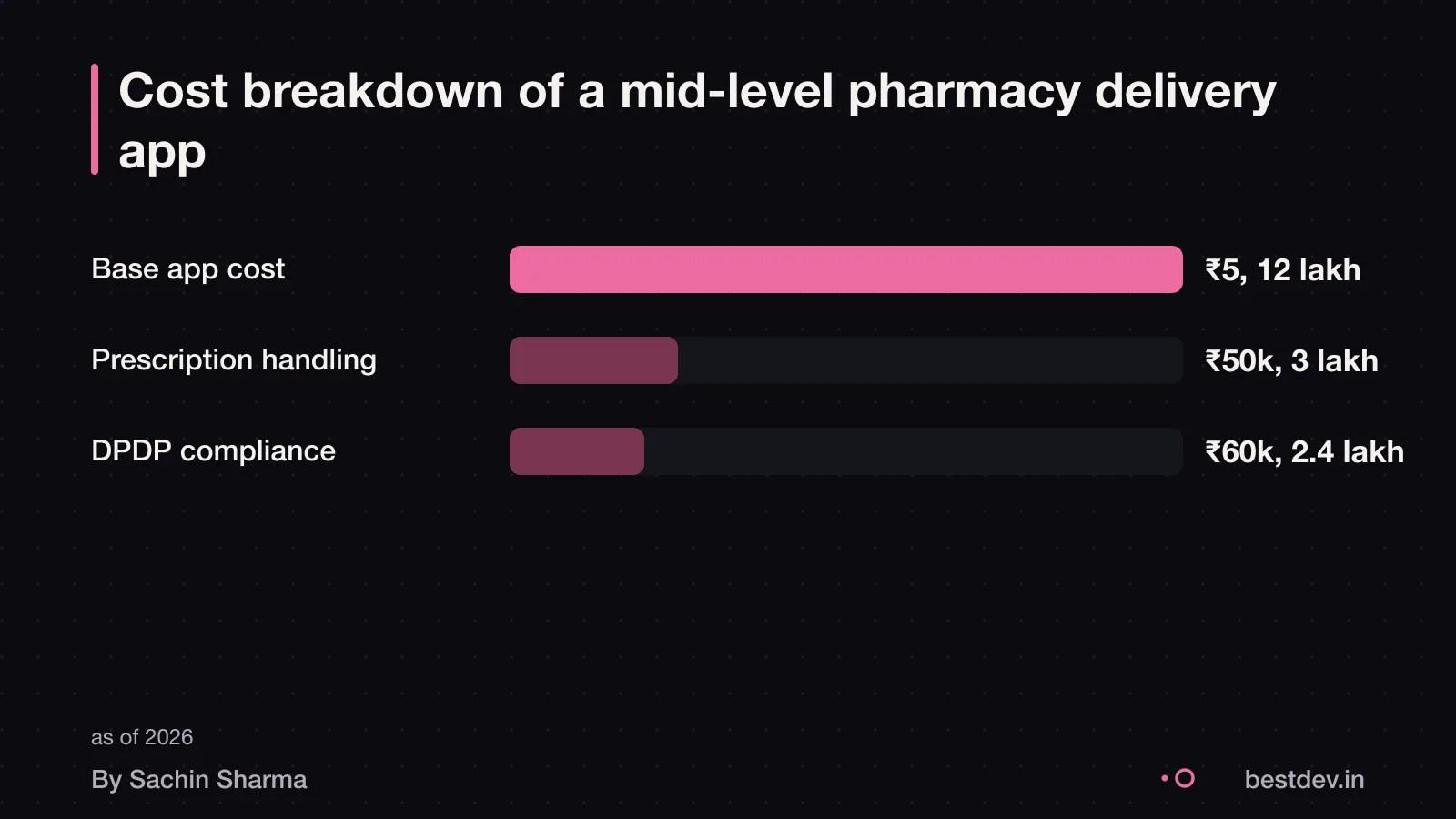
As an estimate, a mid-level pharmacy delivery app costs between ₹5 lakh and ₹12 lakh. This range does not include added compliance for prescription handling or DPDP.
DPDP compliance costs ₹60,000 to ₹2,40,000. This is based on mid-level hourly rates of ₹1,500 to ₹3,000 from the build-cost guide.
Annual maintenance is 15% of the build cost, which is ₹1,20,000. This fee is called a maintenance retainer in the quote.
Server and security costs for storing medical data are not known. You must budget extra for encrypted storage and audit trails. Ask your developer how they meet DPDP rules for health data.
When you should not build a custom pharmacy delivery app
- You should not build a custom pharmacy delivery app if your target market is already served by Zepto, Swiggy or Blinkit. These platforms offer medicine delivery in major cities. Zepto delivers medicines within 10 minutes in metros. Swiggy partners with PharmEasy to sell medicines through Instamart in Bengaluru. Blinkit also offers 10-minute delivery and has piloted prescription medicine delivery in Bengaluru. Using them cuts your tech cost to zero.
- Do not build if you cannot handle low margins and high volume. Pharmacy delivery on large platforms runs on thin profit. You may get volume, but control over pricing, customer data and delivery speed is limited. A custom app gives you full control. Based on a mid-level pharmacy app estimate, it costs ₹5 lakh to ₹12 lakh to build. It may cost more to maintain.
- Signs you should not build include: you are testing demand, you lack a drug licence, or your budget is under ₹3 lakh. Building makes sense only when you need brand control, have regulatory approval, and plan long-term operations.
- If your goal is speed and low risk, start by listing on existing platforms. You can later build a custom app when you have customer data, steady orders, and funding.
Related reading: About Sachin Sharma: software developer & system designer, Contact Sachin Sharma, What does a classifieds app cost in India?.
Questions people ask
How much does a pharmacy delivery app cost in India?
A basic pharmacy delivery app costs ₹2 lakh to ₹5 lakh, a mid-level app costs ₹5 lakh to ₹12 lakh. An advanced app costs ₹12 lakh to ₹25 lakh or more. The range depends on features, compliance, and integration needs. Choose based on your business scale and service goals.
What makes a pharmacy delivery app more expensive than a food delivery app?
A pharmacy delivery app may cost more due to prescription handling, drug licence requirements, and compliance with the Drugs and Cosmetics Act. These add complexity in development, legal setup, and data security, increasing both time and cost.
Do I need a drug licence to run a pharmacy delivery app?
Yes, you need a drug licence under the Drugs and Cosmetics Act, 1940, and Rules, 1945. You must get one licence per state and premise where you operate. Check this for your case with a pharmacist or legal advisor.
How much does prescription upload add to the cost?
API and third-party integration can add ₹50,000 to ₹3,00,000 to your app cost. The final cost depends on whether you use manual checks or automated systems.
Is GST registration needed for a pharmacy delivery app?
Yes, GST registration is needed because 18% GST applies to the platform fee and is due on medicine sales. You must collect and file GST as part of your business compliance. Check this for your case with a chartered accountant.
Who owns the source code after the app is built?
You own the source code only if your agreement says so. By default, the developer retains ownership under Indian contract law. Get full code ownership in writing before final payment.
How much does DPDP Act compliance cost?
As an estimate, DPDP Act compliance may cost ₹60,000 to ₹2,40,000, based on a mid-level rate of ₹1,500 to ₹3,000 an hour. This covers 40 to 80 developer hours for a light-data app. Check this for your case with a data protection officer or lawyer.
Can I use a no-code platform for a pharmacy delivery app?
No, you should not use a no-code platform for a pharmacy delivery app. Compliance, data security, and prescription workflows are too complex and no evidence shows a compliant no-code pharmacy app in India. Build a custom app to meet legal and safety standards.
What is the maintenance cost after launch?
As an estimate, maintenance costs 15% of the build cost yearly, with extra costs for hosting and fees. For hosting, ₹72,000 a year; Apple Developer Program costs ₹9,500. Budget for updates and security patches.
How do I verify a developer can build this?
Ask for proof of past work, test technical skills with a 90-minute live exercise, and check their knowledge of drug laws and data compliance. This helps avoid hiring someone who overstates their experience. See who can do this for you.
Assumptions behind the numbers
- App complexity is mid-level (customer + delivery + admin)
- Team works at ₹1,500–3,000/hour (mid-range India dev rate)
- DPDP compliance is light-data (40–80 hours)
- Reader adjusts team size and hourly rate
I won't hand you a number that pretends to be the market. Instead, here is the working: set the weeks, the people and the rate, and see where the money goes.
- Scope and design17%
- Build56%
- Testing and fixes17%
- Launch and stores11%
The weeks shown are an example of a small app, there to be changed. Fees you pay others (store accounts, cloud, SMS) are not in this total.
What moves it
Six things that move the price
- More user roles
Customer, delivery, pharmacist, admin — each is a separate app surface.
- Prescription AI features
Auto-reading prescriptions adds weeks and model costs.
- Strict DPDP compliance
Consent flows, audit logs, breach alerts take time.
- Cutting to one platform first
Start with Android or iOS alone to halve the build.
- Using pre-built modules
Login, cart, and push systems save weeks if they fit.
- Clear scope and mockups
Fewer changes mean fewer costly mid-build pivots.
Not in the total
Fees that go to someone else
Drug licences
Licences per state and premise. Check current rates.
E-pharmacy registration
Draft rule sets ₹50,000 fee. Confirm latest status.
Cloud, SMS, maps, payments
Usage-based, billed by provider. Razorpay, Twilio, etc.
Before you sign
Ask for these five things
- How many weeks per phase, and with how many people?
- Is prescription handling built in or bolted on?
- What DPDP features are included?
- Are delivery-agent tools part of the app?
- What backend services are used and at what cost?
Keep going