Cost · Generic
What does it cost to build an app in India?
I won't hand you a number that pretends to be the market. Instead, here is the working: set the weeks, the people and the rate, and see where the money goes.
The full explanation
What is a meat and fish delivery app and its base cost?
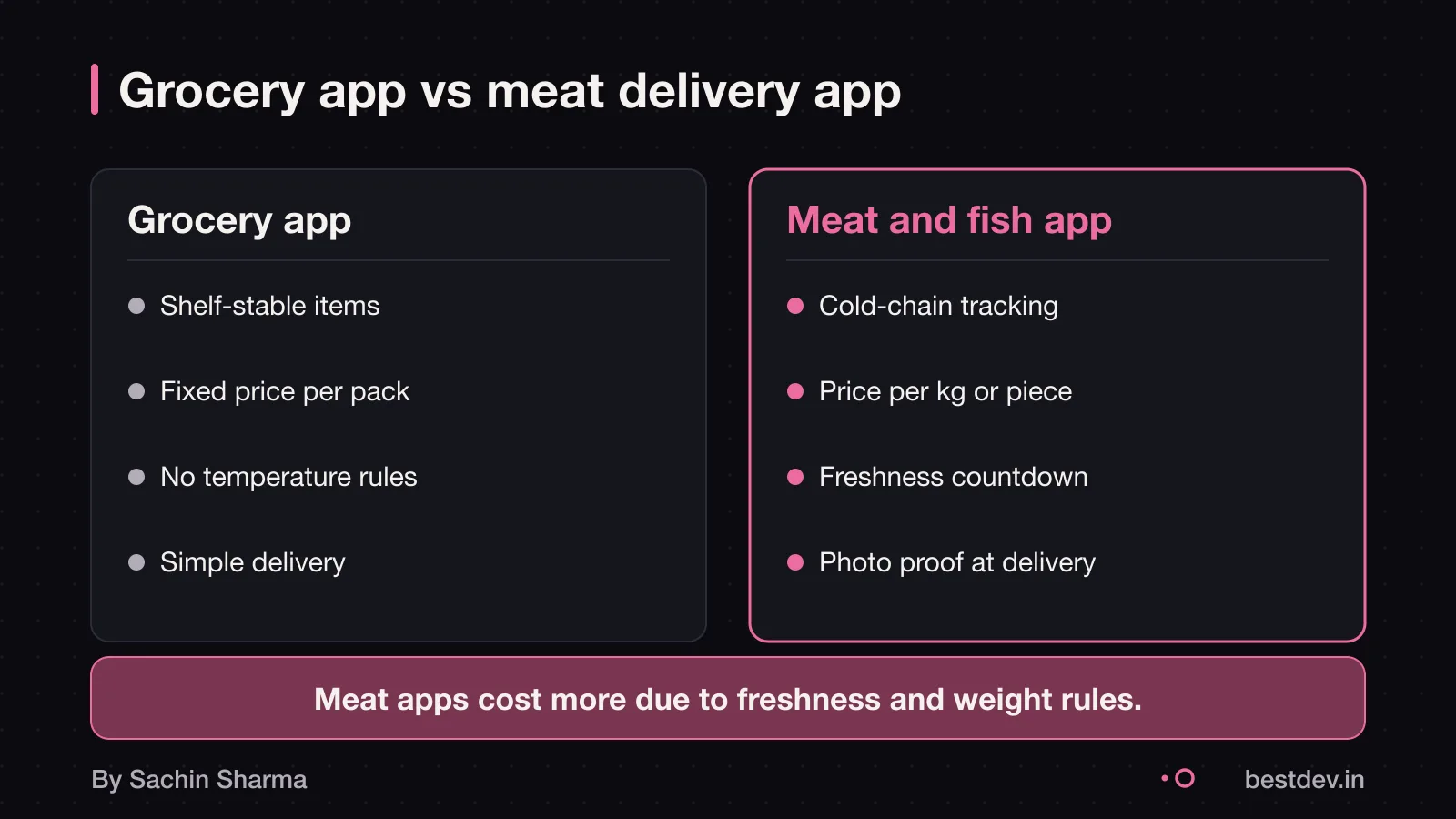
A meat and fish delivery app can deliver fresh meat, fish, chicken and eggs online, like Licious does. It differs from a grocery app because the items are perishable and need freshness tracking, weight-based pricing and cold-chain handling. Traceability is needed so you can track each cut from supplier to delivery, as required for food safety. Licious is an example: it follows a farm-to-fork model and includes recipes and chef-style tips.
As an estimate, assuming a basic MVP, the cost to build such an app in 2026 starts from $15,000. This assumes a simple app with order booking, product listing and payment. Meat delivery app development in India is 60 to 75% cheaper than in the US or UK. A $70,000 app could cost less in India, as the cost is typically 60 to 75% less than US or UK equivalents.
The base app includes customer registration, product catalog, cart and checkout, order history and basic admin access. It does not include advanced features like AI recommendations, batch tracking or delivery fleet management. You can see what features go into such an app in our guide on What features a meat and fish delivery app needs.
What features add the most cost?
Cold-chain freshness alerts, search with filters, and a meat catalogue have documented development costs for a meat delivery app. A standard login or cart adds less cost but is still essential.
Cold-chain freshness alerts cost between $2,500 and $5,500.
A search and filter system for weight, cut, origin and price costs $1,500 to $3,500.
A meat catalogue with cuts, grades and images costs $1,200 to $2,500.
User login via OTP or social accounts costs $800 to $1,500. The cart and checkout flow costs $1,000 to $2,000.
Here is a summary of key feature costs:
| Feature | Cost (USD) | Why it matters |
|---|---|---|
| Cold-chain freshness alerts | $2,500 to $5,500 | Supports temperature monitoring during transit |
| Search and filter | $1,500 to $3,500 | Enables filtering by weight, cut, origin and price |
| Meat catalogue | $1,200 to $2,500 | Displays meat cuts, grades and images |
| Cart and checkout | $1,000 to $2,000 | Processes cart and checkout functions |
| User login | $800 to $1,500 | Supports user login via OTP or social accounts |
Prioritisation of features depends on your business needs. Cold-chain alerts and the meat catalogue cost more than search and cart. For a full list of what to build now or later, see Must-have vs later features for a meat delivery app.
How much does cold-chain and freshness tracking add?
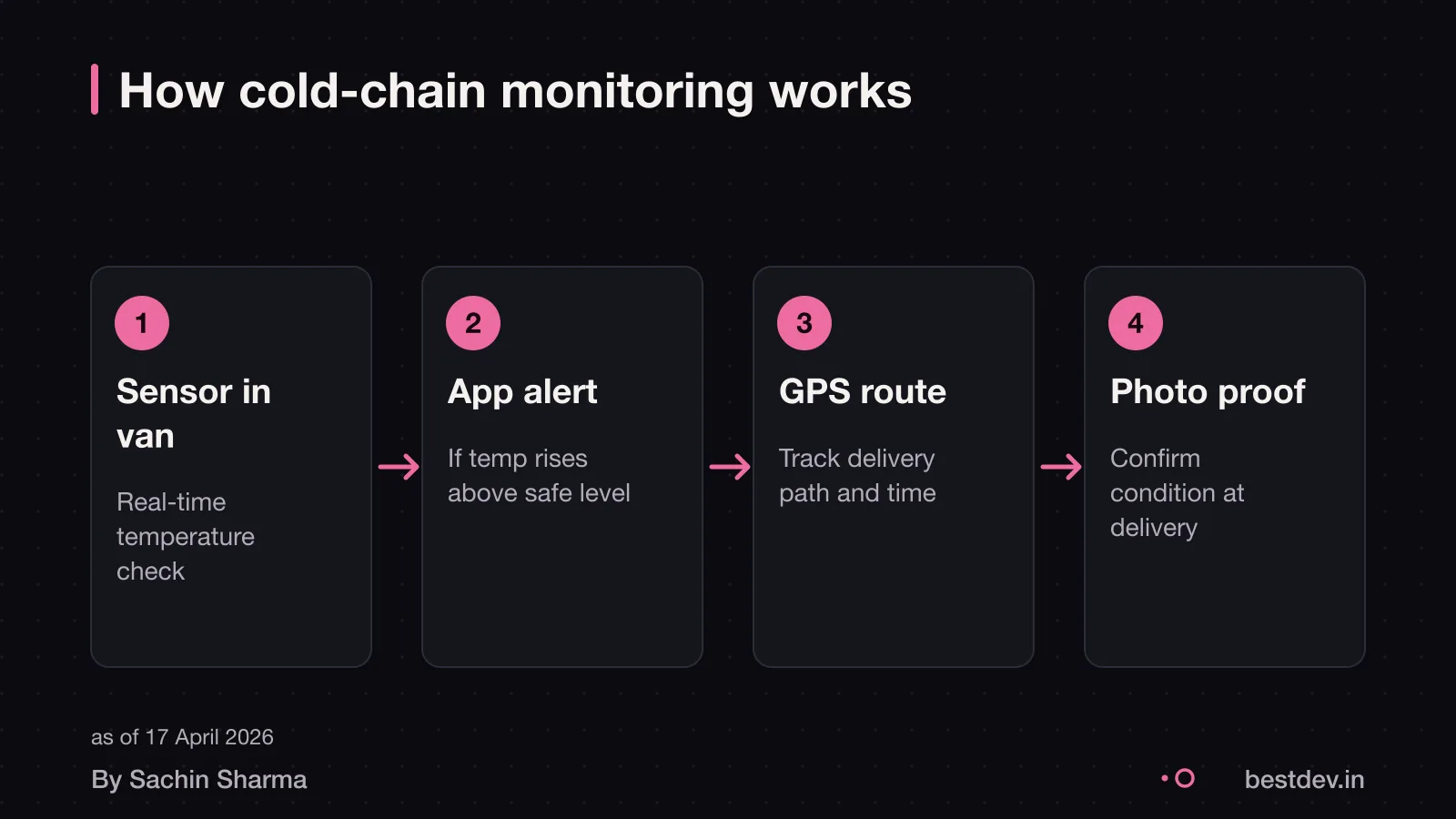
Cold-chain tracking is needed to keep meat and fish fresh during delivery and meet food safety rules. Without it, spoilage can happen fast, especially in heat. The system logs temperatures and sends alerts if a fridge fails or a door is left open.
Adding cold-chain features costs $2,500 to $5,500. These features can include temperature monitoring alerts, insulated packaging integration, and delivery time windows. Real-time monitoring helps drivers fix issues before spoilage occurs.
One logistics platform, FleetRabbit, claims an 85% reduction in spoilage with real-time alerts that trigger driver action. The system flags temperature changes, so drivers can act fast. This also creates audit-ready logs for FSSAI checks.
These features raise the app’s cost but cut losses. For small sellers, this can mean the difference between profit and waste. For larger fleets, it supports compliance and brand trust.
If you are comparing tech teams, note that freelancers may skip full cold-chain integration to save cost. Agencies or full-stack developers are more likely to include it. See Best tech and team choices for food apps for what to ask.
How long does it take to build?
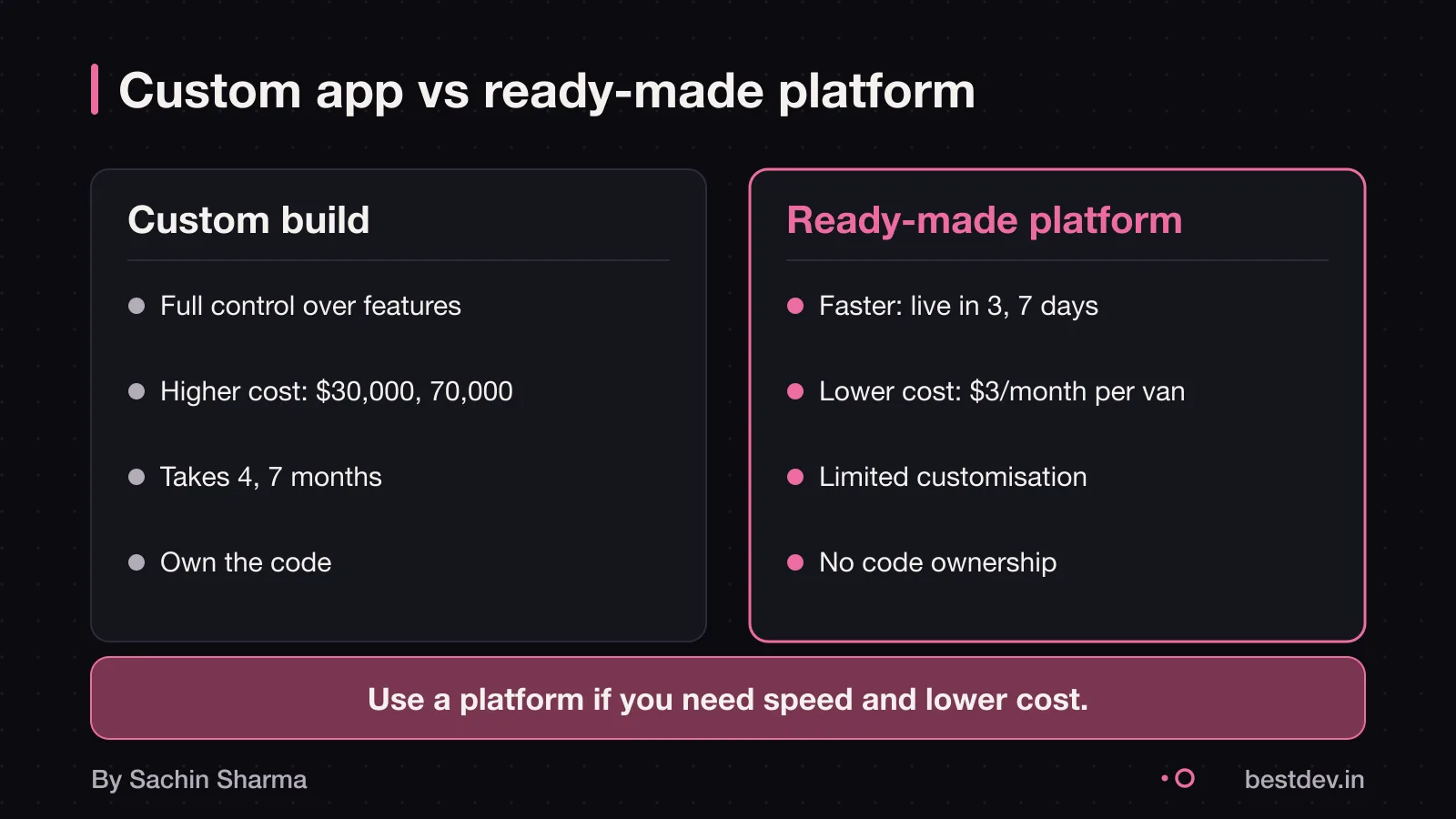
A custom meat and fish delivery app takes 2 to 4 months for Tier 1 features. 4 to 7 months for Tier 2 features, based on Sigosoft's stated timelines. The timeline depends on how many custom features you need, such as cold-chain tracking, weight-based pricing, or FSSAI compliance logs. Complex integrations may slow down development. A ready-made platform like FleetRabbit can get most food delivery fleets operational in 3-7 days. This is much faster than building from scratch, but offers less control over branding and features. For example, FleetRabbit focuses on fleet management, not customer-facing app design. You can cut time by choosing a pre-built solution, but you may miss unique selling points. How long agencies and freelancers take to build apps can help you compare team options.
Build custom or use a ready-made platform?
You can build a custom app or use a ready-made platform like inecta Food ERP. Building custom may give you more control over features, but the extent depends on your development team and requirements. Using a ready-made platform may be faster and have lower initial setup effort, but upfront cost comparisons are not confirmed.
A Flutter cross-platform MVP built by an India-based team can be a cost-effective way to start. A custom app allows you to choose which features to build. Ownership of code depends on your contract, but evidence does not confirm standard terms. in evidence. Custom apps often take more time to launch, but the exact timeline depends on scope and team.
Ready-made platforms like inecta Food ERP run on Microsoft Dynamics 365 Business Central. Ready-made platforms may include unused features, and custom changes might be limited or costly, but evidence does not confirm this for inecta Food ERP.
Building custom may offer more flexibility but requires technical oversight, though the level of control is not quantified in evidence. A ready-made platform may suit those with standard needs, but evidence does not confirm speed or suitability. Your choice depends on budget, timeline, and how much you want to tailor the customer experience.
Freelancer or agency: which fits your build-or-buy choice?
Legal and FSSAI requirements
FSSAI regulates food safety across the country, so you may need to check if your food delivery app requires registration. You can apply under the Tatkal scheme for faster approval, as the scheme is listed for instant license and registration. Without it, you cannot legally sell or deliver food.
A meat shop may need a license, with a fee of ₹500 for a fresh license as of 2026. If your shop is within 100 meters of a masjid, you must get a No Objection Certificate (NOC) from the Imam or Managing Committee. This rule exists to respect local religious sentiments.
Local rules vary by city. For example, in Delhi, a meat shop must be at least 150 meters away from certain religious places or grounds. The distance is measured from all sides of the building. Other cities may have different limits, so check with your local municipal authority.
For full details, read about DPDP Act compliance for food apps.
What if the app fails or the cold chain breaks?
Photo proof with GPS timestamp at delivery can resolve disputes. Without this, you risk refund claims and reputational harm.
Insurance providers now demand proof of proper temperature control before paying spoilage claims. If they fail, you may not be covered.
For refunds, set clear rules in your app: state the acceptable temperature range and delivery window. If the meat arrives outside these, issue a refund.The Food Safety. Standards (Food Recall Procedure) Regulation, 2017 is one of the regulations under FSSAI. May be relevant for handling unsafe products. This rule helps you act fast and stay compliant.
For more on liability, see What these guides do and do not promise.
How to verify a developer can handle this
Ask to see proof of past apps they have built that handle delivery logistics. A developer should show integration with temperature sensors or reefer systems if they claim such experience. As FleetRabbit integrates with 200+ telematics and IoT hardware providers including those systems. Check if their past apps used IoT devices that send data every 1 to 5 minutes. As this can help detect temperature deviations within minutes, not hours. Before paying, agree on milestone payments so you only pay when each part works as promised. For example, release funds only after you test key features in real conditions.
Ask for logs or screenshots of temperature alerts in past projects, not just promises. If they claim to support weight-based pricing, ask how they handled tare weight and variable cuts in prior apps.
App maintenance and support after launch
You must budget for this because costs like cloud hosting, app store fees and annual maintenance are ongoing. As a rule, annual maintenance costs 15 to 20% of the initial build cost. For example, if your app cost ₹50 lakh to build, expect to pay ₹7.5 to ₹10 lakh per year to maintain it.
Support may include integration with systems like POS, payment gateways, CRMs, and logistics platforms.
You should expect clear communication, a response within 48 hours for critical issues, and a plan for version updates. For more on what development includes after launch, see What app development includes after launch.
Worked example: cost for a mid-sized meat delivery business
As an estimate, a mid-sized meat delivery app with 40 screens would cost between ₹35 lakh and ₹52 lakh. This total is built from four main features: the base app, meat catalogue, search and filter, and cold-chain alerts. Each cost is drawn from market data for similar projects as of 29 April 2026.
As an estimate, assuming a mid-range product with both iOS and Android apps, real-time tracking. A vendor management panel, the base app costs between $30,000 and $70,000. As an estimate, assume $45,000 (₹37 lakh) for a mid-range scope. As an estimate, assume $1,800 (₹1.5 lakh). As an estimate, assume $2,500 (₹2.1 lakh). As an estimate, assume $4,000 (₹3.3 lakh).
As an estimate, adding the assumed costs: ₹37 lakh + ₹1.5 lakh + ₹2.1 lakh + ₹3.3 lakh = ₹43.9 lakh. As an estimate, a 10% buffer for integration and testing adds ₹4.4 lakh. As an estimate, the total comes to ₹48.3 lakh. This can be rounded to ₹48 lakh. As an estimate, the cost range is ₹35 to ₹52 lakh, based on the feature cost ranges and exchange rate. This reflects uncertainty in scope and rates.
Assumptions: 40 screens, both platforms native, mid-range complexity, no admin panel extras, and current 2026 exchange rate (~₹82 per $). This does not include hosting, GST, or FSSAI registration. Ongoing costs add ₹5 to 10 lakh per year.
When this advice is wrong: who should not build this app?
You may not need a full app if you can manage orders with WhatsApp, Google Forms or a simple tool like Zoho Inventory. As an estimate, assuming low order volume, a custom app may cost more than it returns.
For more, see When a simple tool beats a full app.
Questions people ask
How much does a meat and fish delivery app cost in India?
As an estimate, assuming development in India at 60 to 75% less than US rates. A meat and fish delivery app could cost from $15,000 to $120,000. As an estimate, assuming ₹83 per dollar, mid-range apps with tracking and vendor panels cost $30,000 to $70,000.
What makes a meat and fish delivery app more expensive than a grocery app?
Cold-chain monitoring, weight-based pricing, and detailed meat catalogues make it cost more. Features like temperature alerts add $2,500 to $5,500, and meat cuts catalogues add $1,200 to $2,500. These are not needed in standard grocery apps.
How long does it take to build a meat and fish delivery app?
It takes 2 to 7 months to build a meat and fish delivery app. Basic apps with core features take 2 to 4 months. Apps with cold-chain tracking and vendor panels take 4 to 7 months.
Do I need FSSAI registration for a meat and fish delivery app?
Yes, FSSAI registration is mandatory for all food businesses in India, including delivery apps. You can apply under the Tatkal scheme for faster approval. Visit fssai.gov.in for details.
What are the hidden costs after the app is built?
Hidden costs include cloud hosting (₹8,000 to ₹60,000/month), annual maintenance (15 to 20% of build cost). Apple App Store fee (₹8,000/year), SMS services, and compliance services for your target country. These can add ₹5 to 10 lakh per year for a mid-sized operation.
Can I use a ready-made platform instead of building custom?
Yes, platforms like inecta Food ERP or FleetRabbit can be used. They are cheaper and faster to set up than custom apps. But you get less control over features like cold-chain alerts or custom pricing.
What happens if the cold chain fails and the meat spoils?
You may be liable for refunds or penalties if the cold chain fails. Insurance claims now require proof of temperature control. Use systems like FleetRabbit that log temperature and photos at delivery.
How do I handle refunds for spoiled products?
Follow FSSAI's Food Recall Procedure Regulation, 2017 for refunds on spoiled items. Have a clear refund policy and collect photo and temperature proof at delivery, as insurance claims may require such evidence. Check this for your case with a food safety lawyer.
What does GST add to the development cost?
GST impact on app development cost is not stated in the evidence. Development contracts may include GST, but rates vary. Confirm the final cost with your developer and check with a chartered accountant for your case.
Can I start with WhatsApp and upgrade later?
Yes, many start with WhatsApp orders before building an app. It works as a low-cost MVP. You can later migrate data to a custom app when demand grows.
Assumptions behind the numbers
- Assumption: 40 screens for a mid-sized app.
- Assumption: Team of 1 developer, 1 designer, 1 tester.
- Assumption: Daily rate of ₹2,000 per person.
- Assumption: Cold-chain alerts cost ₹2.1–4.6 lakh.
- Assumption: Weight tracking feature costs ₹1–2.1 lakh.
I won't hand you a number that pretends to be the market. Instead, here is the working: set the weeks, the people and the rate, and see where the money goes.
- Scope and design15%
- Build60%
- Testing and fixes15%
- Launch and stores10%
The weeks shown are an example of a small app, there to be changed. Fees you pay others (store accounts, cloud, SMS) are not in this total.
What moves it
Six things that move the price
- More screens or roles
Each extra user type (customer, admin, rider) is close to another app.
- Real-time features
Live tracking and chat need more design and more testing.
- Cold-chain alerts
Temperature monitoring and freshness indicators add cost.
- Weight-based pricing
Tracking variable weights and cuts increases backend complexity.
- Cutting to one platform first
Starting with one clear flow can be half the work.
- Using managed services
A managed backend for login and data removes weeks.
- A clear scope up front
Changes mid-build are the most expensive weeks.
Not in the total
Fees that go to someone else
Google Play developer account
A one-time registration fee, paid to Google. Check the current amount.
Apple Developer Program
A yearly fee paid to Apple. Check the current amount.
Cloud, SMS, maps, payments
Usage-based, billed by the provider to you.
Before you sign
Ask for these five things
- How many weeks per phase, and with how many people?
- What is not included?
- Which fees do I pay to others directly?
- What happens to the price when I change my mind?
- What does the first month after launch cost?
Keep going