Hire · Quick commerce
Hire a developer for a quick commerce app
A developer can only price what you describe. Fill the fields, and the brief writes itself.
The full explanation
What is a D2C brand app?
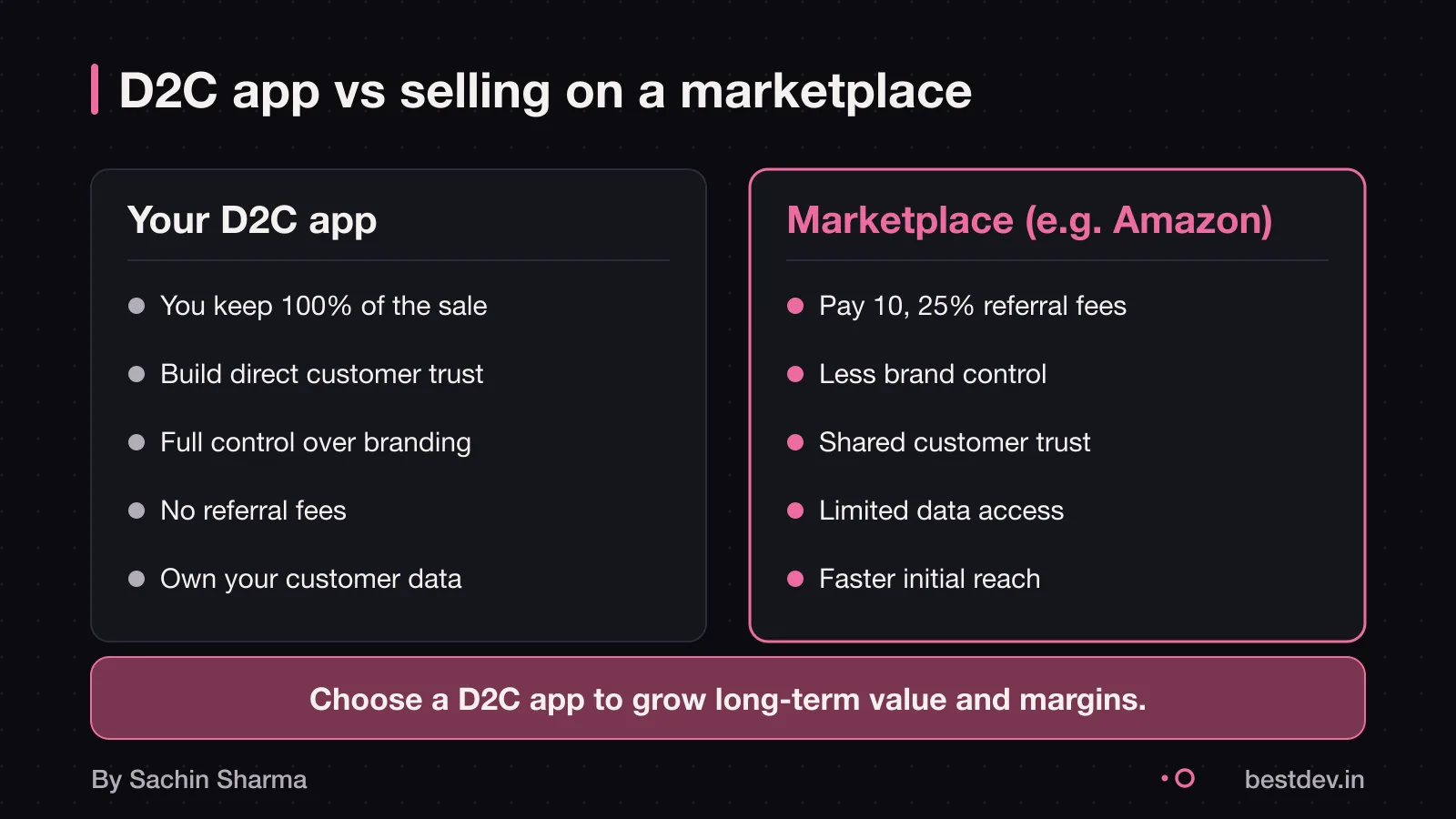
D2C means direct-to-consumer, where your brand sells straight to customers online, without intermediaries like retailers or wholesalers. This cuts out middlemen, so you can control how customers see your brand. Unlike marketplace selling, you own the customer relationship and data.
A D2C app helps your brand grow trust and repeat sales. You can offer loyalty points, early access, and personal deals. It works best when you want customers to come back, not just buy once. For example, a skincare brand can use the app to track usage and send refill reminders.
This approach gives you greater control over the customer experience and provides deeper insights into your customer base. You decide the look, the flow, and how support works. If you are building a brand people recognise, a D2C app can help you stand out.
Do you really need a D2C app?
A website or Instagram page works fine for one-off sales or testing demand. You can grow without an app. Use social media, WhatsApp, and a simple website.
An app can provide enhanced control over the customer experience and deeper insights into customer behavior, which may help improve offers.
How much does a D2C app cost to build?
A basic D2C app build costs ₹4 lakh to ₹12 lakh. Mid-complexity apps cost ₹12 lakh to ₹40 lakh. This includes core features like product listing, cart, checkout, and user accounts. It does not include ongoing maintenance, marketing, or payment gateway fees. The price is driven more by new software needs than product count.
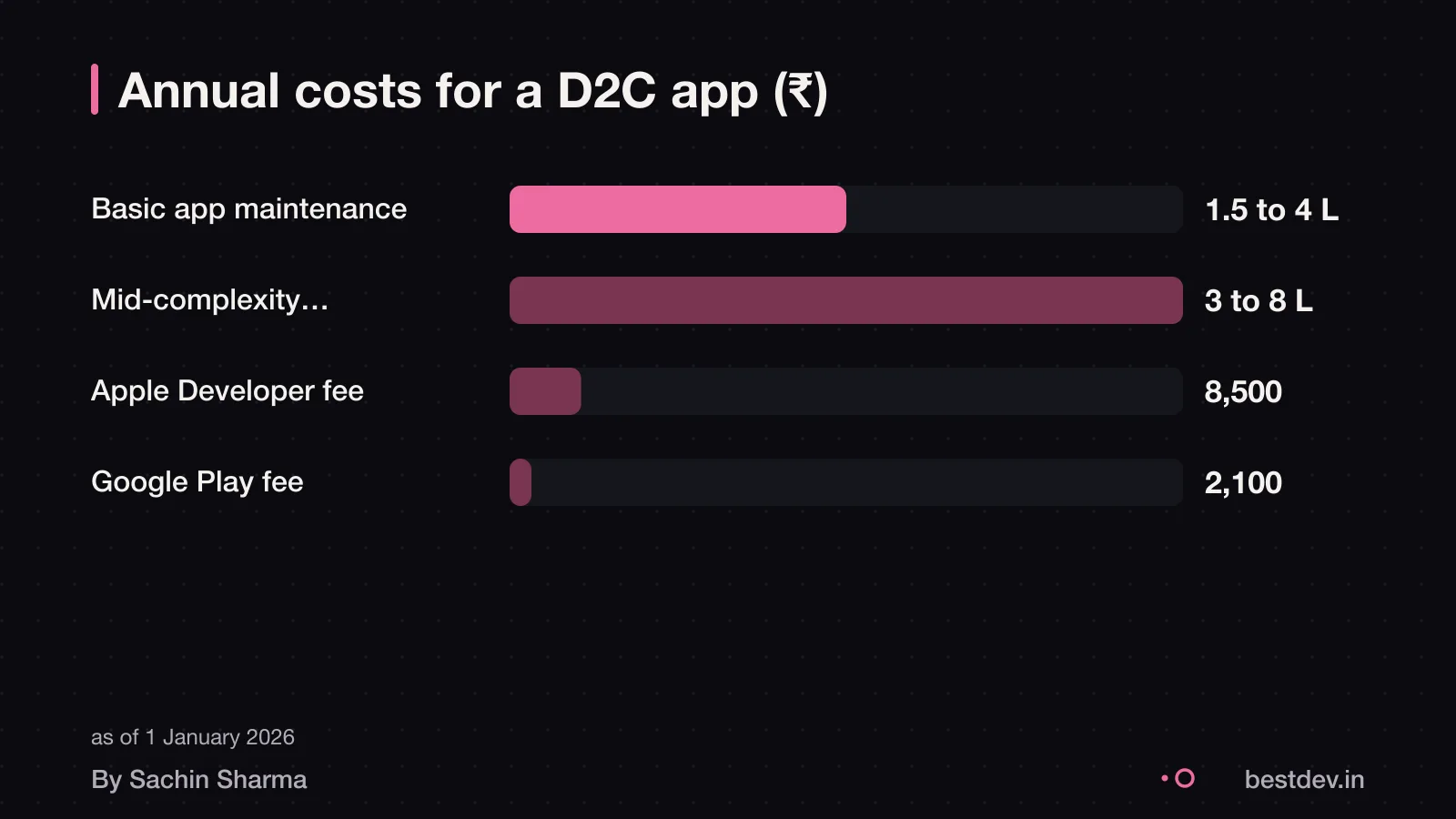
One-time costs include the Google Play one-time ₹2,100 fee and Apple’s ₹8,500 annual fee. Recurring costs include app maintenance (₹1.5 lakh to ₹4 lakh per year for basic. ₹3 lakh to ₹8 lakh for mid-complexity, ₹8 lakh to ₹40 lakh+ for enterprise). Feature development is usually quoted separately and can run 25% to 35% of the original build cost annually. If you are actively adding new functions. Maintenance keeps the app running on new OS versions and devices.
You also pay fees on each sale. From 15 October 2026, UPI payments above ₹2,000 attract a merchant discount rate (MDR) of 0.4%, capped at ₹300 per transaction. This is charged per successful UPI transaction above ₹2,000. Apple and Google charge no listing fees but take 15% to 30% on in-app purchases. However, they do not take a cut of direct sales through your app’s checkout.
Number of products does not directly affect cost. A store with 50 or 5,000 products uses the same backend structure. But if you need custom filters, bulk editing, or advanced inventory sync, those features add cost. COD return rates in fashion or electronics average 20% to 35%, which affects your net revenue but not the app cost.
Worked example: mid-complexity D2C app As an estimate, assuming a mid-complexity app with UPI and COD: - Build cost: ₹25 lakh (within ₹12L, ₹40L range) - Annual maintenance: within ₹3L to ₹8L - Feature development: about 25% of the build cost annually for actively growing products - Apple Developer fee: ₹8,500/year - Google Play: ₹2,100 one-time - UPI MDR: ₹300 per transaction above ₹2,000 (capped)
Total first-year cost: ₹31.3 lakh (build + maintenance + feature development + Apple fee). This does not include hosting, payment gateway setup, or marketing.
You can estimate your own cost using what does it cost to build an app in India.
Freelancer, agency, or in-house: which to hire?
A freelancer costs less per hour but may not reply quickly or stay long. You trade low cost for risk in response time and project continuity. For example, a solo developer might charge ₹800 per hour but vanish after two weeks.
An agency charges more but offers a team and a service agreement. This is the middle ground for small and mid-sized brands in India. You pay a monthly retainer for steady support, defined response times, and backup if one person leaves. For instance, a small agency might charge ₹1.5 lakh per month for upkeep of your live app.
Hiring in-house only makes sense when updates and fixes take up full-time work. This usually happens after you have a large customer base or run multiple apps. One developer on payroll starts at around ₹60,000 per month, not counting tools or overhead.
Most small D2C brands start with an agency retainer for balance. It gives structure without full hiring. If you are testing demand, a freelancer may be enough. If you scale fast, bring someone in-house later.
For a full comparison of trade-offs, see our guide on freelancer or agency for a first app.
You need a contract. Here's why.
You need a contract because without one, you may not own the app code, designs, or data. The Indian Contract Act, 1872 says a promise must be performed by the person who made it or their legal representative. If your developer stops working, you have no legal right to the code unless the contract says so.
Without a contract, you risk losing access to your app if the developer leaves or refuses to hand over files. You also cannot prove ownership in court. Your contract should include assignment of IP rights covering code, designs and assets. That must be written in the contract.
A contract sets clear terms: who owns what, when payments are due, and what happens if things go wrong. It protects both sides. But this is not legal advice. For your case, speak to a lawyer. See what the guides are not for more.
What must be in your contract
Without it, the developer could block updates or charge extra later. Without assignment, the developer may retain rights to code, designs and assets even after payment.
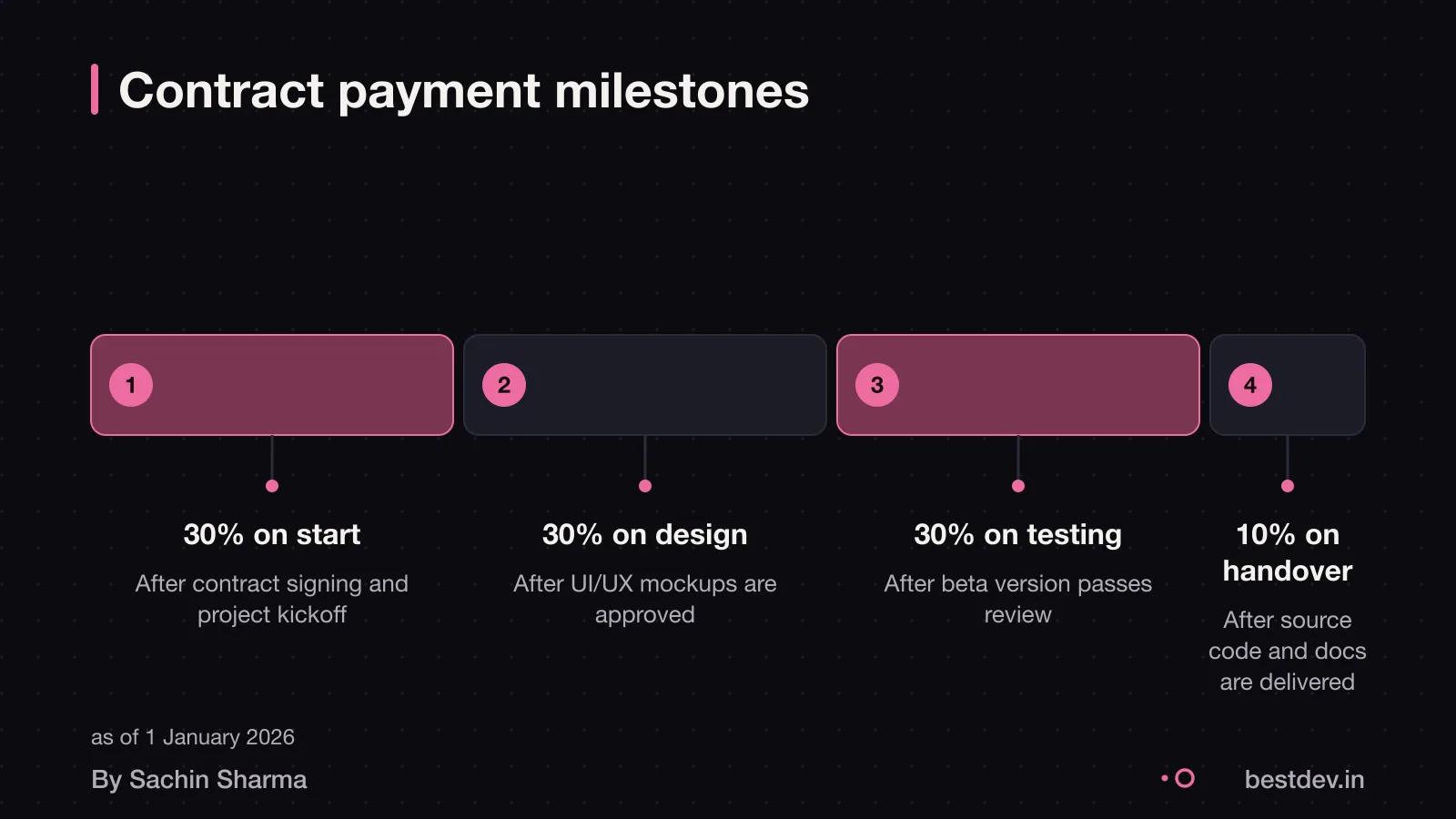
Tie payments to milestones, not dates, and keep the final payment until acceptance. Tie payments to clear milestones, with the final payment released only after you accept the work. This protects you if the developer stops replying or delivers poor work.
List each deliverable by name in the contract, along with what 'done' means for each. For example: “User login screen with OTP verification” or “Order history page with export to PDF.” Define what “done” means for each deliverable. Include delivery of the source code to a GitHub or GitLab repository that you control. This ensures you can switch developers later if needed.
You can check if your developer agrees to these terms by asking: “Will I own the code after payment?” and “Can we list each milestone and what ‘done’ means?” If they hesitate, it may be a red flag. For more, see can I get the source code of my app.
When this advice is wrong for you
When this advice is wrong for you
- If your needs are simple and you sell mostly one-off products, a D2C app may be too much. A website or Instagram shop can work just as well. No-code tools or templates can cut costs and get you online faster.
- If you assume a native app is best without checking your use case, you may waste money. For many brands, a progressive web app (PWA) or hybrid app gives the look and feel of an app without the full build cost.
- As an estimate, assuming custom development starts around ₹4 lakh, a lower budget may require AI builders or no-code platforms instead. These tools let you create a working store with less coding and lower cost. See AI builders vs developers for options.
How to start hiring a developer
Start by sending a clear message that describes your brand, what you want the app to do, and your goals for customers. This helps a developer understand your needs before responding.
Prepare a brief that includes your business context, the systems you use, and any risks you foresee. A clear brief allows a developer to review scope, architecture, and possible project phases.
You should expect a reply that asks questions or suggests a technical conversation. Such a talk helps both sides define the project’s scope, risks, and steps more precisely. Use this to judge whether the developer listens and can guide you well.
To help, here is an app brief template developers can price that covers what most need to quote accurately.
Questions people ask
What should I check before hiring a developer for a D2C brand app?
Check the developer's portfolio for specific tools and results, contact real client references, and verify their legal registration. Specific numbers and named tools beat confident generalities. Legitimate app development awards usually have strict verification processes and do not just take a developer's word for their achievements. Company registration databases show if a business is stable and legitimate.
What is a fair way to pay for a D2C app project?
Tie payments to milestones, not dates, and keep the final payment until acceptance., and keep a final payment until you accept the work. This protects you if the quality is not right. The contract should also assign all code, designs and assets to you once paid. Milestone-based payment is a standard fairness check.
What happens to my code and accounts if the project stops midway?
You should get full access to source code, cloud accounts, design files and technical documentation. The contract must state that source code is delivered to a repository you own. Future teams need these to continue work.
Do I need to register for GST to hire a developer?
You need GST registration if your annual turnover from goods crosses ₹40 lakh or from services crosses ₹20 lakh in most states. If you are below this, you do not need to register. The composition scheme cap is between ₹50 lakh and ₹1.5 crore, varying by state and supplier type. Check this for your case with a chartered accountant.
Can I switch developers after the app is built?
Yes, you can switch developers if you own the source code and have full documentation. Make sure your contract says the code is assigned to you. Access to repositories, design files and deployment systems lets a new team take over.
How do I verify a developer's past work?
Contact the clients listed in their portfolio to confirm they worked together and what the outcome was. Half of the companies mentioned in some testimonials did not exist and the other half had never worked with the agency. Developers with genuine success stories tend to have strong professional networks and endorsements from people in relevant positions.
What if my developer quits mid-project?
If a key developer leaves, risks include delays, lost knowledge, and rework. The severity of the risks depends on how well the project is documented, how modular the codebase is. Whether the development partner has processes to absorb the transition. A good contract and clear documentation reduce this risk.
A developer can only price what you describe. Fill the fields, and the brief writes itself.
Brief: quick commerce app

What kind of business is this?
(not decided yet)

What is the main goal of the app?
(not decided yet)

Which features matter most?
(not decided yet)

Do you need custom design?
(not decided yet)

When do you want to launch?
(not decided yet)

What is your budget range?
(not decided yet)

Please reply with: your assumptions, what is not included, milestones with something I can test, and who will write the code.
Ask every developer
Six questions back
- Who will write the code, by name?
- Which features are in your quote?
- How is peak load tested?
- What is not included?
- Whose name are the repository and store accounts under?
- What does the first month after launch cost?
Keep going