Hire · Quick commerce
Hire a developer for a quick commerce app
A developer can only price what you describe. Fill the fields, and the brief writes itself.
The full explanation
What is a local marketplace app?
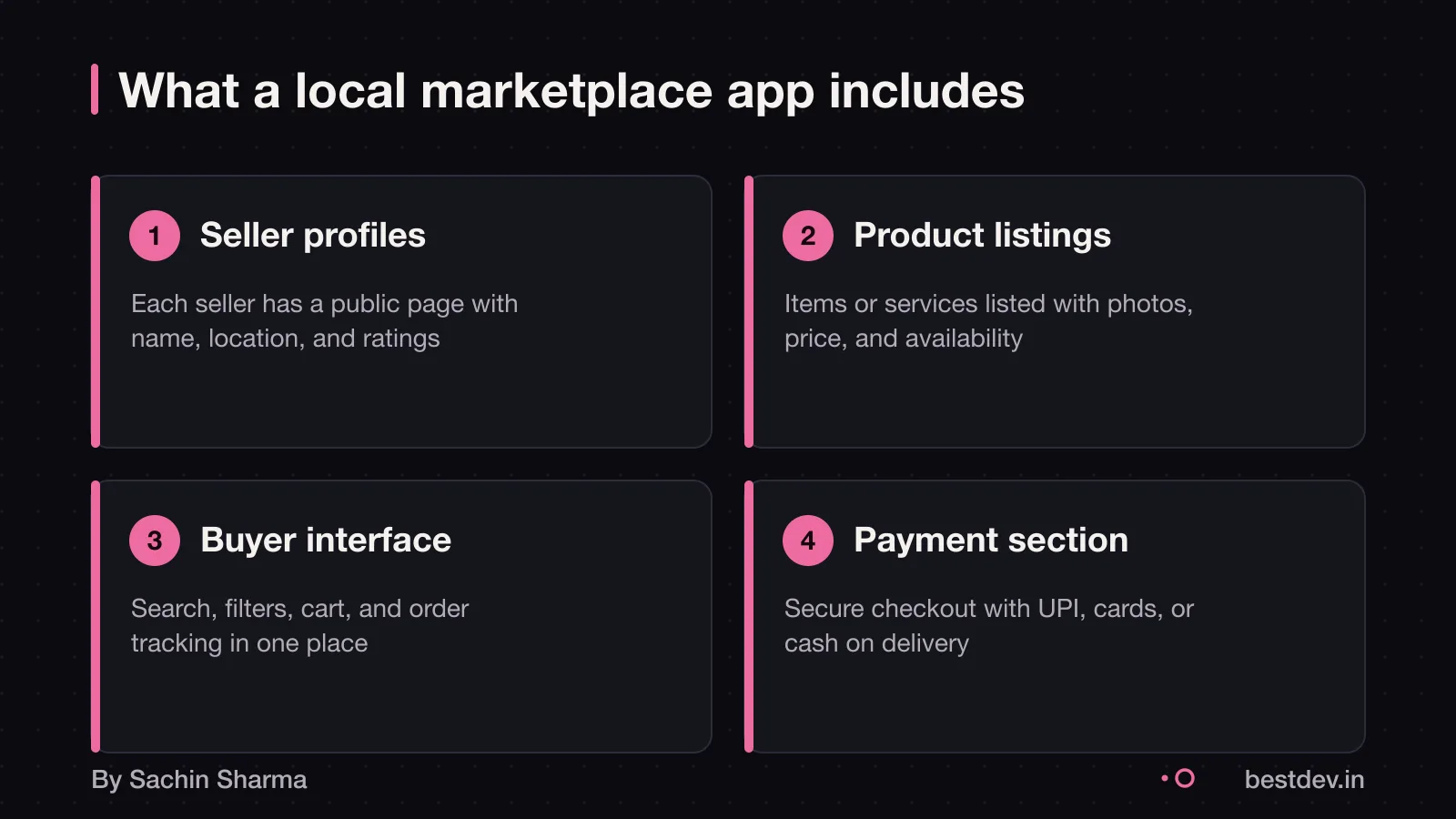
A local marketplace app lets multiple sellers in your city list goods or services in one shared app. This is unlike a single-brand store that sells only its own items. Buyers can browse, compare, and buy from different vendors in one place. The app handles many seller accounts, not just one.
The core functions include listing products, managing inventory, processing payments, and connecting buyers with sellers. It also supports seller onboarding, order tracking, and platform administration. Think of it as a digital marketplace for your region, not a single shop.
The software that runs the app is called a marketplace platform. The app itself is the customer-facing business. To link systems, you may use an API. An API lets apps share data. See What is an API? to understand how parts connect.
Build custom or use a platform?
A white-label platform like Sharetribe can help you test your marketplace idea quickly, with lower upfront cost and less long-term tech risk. Custom development costs have dropped by 30% to 40% over the same period.
For example, setting up a Sharetribe-based marketplace costs ₹2 lakh to ₹6 lakh for customisation. Plus ongoing SaaS fees, and takes 4 to 8 weeks. Shopify Marketplace Connect is free to install and includes up to 50 free marketplace orders per month. It charges a 1% fee on additional orders, with the total fee capped at $99 per month. This makes it low-risk for early sales testing.
Custom builds may be more affordable due to faster tools like Flutter and AI-assisted coding, which can reduce development time. You also get full control over features and branding. But they need clearer planning and a trusted developer.
The first step to hire safely is to write a clear app brief with your core users, key actions, and must-have features. A sharp brief stops scope creep and helps developers give honest quotes. Use an App brief template developers can actually price to start. Compare your options with Build or buy: three routes compared to see what fits your risk and budget.
How much does it cost to build?
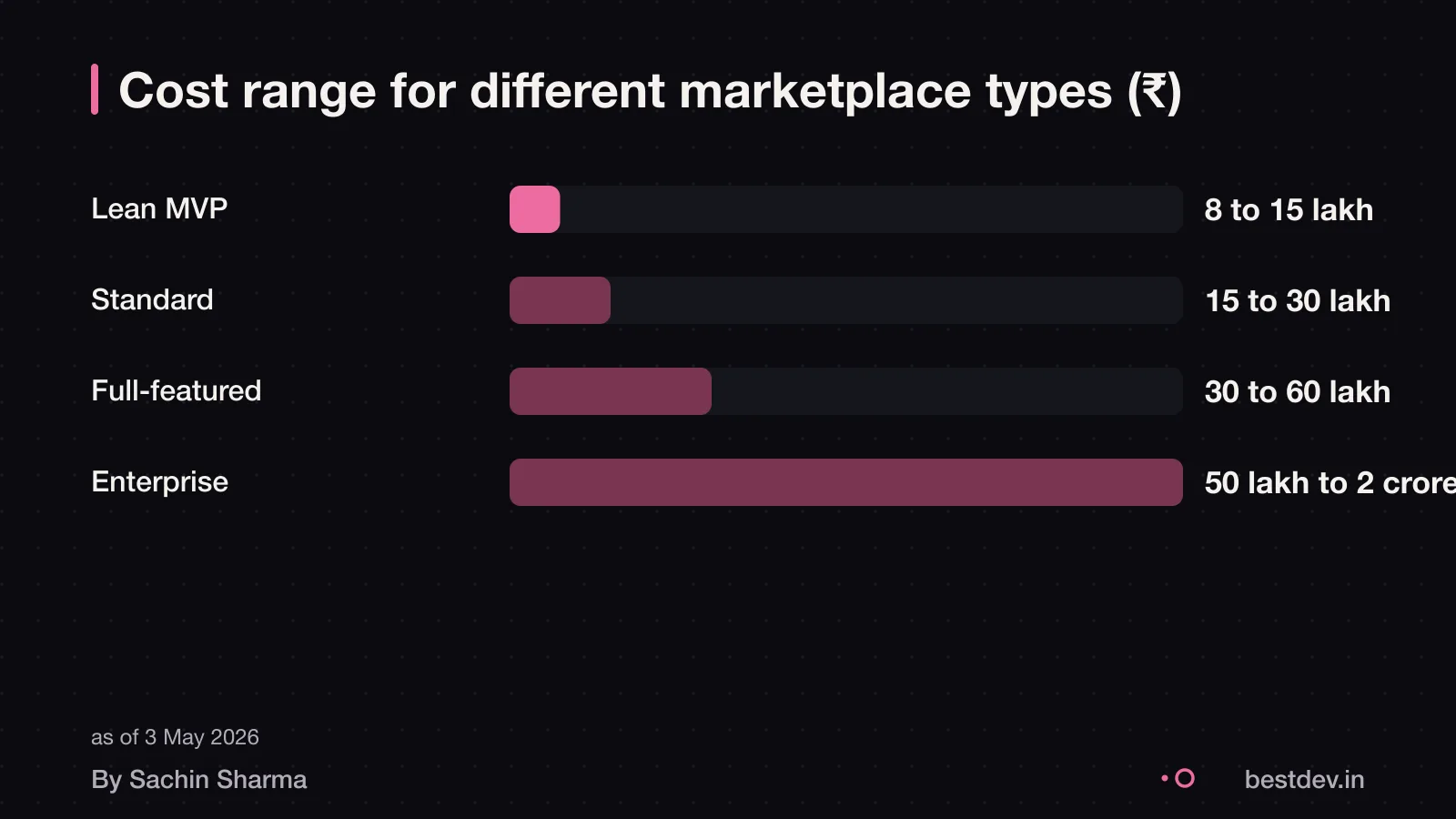
It includes one city, a single service category, a basic web dashboard, and one mobile app (iOS or Android). It covers core features such as user profiles, listings, search, and a single payment gateway.
A standard marketplace with multi-category support, web and mobile apps for iOS and Android, payments and reviews costs ₹15 lakh to ₹30 lakh. Full-featured versions with real-time tracking, in-app chat, and analytics range from ₹30 lakh to ₹60 lakh. An enterprise marketplace with multi-region support, AI features, and B2B add-ons costs ₹50 lakh to ₹2 crore or more.
Worked example: Lean MVP at ₹12 lakh As an estimate, a lean MVP with 40 screens, one payment gateway (Razorpay), basic search, and no advanced analytics would cost around ₹12 lakh. This assumes one full-time developer for 12 weeks, using Flutter for mobile and a Next.js dashboard. Hosting on AWS Mumbai and basic UI/UX design are included as part of the estimate. The estimate does not include legal checks, GST registration, or marketing costs.
The cost rises if you add instant chat, multi-language support, or background sync for low-network areas. For a detailed breakdown of app costs in India, see What does it cost to build an app in India?.
What makes it more expensive?
Adding key features like KYC registration, detailed listings, and smart search raises the cost. Buyer and seller registration with KYC costs ₹1L to ₹3L, and more for B2B setups needing GST and PAN verification. Listings with photos, variants, and pricing add ₹1.5L to ₹4L, with higher costs for complex configurations like real estate. Search, filters, and categorisation cost ₹1.5L to ₹4L. They cost more if you use AI-powered search.
Specialised developer skills increase hourly rates. In India, niche tech skills can raise rates by 30 to 50 percent due to high demand and low supply. DevOps and data engineering can raise developer rates by 20 to 40 percent. If you hire freelancers, factor in a 30 to 50 percent management overhead for coordination and quality checks. This is not a direct fee but time you or your team will spend.
For example, a marketplace needing KYC, rich listings, and AI search will cost more than one with basic profiles and manual filtering. You can reduce cost by skipping non-essential features or using simpler tech. The Flutter developer hourly rate in India affects total price, so choose skills based on actual need.
How long does it take to build?
Scope changes or late feedback may extend the timeline. A full-featured marketplace with real-time tracking, chat and other tools can take 22 to 32 weeks to build.
Timelines for apps like quick commerce depend on features such as delivery logic and fleet management, which are not covered in the evidence. See how long it takes to build a quick commerce app for a closer comparison.
Freelancer or agency: which is better?
A freelancer is cheaper per hour. But you take on more risk and management work. An agency costs more. But it handles coordination, quality, and timelines. Your real cost with a freelancer includes the time you spend managing them. This adds 30 to 50% in overhead. For example, if you pay a freelancer ₹1,200 per hour (about $15), your true cost is ₹1,560 to ₹1,800 per hour. This is once management is factored in.
Mid-level freelancers in India charge $20 to $50 an hour, which is about ₹1,600 to ₹4,000 at current rates. Rates in tier-2 cities are 20 to 30% lower than in tier-1 cities. This makes freelancers seem attractive for tight budgets. But you must manage timelines, feedback, and integration yourself.
Agencies charge higher rates. But they include project management, testing, and team coordination. They reduce your daily effort. They also lower the risk of delays. You should switch to an agency when your management time exceeds 15 hours per week. At that point, the agency’s structure saves you time and stress.
If you are new to tech projects, start with a small agency. Or choose a vetted freelancer through a trusted network. For a detailed comparison, see Freelancer or agency for a first app?.
What are the biggest risks?
Development can slow by 40 to 60% later if the code lacks structure or the developer does not plan for growth. This leads to technical debt that can consume up to 40% of IT balance sheets. As an estimate, this means fixing poor code takes nearly as long as writing it fresh.
Red flags include a developer who does not use source control like Git. Another red flag is no automated testing. A developer with zero interest in your business model is also risky. Ask if they have missed past deadlines. A history of underestimating timelines is a warning sign.
Who owns the code and design?
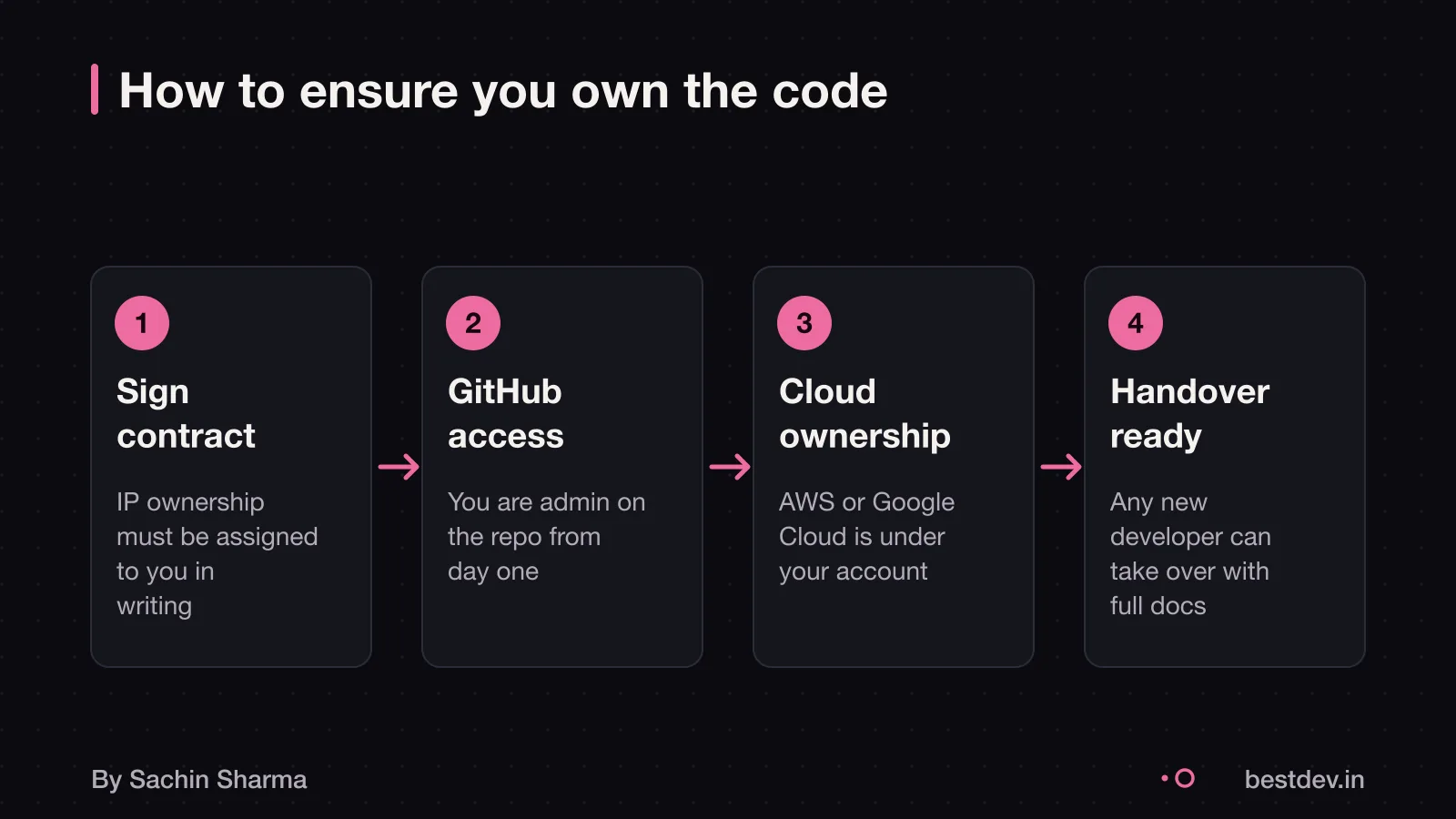
You should own the code and design from day one. The contract should include clauses that assign all intellectual property (IP) to you as soon as it is created. Without this clause, you risk legal disputes or being locked in with one developer.
To switch developers later, you must own the GitHub repository and cloud hosting accounts from the start. You should own the GitHub repository and cloud infrastructure from day one to maintain control. This way, you can add or replace team members without losing access.
With ownership in place, you avoid such risks. You can also audit progress, enforce quality, and scale the team.
A contract may be discharged by rescission if it is voidable. But rescission does not guarantee you will get the code unless the contract includes an IP assignment clause.
Can I get the source code of my app? This guide explains how to verify ownership and download your code safely.
When this advice is wrong
This advice is not for you if your main goal is to test a marketplace idea on a tight budget. In that case, a no-code platform might get you started faster and with less risk. The cost and fit of no-code tools are not known.
It is also not for you if your city or region does not yet have enough vendors or buyers to support a two-sided market. If demand is uncertain, start with a single vendor or service and grow organically. Rules for marketplaces in smaller Indian cities are not fully known. Check local trade norms first.
This advice does not apply if you cannot provide clear requirements or time to review progress. Custom development needs your active input. What the client must provide to start is not known.
If you need a live product in under eight weeks, this path may not work. As an estimate, a lean MVP takes 10 to 14 weeks to build. When speed is critical, consider a hosted solution even if long-term control is lower.
Questions people ask
What should I check before hiring a developer for a local marketplace?
Check for live demos of past work, not just mockups or screenshots. Look at their GitHub contribution graph for consistent activity over time. Ask them to explain technical terms in plain language, as if you're a business owner. Always verify their past project roles through back-channel checks on LinkedIn or professional networks.
What is a fair way to pay a developer for a local marketplace?
A fair way is to use fixed-price milestones tied to clear deliverables, not hourly billing. Pay in stages: part at start, part at key builds, and part on delivery. This keeps both sides accountable and reduces risk of cost overruns.
What happens to my code and accounts if we stop midway?
You must own the GitHub repository and cloud accounts from day one. The contract must include a clause that assigns all intellectual property to you as soon as it is created. Without this, you may lose access or face legal delays.
Can I build a local marketplace without coding?
Yes, you can use platforms like Sharetribe or Shopify Marketplace Connect. Sharetribe setup costs ₹2 lakh to ₹6 lakh plus monthly SaaS fees. Shopify Marketplace Connect is free to install, with up to 50 free orders per month, then a 1% fee on additional orders.
How do I verify a developer's experience with marketplaces?
Ask for live, working links to past marketplace projects, not just descriptions. Check their GitHub profile for regular, long-term contributions that suggest real project work. A lack of public activity or broken links is a red flag.
What legal rules apply when hiring a developer in India?
The Indian Contract Act, 1872 applies to all developer agreements. The contract must be made by free consent, for a lawful object, and with lawful consideration, as defined by the Indian Contract Act, 1872. Ensure your agreement meets these rules. Consult a lawyer for GST, IP, and data privacy clauses.
How much maintenance does a marketplace app need?
The exact monthly maintenance cost is not known. It depends on usage, features, and updates. For general guidance on what upkeep involves and how to plan for it, see /faq/.
Assumptions behind the numbers
- App type and core features affect cost and timeline
- Freelancer vs agency choice affects management overhead
- Timeline affects developer availability and cost
- Budget range helps filter suitable developers
- Constraints help avoid scope creep
A developer can only price what you describe. Fill the fields, and the brief writes itself.
Brief: quick commerce app

What kind of marketplace?
(not decided yet)

Which features do you need?
(not decided yet)

Freelancer or agency?
Freelancer

When do you want to launch?
(not decided yet)

What is your budget range?
(not decided yet)

Any special limits?
(not decided yet)

Please reply with: your assumptions, what is not included, milestones with something I can test, and who will write the code.
Ask every developer
Six questions back
- Who will write the code, by name?
- Which core features are in your quote?
- How is peak load tested?
- What is not included in the price?
- Whose name are the repository and store accounts under?
- What does the first month after launch cost?
Keep going