Cost · Generic
What does it cost to build an app in India?
I won't hand you a number that pretends to be the market. Instead, here is the working: set the base cost, add vendor integrations, and see where the money goes.
The full explanation
What is a flower and gifting app?
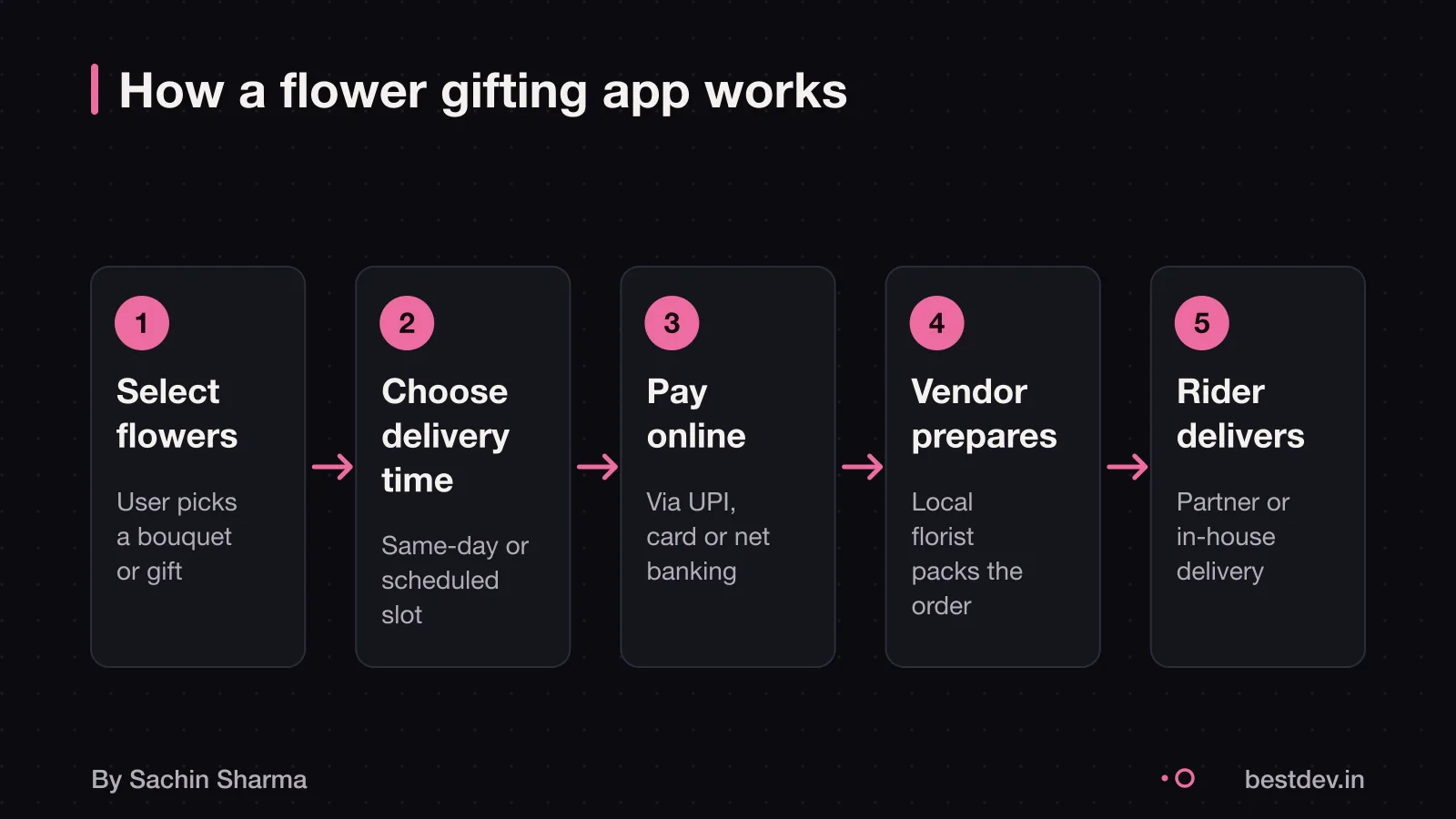
A flower and gifting app lets you order flowers and gifts online and have them delivered to someone’s address. It treats flowers as a unique gift, not just another grocery item. You can send them anywhere in India through the platform. Unlike quick commerce apps that focus on fast delivery of daily essentials, a flower and gifting app is gift-first. It highlights presentation, occasion-based choices, and personal meaning. For example, it may offer curated bouquets for birthdays or anniversaries, not just same-day delivery of random items. This focus shapes the design, pricing and user experience. See how a quick commerce app differs how a quick commerce app differs.
Do you need a flower and gifting app?
Starting with WhatsApp or a Shopify-like store can be cheaper and faster for some small flower and gift sellers. You can manage orders, collect payments, and share tracking using simple tools without coding.
Many buyers use WhatsApp to send images, confirm delivery slots, and share payment links. This works well for local, repeat customers. You can test demand and refine your service before spending on an app.
Features like delivery coordination, vendor management, or personalisation are not included in that base cost. Adding them increases cost and time.
Starting with a minimal setup lets you learn what features your customers actually use. You may find that a gallery, order notes, and payment tracking are enough. Later, you can upgrade to a custom app if growth justifies it. For now, focus on service, not software.
See alternatives to custom build to compare low-cost options with custom apps. Each has trade-offs in control, cost, and scalability. Choose based on your volume, margins, and customer needs.
What features drive the cost up?
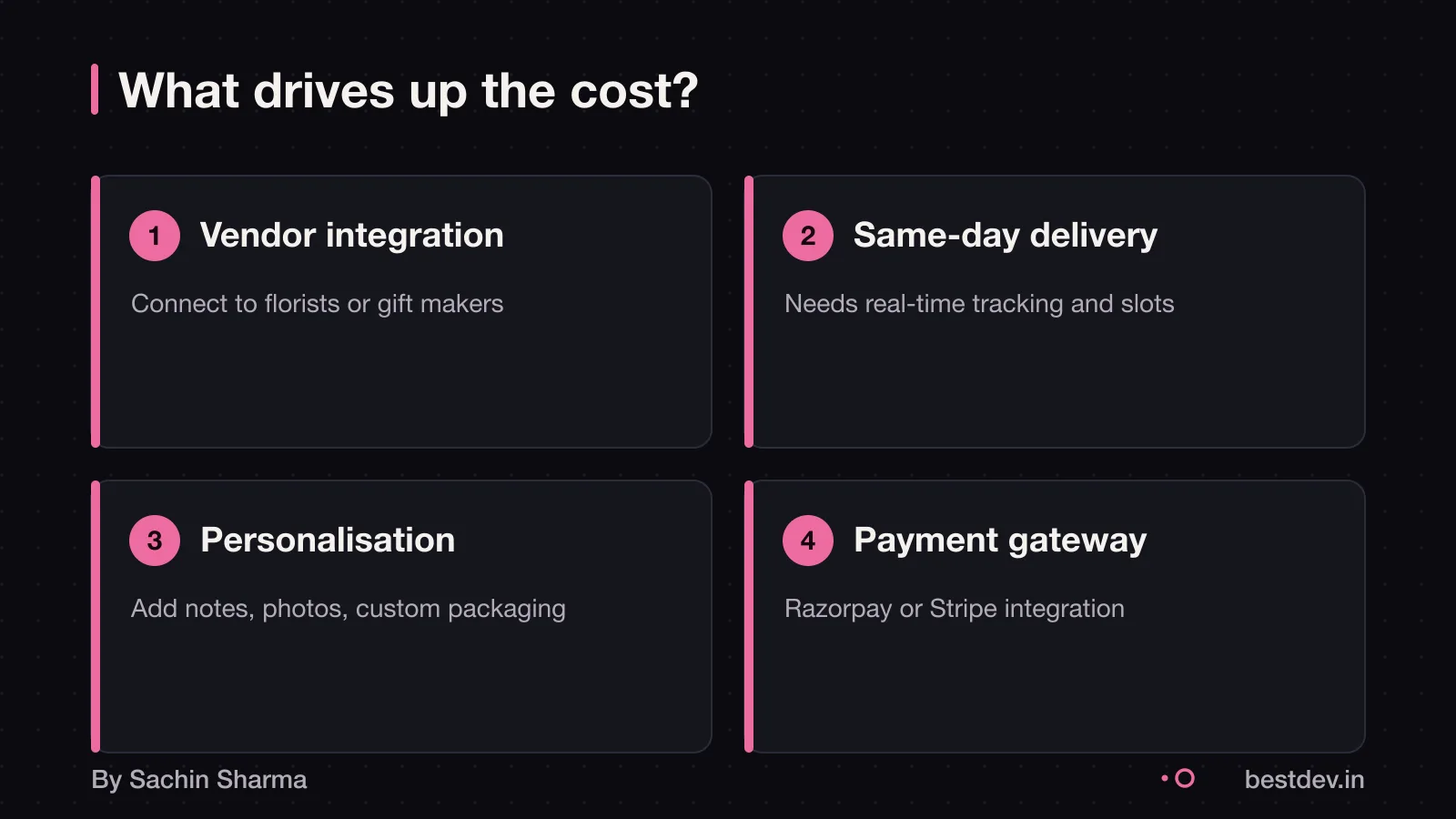
Third-party integrations and custom design are expensive features in a flower and gifting app. Same-day delivery scheduling is complex, but its cost impact is not known. These raise costs because they need extra testing, coordination, and complex logic. For example, linking your app to a delivery partner’s system takes more work than a basic checkout.
Third-party integrations such as payment gateways, maps or WhatsApp Business APIs add ₹50,000 to ₹2 lakh each for proper implementation and testing. This range covers setup, error handling, and live testing. If you connect five services, that could add ₹2.5 lakh to ₹10 lakh to your total cost.
Custom design choices, such as branded animations, unique onboarding screens, or special transitions, add 20% to 40% to the design budget alone. A standard design keeps costs low. A custom look improves user experience but raises cost.
Same-day delivery scheduling must sync real-time availability, assign riders, and handle cancellations, making it complex. Its cost impact is not known. While no exact figure is published, it involves backend logic, vendor coordination, and notifications.
Personalisation options like gift messages, wrapping choices, or photo uploads have no published cost data. They seem simple but may need storage, moderation, and layout changes. As an estimate, assuming light customisation, they could add ₹30,000 to ₹80,000 per feature.
To save money, focus on must-have vs later features must-have vs later features.
Mobile app vs web app: which costs less?
A web app may cost less than a mobile app, as web apps are often more cost-efficient for early products. Mobile apps often cost more due to platform needs. Mobile apps need more testing and follow stricter rules for each platform. This raises the price. If you want a mobile app, Flutter can cut costs by 30 to 40 per cent. This is compared to building separate iOS and Android apps. Flutter uses one codebase for both platforms. For example, a ₹18 lakh native mobile project could cost ₹12 lakh with Flutter. This saves ₹6 lakh. React Native also supports cross-platform builds. But Flutter is more stable for apps that need smooth animations. This includes offline features like gift previews or order tracking.
A web app works well if your customers mostly use phones to browse. It loads in a browser and is cheaper to build and update. But it cannot use all phone features like push alerts or camera access as smoothly. A mobile app gives a faster, richer experience but costs more. You can add a mobile app later.
For a full comparison of tools and trade-offs, see our tech stack comparison for quick commerce apps.
How long does it take to build?
A simple app takes 4 to 6 weeks to build in India. This assumes a simple design, core features like browsing, cart, and payment, and no deep third-party integrations. Delays often come from late feedback, unclear delivery rules, or waiting on external services like payment or mapping APIs. Even with a fast build, allow extra time to train staff and fix early issues.
Freelancer or agency: which is better?
A freelancer may suit tasks where flexibility and direct communication matter, while an agency can handle projects needing structured management and many moving parts. Freelancers offer lower rates and direct contact, which helps when you need quick changes or have a tight budget. Freelancers may not have backup support if they are unavailable. Agencies provide structured project management and can handle multiple moving parts at once, which may reduce risk in complex apps. An agency may help manage coordination, as they handle multiple moving parts at once. A good agency shares a detailed scope document with features, wireframes, tech stack, and a phased delivery plan before signing. This helps you compare fairly. For simpler updates, a freelancer can save money.
For a full comparison of when each option wins, see when each option wins.
What laws and rules apply?
The Digital Personal Data Protection (DPDP) Act 2023 applies to your flower and gifting app. This is true if you collect customer data in digital form. It also applies if you later digitise it. You must get clear consent before processing personal data. For full steps, see the DPDP Act compliance steps guide.
Payment data must be stored only in India. This rule from the Reserve Bank of India (RBI) allows no foreign storage or copying of payment records. Use a payment gateway like Razorpay or Paytm that already follows this rule. Do not send payment logs to tools based outside India.
Check with a legal advisor before launch to confirm your app meets current requirements.
What does maintenance cost after launch?
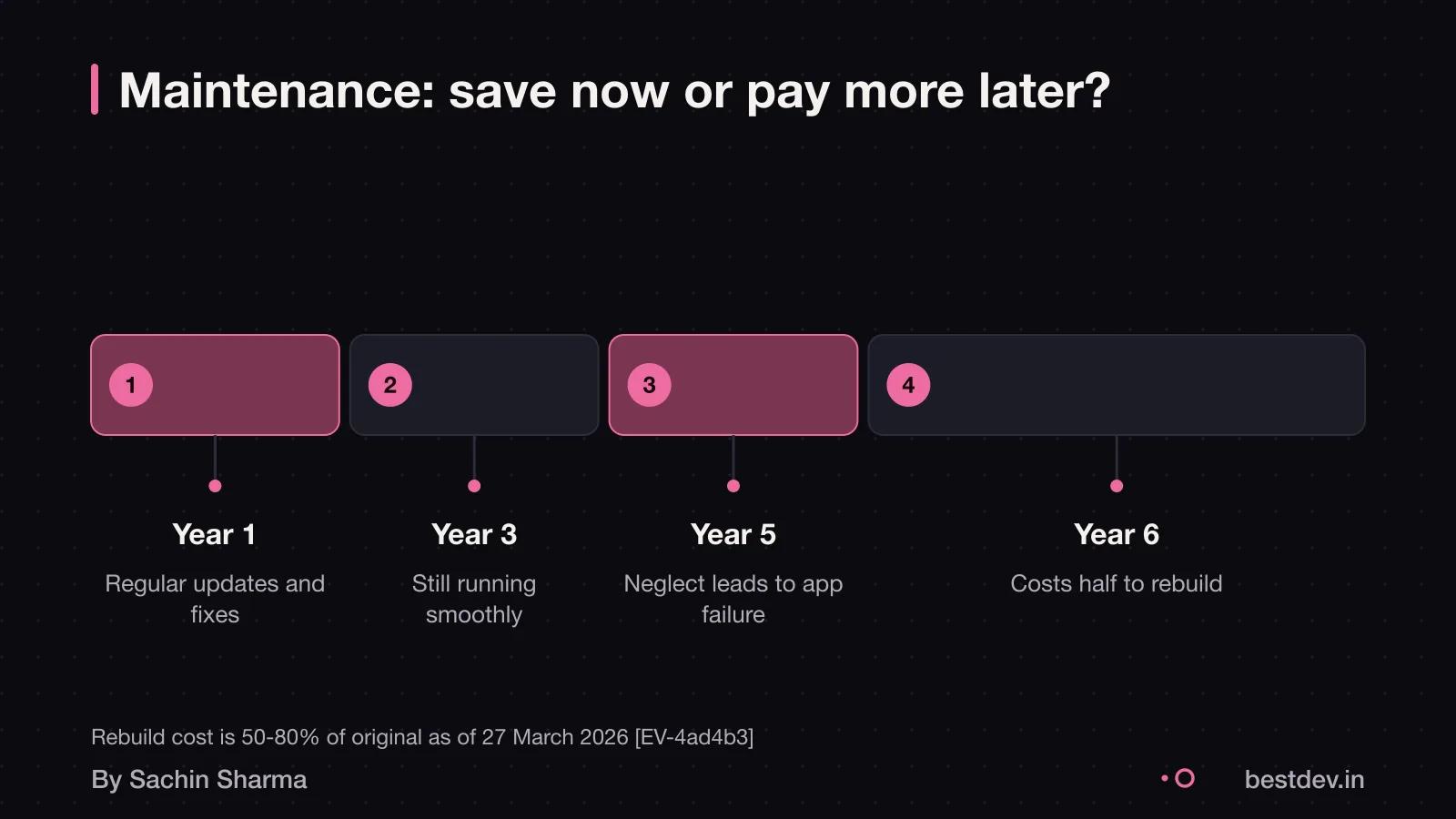
You should budget 15 to 20% of your original app cost each year for maintenance. This covers updates for new phone software, bug fixes, security patches, and small feature tweaks. For a ₹15 lakh app, that means ₹2.25 lakh to ₹3 lakh per year.
If you skip maintenance for over 12 months, your app may need a partial or complete rebuild. Rebuilding after long-term neglect could cost 50 to 80% of the original build price.
Yes, you can switch to a new developer later, but expect a handover time of 2 to 4 weeks. The new team will need time to understand your app’s logic and codebase. To make this easier, ask your current developer for full documentation and access to all accounts. For smooth handovers, read more on handover and switching developers.
Real example: Indiagift.in
Indiagift.in lists 106 products for sale, priced from ₹499 to ₹4,199. It delivers to some cities in India; one customer review mentions Nagpur as of 27 August 2026. The app has an average rating of 4.9 stars from 1,452 customer reviews as of 27 August 2026. This shows a real-world example of a flower and gifting app with a defined product range and customer reviews. A 4.9 rating reflects customer feedback, but does not confirm delivery reliability or service quality.
When this advice is wrong
When this advice is wrong
This advice is not for you if your business already handles more than 500 orders a day. At that scale, you need systems that go beyond standard app features. You should look into custom logistics software with real-time tracking and automated dispatch.
It also does not apply if you want AI features such as image-based bouquet design or smart gift suggestions. These need specialist developers and ongoing model training, which are separate from regular app costs.
If you only need to take orders and payments, an app may be too much. You can start with a WhatsApp catalog or a simple website instead. Ask yourself: do I need a full app, or will a form with payment links work?
For smaller businesses with under 100 daily orders, this cost range is relevant. But if your peak sales happen during festivals like Diwali or Valentine’s Day, plan for extra testing. Check how the app handles high order loads and delivery coordination.
Questions people ask
How much does a flower and gifting app cost in India?
A tightly scoped MVP with 3 to 5 core features, one platform and no complex backend can cost ₹3 to 5 lakh. You can reduce costs by starting with a web app instead of mobile.
What makes a flower and gifting app more expensive?
Third-party integrations like payments, maps, or WhatsApp APIs add ₹50,000 to ₹2 lakh each. Features such as real-time communication, authentication, and third-party integrations increase development time and cost.
How long does it take and what do I pay at each stage?
A simple app takes 4 to 6 weeks to build in India. Most developers charge in phases: 30% upfront, 40% at mid-delivery, and 30% on completion. Exact splits depend on your contract.
Can I reduce costs by starting with a web app?
Yes, a web app is cheaper and faster to launch than a mobile app. It avoids platform-specific rules and testing, and you can later add mobile apps when demand grows.
Can I build this app for less than ₹5 lakh?
Yes, a tightly scoped MVP with 3 to 5 core features, one platform. No complex backend can be built for ₹3 to 5 lakh. Cut costs by skipping advanced features like personalisation or real-time tracking.
What legal risks should I watch for?
RBI rules require all payment data to be stored only in India. The DPDP Act 2023 requires clear consent before collecting names, addresses, or phone numbers. Check this for your case with a chartered accountant or lawyer.
Do I need to store payment data in India?
Yes, RBI's 2018 rule is strict: all payment data must be stored only in India, with no foreign storage or mirroring allowed. This applies even if you use a global payment gateway.
How do I protect myself from app failure?
As an estimate, budget 15 to 20% of the build cost each year for maintenance. Without updates, your app may need a rebuild in 12 months, costing 50 to 80% of the original price.
Can I start with a web app and add mobile later?
Yes, starting with a web app is more cost-efficient and faster to launch. You can build mobile apps later when user demand justifies the added cost and effort.
What if I want to add gift personalisation later?
Plan for personalisation early, as adding it later may require redesigning forms and backend logic. While the exact cost is not known, complex fields like image uploads or date pickers increase development effort.
Assumptions behind the numbers
- Base app cost is ₹3–5 lakh
- Each vendor integration costs ₹50K–₹2L
- Hidden cost buffer is 25–30%
- Annual maintenance is 15–20% of build cost
I won't hand you a number that pretends to be the market. Instead, here is the working: set the base cost, add vendor integrations, and see where the money goes.
- Base app (MVP)25%
- Vendor network25%
- Delivery features25%
- Personalisation25%
The weeks shown are an example of a small app, there to be changed. Fees you pay others (store accounts, cloud, SMS) are not in this total.
What moves it
Six things that move the price
- Multiple vendor types
Each vendor category (florist, baker, gift shop) adds backend work.
- Real-time delivery tracking
Live location sharing and rider updates require more testing.
- Complex gift combos
Bundles with custom options raise design and logic costs.
- Single city launch
Limiting to one city cuts mapping and logistics setup.
- Pre-set messages only
Avoiding custom text fields reduces backend and moderation.
- Admin-only vendor onboarding
Manual vendor entry lowers initial dev time.
Not in the total
Fees that go to someone else
Google Play developer account
A one-time registration fee, paid to Google. Check the current amount.
Apple Developer Program
A yearly fee paid to Apple. Check the current amount.
Cloud, SMS, maps, payments
Usage-based, billed by the provider to you.
Before you sign
Ask for these five things
- What features are in the base cost?
- How many vendor integrations are planned?
- Are delivery or personalisation features needed?
- What fees do I pay directly?
- Is ongoing maintenance included?
Keep going